

The DOI matches its Crossref record; 36 of the 39 references it cites were found in a registry or an index.
Comparative effectiveness of different treatment pathways for opioid use disorder.
Open accessAbstract
Importance: Although clinical trials demonstrate the superior effectiveness of medication for opioid use disorder (MOUD) compared with nonpharmacologic treatment, national data on the comparative effectiveness of real-world treatment pathways are lacking. Objective: To examine associations between opioid use disorder (OUD) treatment pathways and overdose and opioid-related acute care use as proxies for OUD recurrence. Design, Setting, and Participants: This retrospective comparative effectiveness research study assessed deidentified claims from the OptumLabs Data Warehouse from individuals aged 16 years or older with OUD and commercial or Medicare Advantage coverage. Opioid use disorder was identified based on 1 or more inpatient or 2 or more outpatient claims for OUD diagnosis codes within 3 months of each other; 1 or more claims for OUD plus diagnosis codes for opioid-related overdose, injection-related infection, or inpatient detoxification or residential services; or MOUD claims between January 1, 2015, and September 30, 2017. Data analysis was performed from April 1, 2018, to June 30, 2019. Exposures: One of 6 mutually exclusive treatment pathways, including (1) no treatment, (2) inpatient detoxification or residential services, (3) intensive behavioral health, (4) buprenorphine or methadone, (5) naltrexone, and (6) nonintensive behavioral health. Main Outcomes and Measures: Opioid-related overdose or serious acute care use during 3 and 12 months after initial treatment. Results: A total of 40 885 individuals with OUD (mean [SD] age, 47.73 [17.25] years; 22 172 [54.2%] male; 30 332 [74.2%] white) were identified. For OUD treatment, 24 258 (59.3%) received nonintensive behavioral health, 6455 (15.8%) received inpatient detoxification or residential services, 5123 (12.5%) received MOUD treatment with buprenorphine or methadone, 1970 (4.8%) received intensive behavioral health, and 963 (2.4%) received MOUD treatment with naltrexone. During 3-month follow-up, 707 participants (1.7%) experienced an overdose, and 773 (1.9%) had serious opioid-related acute care use. Only treatment with buprenorphine or methadone was associated with a reduced risk of overdose during 3-month (adjusted hazard ratio [AHR], 0.24; 95% CI, 0.14-0.41) and 12-month (AHR, 0.41; 95% CI, 0.31-0.55) follow-up. Treatment with buprenorphine or methadone was also associated with reduction in serious opioid-related acute care use during 3-month (AHR, 0.68; 95% CI, 0.47-0.99) and 12-month (AHR, 0.74; 95% CI, 0.58-0.95) follow-up. Conclusions and Relevance: Treatment with buprenorphine or methadone was associated with reductions in overdose and serious opioid-related acute care use compared with other treatments. Strategies to address the underuse of MOUD are needed.
Overview
The claims and statistics of this paper haven’t been checked yet.
Run the check — free, no account needed. It reads the open-access text and checks the sources it cites.
Integrity signals
Registry
Cites
Statistics
Figures
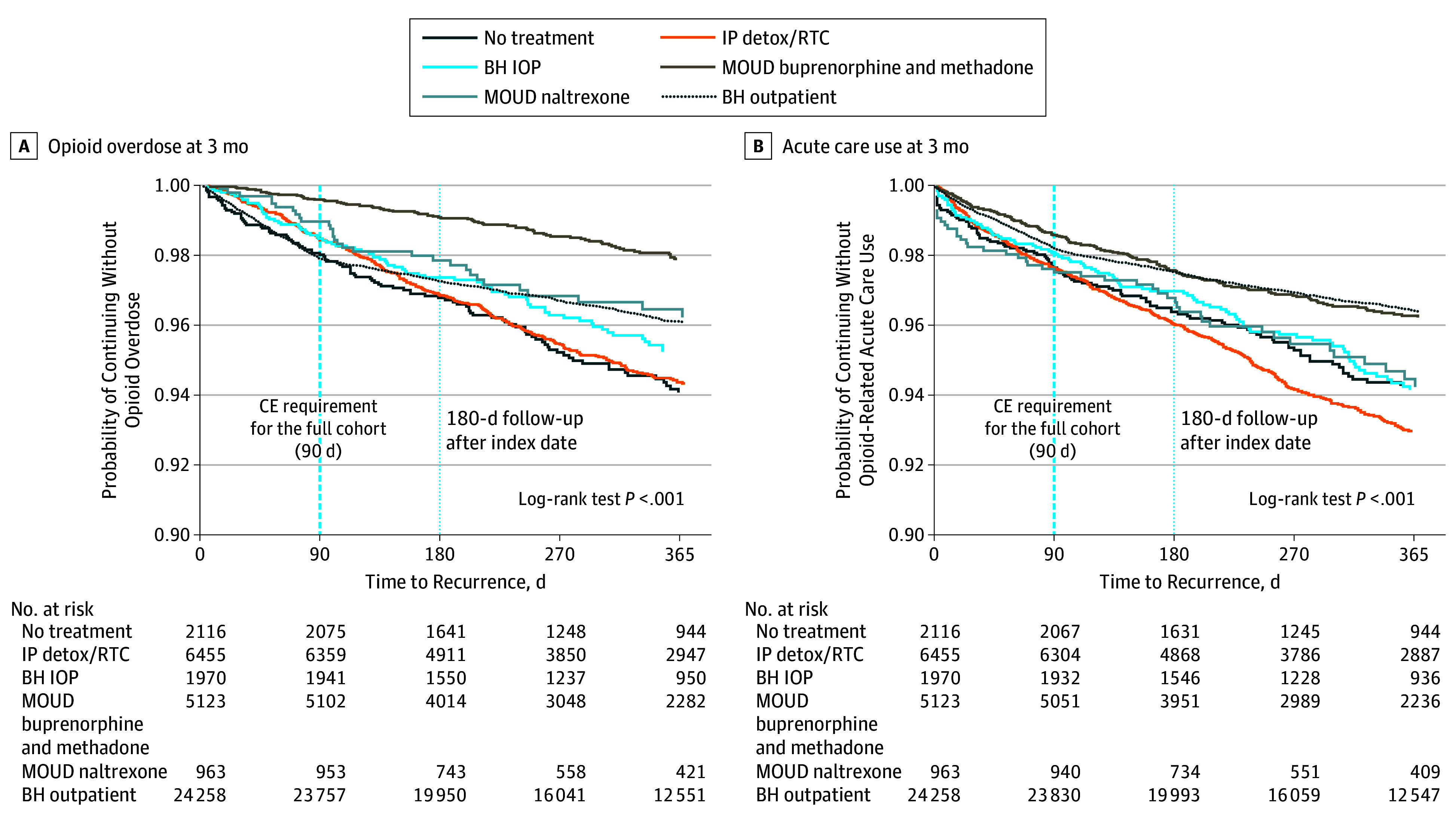
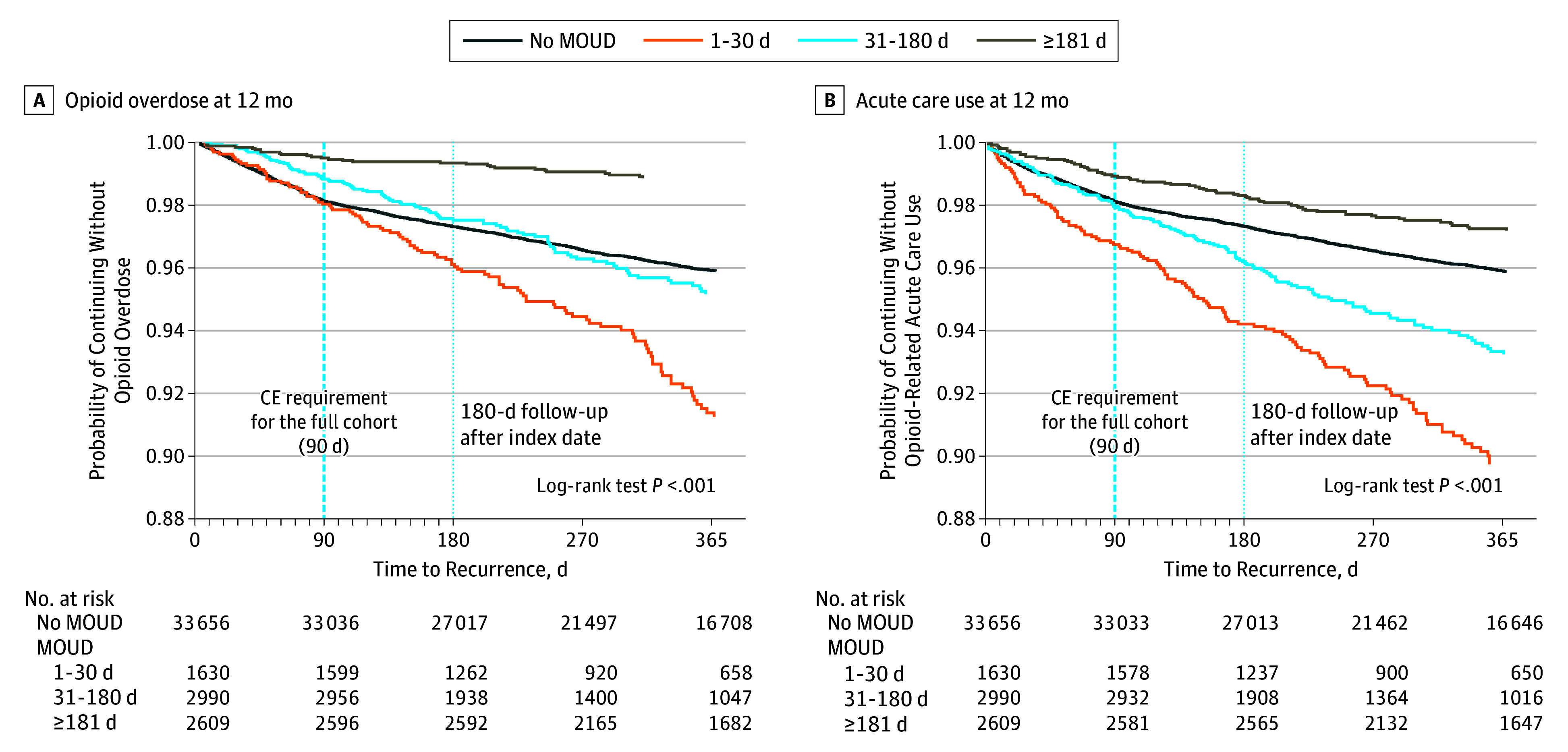
Verification
Claims the paper makes
The claims and statistics of this paper haven’t been checked yet.
Run the check — free, no account needed. It reads the open-access text and checks the sources it cites.
Claims other papers make about this one
Each is checked against this paper’s own text: does it say what the citing paper says it does?
The source backs part of the claim, not all of it — or backs it for a different population, condition or comparison.
In the citing paper
“Although data show that detoxification fails to reduce risk of relapse and overdose, we included it to reflect its real-world use.20”
From Economic Evaluation of Extended-Release Buprenorphine for Persons With Opioid Use Disorder (2023) · cites this paper as [20]
Experimental — accuracy not yet measured
Self-check
Percentages, sums and reported differences re-computed from the paper’s own numbers.
The self-check needs the paper’s full text.
Citations
Cites
Coding algorithms for defining comorbidities in ICD-9-CM and ICD-10 administrative data
Quan, H., Sundararajan, V., Halfon, P., Fong, A., Burnand, B., Luthi, J.-C., Saunders, L. D., Beck, C. A., Feasby, T. E., & Ghali, W. A. (2005) · Medical Care · doi:10.1097/01.mlr.0000182534.19832.83 · Cited by 10,669
Sordo, L., Barrio, G., Bravo, M. J., Indave, B. I., Degenhardt, L., Wiessing, L., Ferri, M., & Pastor-Barriuso, R. (2017) · BMJ · doi:10.1136/bmj.j1550 · Cited by 1,816
Drug and Opioid-Involved Overdose Deaths — United States, 2013–2017
Scholl, L., Seth, P., Kariisa, M., Wilson, N. O., & Baldwin, G. T. (2018) · MMWR Morbidity and Mortality Weekly Report · doi:10.15585/mmwr.mm675152e1 · Cited by 1,754
Larochelle, M. R., Bernson, D., Land, T., Stopka, T. J., Wang, N., Xuan, Z., Bagley, S. M., Liebschutz, J. M., & Walley, A. Y. (2018) · Annals of Internal Medicine · doi:10.7326/m17-3107 · Cited by 1,076
Self-citationLee, J. D., Nunes, E. V., Novo, P., Bachrach, K., Bailey, G. L., Bhatt, S., Farkas, S., Fishman, M., Gauthier, P., Hodgkins, C. C., et al. (2018) · The Lancet · doi:10.1016/s0140-6736(17)32812-x · Cited by 700
Zibbell, J. E., Asher, A. K., Patel, R. C., Kupronis, B. A., Iqbal, K., Ward, J. W., & Holtzman, D. J. (2017) · American Journal of Public Health · doi:10.2105/ajph.2017.304132 · Cited by 699
The triple wave epidemic: Supply and demand drivers of the US opioid overdose crisis
Ciccarone, D. (2019) · International Journal of Drug Policy · doi:10.1016/j.drugpo.2019.01.010 · Cited by 677
National and state treatment need and capacity for opioid agonist medication-assisted treatment
Jones, C. M., Campopiano, M., Baldwin, G., & McCance-Katz, E. (2015) · American Journal of Public Health · doi:10.2105/ajph.2015.302664 · Cited by 668
Weiss, R. D. (2011) · Archives of General Psychiatry · doi:10.1001/archgenpsychiatry.2011.121 · Cited by 540
Medications for Opioid Use Disorder Save Lives
Mancher, M., & Leshner, A. (2019) · National Academies Press eBooks · doi:10.17226/25310 · Cited by 473
Cited by
Sorted by citations
Goedel, W. C., Shapiro, A. M., Cerdá, M., Tsai, J. W., Hadland, S. E., & Marshall, B. D. L. (2020) · JAMA Network Open · doi:10.1001/jamanetworkopen.2020.3711 · Cited by 310
Mauro, P. M., Gutkind, S., Annunziato, E. M., & Samples, H. (2022) · JAMA Network Open · doi:10.1001/jamanetworkopen.2022.3821 · Cited by 226
The opioid crisis: a contextual, social-ecological framework
Jalali, M. S., Botticelli, M. P., Hwang, R. C., Koh, H. K., & McHugh, R. K. (2020) · Health Research Policy and Systems · doi:10.1186/s12961-020-00596-8 · Cited by 242
Racial Inequality in Receipt of Medications for Opioid Use Disorder
Barnett, M. L., Meara, E. R., Lewinson, T., Hardy, B., Chyn, D., Onsando, W. M., Huskamp, H. A., Mehrotra, A., & Morden, N. E. (2023) · New England Journal of Medicine · doi:10.1056/nejmsa2212412 · Cited by 190
Intervention Stigma toward Medications for Opioid Use Disorder: A Systematic Review
Madden, E. F., Prevedel, S. M., Light, T., & Sulzer, S. H. (2021) · Substance Use & Misuse · doi:10.1080/10826084.2021.1975749 · Cited by 178
Metadata
- Authors
- Wakeman, S. E., Larochelle, M. R., Ameli, O., Chaisson, C. E., McPheeters, J. T., Crown, W. H., Azocar, F., & Sanghavi, D. M.
- Affiliations
- Harvard University (US)
- Boston University (US)
- Integrated Programs, OptumLabs Inc, Cambridge, Massachusetts
- Optum (United States) (US)
- Department of Research, OptumLabs, Cambridge, Massachusetts
- Department of Research, Optum Behavioral Health, Cambridge, Massachusetts
- UnitedHealth Group (United States) (US)
- Corresponding author
- Wakeman, Sarah E.
- ORCID
- Venue
- JAMA Network Open
- Publisher
- American Medical Association (AMA)
- Published
- 2020-02-05
- Volume
- 3
- Issue
- 2
- Pages
- e1920622
- ISSN
- 2574-3805 (ISSN-L)
- PMC
- PMC11143463
- OpenAlex
- W3005454586
- Cited by
- 995
- References
- 39
- Citations by year
- 2026: 137 · 2025: 170 · 2024: 192 · 2023: 161 · 2022: 158 · 2021: 128 · 2020: 49
- FWCI
- 92.82
- Type
- journal article
- Language
- en
- Open access
- gold
- doi.org
- Licence
- cc-by-nc-nd
- Locations
- JAMA Network Open (publishedVersion, cc-by-nc-nd)
- PubMed Central (publishedVersion, cc-by-nc-nd)
- PubMed (publishedVersion)
- Funders
- Massachusetts General Hospital
- School of Medicine, Boston University (1UL1TR001430)
- Laura and John Arnold Foundation
- Office of National Drug Control Policy (G1799ONDCP06B)
- Hamilton Health Sciences Foundation
- National Institutes of Health (UL1TR001430)
- Centers for Disease Control and Prevention (U01CE002780)
- U.S. Food and Drug Administration (HHSF223200910006I)
- Substance Abuse and Mental Health Services Administration (1H79TI081442-01)
- National Institute on Drug Abuse (K23DA042168, R01DA044526, UG1DA015831, G1799ONDCP06B)
- National Center for Advancing Translational Sciences
- Topics
- Health Sciences › Medicine › Public Health, Environmental and Occupational Health › Opioid Use Disorder Treatment
- Health Sciences › Medicine › Epidemiology › Substance Abuse Treatment and Outcomes
- Health Sciences › Medicine › Anesthesiology and Pain Medicine › Pain Management and Opioid Use
- Keywords
- opioid use disorder, medication-assisted treatment, buprenorphine, methadone, naltrexone, inpatient detoxification, residential treatment, opioid overdose, acute care utilization, treatment pathways, comparative effectiveness, real-world evidence, injection-related infections
- MeSH terms
- Adolescent, Adult, Analgesics, Opioid, Behavior Therapy, Buprenorphine, Female, Humans, Male, Methadone, Middle Aged, Opioid-Related Disorders, Retrospective Studies, United States, Proportional Hazards Models, Substance Abuse Treatment Centers, Treatment Outcome, Critical Pathways, Young Adult, Comparative Effectiveness Research, Opiate Substitution Treatment
About these checks
Registry, retraction, Cites and statistics results are computed, not judged, with one exception: a printed reference that no index lists is read once by a model before it counts as a citation error. Claims are extracted by a model and kept only when their quote appears verbatim in the text; each cited source is then checked, with a model’s help, for whether it says what the claim relies on. Those verdicts can be wrong — read the claim’s quote and the cited source before relying on one.
Statistics and arithmetic are recomputed, not judged.
Confidence bands are shown only for fields calibrated on our annotated test set. None is calibrated yet, so no band is shown.
What counts as a claim ›How we measure confidence ›How we check this ›
Are you an author, or do you see a problem with this page? Request a review
