

Home-Based Gamma Transcranial Alternating Current Stimulation in Patients With Alzheimer Disease: A Randomized Clinical Trial
Open accessThe DOI matches its Crossref record; 29 of the 29 references it cites were found in a registry or an index; none of the 19 sources its claims cite is checked for support yet.
Abstract
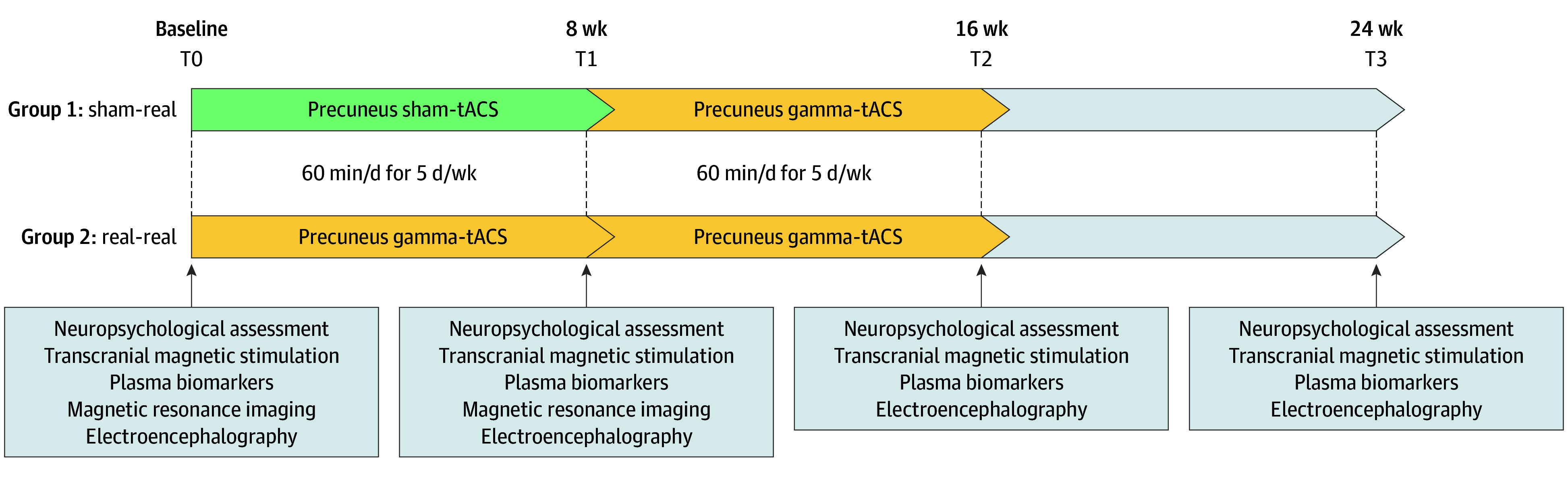
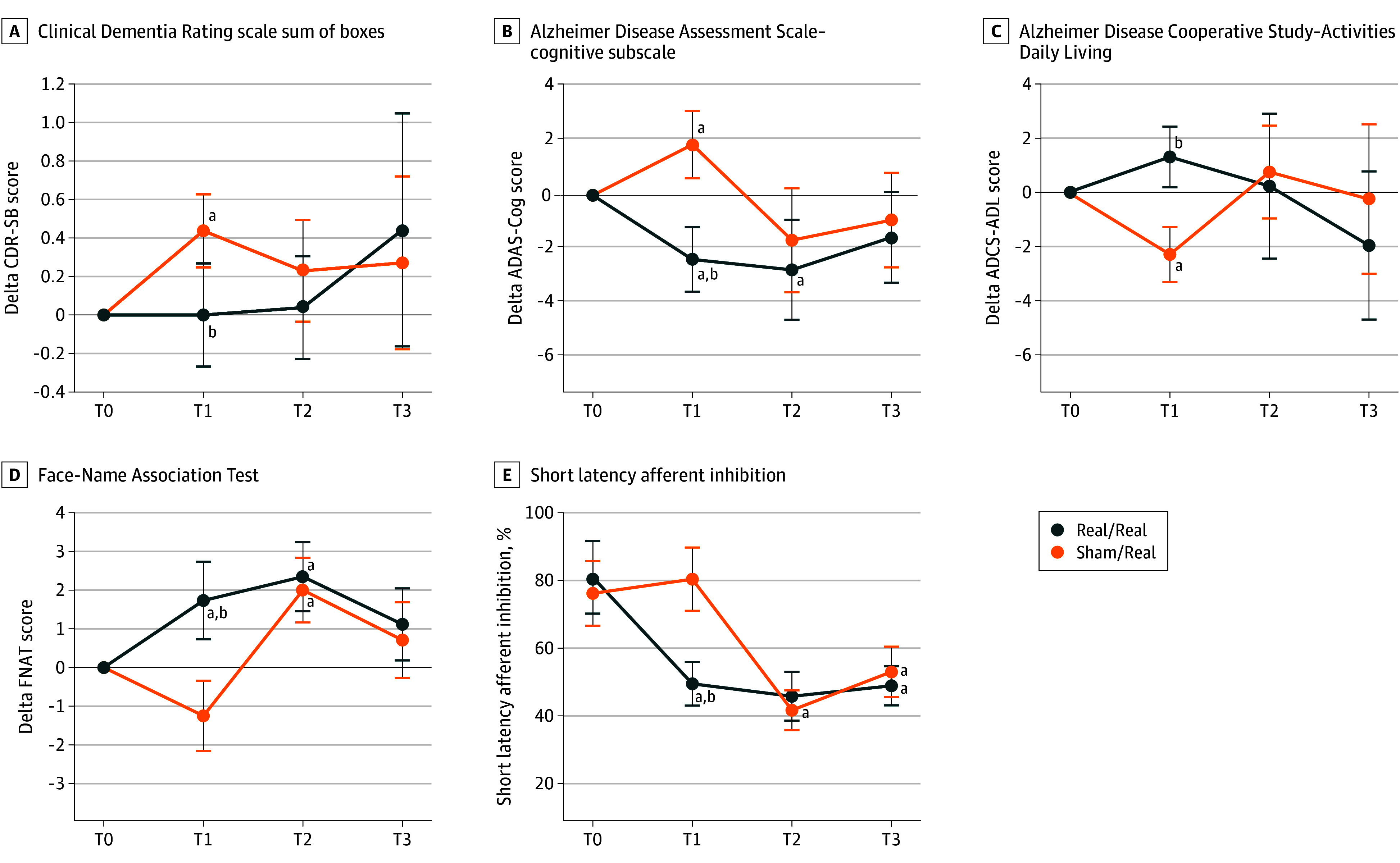
Importance: Alzheimer disease (AD) is characterized by dysregulated gamma brain oscillations. Transcranial alternating current stimulation (tACS) is a novel, noninvasive brain stimulation technique capable of entraining cerebral oscillations at targeted frequencies. Objective: To assess the safety, feasibility, and efficacy of home-based gamma tACS applied over the precuneus in patients with prodromal and mild AD. Design, Setting, and Participants: This double-blind, randomized, sham-controlled clinical trial with an open-label extension phase was conducted at a tertiary AD research clinic in Italy from December 10, 2022, to October 15, 2024. Patients with a diagnosis of AD were eligible to participate. Intervention: Participants were randomized to receive either home-based gamma tACS (5 sessions/wk, 60 minutes each) or sham stimulation for 8 weeks (double-blind phase). All participants subsequently received gamma tACS for an additional 8 weeks (open-label phase) and an 8-week follow-up. Main Outcomes and Measures: The primary end points were safety, feasibility, and clinical efficacy. Secondary end points included measures of biological efficacy, including gamma band power via electroencephalography, cholinergic neurotransmission, AD plasma biomarker levels, and brain connectivity as assessed via magnetic resonance imaging. Results: Sixty consecutive patients with prodromal or mild AD were screened; 50 were randomized to gamma or sham tACS (mean [SD] age, 67.3 [7.8] years; 25 [50.0%] female and 25 [50.0%] male). Home-based gamma tACS was safe and well-tolerated. A significant enhancement in global cognitive functions, activities of daily living, and associative memory performances was observed. Marginal mean differences between the sham vs gamma tACS groups were significant for the Clinical Dementia Rating sum of boxes (0.35; 95% CI, 0.10-0.61; P = .007), Alzheimer Disease Assessment Scale–cognitive subscale (0.93; 95% CI, 0.50-1.36; P = .001), Alzheimer Disease Cooperative Study–Activities of Daily Living (−0.55; 95% CI, −0.89 to −0.21; P = .02), and Face-Name Association Test (−1.14; 95% CI, −1.66 to −0.61; P ≤ .001). During the open-label phase, a significant marginal mean difference was observed for Alzheimer Disease Assessment Scale–cognitive subscale (−0.59; 95% CI, −1.02 to −0.16; P = .007), Alzheimer Disease Cooperative Study–Activities of Daily Living (0.41; 95% CI, 0.04-0.08; P = .02), and Face-Name Association Test (1.04; 95% CI, 0.50-1.57; P = .003). Neurophysiological measures showed an increase in cholinergic transmission, coinciding with an increase in gamma power following gamma tACS, effects not seen with sham stimulation. No changes of plasma biomarkers were observed. No add-on effect was observed after 2 repeated treatments with gamma tACS, suggesting that 8 rather than 16 weeks of treatment represents the ideal duration. Conclusions and Relevance: In this randomized clinical trial, home-based gamma tACS was feasible and improved clinical outcomes in AD, with neurophysiological evidence of brain engagement. These findings support further investigation of gamma tACS as a potential therapeutic intervention for AD. Trial Registration: ClinicalTrials.gov Identifier: NCT05643326
Overview
CoChat Summary
TL;DR
In this double-blind, randomized, sham-controlled trial with an open-label extension, home-based gamma tACS over the precuneus in 50 patients with prodromal or mild Alzheimer disease was safe and well tolerated and improved some cognitive/functional measures and indirect cholinergic neurotransmission. Gamma tACS also increased gamma EEG power over parietal and frontal regions, while plasma AD biomarkers and precuneus MRI connectivity showed no significant changes.
Key findings
- Gamma tACS was safe and well tolerated in the home setting, with no major adverse events and high adherence (<1.3% missed sessions); the only adverse effect noted was light flickering, and caregiver burden was low (mean [SD] score, 2.6 [2.4] on a 0-10 Likert scale).
- In the randomized, double-blind phase (T1 vs T0), significant between-group marginal mean differences favored tACS for CDR-SB (0.35; 95% CI, 0.10-0.61; P = .007), ADAS-Cog-13 (0.93; 95% CI, 0.50-1.36; P = .001), ADCS-ADL (−0.55; 95% CI, −0.89 to −0.21; P = .02), FNAT (−1.14; 95% CI, −1.66 to −0.61; P < .001), and SAI (1.25; 95% CI, 0.72-1.78; P < .001).
- During the open-label phase (T2 vs T1), significant marginal mean differences were observed for ADAS-Cog-13 (−0.59; 95% CI, −1.02 to −0.16; P = .007), ADCS-ADL (0.41; 95% CI, 0.04-0.77; P = .02), FNAT (1.04; 95% CI, 0.50-1.57; P = .003), and SAI (−1.34; 95% CI, −1.86 to −0.83; P < .001); no significant marginal mean differences were found at follow-up (T3 vs T2).
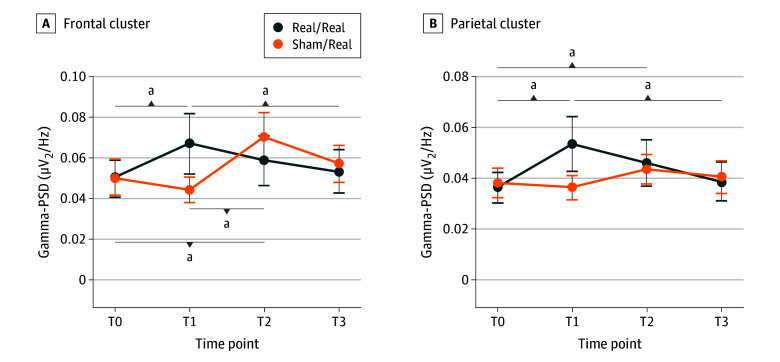
- EEG showed a significant time × treatment interaction for gamma power in the parietomedial cluster (F3,135 = 3.023; η2 = 0.063; P = .03) and frontomedial cluster (F3,135 = 3.598; η2 = 0.074; P = .02), with no significant effects on other frequency bands; gamma tACS did not significantly change plasma phosphorylated tau217, amyloid-β1-42, amyloid-β1-40, neurofilament light, or glial fibrillary acidic protein, and precuneus connectivity showed no significant between-group or within-group differences.
Methods
- Double-blind, randomized, sham-controlled clinical trial followed by an open-label phase; 53 participants were initially enrolled, 3 dropped out, and 50 were analyzed (mean [SD] age, 67.3 [7.8] years; 25 female [50.0%] and 25 male [50.0%]) with prodromal or mild AD (CDR 0.5 or 1.0) and positive amyloid PET and/or CSF AD-related pattern.
- Participants received home-based gamma tACS over the precuneus (Pz) and right deltoid at 3 mA peak-to-trough for 60 minutes, 5 d/wk for 8 weeks; sham stimulation discontinued current after 60 seconds. All participants then received gamma tACS for an additional 8 weeks (open-label) and an 8-week follow-up.
- Outcomes at T0-T3 included cognitive/behavioral scales, TMS short-latency afferent inhibition (SAI), plasma biomarkers, and EEG; a subgroup underwent MRI at T0 and T1. Analyses used mixed models for clinical, biological, and neurophysiological measures and 2-way ANOVA for EEG, with two-sided P < .05 in R version 4.2.2.
Limitations
- The paper states that a larger sample may further strengthen results; home-based delivery reduced direct supervision of stimulation sessions; no longer follow-up was included to evaluate long-term effects; and future studies should consider genetic or environmental modulators of treatment response.
- Evident from the text: MRI connectivity analysis included only a subgroup of 27 age- and sex-matched patients, limiting power for imaging conclusions.
- Evident from the text: the open-label phase was not sham-controlled, and the follow-up phase showed no significant between-group differences, so persistence and specificity of effects beyond the randomized phase remain uncertain.
Model-written summary. Check it against the paper before relying on it.
Integrity signals
Registry
Cites
Statistics
Figures
Verification
Claims the paper makes
0 Valid · 0 Not valid · 10 Not checked · 86 Own results and interpretations
A result the paper reports from its own data — it cites no other source for it, so there is none to check. The quote shows it is in the paper.
In the paper
“ADAS-Cog-13 (0.93; 95% CI, 0.50-1.36; P = .001)”
§ Home-Based Gamma Transcranial Alternating Current Stimulation in Patients With Alzheimer Disease > Results > Effects on Cognitive Functions
plain- Asserted: passes — The authors put it forward as true.
- Checkable: passes — It can be checked against evidence.
- Load-bearing: passes — The paper’s conclusions depend on it.
- Based: passes — The paper gives a reason why it holds.
A result the paper states — it cites no source for it, so there is none to check. The quote shows it is in the paper.
In the paper
“while those already treated reached a plateau”
§ Home-Based Gamma Transcranial Alternating Current Stimulation in Patients With Alzheimer Disease > Discussion
plain- Asserted: passes — The authors put it forward as true.
- Checkable: passes — It can be checked against evidence.
- Load-bearing: passes — The paper’s conclusions depend on it.
- Based: passes — The paper gives a reason why it holds.
A result the paper reports from its own data — it cites no other source for it, so there is none to check. The quote shows it is in the paper.
In the paper
“which did not impact treatment adherence”
§ Home-Based Gamma Transcranial Alternating Current Stimulation in Patients With Alzheimer Disease > Results > Participants
plain- Asserted: passes — The authors put it forward as true.
- Checkable: passes — It can be checked against evidence.
- Load-bearing: unclear — It is unclear whether the paper’s conclusions depend on it.
- Based: passes — The paper gives a reason why it holds.
A result the paper reports from its own data — it cites no other source for it, so there is none to check. The quote shows it is in the paper.
In the paper
“or within groups over time (T0 vs T1, 5.2 vs 5.3; P = .18)”
§ Home-Based Gamma Transcranial Alternating Current Stimulation in Patients With Alzheimer Disease > Results > Effect on Precuneus Connectivity
plainn = 27- Asserted: passes — The authors put it forward as true.
- Checkable: passes — It can be checked against evidence.
- Load-bearing: unclear — It is unclear whether the paper’s conclusions depend on it.
- Based: passes — The paper gives a reason why it holds.
A result the paper reports from its own data — it cites no other source for it, so there is none to check. The quote shows it is in the paper.
In the paper
“FNAT (−0.34 to −0.01; Δ, 0.30; P = .02) from T0 to T3”
§ Home-Based Gamma Transcranial Alternating Current Stimulation in Patients With Alzheimer Disease > Results > Effects on Cognitive Functions
plain- Asserted: passes — The authors put it forward as true.
- Checkable: passes — It can be checked against evidence.
- Load-bearing: passes — The paper’s conclusions depend on it.
- Based: passes — The paper gives a reason why it holds.
63 more claims
Create a free account to see all 96 claims and to verify the 19 references still open.
- It may state two separate claims as one. 22
- Probably not a substantial claim. 14
Self-check
Percentages, sums and reported differences re-computed from the paper’s own numbers.
Each contradiction between two passages listed here was confirmed by an independent check.
Rated major: it would touch a result — a value a result rests on, reported and recomputed p-values on opposite sides of the significance level, two passages that conflict with no sign which is right, or a cited work retracted before this paper was published.
In the paper
“| ADCS-ADL | −0.36 (0.13) | −0.04 (0.13) | 0.41 (0.04 to 0.77) | .02 |”
§ Home-Based Gamma Transcranial Alternating Current Stimulation in Patients With Alzheimer Disease > Results > Effects on Cognitive Functions
Reported 0.41 · recomputed -0.32
Rated major: it would touch a result — a value a result rests on, reported and recomputed p-values on opposite sides of the significance level, two passages that conflict with no sign which is right, or a cited work retracted before this paper was published.
In the paper
“| FNAT | −1.31 (0.19) | −0.27 (0.18) | 1.04 (0.50 to 1.57) | .003 |”
§ Home-Based Gamma Transcranial Alternating Current Stimulation in Patients With Alzheimer Disease > Results > Effects on Cognitive Functions
Reported 1.04 · recomputed -1.04
Rated major: it would touch a result — a value a result rests on, reported and recomputed p-values on opposite sides of the significance level, two passages that conflict with no sign which is right, or a cited work retracted before this paper was published.
In the paper
§ Home-Based Gamma Transcranial Alternating Current Stimulation in Patients With Alzheimer Disease > Discussion
“In the randomized phase, only participants receiving real stimulation showed consistent clinical gains and neurophysiological changes, including increased gamma power on EEG and enhanced cholinergic transmission (SAI), supporting a true biological effect.”
§ Home-Based Gamma Transcranial Alternating Current Stimulation in Patients With Alzheimer Disease > Results > EEG Analysis
“Moreover, in group 1 (sham stimulation to tACS), there was a significant increase of gamma PSD at T2 compared with T0 (mean [SD] difference, 0.021 [0.011] µV2/Hz; t45 = 2.151; P = .04) and at T1 compared with T0 (mean [SD] difference, 0.026 [0.008] µV2/Hz; t45 = 3.139; P = .003).”
Rated minor: it would not touch a result — a value no result rests on, a p-value that stays on the same side of the significance level, or a conflict that is clerical, resolved elsewhere in the paper, or outside its own findings.
In the paper
“| CDR-SB | −0.02 (0.11) | −0.11 (0.11) | −0.09 (−0.41 to 0.23) | .99 |”
§ Home-Based Gamma Transcranial Alternating Current Stimulation in Patients With Alzheimer Disease > Results > Effects on Cognitive Functions
Reported -0.09 · recomputed 0.09
Rated minor: it would not touch a result — a value no result rests on, a p-value that stays on the same side of the significance level, or a conflict that is clerical, resolved elsewhere in the paper, or outside its own findings.
In the paper
§ Home-Based Gamma Transcranial Alternating Current Stimulation in Patients With Alzheimer Disease > Discussion
“The lack of between-group differences during the open-label and follow-up phases should not be interpreted as evidence that initial improvements were due to chance.”
§ Home-Based Gamma Transcranial Alternating Current Stimulation in Patients With Alzheimer Disease > Results > Effects on Cognitive Functions
“During the open-label phase (T2 vs T1), a significant marginal mean difference was observed for ADAS-Cog-13 (−0.59; 95% CI, −1.02 to −0.16; P = .007), ADCS-ADL (0.41; 95% CI, 0.04-0.77; P = .02), and FNAT (1.04; 95% CI, 0.50-1.57; P = .003).”
Citations
Cites
Fitting Linear Mixed-Effects Models Using lme4
Bates, D., Mächler, M., Bolker, B., & Walker, S. (2015) · Journal of Statistical Software · doi:10.18637/jss.v067.i01 · Cited by 86,835
Delorme, A., & Makeig, S. (2004) · Journal of Neuroscience Methods · doi:10.1016/j.jneumeth.2003.10.009 · Cited by 24,371
Jenkinson, M., Beckmann, C. F., Behrens, T. E. J., Woolrich, M. W., & Smith, S. M. (2012) · NeuroImage · doi:10.1016/j.neuroimage.2011.09.015 · Cited by 11,314
NIA‐AA Research Framework: Toward a biological definition of Alzheimer's disease
Jack, C. R., Bennett, D. A., Blennow, K., Carrillo, M. C., Dunn, B., Haeberlein, S. B., Holtzman, D. M., Jagust, W., Jessen, F., Karlawish, J., et al. (2018) · Alzheimer's & Dementia · doi:10.1016/j.jalz.2018.02.018 · Cited by 10,537
The Neuropsychiatric Inventory: Comprehensive assessment of psychopathology in dementia
Cummings, J. L., Mega, M., Gray, K., Rosenberg-Thompson, S., Carusi, D. A., & Gornbein, J. (1994) · Neurology · doi:10.1212/wnl.44.12.2308 · Cited by 7,568
Gamma frequency entrainment attenuates amyloid load and modifies microglia
Iaccarino, H. F., Singer, A. C., Martorell, A. J., Rudenko, A., Gao, F., Gillingham, T. Z., Mathys, H., Seo, J., Kritskiy, O., Abdurrob, F., et al. (2016) · Nature · doi:10.1038/nature20587 · Cited by 1,328
Application of a multidimensional caregiver burden inventory
Novak, M., & Guest, C. (1989) · The Gerontologist · doi:10.1093/geront/29.6.798 · Cited by 1,205
An Inventory to Assess Activities of Daily Living for Clinical Trials in Alzheimerʼs Disease
Galasko, D., Bennett, D., Sano, M., Ernesto, C., Thomas, R., Grundman, M., & Ferris, S. (1997) · Alzheimer Disease & Associated Disorders · doi:10.1097/00002093-199700112-00005 · Cited by 1,194
L'examen clinique in psychologie
Rey, A. (1964) · Presses Universitaires de France eBooks · Cited by 1,190
Precuneus Is a Functional Core of the Default-Mode Network
Utevsky, A. V., Smith, D. V., & Huettel, S. A. (2014) · The Journal of Neuroscience · doi:10.1523/jneurosci.4227-13.2014 · Cited by 897
Cited by
Zare, F., Shakhmurova, G., Rizaev, J., Smerat, A., Abbood, R. S., Patil, V., & Kumar‐Mishra, M. (2026) · Brain and Behavior · doi:10.1002/brb3.71374 · Cited by 12
“In parallel, gamma transcranial alternating current stimulation has shown feasibility and preliminary cognitive benefits in prodromal or mild AD (Cantoni et al. 2025 ).”
Benussi, A., Cantoni, V., Palacino, F., Altomare, D., Moretti, D. V., Manganotti, P., & Borroni, B. (2026) · Alzheimer s & Dementia Diagnosis Assessment & Disease Monitoring · doi:10.1002/dad2.70275 · Cited by 8
Self-citationHuang, B., & Tang, G. (2026) · Pathology - Research and Practice · doi:10.1016/j.prp.2026.156564 · Cited by 7
Salehinejad, M. A., & Jouzdani, A. F. (2026) · Brain Network Disorders · doi:10.1016/j.bnd.2026.01.002 · Cited by 5
Cantoni, V., Grassi, M., Premi, E., Cupidi, C., Zummo, E., Cotelli, M. S., Benussi, A., & Borroni, B. (2026) · Journal of Alzheimer s Disease · doi:10.1177/13872877261461248 · Cited by 2
Self-citation
Metadata
- Authors
- Cantoni, V., Casula, E. P., Tarantino, B., Cupidi, C., Huber, N., Altomare, D., Premi, E., Zummo, E., Esposito, R., Leonardi, C., Herukka, S.-K., Solje, E., Ferrari, A., Cotelli, M. S., Gasparotti, R., Martorana, A., Fracassi, C., Santarnecchi, E., Koch, G., Haapasalo, A., Grassi, M., Benussi, A., & Borroni, B.
- Affiliations
- Azienda Socio Sanitaria Territoriale degli Spedali Civili di Brescia (IT)
- University of Rome Tor Vergata (IT)
- University of Pavia (IT)
- Fondazione Istituto G. Giglio di Cefalù (IT)
- University of Eastern Finland (FI)
- University of Brescia (IT)
- Fondazione Santa Lucia (IT)
- Centro San Giovanni di Dio Fatebenefratelli (IT)
- Gordon Center for Medical Imaging (US)
- University of Ferrara (IT)
- University of Trieste (IT)
- Corresponding author
- Borroni, Barbara
- ORCID
- Cantoni, Valentina
- Casula, Elias Paolo
- Tarantino, Barbara
- Cupidi, Chiara
- Huber, Nadine
- Altomare, Daniele
- Premi, Enrico
- Esposito, Romina
- Herukka, Sanna-Kaisa
- Solje, Eino
- Cotelli, Maria Sofia
- Gasparotti, Roberto
- Martorana, Alessandro
- Fracassi, Claudia
- Santarnecchi, Emiliano
- Koch, Giacomo
- Haapasalo, Annakaisa
- Grassi, Mario
- Benussi, Alberto
- Borroni, Barbara
- Venue
- JAMA Network Open
- Publisher
- American Medical Association (AMA)
- Published
- 2025-12-08
- Volume
- 8
- Issue
- 12
- Pages
- e2546556
- ISSN
- 2574-3805 (ISSN-L)
- PMC
- PMC12687098
- OpenAlex
- W4417122943
- Semantic Scholar
- 8aec77c4eeb3405997d6e1efb585c650551890ed
- Cited by
- 28
- References
- 29
- Citations by year
- 2026: 28
- FWCI
- 7.86
- Type
- journal article
- Language
- en
- Open access
- gold
- doi.org
- Licence
- cc-by
- Locations
- JAMA Network Open (publishedVersion, cc-by)
- PubMed Central (publishedVersion, cc-by)
- PubMed (publishedVersion)
- ArTS Archivio della ricerca di Trieste (University of Trieste https://www.units.it/) (submittedVersion, cc-by)
- Cineca Institutional Research Information System (Tor Vergata University) (submittedVersion)
- Institutional Research Information System (Università degli Studi di Brescia) (submittedVersion)
- Funders
- European Commission
- Fondazione Cariplo (2021-1516)
- Ministero della Salute
- Fondation pour la Recherche sur Alzheimer
- Topics
- Life Sciences › Neuroscience › Neurology › Transcranial Magnetic Stimulation Studies
- Life Sciences › Neuroscience › Cellular and Molecular Neuroscience › Alzheimer's disease research and treatments
- Health Sciences › Medicine › Psychiatry and Mental health › Dementia and Cognitive Impairment Research
- Keywords
- Alzheimer's disease, transcranial alternating current stimulation, gamma oscillations, precuneus, prodromal Alzheimer's disease, mild Alzheimer disease, cognitive function, activities of daily living, associative memory, cholinergic neurotransmission, acetylcholinesterase, acetylcholine, amyloid-beta, tau protein, brain connectivity, feasibility and safety, non-invasive brain stimulation
- MeSH terms
- Aged, Aged, 80 and over, Alzheimer Disease, Double-Blind Method, Electroencephalography, Feasibility Studies, Female, Humans, Italy, Male, Middle Aged, Treatment Outcome, Transcranial Direct Current Stimulation
About these checks
Registry, retraction, Cites and statistics results are computed, not judged, with one exception: a printed reference that no index lists is read once by a model before it counts as a citation error. Claims are extracted by a model and kept only when their quote appears verbatim in the text; each cited source is then checked, with a model’s help, for whether it says what the claim relies on. Those verdicts can be wrong — read the claim’s quote and the cited source before relying on one.
A language model drew the claims from the paper on 2026-11-27, under version 3 of the claim definition (model deepseek-v4.1-flash, prompt extract-v3).
A second model labelled each claim on 2026-11-27 (model jev-1.13-20260917, definition revision gold-guideline-v0.2).
Statistics and arithmetic are recomputed, not judged.
Confidence bands are shown only for fields calibrated on our annotated test set. None is calibrated yet, so no band is shown.
What counts as a claim ›How we measure confidence ›How we check this ›
Are you an author, or do you see a problem with this page? Request a review
Data sources
Bibliographic data: Semantic Scholar, OpenAlex, Crossref.
Contains information from the Semantic Scholar Academic Graph Datasets, made available under the ODC Attribution License (ODC-BY 1.0).
Semantic Scholar’s data is described in: Kinney, R., et al. (2023). The Semantic Scholar Open Data Platform. arXiv:2301.10140.
