

The DOI matches its Crossref record; 23 of the 26 references it cites were found in a registry or an index.
Five-Year Extension Results of the Phase 1 START Trial of Onasemnogene Abeparvovec in Spinal Muscular Atrophy
Open accessAbstract
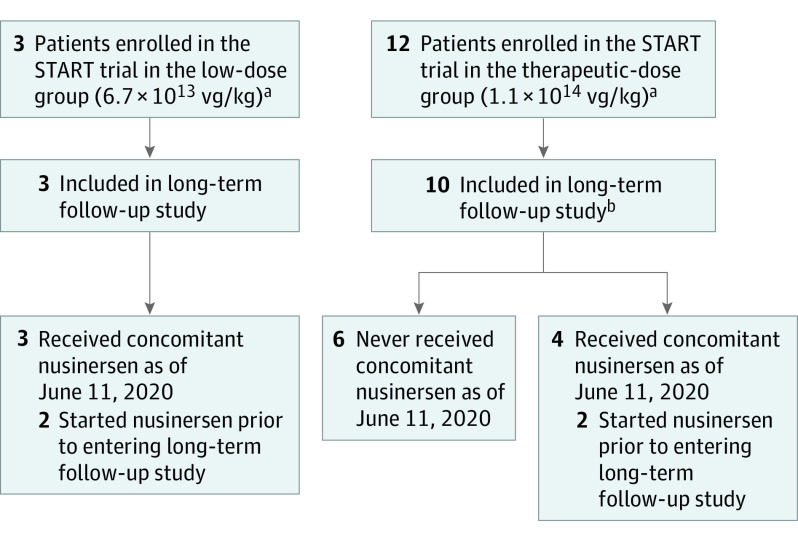
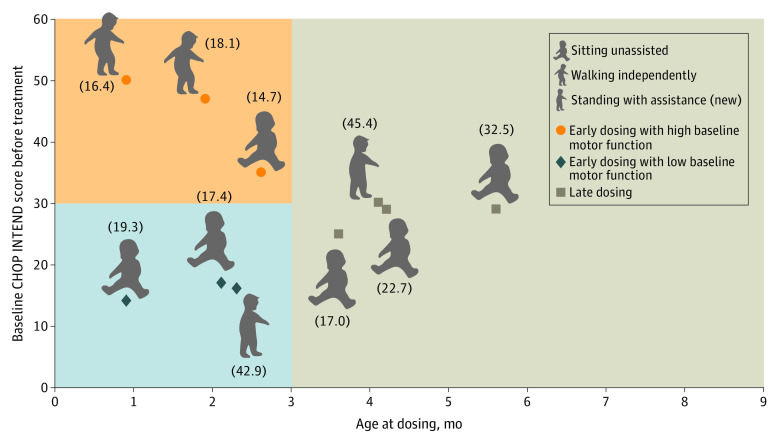
Importance: This ongoing study assesses long-term safety and durability of response in infants with spinal muscular atrophy (SMA) type 1 after dosing with onasemnogene abeparvovec gene replacement therapy. Objective: The primary objective of this ongoing study is to assess safety. The secondary objective is to determine whether developmental milestones achieved in the START phase 1 clinical trial were maintained and new milestones gained. Design, Setting, and Participants: This study is an ongoing, observational, follow-up study for continuous safety monitoring for 15 years in patients from the START phase I study (conducted May 5, 2014, through December 15, 2017) at Nationwide Children's Hospital in Columbus, Ohio. Participants were symptomatic infants with SMA type 1 and 2 copies of SMN2 previously treated with an intravenous dose of onasemnogene abeparvovec (low dose, 6.7 × 10¹³ vg/kg; or therapeutic dose, 1.1 × 10¹⁴ vg/kg) in START. Thirteen of 15 original START patients are included in this analysis; 2 patients' families declined follow-up participation. Data were analyzed from September 21, 2017, to June 11, 2020. Exposures: Median time since dosing of 5.2 (range, 4.6-6.2) years; 5.9 (range, 5.8-6.2) years in the low-dose cohort and 4.8 (range, 4.6-5.6) years in the therapeutic-dose cohort. Main Outcomes and Measures: The primary outcome measure was the incidence of serious adverse events (SAEs). Results: At data cutoff on June 11, 2020, 13 patients treated in START were enrolled in this study (median age, 38.9 [range, 25.4-48.0] months; 7 females; low-dose cohort, n = 3; and therapeutic-dose cohort, n = 10). Serious adverse events occurred in 8 patients (62%), none of which resulted in study discontinuation or death. The most frequently reported SAEs were acute respiratory failure (n = 4 [31%]), pneumonia (n = 4 [31%]), dehydration (n = 3 [23%]), respiratory distress (n = 2 [15%]), and bronchiolitis (n = 2 [15%]). All 10 patients in the therapeutic-dose cohort remained alive and without the need for permanent ventilation. Prior to baseline, 4 patients (40%) in the therapeutic-dose cohort required noninvasive ventilatory support, and 6 patients (60%) did not require regular ventilatory support, which did not change in long-term follow-up. All 10 patients treated with the therapeutic dose maintained previously acquired motor milestones. Two patients attained the new milestone of "standing with assistance" without the use of nusinersen. Conclusions and Relevance: The findings of this ongoing clinical follow-up of patients with SMA type 1 treated with onasemnogene abeparvovec supports the long-term favorable safety profile up to 6 years of age and provides evidence for sustained clinical durability of the therapeutic dose. Trial Registration: ClinicalTrials.gov Identifier: NCT03421977.
Overview
The claims and statistics of this paper haven’t been checked yet.
Run the check — free, no account needed. It reads the open-access text and checks the sources it cites.
Integrity signals
Registry
Cites
Statistics
Figures
Verification
Claims the paper makes
The claims and statistics of this paper haven’t been checked yet.
Run the check — free, no account needed. It reads the open-access text and checks the sources it cites.
Claims other papers make about this one
Each is checked against this paper’s own text: does it say what the citing paper says it does?
The cited source says what the claim attributes to it.
In the citing paper
“Additionally, a follow-up safety study has revealed a favorable safety profile of the therapy following 6.2 years from dosing, as well as providing evidence of sustained clinical durability [92].”
From Circumventing the packaging limit of AAV-mediated gene replacement therapy for neurological disorders (2022) · cites this paper as [92]
Self-check
Percentages, sums and reported differences re-computed from the paper’s own numbers.
The self-check needs the paper’s full text.
Citations
Cites
1 retracted
Foust, K. D., Wang, X., McGovern, V. L., Braun, L., Bevan, A. K., Haidet, A. M., Le, T. T., Morales, P. R., Rich, M. M., Burghes, A. H. M., et al. (2010) · Nature Biotechnology · doi:10.1038/nbt.1610 · Cited by 688
RetractedCook, R. J., Dickens, B. M., & Fathalla, M. F. (2003) · Oxford University Press eBooks · doi:10.1093/acprof:oso/9780199241323.003.0025 · Cited by 10,825
Single-Dose Gene-Replacement Therapy for Spinal Muscular Atrophy
Mendell, J. R., Al-Zaidy, S., Shell, R., Arnold, W. D., Rodino-Klapac, L. R., Prior, T. W., Lowes, L., Alfano, L., Berry, K., Church, K., et al. (2017) · New England Journal of Medicine · doi:10.1056/nejmoa1706198 · Cited by 2,381
Self-citationMercuri, E. M., Finkel, R. S., Francesco Muntoni, A., Wirth, B., Montes, J., Main, M. L., Mazzone, E. S., Vitale, M. G., Snyder, B. D., Quijano‐Roy, S., et al. (2017) · Neuromuscular Disorders · doi:10.1016/j.nmd.2017.11.005 · Cited by 1,060
Verhaart, I. E. C., Robertson, A., Wilson, I. J., Aartsma-Rus, A., Cameron, S., Jones, C. C., Cook, S. F., & Lochmüller, H. (2017) · Orphanet Journal of Rare Diseases · doi:10.1186/s13023-017-0671-8 · Cited by 739
Vivo, D. C. D., Bertini, E., Swoboda, K. J., Hwu, W., Crawford, T. O., Finkel, R. S., Kirschner, J., Kuntz, N. L., Parsons, J. A., Ryan, M. M., et al. (2019) · Neuromuscular Disorders · doi:10.1016/j.nmd.2019.09.007 · Cited by 669
Sugarman, E. A., Nagan, N., Zhu, H., Akmaev, V. R., Zhou, Z., Rohlfs, E. M., Flynn, K., Hendrickson, B. C., Scholl, T., Sirko-Osadsa, D. A., et al. (2012) · European Journal of Human Genetics · doi:10.1038/ejhg.2011.134 · Cited by 661
Observational study of spinal muscular atrophy type I and implications for clinical trials
Finkel, R. S., McDermott, M., Kaufmann, P., Darras, B. T., Chung, W. K., Sproule, D. M., Kang, P. B., Foley, A. R., Yang, M. L., Martens, W. B., et al. (2014) · Neurology · doi:10.1212/wnl.0000000000000741 · Cited by 530
Ashwal, S., Bale, J. F., Coulter, D. L., Eiben, R., & Garg, B. P. (2006) · Annals of Neurology · doi:10.1002/(issn)1531-8249 · Cited by 514
Cited by
Sorted by citations
Adeno-associated virus as a delivery vector for gene therapy of human diseases
Wang, J.-H., Gessler, D. J., Zhan, W., Gallagher, T. L., & Gao, G. (2024) · Signal Transduction and Targeted Therapy · doi:10.1038/s41392-024-01780-w · Cited by 904
Mercuri, E. M., Sumner, C. J., Muntoni, F., Darras, B. T., & Finkel, R. S. (2022) · Nature Reviews Disease Primers · doi:10.1038/s41572-022-00380-8 · Cited by 473
Strauss, K. A., Farrar, M. A., Muntoni, F., Saito, K., Mendell, J. R., Servais, L., McMillan, H. J., Finkel, R. S., Swoboda, K. J., Kwon, J. M., et al. (2022) · Nature Medicine · doi:10.1038/s41591-022-01866-4 · Cited by 338
Self-citationPhage-assisted evolution and protein engineering yield compact, efficient prime editors
Doman, J. L., Pandey, S., Neugebauer, M. E., An, M., Davis, J. R., Randolph, P. B., McElroy, A. N., Gao, X. D., Raguram, A., Richter, M. F., et al. (2023) · Cell · doi:10.1016/j.cell.2023.07.039 · Cited by 327
Strauss, K. A., Farrar, M. A., Francesco Muntoni, A., Saito, K., Mendell, J. R., Servais, L., McMillan, H. J., Finkel, R. S., Swoboda, K. J., Kwon, J. M., et al. (2022) · Nature Medicine · doi:10.1038/s41591-022-01867-3 · Cited by 288
Self-citation
Metadata
- Authors
- Mendell, J. R., Al-Zaidy, S. A., Lehman, K. J., McColly, M., Lowes, L. P., Alfano, L. N., Reash, N. F., Iammarino, M. A., Church, K. R., Kleyn, A., Meriggioli, M. N., & Shell, R.
- Affiliations
- Nationwide Children's Hospital (US)
- Al-Zaidy and Associates, LLC, Columbus, Ohio
- Novartis Gene Therapies, Inc. (United States) (GB)
- Corresponding author
- Mendell, Jerry R.
- ORCID
- Venue
- JAMA Neurology
- Publisher
- American Medical Association (AMA)
- Published
- 2021-07-01
- Volume
- 78
- Issue
- 7
- Pages
- 834
- ISSN
- 2168-6149 (ISSN-L)
- PMC
- PMC8129901
- OpenAlex
- W3160334825
- Cited by
- 295
- References
- 26
- Citations by year
- 2026: 42 · 2025: 51 · 2024: 74 · 2023: 54 · 2022: 53 · 2021: 19
- FWCI
- 28.08
- Type
- journal article
- Language
- en
- Open access
- hybrid
- doi.org
- Licence
- cc-by-nc-nd
- Locations
- JAMA Neurology (publishedVersion, cc-by-nc-nd)
- PubMed Central (publishedVersion, cc-by-nc-nd)
- PubMed (publishedVersion)
- Topics
- Health Sciences › Medicine › Genetics (clinical) › Neurogenetic and Muscular Disorders Research
- Life Sciences › Biochemistry, Genetics and Molecular Biology › Genetics › Virus-based gene therapy research
- Health Sciences › Medicine › Genetics (clinical) › Lysosomal Storage Disorders Research
- Keywords
- onasemnogene abeparvovec, spinal muscular atrophy type 1, gene replacement therapy, START trial, long-term safety, serious adverse events, acute respiratory failure, pneumonia, developmental milestones, infants, durability of response, respiratory syncytial virus infection, influenza
- MeSH terms
- Biological Products, Child, Child, Preschool, Female, Follow-Up Studies, Humans, Male, Recombinant Fusion Proteins, Spinal Muscular Atrophies of Childhood, Genetic Therapy, Treatment Outcome
About these checks
Registry, retraction, Cites and statistics results are computed, not judged, with one exception: a printed reference that no index lists is read once by a model before it counts as a citation error. Claims are extracted by a model and kept only when their quote appears verbatim in the text; each cited source is then checked, with a model’s help, for whether it says what the claim relies on. Those verdicts can be wrong — read the claim’s quote and the cited source before relying on one.
Statistics and arithmetic are recomputed, not judged.
Confidence bands are shown only for fields calibrated on our annotated test set. None is calibrated yet, so no band is shown.
What counts as a claim ›How we measure confidence ›How we check this ›
Are you an author, or do you see a problem with this page? Request a review
