

The DOI matches its Crossref record; 13 of the 13 references it cites were found in a registry or an index.
Repurposing Semaglutide and Liraglutide for Alcohol Use Disorder
Open accessAbstract
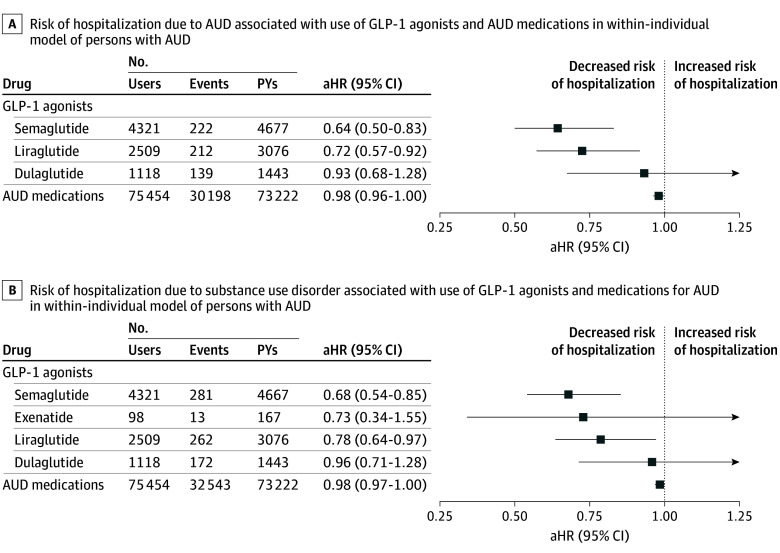
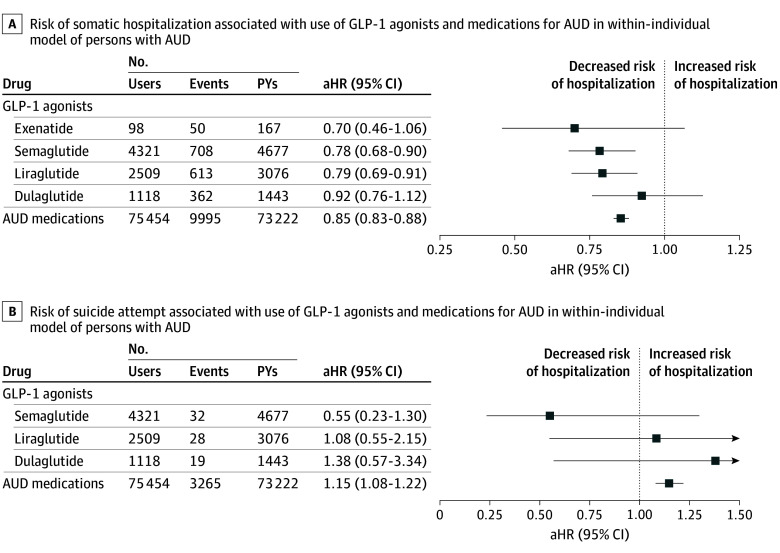
Importance: Preliminary studies suggest that glucagon-like peptide-1 receptor (GLP-1) agonists, used to treat type 2 diabetes and obesity, may decrease alcohol consumption. Objective: To test whether the risk of hospitalization due to alcohol use disorder (AUD) is decreased during the use of GLP-1 agonists compared with periods of nonuse for the same individual. Design, Setting, and Participants: This cohort study was an observational study conducted nationwide in Sweden using data from January 2006 to December 2023. The population-based cohort was identified from registers of inpatient care, specialized outpatient care, sickness absence, and disability pension. Participants were all residents aged 16 to 64 years who had a diagnosis of AUD. Exposures: The primary exposure was use of individual GLP-1 agonists (compared with nonuse of GLP-1 agonists), and the secondary exposure was medications with indication for AUD. Main Outcomes and Measures: The primary outcome was AUD hospitalization analyzed in a Cox regression within-individual model. Secondary outcomes were any substance use disorder (SUD)–related hospitalization, somatic hospitalization, and suicide attempt. Results: The cohort included 227 866 individuals with AUD; 144 714 (63.5%) were male and 83 154 (36.5%) were female, with a mean (SD) age of 40.0 (15.7) years. Median (IQR) follow-up time was 8.8 (4.0-13.3) years. A total of 133 210 individuals (58.5%) experienced AUD hospitalization. Semaglutide (4321 users) was associated with the lowest risk (AUD: adjusted hazard ratio [aHR], 0.64; 95% CI, 0.50-0.83; any SUD: aHR, 0.68; 95% CI, 0.54-0.85) and use of liraglutide (2509 users) with the second lowest risk (AUD: aHR, 0.72; 95% CI, 0.57-0.92; any SUD: aHR, 0.78; 95% CI, 0.64-0.97) of both AUD and SUD hospitalization. Use of any AUD medication was associated with a modestly decreased risk (aHR, 0.98; 95% CI, 0.96-1.00). Semaglutide (aHR, 0.78; 95% CI, 0.68-0.90) and liraglutide (aHR, 0.79; 95% CI, 0.69-0.91) use were also associated with decreased risk of somatic hospitalizations but not associated with suicide attempts (semaglutide: aHR, 0.55; 95% CI, 0.23-1.30; liraglutide: aHR, 1.08; 95% CI, 0.55-2.15). Conclusions and Relevance: Among patients with AUD and comorbid obesity/type 2 diabetes, the use of semaglutide and liraglutide were associated with a substantially decreased risk of hospitalization due to AUD. This risk was lower than that of officially approved AUD medications. Semaglutide and liraglutide may be effective in the treatment of AUD, and clinical trials are urgently needed to confirm these findings.
Overview
The claims and statistics of this paper haven’t been checked yet.
Run the check — free, no account needed. It reads the open-access text and checks the sources it cites.
Integrity signals
Registry
Cites
Statistics
Figures
Verification
Claims the paper makes
The claims and statistics of this paper haven’t been checked yet.
Run the check — free, no account needed. It reads the open-access text and checks the sources it cites.
Claims other papers make about this one
Each is checked against this paper’s own text: does it say what the citing paper says it does?
The cited source says what the claim attributes to it.
In the citing paper
“A large observational study in Sweden similarly found that semaglutide and liraglutide use were associated with a lower risk of hospitalization due to alcohol use disorder (aHR for semaglutide: 0.64, 95% CI 0.50, 0.83; aHR for liraglutide: 0.72, 95% CI 0.57, 0.92).62”
From The expanding role of GLP-1 receptor agonists: a narrative review of current evidence and future directions (2025) · cites this paper as [62]
The cited source says what the claim attributes to it.
In the citing paper
“Beyond metabolic benefits, semaglutide has shown promise in cardiovascular disease 17 and alcohol and substance use disorder treatment [18][19][20] and neurocognitive protection.21”
From Neurodegeneration and Stroke After Semaglutide and Tirzepatide in Patients With Diabetes and Obesity (2025) · cites this paper as [17]
Self-check
Percentages, sums and reported differences re-computed from the paper’s own numbers.
The self-check needs the paper’s full text.
Citations
Cites
Fixed Effects Regression Models
Allison, P. (2009) · doi:10.4135/9781412993869 · Cited by 3,999
The role of glucagon‐like peptide 1 (GLP‐1) in addictive disorders
Klausen, M. K., Thomsen, M., Wortwein, G., & Fink‐Jensen, A. (2022) · British Journal of Pharmacology · doi:10.1111/bph.15677 · Cited by 259
Chuong, V., Farokhnia, M., Khom, S., Pince, C. L., Elvig, S. K., Vlkolinsky, R., Marchette, R. C. N., Koob, G. F., Roberto, M., Vendruscolo, L. F., et al. (2023) · JCI Insight · doi:10.1172/jci.insight.170671 · Cited by 214
From prescription drug purchases to drug use periods – a second generation method (PRE2DUP)
Tanskanen, A. J., Taipale, H. T., Koponen, M., Tolppanen, A., Hartikainen, S. A., Ahonen, R. S., & Tiihonen, J. (2015) · BMC Medical Informatics and Decision Making · doi:10.1186/s12911-015-0140-z · Cited by 200
Self-citationSemaglutide reduces alcohol intake and relapse-like drinking in male and female rats
Aranäs, C., Edvardsson, C. E., Shevchouk, O. T., Zhang, Q., Witley, S., Blid Sköldheden, S., Zentveld, L., Vallöf, D., Tufvesson-Alm, M., & Jerlhag, E. (2023) · eBioMedicine · doi:10.1016/j.ebiom.2023.104642 · Cited by 158
Prevention, screening, and treatment for heavy drinking and alcohol use disorder
Knox, J., Hasin, D. S., Larson, F. R. R., & Kranzler, H. R. (2019) · The Lancet Psychiatry · doi:10.1016/s2215-0366(19)30213-5 · Cited by 158
Suchankova, P., Yan, J., Schwandt, M. L., Stangl, B. L., Caparelli, E. C., Momenan, R., Jerlhag, E., Engel, J. A., Hodgkinson, C. A., Egli, M., et al. (2015) · Translational Psychiatry · doi:10.1038/tp.2015.68 · Cited by 146
Wium‐Andersen, I. K., Wium‐Andersen, M. K., Fink‐Jensen, A., Rungby, J., Jørgensen, M. B., & Osler, M. (2022) · Basic & Clinical Pharmacology & Toxicology · doi:10.1111/bcpt.13776 · Cited by 93
Wang, W. Y., Volkow, N. D., Berger, N. A., Davis, P. B., Kaelber, D. C., & Xu, R. (2024) · Molecular Psychiatry · doi:10.1038/s41380-024-02498-5 · Cited by 89
Taipale, H. T., Tanskanen, A. J., Koponen, M., Tolppanen, A., Tiihonen, J., & Hartikainen, S. A. (2016) · Clinical Epidemiology · doi:10.2147/clep.s116160 · Cited by 73
Self-citation
Cited by
Sorted by citations
GLP-1-based therapies for diabetes, obesity and beyond
Drucker, D. J. (2025) · Nature Reviews Drug Discovery · doi:10.1038/s41573-025-01183-8 · Cited by 297
Moiz, A., Filion, K. B., Tsoukas, M. A., Yu, O. H. Y., Peters, T. M., & Eisenberg, M. J. (2025) · EClinicalMedicine · doi:10.1016/j.eclinm.2025.103363 · Cited by 157
INTEGRATE: international guidelines for the algorithmic treatment of schizophrenia
McCutcheon, R. A., Pillinger, T., Varvari, I., Halstead, S., Ayinde, O. O., Crossley, N. A., Correll, C. U., Hahn, M., Howes, O. D., Kane, J. M., et al. (2025) · The Lancet Psychiatry · doi:10.1016/s2215-0366(25)00031-8 · Cited by 94
Self-citationThe expanding landscape of GLP-1 medicines
Drucker, D. J. (2026) · Nature Medicine · doi:10.1038/s41591-025-04124-5 · Cited by 70
Cai, M., Choi, T., Xie, Y., & Al‐Aly, Z. (2026) · BMJ · doi:10.1136/bmj-2025-086886 · Cited by 47
Metadata
- Authors
- Lähteenvuo, M., Tiihonen, J., Solismaa, A., Tanskanen, A., Mittendorfer-Rutz, E., & Taipale, H.
- Affiliations
- University of Eastern Finland (FI)
- Tampere University (FI)
- Department of Clinical Neuroscience, Karolinska Institutet, Stockholm, Sweden
- Corresponding author
- Lähteenvuo, Markku
- Venue
- JAMA Psychiatry
- Publisher
- American Medical Association (AMA)
- Published
- 2025-01-01
- Volume
- 82
- Issue
- 1
- Pages
- 94
- ISSN
- 2168-622X (ISSN-L)
- PMC
- PMC11561716
- OpenAlex
- W4404319582
- Cited by
- 134
- References
- 13
- Citations by year
- 2026: 68 · 2025: 66
- FWCI
- 40.89
- Type
- journal article
- Language
- en
- Open access
- hybrid
- doi.org
- Licence
- cc-by
- Locations
- JAMA Psychiatry (publishedVersion, cc-by)
- PubMed (publishedVersion)
- PubMed Central (publishedVersion, cc-by)
- Tampere University Institutional Repository (Tampere University) (submittedVersion, cc-by)
- Topics
- Health Sciences › Medicine › Epidemiology › Substance Abuse Treatment and Outcomes
- Health Sciences › Medicine › Endocrinology, Diabetes and Metabolism › Diabetes Treatment and Management
- Health Sciences › Medicine › Pathology and Forensic Medicine › Alcohol Consumption and Health Effects
- Keywords
- alcoholism, semaglutide, liraglutide, GLP-1 receptor agonists, drug repurposing, alcohol-related hospitalizations, suicide attempts, alcohol consumption reduction, type 2 diabetes, obesity, Sweden
- MeSH terms
- Liraglutide, Semaglutide, Adolescent, Adult, Alcoholism, Glucagon-Like Peptides, Female, Hospitalization, Humans, Hypoglycemic Agents, Male, Middle Aged, Sweden, Cohort Studies, Young Adult
About these checks
Registry, retraction, Cites and statistics results are computed, not judged, with one exception: a printed reference that no index lists is read once by a model before it counts as a citation error. Claims are extracted by a model and kept only when their quote appears verbatim in the text; each cited source is then checked, with a model’s help, for whether it says what the claim relies on. Those verdicts can be wrong — read the claim’s quote and the cited source before relying on one.
Statistics and arithmetic are recomputed, not judged.
Confidence bands are shown only for fields calibrated on our annotated test set. None is calibrated yet, so no band is shown.
What counts as a claim ›How we measure confidence ›How we check this ›
Are you an author, or do you see a problem with this page? Request a review
