

The DOI matches its Crossref record; 42 of the 42 references it cites were found in a registry or an index.
Dual Modification of Metal–Organic Frameworks for Exceptional High Piezo‐Photocatalytic Hydrogen Production
Open accessAbstract
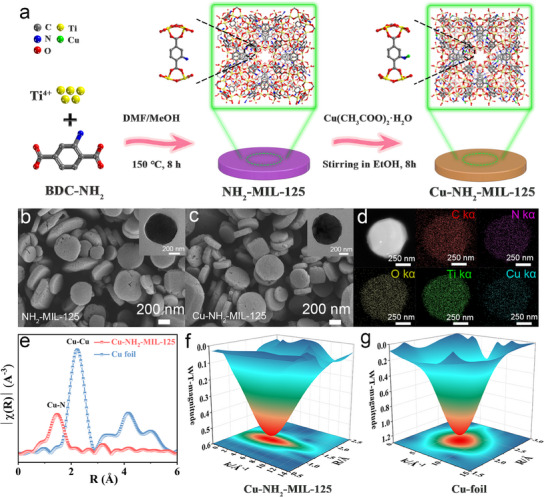
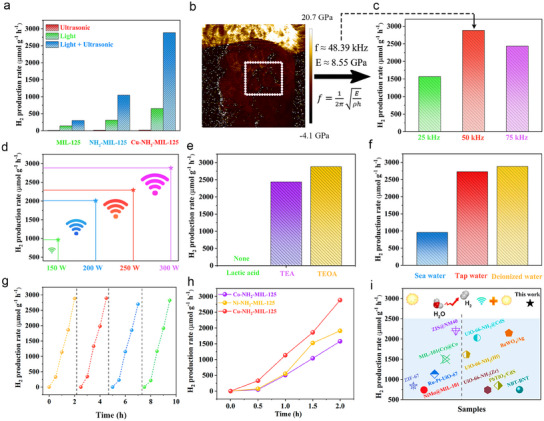
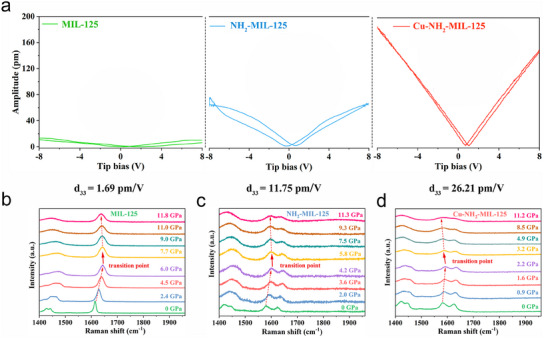
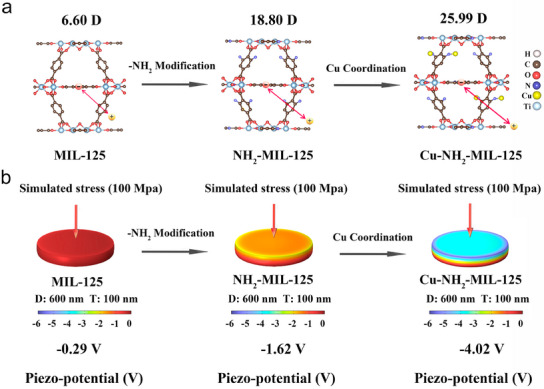
Metal–organic frameworks (MOFs) face significant challenges in photocatalysis due to severe carrier recombination. Here, a novel approach is presented that incorporates ─NH 2 groups and Cu ions onto MOFs with a MIL‐125 skeleton, forming NH 2‐MIL‐125 and Cu‐NH 2‐MIL‐125. This modification effectively enhances the polarity of MOFs, evidenced by significantly increased d 33 values (from 1.69 to 26.21 pm/V) and notable higher dipole moments (from 6.60 to 25.99 D). Notably, it's the first demonstration of boosting MOFs piezoelectricity via a dual modulation strategy. Moreover, the polarity can be further amplified by ultrasonic vibration based on the positive piezoelectric effect, which is justified by in situ Raman spectra, COMSOL simulations, and DFT calculations, by taking into account the applied pressure. The positive impact of introduced piezoelectric effect in facilitating charge separation and transfer of Cu‐NH 2‐MIL‐125, proved by enhanced current response. Consequently, through coupling piezocatalysis and photocatalysis, the H 2 production rate of Cu‐NH 2‐MIL‐125 can be significantly enhanced to ≈2884.2 µmol·g−1·h−1, 2.76 and 9.92 times higher than that of NH 2‐MIL‐125 and MIL‐125, respectively, ranking first in all reported MOF‐based piezo‐photocatalysts. This research demonstrates the prospective opportunity for alleviating the severe carriers recombination problem for MOFs through the implantation of piezoelectric field driving force.
Overview
The claims and statistics of this paper haven’t been checked yet.
Run the check — free, no account needed. It reads the open-access text and checks the sources it cites.
Integrity signals
Registry
Cites
Statistics
Figures
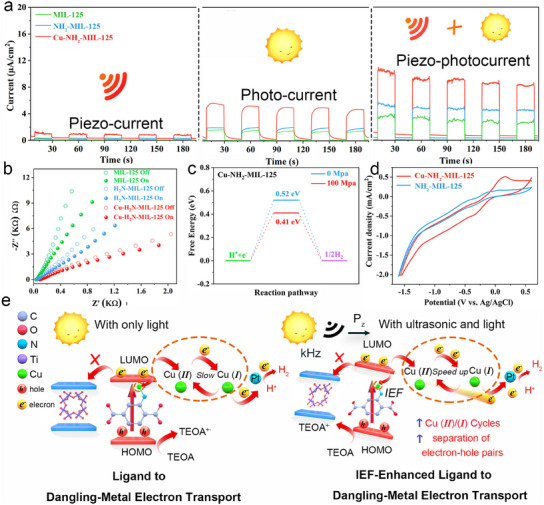
Verification
Claims the paper makes
The claims and statistics of this paper haven’t been checked yet.
Run the check — free, no account needed. It reads the open-access text and checks the sources it cites.
Self-check
Percentages, sums and reported differences re-computed from the paper’s own numbers.
The self-check needs the paper’s full text.
Citations
Cites
Fu, Y., Sun, D., Chen, Y., Huang, R., Ding, Z., Fu, X., & Li, Z. (2012) · Angewandte Chemie International Edition · doi:10.1002/anie.201108357 · Cited by 1,765
A New Photoactive Crystalline Highly Porous Titanium(IV) Dicarboxylate
Dan-Hardi, M., Serre, C., Frot, T., Rozes, L., Maurin, G., Sánchez, C., & Férey, G. (2009) · Journal of the American Chemical Society · doi:10.1021/ja903726m · Cited by 1,445
Tu, S., Guo, Y., Zhang, Y., Hu, C., Zhang, T., Ma, T., & Huang, H. (2020) · Advanced Functional Materials · doi:10.1002/adfm.202005158 · Cited by 996
Self-citationDestruction of Metal–Organic Frameworks: Positive and Negative Aspects of Stability and Lability
Feng, L., Wang, K., Day, G. S., Ryder, M. R., & Zhou, H.-C. “. (2020) · Chemical Reviews · doi:10.1021/acs.chemrev.0c00722 · Cited by 675
Self-citationMetal–Organic Frameworks as Photocatalysts for Solar-Driven Overall Water Splitting
Navalón, S., Dhakshinamoorthy, A., Álvaro, M., Ferrer, B., & Garcı́a, H. (2022) · Chemical Reviews · doi:10.1021/acs.chemrev.2c00460 · Cited by 562
Switching on the Photocatalysis of Metal–Organic Frameworks by Engineering Structural Defects
Ma, X., Wang, L., Zhang, Q., & Jiang, H. (2019) · Angewandte Chemie International Edition · doi:10.1002/anie.201907074 · Cited by 548
Metal–organic framework heterojunctions for photocatalysis
Dhakshinamoorthy, A., Li, Z., Yang⧫, S., & Garcı́a, H. (2024) · Chemical Society Reviews · doi:10.1039/d3cs00205e · Cited by 424
Zhang, C., Lei, D., Xie, C., Hang, X., He, C., & Jiang, H. (2021) · Advanced Materials · doi:10.1002/adma.202106308 · Cited by 421
Ionic Liquids Functionalized MOFs for Adsorption
Li, X., Chen, K., Guo, R., & Wei, Z. (2023) · Chemical Reviews · doi:10.1021/acs.chemrev.3c00248 · Cited by 410
Self-citationXu, M., Lu, M., Qin, G., Wu, X., Yu, T., Zhang, L., Li, K., Cheng, X. Y., & Lan, Y. (2022) · Angewandte Chemie International Edition · doi:10.1002/anie.202210700 · Cited by 322
Cited by
Sorted by citations
When covalent organic frameworks meet metals: From opportunities toward applications
Wu, D., Wang, H., Nie, Y., Wan, H., Liu, S., Yang, S., Li, H., Zhang, H., Zhu, C., & Ma, T. (2025) · Progress in Materials Science · doi:10.1016/j.pmatsci.2025.101538 · Cited by 76
Self-citationGao, M., Yang, G., Shen, B., Zhao, D., Hao, D., Zhu, H., & Wang, Q. (2025) · Chemical Engineering Journal · doi:10.1016/j.cej.2025.170896 · Cited by 55
Che, H., Wang, X., Yue, H., Chen, C., Xie, D., Yang, S., Liu, B., & Ao, Y. (2025) · Advanced Functional Materials · doi:10.1002/adfm.202516979 · Cited by 33
Design Concept of Metal Sulfide Photocatalyst for Efficient Photocatalytic Hydrogen Evolution
Gao, Q., Zheng, X., Lin, J., Zhai, J., Yang, F., Chen, X., Wang, M., Yang, M., Li, J., Shi, X., et al. (2026) · Nano-Micro Letters · doi:10.1007/s40820-026-02111-0 · Cited by 33
Guo, Z., Qin, H., Shan, P., Xiong, B., Wang, L., Shi, W., Sun, Y., & Guo, F. (2025) · Chemical Engineering Journal · doi:10.1016/j.cej.2025.165829 · Cited by 27
Ly, N. H., Son, S. J., Kamyab, H., Vasseghian, Y., & Joo, S. (2025) · Advanced Science · doi:10.1002/advs.202513811 · Cited by 26
Liang, Z., Wang, Y., Li, X., Peng, X., Gong, L., Xiao, L., Yang, X., Zou, B., Zhou, Y., & Liu, J. (2025) · Nature Communications · doi:10.1038/s41467-025-67467-0 · Cited by 23
Self-citationLan, Y., Gao, L., Qian, J., Liu, J., Shen, B., Yang, M., Tu, W., Zhai, J., & Liu, G. (2025) · Chemical Science · doi:10.1039/d5sc07619f · Cited by 17
Chelh, A., Akenoun, B., Dahbi, S., & Hamid Ez-zahraouy, A. (2025) · Journal of Energy Storage · doi:10.1016/j.est.2025.118927 · Cited by 16
Liu, S., Li, J., Liu, Z., Song, J., Lv, H., Xiao, D., Wang, Q., Zhang, Y., & Xue, Q. (2025) · Advanced Science · doi:10.1002/advs.202518794 · Cited by 16
Li, J., Meng, H., Wang, J., Xi, S., Hao, J., Yang, C., Yang, Y., Kuang, Z., Zhu, Y., & Zhang, X.-M. (2026) · Journal of the American Chemical Society · doi:10.1021/jacs.5c20751 · Cited by 16
Tian, X.-J., Guo, S.-J., Wu, Z., Xu, N., Han, G., Chai, Y., & Dong, B. (2025) · Materials Horizons · doi:10.1039/d5mh01457c · Cited by 15
Li, F., Yang, D., Wu, W., Wu, K., Kong, J., Wang, J., Yang, P., & Hu, N. (2025) · ACS Nano · doi:10.1021/acsnano.5c12305 · Cited by 15
Xu, X., Lin, H., Zhang, D., Han, J., Wu, G., & Xing, W. (2025) · Composites Part B Engineering · doi:10.1016/j.compositesb.2025.112852 · Cited by 13
Li, Z., Zhang, Z., Lin, Z., Zhao, K., Han, B., Yao, S., & Liu, Y. (2025) · ChemSusChem · doi:10.1002/cssc.202500972 · Cited by 12
Xi, X., Li, N., She, L., Shen, P., Liu, Y., & Ma, J. (2025) · Journal of Alloys and Compounds · doi:10.1016/j.jallcom.2025.181393 · Cited by 12
Chen, J., Sun, Z., Ma, S., Wang, B., Xu, E., Wang, Z., Ren, P., Zhang, G. Z., Yao, Z., & Zhang, J. (2026) · Journal of the American Chemical Society · doi:10.1021/jacs.5c16984 · Cited by 11
CuInS2-based S-scheme heterojunction photocatalysts for efficient photocatalytic hydrogen evolution
Zhai, J., Lin, J., Yang, F., Li, J., Shi, X., Xiao, Y., Tian, X., & Liu, Y. (2026) · Coordination Chemistry Reviews · doi:10.1016/j.ccr.2026.218025 · Cited by 11
Shi, C., Zheng, R., Yue, Y., Wu, M., Li, P., Fan, L., Guo, C., Zhang, X., Luo, P., Zhang, J., et al. (2025) · Nanoscale Horizons · doi:10.1039/d5nh00359h · Cited by 10
Zhang, H., Pang, M., An, J., Yang, M., Kong, Z., Ren, L., Wang, Z., Ye, J., Pak, Y. L., Gao, X., et al. (2025) · Materials Today Bio · doi:10.1016/j.mtbio.2025.102523 · Cited by 10
Ultrasound‐Driven Piezoelectric Bi‐Ru Heterojunctions for Water‐Splitting Gas Therapy in Tumors
Pan, J., Du, J., Zheng, J., Qian, H., Li, X., Zheng, L., Miao, Y., & Li, Y. (2025) · Advanced Functional Materials · doi:10.1002/adfm.202516207 · Cited by 9
Self-citationHarnessing Metal‐Organic Framework Composites for Improved Photocatalytic Performance
Ye, C., Liao, H., Zhang, L., Zhu, Z., Huang, Y., Lei, H., Wang, L., Zheng, J., Lin, X., Liu, X., et al. (2025) · Small Structures · doi:10.1002/sstr.202500383 · Cited by 9
Ghosh, A., Surendran, D., Barman, S., Jena, R., Bhakar, M., Nath, S., Sheet, G., Zaręba, J. K., & Maji, T. K. (2025) · Advanced Materials · doi:10.1002/adma.202511679 · Cited by 9
Piezocatalysis and piezo-assisted catalysis in environmental remediation and energy conversion
Jiang, S., Mai, Q., Xu, H., Yibo, M. A., Jia, B., & Ma, T. (2026) · Chemical Communications · doi:10.1039/d5cc06489a · Cited by 9
Self-citationEfficient Dual‐Path Piezosynthesis of Hydrogen Peroxide by Breaking Symmetry of UiO‐66
Liu, T., Liu, Z., Lv, G., Guo, L., Liu, M., Guo, J., Wang, G., Zhang, Z., Liu, Y., Wang, L., et al. (2026) · Advanced Functional Materials · doi:10.1002/adfm.74769 · Cited by 9
Zhou, Y., Liu, C., Li, X., Zhan, P., Xu, X., & Peng, X. (2026) · Rare Metals · doi:10.1002/rar2.70175 · Cited by 9
Self-citationZhao, F., Chen, S., Song, C., Jiang, Y., Yang, K., He, Y., & Liu, X. (2026) · eScience Energy · doi:10.1016/j.esen.2026.100026 · Cited by 8
Design concept and solar-to-energy applications of CuPbSbS3 from photovoltaics to photocatalysis
Liu, Y., Chen, X., Li, G., Wang, M., Yang, M., Li, J., Shi, X., Xiao, Y., Su, F., & Tian, X. (2026) · Coordination Chemistry Reviews · doi:10.1016/j.ccr.2026.217656 · Cited by 8
Emerging metal–organic framework-based materials for photocatalytic nitrogen reduction reactions
Chen, L., Li, L., Yu, Y., Luo, X., Gao, Y., Chen, Y., Xiao, Y., Feng, S., Shuai, L., & Liao, G. (2026) · Materials Chemistry Frontiers · doi:10.1039/d6qm00109b · Cited by 7
Yin, J., & Sun, C. (2025) · Journal of environmental chemical engineering · doi:10.1016/j.jece.2025.119042 · Cited by 7
Ma, X., Zhang, B., Huang, X., & Xu, Q. T. (2025) · Fuel · doi:10.1016/j.fuel.2025.138073 · Cited by 7
Li, C., Chen, P., Zhang, Y., Ye, Y., Ouyang, G., & Guo, L. (2026) · Angewandte Chemie International Edition · doi:10.1002/anie.202520573 · Cited by 7
Li, F. B., Kong, J., Fang, Z., Wan, L., Gu, J. H., Ji, C.-C., & Zhou, Y. (2025) · Journal of environmental chemical engineering · doi:10.1016/j.jece.2025.118075 · Cited by 6
Sarangi, P. P., Sahu, J., Giri, R. K., & Parida, K. M. (2025) · Dalton Transactions · doi:10.1039/d5dt02178b · Cited by 6
Liu, Y., Li, N., Shen, P., Xi, X., She, L., & Ma, J. (2025) · International Journal of Hydrogen Energy · doi:10.1016/j.ijhydene.2025.150237 · Cited by 5
Hei, P., Hu, G., Yu, L., Lin, Y., Ning, X., Li, B., Wang, Y., Chen, Z., Chong, H., Cheng, H., et al. (2025) · Chemical Engineering Journal · doi:10.1016/j.cej.2025.170373 · Cited by 5
Yi, J., Wan, J., Alemán, J., Wang, Y., Zuo, S., & Li, J. (2025) · Surfaces and Interfaces · doi:10.1016/j.surfin.2025.108059 · Cited by 5
Tu, S., Zhou, C., Hao, T., Kuang, L., Huang, H. F., Xu, L., Chen, T., Huang, H., & Yan, B. (2025) · Water Research · doi:10.1016/j.watres.2025.125103 · Cited by 5
Self-citationNing, J., Cao, Z., Wang, J., Cao, Y., Zhang, F., & Wang, L. (2026) · ACS Sustainable Chemistry & Engineering · doi:10.1021/acssuschemeng.5c14012 · Cited by 5
Li, X., Yang, X., Chen, Q., Yuan, Q., Huang, H., Tu, S., Zhang, Q., Chen, F., & Fu, M. (2026) · Small · doi:10.1002/smll.202600067 · Cited by 5
Self-citationWang, B., Sun, Z., Chen, J., Ye, J., Kumar, A., Ren, P., Zhang, G., & Zhang, J. (2026) · Journal of Materials Chemistry A · doi:10.1039/d5ta10240e · Cited by 5
Zhang, Y., Jiang, Y., Fu, W., Zhai, C., & Guo, J. (2025) · Journal of environmental chemical engineering · doi:10.1016/j.jece.2025.119236 · Cited by 4
Wang, W., Zhang, Y., Zhao, F., Wang, L., Meng, F., Qin, S., & Zhao, J. (2025) · Chinese Journal of Structural Chemistry · doi:10.1016/j.cjsc.2025.100833 · Cited by 4
Tian, N., Zhou, T., He, Y., Huang, H., & Zhang, Y. (2025) · International Journal of Hydrogen Energy · doi:10.1016/j.ijhydene.2025.152871 · Cited by 4
Self-citationLiu, L., Wang, L., Liu, C., Zhang, Y., Usmanov, D. T., Han, Z., & Yu, Z. J. (2026) · Journal of Colloid and Interface Science · doi:10.1016/j.jcis.2026.139860 · Cited by 4
Abbas, B., & Ravindra, A. V. (2026) · International Journal of Hydrogen Energy · doi:10.1016/j.ijhydene.2026.154193 · Cited by 4
Li, C., Chen, P., Zhang, Y., Ye, Y., Zou, G., Ouyang, G., & Guo, L. (2026) · Applied Catalysis B: Environmental · doi:10.1016/j.apcatb.2026.126916 · Cited by 4
Atomically dispersed Cu-doped TiO2 derived from MOF for photocatalytic hydrogen evolution
Song, H., Zhao, H., Yan, X., Zhu, X., Chen, R., & Liao, Q. (2026) · Chemical Engineering Journal · doi:10.1016/j.cej.2026.177520 · Cited by 4
Ruan, L., Sun, D., Ma, J., Luo, P., Feng, Y., Wang, X., Ran, H., Gan, L., Wang, G., Dai, J.-Y., et al. (2026) · Advanced Materials · doi:10.1002/adma.73832 · Cited by 4
Fu, J., Zhang, P., Wang, L., Zhang, W., Zhang, M., Wang, Y., Li, C., & Dong, H. (2026) · Journal of Water Process Engineering · doi:10.1016/j.jwpe.2026.109573 · Cited by 3
Qin, Y., Zhao, C., Wu, H. M., Liu, Z., Zhang, H., Guo, X., & Bao, H. (2026) · ACS Sustainable Chemistry & Engineering · doi:10.1021/acssuschemeng.5c10605 · Cited by 3
Huang, B., Wu, Z., Xu, M., Chen, Z., Wu, Y., Li, T., Weng, W., Xiao, W., Lu, L., Ge, P., et al. (2026) · Nano Materials Science · doi:10.1016/j.nanoms.2026.02.005 · Cited by 3
Self-citationLiu, P., Dong, L., Zhang, Z., Yu, J., Li, Z., Qiao, Z., Gong, L.-G., Lu, S., Jin, X., & Zhang, F.-M. (2026) · The Catalyst · doi:10.1007/s44422-026-00025-x · Cited by 3
Zhang, K., Feng, A., Xu, S., Chen, H., Ou, C., Wu, Q., Yu, H., Fang, B., & Zhong, G. (2026) · ACS Sustainable Chemistry & Engineering · doi:10.1021/acssuschemeng.6c00376 · Cited by 3
Self-citationStrain engineering of piezo-photocatalysis for water splitting
Zhang, W., Li, X., Cen, H., Liu, Z., Wang, X., & Liu, Z. (2026) · Catalysis Science & Technology · doi:10.1039/d5cy01423a · Cited by 2
Self-citationBao, C., Wei, S.-J., Zhang, Q., Li, Y.-L., Feng, M., & Hu, T. (2026) · Composites Part B Engineering · doi:10.1016/j.compositesb.2026.113533 · Cited by 2
Current Understanding and Challenges of Metal‐Doped MOFs for Photocatalytic Hydrogen Production
Sun, N., Wei, X., Liu, J. L., Jiang, Q., & Sun, Y. (2026) · Energy Technology · doi:10.1002/ente.202502209 · Cited by 2
Sulfur-mediated Ni/Ti bimetallic MOF-derived materials for boosted photocatalytic hydrogen evolution
Rau, J., Huang, Q., Wang, Y., Cai, S., Mao, Z., & Huang, J. (2026) · International Journal of Hydrogen Energy · doi:10.1016/j.ijhydene.2026.154761 · Cited by 2
Tailored D‐π Conjugation Boosts Piezocatalytic CO 2 Reduction in a Platinum(II)‐Acetylide Framework
Zhu, M., Zhou, Y., Wang, K., Fan, X., Ding, Y., Wong, W., & Xu, L. (2026) · Advanced Science · doi:10.1002/advs.75849 · Cited by 3
Self-citationLi, S., Yue, X., Huang, F., (49333), Q. Z., Huang, X., Zhao, J., Bao, L., & Jiang, Y. (2026) · Green Carbon · doi:10.1016/j.greenca.2026.02.014 · Cited by 2
Song, S., Yan, X., Zhu, J., Liu, Y., Wang, L. M., Mu, F., He, H., Ji, Q., & Yang, S. (2026) · Water Research · doi:10.1016/j.watres.2026.126357 · Cited by 2
Piezocatalysis-enhanced tribocatalytic CO2 reduction via tungsten bronze K2NdNb5O15 nanopowders
Wu, S., Zhu, Z., Song, X., Jin, Z., Tang, L., Jiang, C., Hu, C., Liu, L., Fang, L., & Cheng, Z. (2025) · Fuel · doi:10.1016/j.fuel.2025.136156 · Cited by 2
Jia, L., Li, S., Zhang, D., Zhou, X., & Li, H. (2025) · ACS Applied Materials & Interfaces · doi:10.1021/acsami.5c07735 · Cited by 1
Sun, M.-Y., Liu, B.-H., Wang, X., Li, L., Huang, H.-B., & Tang, H. (2025) · Chemical Communications · doi:10.1039/d5cc05886d · Cited by 1
Self-citationOne-dimensional high-entropy sulfides for efficient photocatalytic H2 evolution
Hong, M., Li, F., & Yin, H. (2025) · Materials Letters · doi:10.1016/j.matlet.2025.139911 · Cited by 1
Stable acidic H 2 O 2 electrosynthesis via in situ Ti–N bridging sites
Zhang, Y., Ding, S., & Chen, S. (2025) · Chemical Communications · doi:10.1039/d5cc06247k · Cited by 1
CuTM‐BTC via Linker Fluorination: A Promising Photocatalyst for Hydrogen Evolution Reaction
Ji, Y., Xu, H., Zhang, J., Liu, B.-E., & Xiao, B. (2026) · ChemistrySelect · doi:10.1002/slct.202504628 · Cited by 1
Dual-pathway sensing in Ti-MOFs for selective VOC discrimination by SERS
Guo, Z., Ren, X., Hu, J., Dong, Y., Cao, W., Liu, S. L., & Dai, Z. H. (2026) · Chemical Communications · doi:10.1039/d6cc00090h · Cited by 1
Tian, H., Zhang, R., Wang, Q., & Liu, B. (2026) · ACS Applied Nano Materials · doi:10.1021/acsanm.5c05860 · Cited by 1
Zhou, Q., Zhang, J., Li, M., Bai, W., Guo, W., Zhou, A., Gong, L., Liu, Y., Chen, Z., Yu, H., et al. (2026) · Science China Chemistry · doi:10.1007/s11426-025-3225-9 · Cited by 1
Zhang, Z., Alshaikh, M. A., Saudagar, A. K. J., Chen, G., Zhang, J., Shan, L., Alawad, M. A., & Suriyaprakash, J. (2026) · Materials Today Chemistry · doi:10.1016/j.mtchem.2026.103574 · Cited by 1
Cui, H., Zhang, M., Zhang, W. E., Luo, C., Zhang, X., Li, Y., & Zhang, L. (2026) · Materials Today Chemistry · doi:10.1016/j.mtchem.2026.103747 · Cited by 1
Piezocatalytic water purification: exploring the potential of perovskites in the current context
Roy, J., Roy, S., Ullah, Z., Bag, N., Mondal, D., Sau, A., Gong, T., Ghosh, S., Madni, M., Basu, R., et al. (2026) · Current Opinion in Solid State and Materials Science · doi:10.1016/j.cossms.2026.101279 · Cited by 1
Feng, W., Yuan, J., Li, S., Tang, X., Xu, D., Meng, S., Wang, K., & Weng, B. (2026) · Applied Catalysis B: Environmental · doi:10.1016/j.apcatb.2026.127127 · Cited by 1
Self-citationStructure–property relationships in high-entropy MOFs for catalysis
Zhang, P., Wang, S., Zhu, G., Zhang, N., Wang, H., & Luo, W. (2026) · Nano Energy · doi:10.1016/j.nanoen.2026.112181 · Cited by 1
Priyadarshini, N., Barik, S. R., Panda, J., Mansingh, S., Senapati, S., Mishra, A., Dash, B. N., & Parida, K. M. (2026) · Energy & Fuels · doi:10.1021/acs.energyfuels.6c01941 · Cited by 1
Li, Z., Hao, J., Tan, S., Zhao, X., Ma, J. J., Yin, Z., Song, Z., Qiu, J., & Li, Y. (2026) · Applied Catalysis B: Environmental · doi:10.1016/j.apcatb.2026.127255 · Cited by 1
Wei, X., Chen, S., Zhou, X., Wang, H., Guo, W., Niu, X., Li, W. H., Ding, Z., & Chi, H. (2026) · Advanced Science · doi:10.1002/advs.76906 · Cited by 1
Piezoelectric Catalysis in Water Treatment: Mechanism, Material Design and Application Progress
Guan, Y., Wei, H., Hu, Z., Li, Y., Sun, J., Yao, K., Chen, X., Ke, Y., Yang, Y., Liu, H., et al. (2026) · Chinese Journal of Structural Chemistry · doi:10.1016/j.cjsc.2026.101075 · Cited by 1
Zhang, K., Feng, A., Xu, S., Zhong, G., & Fang, B. (2026) · Catalysts · doi:10.3390/catal16090755 · Cited by 1
Self-citationAhmad, R. U. S., Hilal, M. E., Zhu, W., Ahmed, S. B., Khan, W., Gunasekaran, I., Khan, B., & Khoo, B. L. (2026) · Advanced Materials Technologies · doi:10.1002/admt.71248 · Cited by 1
Ma, X., Zhang, B., Huang, X., & Xu, Q. T. (2025) · SSRN Electronic Journal · doi:10.2139/ssrn.5538708
Su, L., Zhang, X., Niu, L., Yu, H., Guo, L., Peng, Y., Yu, J., Liu, C., Liao, F., Liu, Y., et al. (2025) · Nano Research · doi:10.26599/nr.2025.94908297
Li, M., Liu, C., Liu, X., Xie, Z., Du, C., & Su, Y. (2026) · Journal of environmental chemical engineering · doi:10.1016/j.jece.2026.121884
Li, C., Chen, P., Zhang, Y., Ye, Y., Ouyang, G., & Guo, L. (2026) · Angewandte Chemie · doi:10.1002/ange.202520573
Zheng, D., Zhu, J., Tang, W., Xu, M., & Gu, Z. (2026) · Journal of Analysis and Testing · doi:10.1007/s41664-026-00434-w
Qi, B., Li, R. Y., Jiang, H., Ye, S., Sohn, W. Y., & Pan, Z. (2026) · Nanoscale · doi:10.1039/d6nr00602g
Jiang, Y., Ye, L., Lu, Y., Guo, J., Li, H., Shuaib, S. S. A., Wei, Y., Cai, M., & Sun, S. Y. (2026) · ChemPhotoChem · doi:10.1002/cptc.70168
Yin, H., Li, X., He, A., Dai, B., Dong, H., Pan, Z., Yan, J., Qie, W., Zhang, H., Zhou, C., et al. (2026) · Advanced Healthcare Materials · doi:10.1002/adhm.71257
Self-citationLiu, J., Li, J., Sun, H., Seo, J., Zhang, Y., & Yu, Y. (2026) · Materials Today Bio · doi:10.1016/j.mtbio.2026.103299
Chen, Y., Jin, Y., Tan, Q., Ji, Y., Wang, D., Dong, R., & Fang, J. (2026) · ACS Materials Letters · doi:10.1021/acsmaterialslett.6c00432
Li, X., Rhimi, B., Labidi, A., Harrath, K., Rouinkou, M., Shao, X., & Wang, C. (2026) · EnergyChem · doi:10.1016/j.enchem.2026.100207
Self-citationZhang, Y., Chi, Y., Li, T., Cao, C., Liu, Y., & Li, Y. L. (2026) · ChemPlusChem · doi:10.1002/cplu.70200
Efficient methylamine electrosynthesis from CO 2 and NO over Mo 1 Cu alloys
Liu, B., Yin, C., Yu, Y., & Chu, K. (2026) · Chemical Communications · doi:10.1039/d6cc03813a
Bi, J., Qian, Y., Zhan, Q., Xue, H., Liu, N., Zhang, X., Wang, Z., Zhu, L., & Han, Y. (2026) · Small · doi:10.1002/smll.74874
Yao, W., Tursun, M., Wang, S., Yan, P., Tuerdi, A., & Abdukayum, A. (2026) · ACS Applied Nano Materials · doi:10.1021/acsanm.6c02069
Yu, Y., Hu, J., Chen, F., Zhu, Z., Lu, Y., Li, J., & Huang, H. (2026) · Angewandte Chemie International Edition · doi:10.1002/anie.2142051
Self-citationYu, Y., Hu, J., Chen, F., Zhu, Z., Lu, Y., Li, J., & Huang, H. (2026) · Angewandte Chemie · doi:10.1002/ange.2142051
Self-citationChen, B.-R., Chen, Y., Zhang, M.-X., Wang, W., Tian, X.-Z., Zhong, W.-Y., Wang, H.-L., Xing, C., Li, L., Wu, Y.-H., et al. (2026) · Chinese Journal of Structural Chemistry · doi:10.1016/j.cjsc.2026.101074
Dual-Redox-Enabled Photocatalytic Degradation of PFOA over a MIL-125-NH2/rGO Composite
Shen, X., Li, R., Chen, B., & Zhu, X. (2026) · ACS ES&T Engineering · doi:10.1021/acsestengg.6c00421
Metadata
- Authors
- Hu, H., Li, X., Zhang, K., Yan, G., Kong, W., Qin, A., Ma, Y., Li, A., Wang, K., Huang, H., Sun, X., & Ma, T.
- Affiliations
- Liaoning University (CN)
- Australian Research Council (AU)
- Shenyang University of Chemical Technology (CN)
- Liaocheng University (CN)
- China University of Geosciences (Beijing) (CN)
- Corresponding author
- Sun, Xiaodong
- Ma, Tianyi
- ORCID
- Venue
- Advanced Materials
- Publisher
- Wiley
- Published
- 2025-03-30
- Volume
- 37
- Issue
- 20
- Pages
- e2419023-e2419023
- ISSN
- 0935-9648 (ISSN-L)
- 1521-4095
- PMC
- PMC12087703
- OpenAlex
- W4409023411
- Cited by
- 122
- References
- 42
- Citations by year
- 2026: 85 · 2025: 37
- FWCI
- 26.67
- Type
- journal article
- Language
- en
- Open access
- hybrid
- doi.org
- Licence
- Locations
- Advanced Materials (publishedVersion, cc-by-nc-nd)
- PubMed Central (publishedVersion, cc-by-nc-nd)
- PubMed (publishedVersion)
- Funders
- National Natural Science Foundation of China (22101105, 52071171, 52202248, 22401198)
- Topics
- Physical Sciences › Chemistry › Inorganic Chemistry › Metal-Organic Frameworks: Synthesis and Applications
- Physical Sciences › Energy › Renewable Energy, Sustainability and the Environment › Advanced Photocatalysis Techniques
- Physical Sciences › Materials Science › Materials Chemistry › Hydrogen Storage and Materials
- Keywords
- metal-organic frameworks, piezo-photocatalysis, hydrogen production, MIL-125(Ti), amine functionalization, copper doping, piezoelectric properties, charge recombination, charge separation, ultrasonic vibration, piezoelectric field, dipole moment, piezoelectric coefficient
About these checks
Registry, retraction, Cites and statistics results are computed, not judged, with one exception: a printed reference that no index lists is read once by a model before it counts as a citation error. Claims are extracted by a model and kept only when their quote appears verbatim in the text; each cited source is then checked, with a model’s help, for whether it says what the claim relies on. Those verdicts can be wrong — read the claim’s quote and the cited source before relying on one.
Statistics and arithmetic are recomputed, not judged.
Confidence bands are shown only for fields calibrated on our annotated test set. None is calibrated yet, so no band is shown.
What counts as a claim ›How we measure confidence ›How we check this ›
Are you an author, or do you see a problem with this page? Request a review
