

The DOI matches its Crossref record; 41 of the 42 references it cites were found in a registry or an index; 4 of the 13 sources its claims cite were checked for support.
Highly Active and Stable Alkaline Hydrogen Evolution Electrocatalyst Based on Ir‐Incorporated Partially Oxidized Ru Aerogel under Industrial‐Level Current Density
Open accessAbstract
AbstractThe realization of large‐scale industrial application of alkaline water electrolysis for hydrogen generation is severely hampered by the cost of electricity. Therefore, it is currently necessary to synthesize highly efficient electrocatalysts with excellent stability and low overpotential under an industrial‐level current density. Herein, Ir‐incorporated in partially oxidized Ru aerogel has been designed and synthesized via a simple in situ reduction strategy and subsequent oxidation process. The electrochemical measurements demonstrate that the optimized Ru98Ir2‐350 electrocatalyst exhibits outstanding hydrogen evolution reaction (HER) performance in an alkaline environment (1 M KOH). Especially, at the large current density of 1000 mA cm−2, the overpotential is as low as 121 mV, far exceeding the benchmark Pt/C catalyst. Moreover, the Ru98Ir2‐350 catalyst also displays excellent stability over 1500 h at 1000 mA cm−2, denoting its industrial applicability. This work provides an efficient route for developing highly active and ultra‐stable electrocatalysts for hydrogen generation under industrial‐level current density.
Overview
CoChat Summary
TL;DR
Ir-incorporated partially oxidized Ru aerogel (Ru98Ir2-350) is reported as an alkaline HER electrocatalyst that reaches industrial-level current density with low overpotential and long-term stability. It requires 121 mV overpotential at 1000 mA cm−2 in 1 M KOH and operates for over 1500 h at that current density.
Key findings
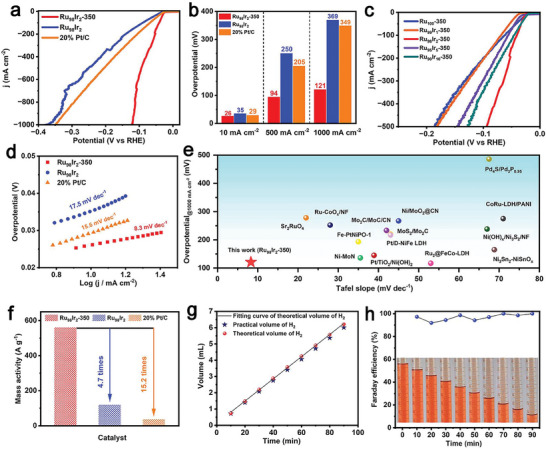
- Ru98Ir2-350 requires overpotentials of 26, 94, and 121 mV at 10, 500, and 1000 mA cm−2, respectively, lower than Ru98Ir2 (35, 250, and 369 mV) and commercial Pt/C (29, 205, and 349 mV).
- It shows a Tafel slope of 8.3 mV dec−1, better than Pt/C (15.6 mV dec−1) and other prepared samples (9.8–31.8 mV dec−1), and a mass activity of 560.7 A g−1 at 100 mV overpotential, 4.7 times Ru98Ir2 (119.4 A g−1) and 15.2 times Pt/C (36.8 A g−1).
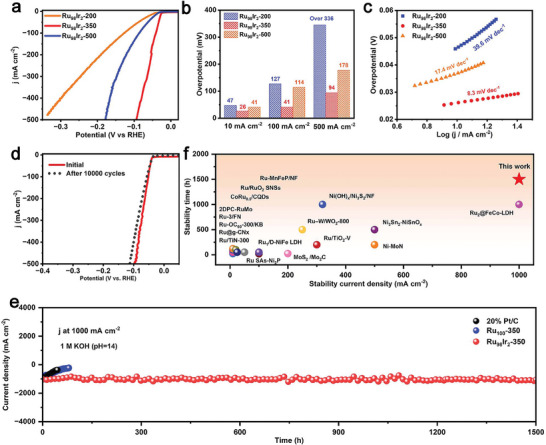
- Stability: after 10,000 CV cycles activity decreases only slightly; in i-t testing at 1000 mA cm−2, current density decreases only slightly over 1500 h, outperforming Pt/C and Ru100-350.
- Faraday efficiency for H2 production is ≈100% within 90 min at 50 mA cm−2; ECSA is 954 cm2 and Cdl is 194.7 mF cm−2.
Methods
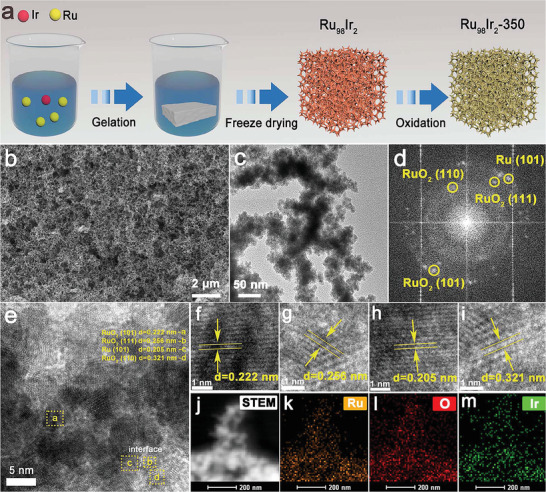
- RuIr aerogels with Ru:Ir ratios of 100:0, 99:1, 98:2, 95:5, and 90:10 were synthesized by one-step in situ NaBH4 reduction, then oxidized at 350 °C to form partially oxidized aerogels; Ru98Ir2-350 was the optimized sample.
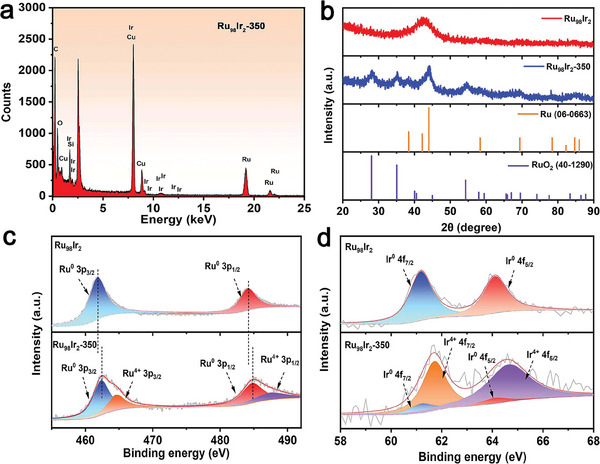
- Characterization used XRD, FE-SEM, XPS, HRTEM/EDX, HAADF-STEM, and Raman spectroscopy.
- HER performance was measured in 1 M KOH using a three-electrode cell with carbon paper working electrode, Hg/HgO reference, and graphite counter electrode; LSV was at 1 mV s−1 with 100% iR compensation, stability by CV at 100 mV s−1 and i-t at 1000 mA cm−2, plus EIS, Cdl/ECSA, and water-displacement Faraday efficiency measurements.
Limitations
- The paper does not include an explicit limitations section.
- Evident from the text: owing to the extremely low Ir content, no identified structural information of Ir species (Ir or IrO2) was found by HRTEM/FFT; Ir incorporation is inferred mainly from EDX, XPS, and Raman.
- Evident from the text: the long-term stability test is reported at 1000 mA cm−2 in 1 M KOH under constant applied potential, and Pt/C comparison used a different mass loading (5 mg cm−2) than the Ru-based catalyst (1 mg cm−2).
Model-written summary. Check it against the paper before relying on it.
Integrity signals
Registry
Cites
Statistics
Figures
Verification
Claims the paper makes
3 Valid · 1 Not valid · 4 Not checked · 35 Own results and interpretations
A result the paper reports from its own data — it cites no other source for it, so there is none to check. The quote shows it is in the paper.
In the paper
“As listed in Table S1 (Supporting Information), Ru98Ir2‐350 presents the highest ECSA value of 954 cm2 among all the other samples.”
- Also stated in: § Electrocatalytic HER Performance Evaluation · plain
“Ru98Ir2‐350 presents the highest ECSA value of 954 cm2 among all the other samples.”
§ Highly Active and Stable Alkaline Hydrogen Evolution Electrocatalyst Based on Ir‐Incorporated Partially Oxidized Ru Aerogel under Industrial‐Level Current Density > Results and Discussion > Electrocatalytic HER Performance Evaluation
plain- Asserted: passes — The authors put it forward as true.
- Checkable: passes — It can be checked against evidence.
- Load-bearing: unclear — It is unclear whether the paper’s conclusions depend on it.
- Based: passes — The paper gives a reason why it holds.
- Also stated in: § Electrocatalytic HER Performance Evaluation · plain
A result the paper reports from its own data — it cites no other source for it, so there is none to check. The quote shows it is in the paper.
In the paper
“Ru98Ir2‐350 displays the largest Cdl value of 194.7 mF cm−2 in comparison to other samples (22.8–127.5 mF cm−2).”
§ Highly Active and Stable Alkaline Hydrogen Evolution Electrocatalyst Based on Ir‐Incorporated Partially Oxidized Ru Aerogel under Industrial‐Level Current Density > Results and Discussion > Electrocatalytic HER Performance Evaluation
plain- Asserted: passes — The authors put it forward as true.
- Checkable: passes — It can be checked against evidence.
- Load-bearing: passes — The paper’s conclusions depend on it.
- Based: passes — The paper gives a reason why it holds.
A result the paper reports from its own data — it cites no other source for it, so there is none to check. The quote shows it is in the paper.
In the paper
“By comparing the LSV curves before and after 10 000 CV cycles (Figure 4d), it was found that the electrocatalytic activity of Ru98Ir2‐350 showed only a little decrease, demonstrating excellent CV stability.”
§ Highly Active and Stable Alkaline Hydrogen Evolution Electrocatalyst Based on Ir‐Incorporated Partially Oxidized Ru Aerogel under Industrial‐Level Current Density > Results and Discussion > Electrocatalytic HER Stability Evaluation
boosted- Asserted: passes — The authors put it forward as true.
- Checkable: passes — It can be checked against evidence.
- Load-bearing: passes — The paper’s conclusions depend on it.
- Based: passes — The paper gives a reason why it holds.
A result the paper reports from its own data — it cites no other source for it, so there is none to check. The quote shows it is in the paper.
In the paper
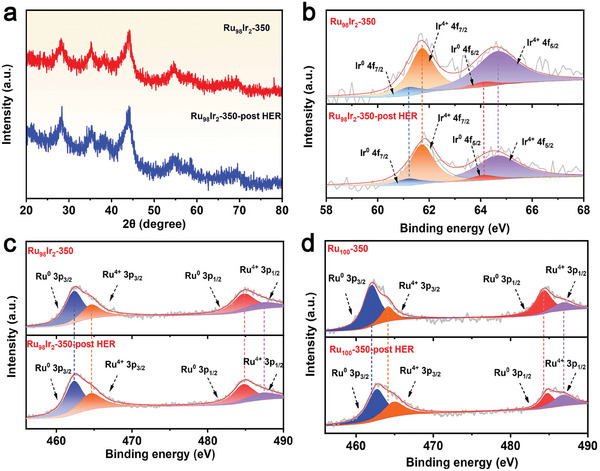
“further illustrating that a portion of metallic Ru is oxidized into RuO2 upon heat treatment.”
§ Highly Active and Stable Alkaline Hydrogen Evolution Electrocatalyst Based on Ir‐Incorporated Partially Oxidized Ru Aerogel under Industrial‐Level Current Density > Results and Discussion > Materials Preparation and Structural Characterization
plainstates a cause- Asserted: passes — The authors put it forward as true.
- Checkable: passes — It can be checked against evidence.
- Load-bearing: passes — The paper’s conclusions depend on it.
- Based: passes — The paper gives a reason why it holds.
A result the paper reports from its own data — it cites no other source for it, so there is none to check. The quote shows it is in the paper.
In the paper
“The Ir 4f and Ru 3p XPS spectra of Ru98Ir2‐350 before and after HER durability measurement (Figure 5b,c) are also unchanged.”
§ Highly Active and Stable Alkaline Hydrogen Evolution Electrocatalyst Based on Ir‐Incorporated Partially Oxidized Ru Aerogel under Industrial‐Level Current Density > Results and Discussion > Characterization of Post‐HER Ru98Ir2‐350 and Mechanism of Ultra‐High Stability
plainSingle case- Asserted: passes — The authors put it forward as true.
- Checkable: passes — It can be checked against evidence.
- Load-bearing: passes — The paper’s conclusions depend on it.
- Based: passes — The paper gives a reason why it holds.
23 more claims
Create a free account to see all 43 claims and every source verdict.
- Probably not a substantial claim. 9
- It may state two separate claims as one. 7
Citations
Cites
Benchmarking Heterogeneous Electrocatalysts for the Oxygen Evolution Reaction
McCrory, C. C. L., Jung, S., Peters, J. C., & Jaramillo, T. F. (2013) · Journal of the American Chemical Society · doi:10.1021/ja407115p · Cited by 7,026
Earth-abundant catalysts for electrochemical and photoelectrochemical water splitting
Roger, I., Shipman, M. A., & Symes, M. D. (2017) · Nature Reviews Chemistry · doi:10.1038/s41570-016-0003 · Cited by 3,503
Wu, Z.-Y., Chen, F.-Y., Li, B., Yu, S.-W., Finfrock, Y. Z., Meira, D. M., Yan, Q.-Q., Zhu, P., Chen, M.-X., Song, T.-W., et al. (2023) · Nature Materials · doi:10.1038/s41563-022-01380-5 · Cited by 1,004
Single-Atom Vacancy Defect to Trigger High-Efficiency Hydrogen Evolution of MoS2
Wang, X., Zhang, Y., Si, H., Zhang, Q., Wu, J., Gao, L., Wei, X., Sun, Y., Liao, Q., Zhang, Z., et al. (2020) · Journal of the American Chemical Society · doi:10.1021/jacs.9b12113 · Cited by 969
Zhou, K. L., Wang, Z., Han, C. B., Ke, X., Wang, C., Jin, Y., Zhang, Q., Liu, J., Wang, H., & Yan, H. (2021) · Nature Communications · doi:10.1038/s41467-021-24079-8 · Cited by 765
Self-citationGrimaud, A., Demortière, A., Saubanère, M., Dachraoui, W., Duchamp, M., Doublet, M.-L., & Tarascon, J.-M. (2016) · Nature Energy · doi:10.1038/nenergy.2016.189 · Cited by 649
Wang, Y., Yang, R., Ding, Y., Zhang, B., Li, H., Bai, B., Li, M., Cui, Y., Xiao, J., & Wu, Z.-S. (2023) · Nature Communications · doi:10.1038/s41467-023-37008-8 · Cited by 547
Liu, H., Zhang, Z., Fang, J., Li, M., Sendeku, M. G., Wang, X., Wu, H., Li, Y., Ge, J., Zhuang, Z., et al. (2023) · Joule · doi:10.1016/j.joule.2023.02.012 · Cited by 537
Dynamic charge and oxidation state of Pt/CeO2 single-atom catalysts
Daelman, N., Capdevila-Cortada, M., & López, N. (2019) · Nature Materials · doi:10.1038/s41563-019-0444-y · Cited by 435
Zhao, G., Li, P., Cheng, N., Dou, S. X., & Sun, W. (2020) · Advanced Materials · doi:10.1002/adma.202000872 · Cited by 333
Cited by
Yan, Z., Tao, S., Wang, J., Lu, X., & Lu, T. (2024) · Advanced Materials · doi:10.1002/adma.202411942 · Cited by 142
Self-citationOrbital-level band gap engineering of RuO2 for enhanced acidic water oxidation
Wang, X., Pi, W., Li, Z. Y., Hu, S., Bao, H., Xu, W., & Yao, N. (2025) · Nature Communications · doi:10.1038/s41467-025-60083-y · Cited by 122
Zhang, Z., Tang, S., Xu, L., Wang, J., Li, A., Jing, M., Yang, X., & Song, F. (2024) · International Journal of Hydrogen Energy · doi:10.1016/j.ijhydene.2024.06.061 · Cited by 59
Shi, X., Gu, W., Zhang, B., Zhao, Y., Zhang, A., Xiao, W., Wei, S., & Pang, H. (2025) · Advanced Functional Materials · doi:10.1002/adfm.202423760 · Cited by 57
Prospect of Ruthenium for Hydrogen Evolution Reaction in Alkaline Media through In Situ Monitoring
Kim, J., Pang, W. K., Mun, J., Song, T., Chen, J., Kim, J. H., & Yoon, D. H. (2025) · Advanced Energy Materials · doi:10.1002/aenm.202502858 · Cited by 38
Zang, B., Liu, X., Gu, C., Chen, J., Wang, L., & Zheng, W. (2024) · Nanomaterials · doi:10.3390/nano14141172 · Cited by 22
Lee, G., Jun, S. E., Lim, J., Kim, J., Lee, H., Cheon, W. S., Ryoo, G. W., Cho, B., Lee, S., Kwon, M. S., et al. (2025) · Advanced Science · doi:10.1002/advs.202414622 · Cited by 23
Fang, W., Tang, T., Li, M., Xin, S., Wu, Y., Cao, Y., Yu, Z., Cui, W., Li, Z., & Zhao, H. (2024) · Chemical Engineering Journal · doi:10.1016/j.cej.2024.156013 · Cited by 15
Cao, X., & Lin, B. (2025) · Nano Research Energy · doi:10.26599/nre.2025.9120178 · Cited by 16
Xue, H., Wang, J., Li, X., Liu, Z., Zhang, H., Zhang, Y., Zhang, Y., Pan, J., Han, M., & He, Y. (2024) · Small · doi:10.1002/smll.202405838 · Cited by 12
Zhang, W., Xie, X., Cao, C., Li, Y., Khan, M. I., & Zhu, Q. (2025) · Rare Metals · doi:10.1007/s12598-025-03427-3 · Cited by 12
Chen, J., Xie, Z., Tang, Y., Tang, Z., & Wang, X. (2024) · New Journal of Chemistry · doi:10.1039/d4nj02733g · Cited by 10
Zhao, M., Yuan, J., Yang, F., Liu, H., Sun, X., Sun, Y., Sun, S., Liu, J., & Li, Y. (2025) · Green Chemistry · doi:10.1039/d5gc03579a · Cited by 9
Sardar, M., Aamir, M., Sher, M., Lee, I. E., Wali, Q., Khan, M. E., Akhtaruzzaman, M., Shahiduzzaman, M., Akhtar, J., & Nunzi, J. (2025) · Chemical Engineering Journal Advances · doi:10.1016/j.ceja.2025.100897 · Cited by 9
Wang, Y., Qin, H., Wang, X., Yan, F., Zhao, Y., & Yu, X. (2025) · ChemSusChem · doi:10.1002/cssc.202501240 · Cited by 9
Amorim, I., Spera, N. C. M., Nicoara, N., Ramasamy, D., Alves, D. F., Stollenwerk, M., Stadtmüller, J., Döhring, T., Sadewasser, S., Kolen’ko, Y. V., et al. (2024) · International Journal of Hydrogen Energy · doi:10.1016/j.ijhydene.2024.10.306 · Cited by 7
Pratama, D. S. A., Haryanto, A., Lim, H. W., & Lee, C. W. (2026) · Carbon Energy · doi:10.1002/cey2.70238 · Cited by 5
Wang, L. (2024) · Preprints.org · doi:10.20944/preprints202405.0854.v1 · Cited by 2
Salah, A., Ren, H., Yu, F., Al‐Ansi, N., Lang, Z., Li, Y., Wang, Y., & Tan, H. (2026) · Advanced Energy Materials · doi:10.1002/aenm.202506175 · Cited by 2
Biopolymers in renewable energy systems and storage applications
Sơn, N. T., My, L. T., & Tan, L. V. (2026) · Renewable and Sustainable Energy Reviews · doi:10.1016/j.rser.2026.117192 · Cited by 1
Wang, H., Wang, H., Sun, Q., Li, Q., Liu, X., Xing, L., Guo, S., Zhu, Y., Wan, Z., Luan, H., et al. (2026) · Catalysis Letters · doi:10.1007/s10562-026-05300-z · Cited by 1
Ou-Yang, Z.-Y., Nie, J., Xia, S., Xie, M., Xian, M.-H., Wan, H., Huang, G., & Huang, W. (2024) · Applied Physics Letters · doi:10.1063/5.0226555 · Cited by 1
Mohanraj, M., Aparnasree, M., Rajni, K. S., Aravindan, V., & Ulaganathan, M. (2026) · Small · doi:10.1002/smll.74686
Xia, Y., Ma, S.-Z., Wang, Y., Du, J.-W., Chen, Y., Kong, Y.-H., Sun, W. T., ZHANG, C., Sun, H., & Cai, Z. (2026) · ACS Applied Nano Materials · doi:10.1021/acsanm.6c02154
Yan, S., Guan, L., Zhu, Y., Wang, X., Ao, G., Zhang, D., & Xu, L. (2026) · Journal of Materials Science · doi:10.1007/s10853-026-12184-2
Self-citationHuang, H., Zhong, W., Kang, Q., Wang, Y., Zhang, C., Lei, H., Li, Z., Zhang, Q., Wei, W., Yang, J., et al. (2026) · Journal of the American Chemical Society · doi:10.1021/jacs.6c09149
Graphene-Supported Ir-Doped FeCoNiO x Nanosheets for Efficient Oxygen Evolution Electrocatalysis
Rong, W., Chen, Y., Han, K., Dang, R., Dong, Y., Sun, L. G., Liu, J., Meng, H., & Cao, Q. (2025) · ACS Applied Nano Materials · doi:10.1021/acsanm.5c04675
Liu, L. T., Guan, J., Sun, S., Yuan, K., Lu, J., Xie, R., Xia, Z., Wang, Y., Wu, X., & Cui, S. (2026) · Small · doi:10.1002/smll.74322
Metadata
- Authors
- Yan, S., Chen, X., Li, W., Zhong, M., Xu, J., Xu, M., Wang, C., Pinna, N., & Lu, X.
- Affiliations
- Alan G. MacDiarmid Institute, College of Chemistry Jilin University Changchun 130012 P. R. China
- Jilin University (CN)
- Humboldt-Universität zu Berlin (DE)
- Corresponding author
- Lu, Xiaofeng
- Venue
- Advanced Science
- Publisher
- Wiley
- Published
- 2023-12-10
- Volume
- 11
- Issue
- 7
- Pages
- e2307061-e2307061
- ISSN
- 2198-3844 (ISSN-L)
- PMC
- PMC10870084
- OpenAlex
- W4389526771
- Semantic Scholar
- 521d241592818211f3aa5124503d1de84563aa50
- Cited by
- 30
- References
- 42
- Citations by year
- 2026: 10 · 2025: 10 · 2024: 9 · 2023: 1
- FWCI
- 1.43
- Type
- journal article
- Language
- en
- Open access
- gold
- doi.org
- Licence
- Locations
- Advanced Science (publishedVersion, cc-by)
- PubMed Central (publishedVersion, cc-by)
- PubMed (publishedVersion)
- DOAJ (DOAJ: Directory of Open Access Journals) (submittedVersion, cc-by-sa)
- Funders
- National Natural Science Foundation of China (52273055)
- Topics
- Physical Sciences › Energy › Renewable Energy, Sustainability and the Environment › Electrocatalysts for Energy Conversion
- Physical Sciences › Energy › Renewable Energy, Sustainability and the Environment › CO2 Reduction Techniques and Catalysts
- Physical Sciences › Engineering › Electrical and Electronic Engineering › Fuel Cells and Related Materials
- Keywords
- hydrogen evolution reaction, alkaline water electrolysis, electrocatalyst stability, high current density, in situ reduction, overpotential, hydrogen production
About these checks
Registry, retraction, Cites and statistics results are computed, not judged, with one exception: a printed reference that no index lists is read once by a model before it counts as a citation error. Claims are extracted by a model and kept only when their quote appears verbatim in the text; each cited source is then checked, with a model’s help, for whether it says what the claim relies on. Those verdicts can be wrong — read the claim’s quote and the cited source before relying on one.
The claim verdicts this report counts are experimental: their accuracy is not yet measured.
A language model drew the claims from the paper on 2026-10-11, under version 3 of the claim definition (model deepseek-v4.1-flash, prompt extract-v3).
A second model labelled each claim on 2026-10-11 (model jev-1.13-20260917, definition revision gold-guideline-v0.2).
Statistics and arithmetic are recomputed, not judged.
Confidence bands are shown only for fields calibrated on our annotated test set. None is calibrated yet, so no band is shown.
What counts as a claim ›How we measure confidence ›How we check this ›
Are you an author, or do you see a problem with this page? Request a review
Data sources
Bibliographic data: Semantic Scholar, OpenAlex, Crossref.
Contains information from the Semantic Scholar Academic Graph Datasets, made available under the ODC Attribution License (ODC-BY 1.0).
Semantic Scholar’s data is described in: Kinney, R., et al. (2023). The Semantic Scholar Open Data Platform. arXiv:2301.10140.
