

The DOI matches its Crossref record; 7 of the 7 references it cites were found in a registry or an index.
Lovo‐cel gene therapy for sickle cell disease: Treatment process evolution and outcomes in the initial groups of the HGB ‐206 study
Abstract
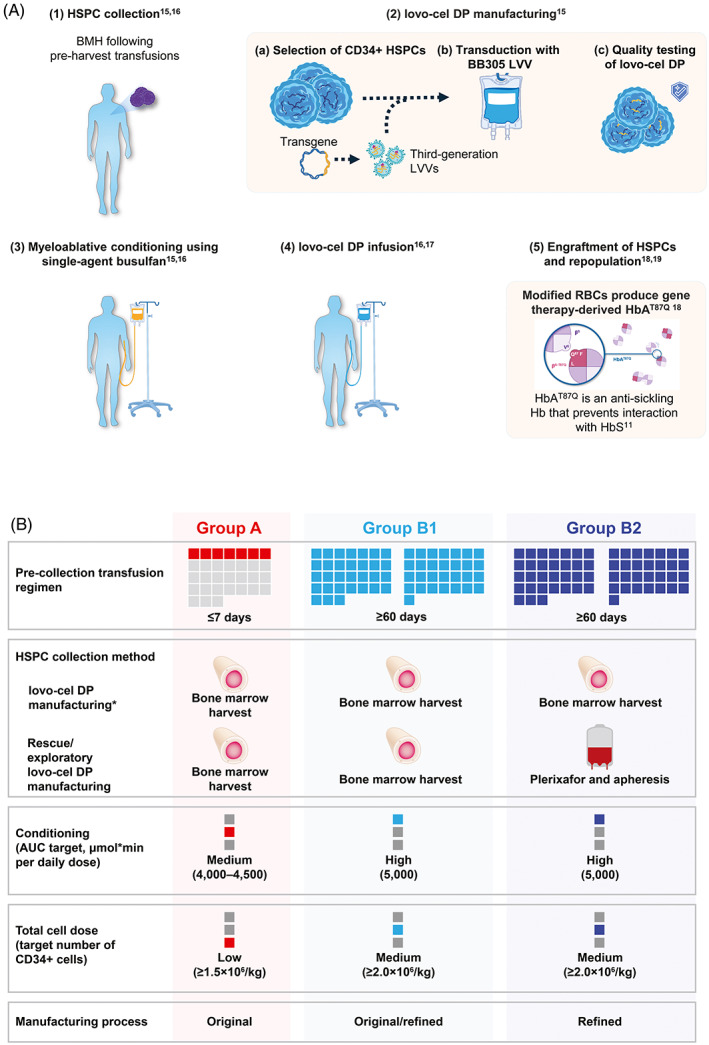
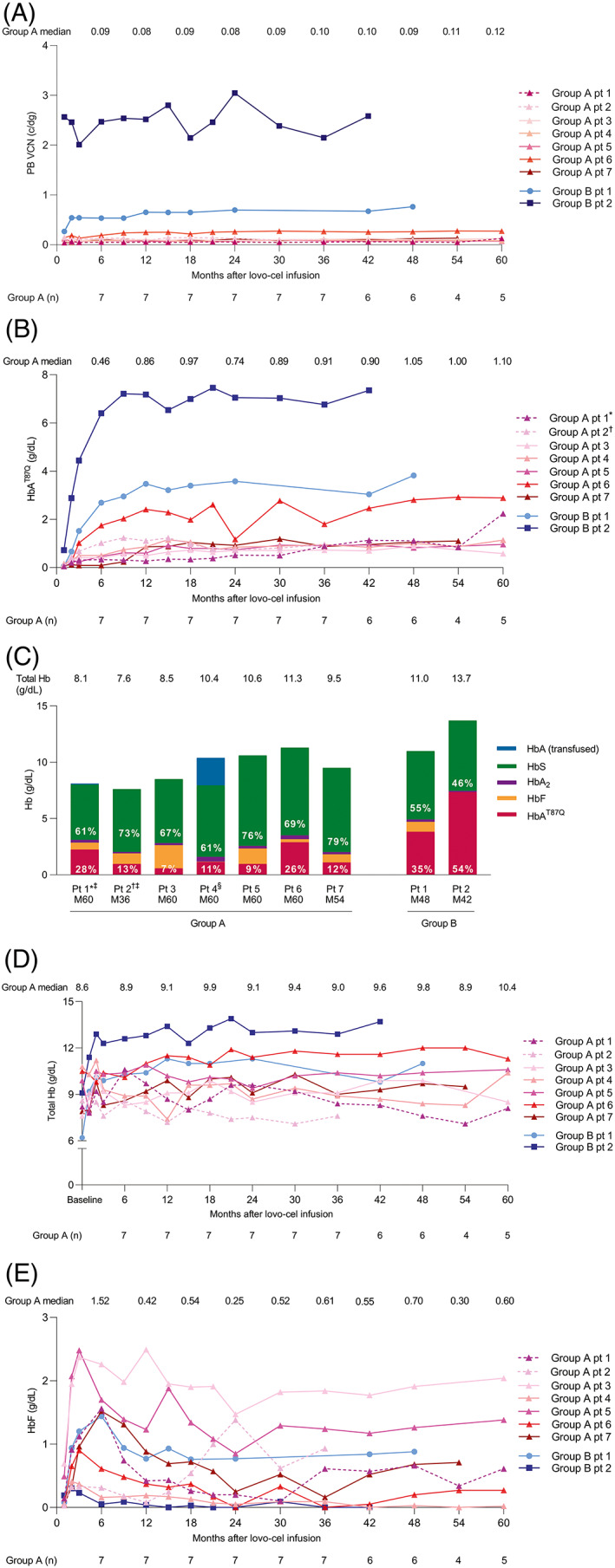
lovo‐cel (bb1111; LentiGlobin for sickle cell disease [SCD]) gene therapy (GT) comprises autologous transplantation of hematopoietic stem and progenitor cells transduced with the BB305 lentiviral vector encoding a modified β‐globin gene (β A‐T87Q ) to produce anti‐sickling hemoglobin (HbA T87Q ). The efficacy and safety of lovo‐cel for SCD are being evaluated in the ongoing phase 1/2 HGB‐206 study ( ClinicalTrials.gov : NCT02140554). The treatment process evolved over time, using learnings from outcomes in the initial patients to optimize lovo‐cel's benefit–risk profile. Following modest expression of HbA T87Q in the initial patients (Group A, n = 7), alterations were made to the treatment process for patients subsequently enrolled in Group B ( n = 2, patients B1 and B2), including improvements to cell collection and lovo‐cel manufacturing. After 6 months, median Group A peripheral blood vector copy number (≥0.08 c/dg) and HbA T87Q levels (≥0.46 g/dL) were inadequate for substantial clinical effect but stable and sustained over 5.5 years; both markedly improved in Group B (patient B1: ≥0.53 c/dg and ≥2.69 g/dL; patient B2: ≥2.14 c/dg and ≥6.40 g/dL, respectively) and generated improved biologic and clinical efficacy in Group B, including higher total hemoglobin and decreased hemolysis. The safety of the lovo‐cel for SCD treatment regimen largely reflected the known side effects of HSPC collection, busulfan conditioning regimen, and underlying SCD; acute myeloid leukemia was observed in two patients in Group A and deemed unlikely related to insertional oncogenesis. Changes made during development of the lovo‐cel treatment process were associated with improved outcomes and provide lessons for future SCD GT studies.
Overview
The claims and statistics of this paper haven’t been checked yet.
Run the check — free, no account needed. It reads the open-access text and checks the sources it cites.
Integrity signals
Registry
Cites
Statistics
Figures
Verification
Claims the paper makes
The claims and statistics of this paper haven’t been checked yet.
Run the check — free, no account needed. It reads the open-access text and checks the sources it cites.
Claims other papers make about this one
Each is checked against this paper’s own text: does it say what the citing paper says it does?
In the citing paper
“Although insertional mutagenesis risk has been reduced by improved vector design19, the development of myelodysplastic syndrome (MDS) and acute myeloid leukemia (AML) at 3–5.5 years post-transplantation in 2 of 47 patients who had undergone GT for SCD20–23 has generated renewed concerns.”
From Clonal selection of hematopoietic stem cells after gene therapy for sickle cell disease (2023) · cites this paper as [23]
Self-check
Percentages, sums and reported differences re-computed from the paper’s own numbers.
The self-check needs the paper’s full text.
Citations
Cites
Kato, G. J., Piel, F. B., Reid, C. D., Gaston, M. H., Ohene-Frempong, K., Krishnamurti, L., Smith, W. R., Panepinto, J. A., Weatherall, D. J., Costa, F. F., et al. (2018) · Nature Reviews Disease Primers · doi:10.1038/nrdp.2018.10 · Cited by 1,501
Pulmonary Hypertension as a Risk Factor for Death in Patients with Sickle Cell Disease
Gladwin, M. T., Sachdev, V., Jison, M. L., Shizukuda, Y., Plehn, J. F., Minter, K., Brown, B., Coles, W. A., Nichols, J. S., Ernst, I., et al. (2004) · New England Journal of Medicine · doi:10.1056/nejmoa035477 · Cited by 1,325
Transfusion independence and HMGA2 activation after gene therapy of human β-thalassaemia
Cavazzana-Calvo, M., Payen, E., Negre, O., Wang, G., Hehir, K., Fusil, F., Down, J., Denaro, M., Brady, T., Westerman, K., et al. (2010) · Nature · doi:10.1038/nature09328 · Cited by 1,276
Self-citationPathophysiology of Sickle Cell Disease
Sundd, P., Gladwin, M. T., & Novelli, E. M. (2019) · Annual Review of Pathology Mechanisms of Disease · doi:10.1146/annurev-pathmechdis-012418-012838 · Cited by 813
Gene therapy in a patient with sickle cell disease
Ribeil, J.-A., Hacein-Bey-Abina, S., Payen, E., Magnani, A., Semeraro, M., Magrin, E., Caccavelli, L., Neven, B., Bourget, P., El Nemer, W., et al. (2017) · New England Journal of Medicine · doi:10.1056/nejmoa1609677 · Cited by 696
Self-citationCorrection of sickle cell disease in transgenic mouse models by gene therapy
Pawliuk, R., Westerman, K. A., Fabry, M. E., Payen, E., Tighe, R., Bouhassira, E. E., Acharya, S. A., Ellis, J., London, I. M., Eaves, C. J., et al. (2001) · Science · doi:10.1126/science.1065806 · Cited by 579
Self-citationBiologic and Clinical Efficacy of LentiGlobin for Sickle Cell Disease
Kanter, J., Walters, M. C., Krishnamurti, L., Mapara, M. Y., Kwiatkowski, J. L., Rifkin-Zenenberg, S., Aygun, B., Kasow, K. A., Pierciey, F. J., Bonner, M., et al. (2022) · New England Journal of Medicine · doi:10.1056/nejmoa2117175 · Cited by 442
Self-citation
Research works printed but not linked: 28
- 10.1182/blood-2007-03-079665 · DOI
- Platt OS, 1984, Hydroxyurea increases fetal hemoglobin production in sickle cell anemia, Trans Assoc Am Phys, 97, 268
- BradtPS E. Synnott P. Chapman R. Rind D.M.;Pearson S.Crizanlizumab Voxelotor and L‐glutamine for sickle cell disease: effectiveness and value. Institute for Clinical and Economic Review;2020.
- 10.1111/bjh.12413 · DOI · Paper page
- 10.1016/j.bbmt.2015.10.017 · DOI
- 10.1016/j.bbmt.2009.10.005 · DOI
- 10.1182/asheducation-2011.1.273 · DOI
- 10.1111/ejh.13546 · DOI
- 10.1073/pnas.92.7.3014 · DOI · Paper page
- 10.1016/j.omtm.2020.04.013 · DOI
- 10.1038/s41591-021-01650-w · DOI
- 10.1089/hum.2016.007 · DOI · Paper page
- 10.1016/j.stem.2017.10.010 · DOI
- 10.15252/emmm.201809958 · DOI
- 10.1182/blood-2019-129124 · DOI
- 10.1002/ajh.25867 · DOI
- 10.1182/blood.V126.23.202.202 · DOI
- 10.1164/rccm.201401-0065ST · DOI
- 10.1182/bloodadvances.2019001330 · DOI · Paper page
- 10.1056/NEJMoa2109167 · DOI · Paper page
- 10.1053/bbmt.2002.v8.pm12374452 · DOI
- 10.1111/j.1365-2141.1995.tb05199.x · DOI
- Locatelli F, 1996, Hematopoietic and immune recovery after transplantation of cord blood progenitor cells in children, Bone Marrow Transplant, 18, 1095
- 10.1172/JCI109286 · DOI
- 10.1016/j.beha.2019.02.004 · DOI
- 10.1182/blood-2017-05-783233 · DOI · Paper page
- 10.1177/0141076816651037 · DOI · Paper page
- 10.1111/bjh.15902 · DOI
Cited by
Clonal selection of hematopoietic stem cells after gene therapy for sickle cell disease
Spencer Chapman, M., Cull, A. H., Ciuculescu, M. F., Esrick, E. B., Mitchell, E., Jung, H., O’Neill, L., Roberts, K., Fabre, M. A., Williams, N., et al. (2023) · Nature Medicine · doi:10.1038/s41591-023-02636-6 · Cited by 67
Ex vivo modification of hematopoietic stem and progenitor cells for gene therapy
Williams, D. A., Kohn, D. B., & Thrasher, A. J. (2025) · Molecular Therapy · doi:10.1016/j.ymthe.2025.03.058 · Cited by 11
Metadata
- Authors
- Kanter, J., Thompson, A. A., Pierciey, F. J., Hsieh, M., Uchida, N., Leboulch, P., Schmidt, M., Bonner, M., Guo, R., Miller, A., Ribeil, J., Davidson, D., Asmal, M., Walters, M. C., & Tisdale, J. F.
- Venue
- American Journal of Hematology
- Publisher
- Wiley
- Published
- 2022-10-10
- Volume
- 98
- Issue
- 1
- Pages
- 11-22
- ISSN
- 0361-8609
- 1096-8652
- PMC
- PMC10092845
- Cited by
- 134
- References
- 7
- Language
- en
- Funders
- bluebird bio
About these checks
Registry, retraction, Cites and statistics results are computed, not judged, with one exception: a printed reference that no index lists is read once by a model before it counts as a citation error. Claims are extracted by a model and kept only when their quote appears verbatim in the text; each cited source is then checked, with a model’s help, for whether it says what the claim relies on. Those verdicts can be wrong — read the claim’s quote and the cited source before relying on one.
Statistics and arithmetic are recomputed, not judged.
Confidence bands are shown only for fields calibrated on our annotated test set. None is calibrated yet, so no band is shown.
What counts as a claim ›How we measure confidence ›How we check this ›
Are you an author, or do you see a problem with this page? Request a review
How to cite
Cite CoChat for the checks on this page, and the paper for its own findings.
- This page
- CoChat. (2026). Citation check: Lovo‐cel gene therapy for sickle cell disease: Treatment process evolution and outcomes in the initial groups of the HGB ‐206 study. https://app.cochat.ai/papers/10.1002/ajh.26741
- The paper
- Kanter, J., Thompson, A. A., Pierciey, F. J., Hsieh, M., Uchida, N., Leboulch, P., Schmidt, M., Bonner, M., Guo, R., Miller, A., Ribeil, J., Davidson, D., Asmal, M., Walters, M. C., & Tisdale, J. F. (2023). Lovo‐cel gene therapy for sickle cell disease: Treatment process evolution and outcomes in the initial groups of the HGB ‐206 study. American Journal of Hematology. https://doi.org/10.1002/ajh.26741
