

Novel loci for Alzheimer's disease identified by a genome‐wide association study in Ashkenazi Jews
Open accessThe DOI matches its Crossref record; 62 of the 62 references it cites were found in a registry or an index; none of the 42 sources its claims cite is checked for support yet.
Abstract
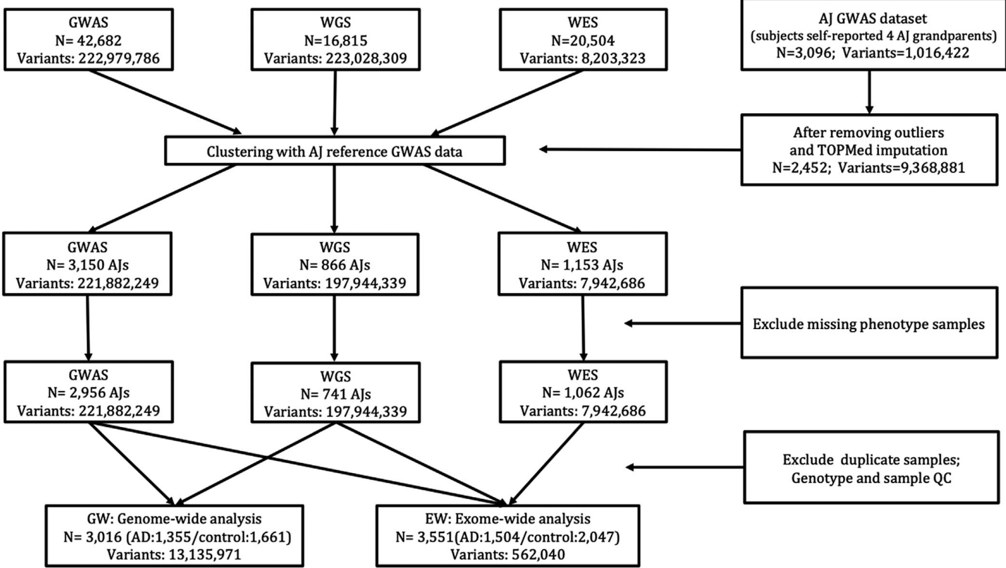
INTRODUCTION: Most Alzheimer's disease (AD) loci have been discovered in individuals with European ancestry (EA). METHODS: We applied principal component analysis using Gaussian mixture models and an Ashkenazi Jewish (AJ) reference genome‐wide association study (GWAS) data set to identify Ashkenazi Jews ascertained in GWAS (n = 42,682), whole genome sequencing (WGS, n = 16,815), and whole exome sequencing (WES, n = 20,504) data sets. The association of AD was tested genome wide (GW) in the GWAS and WGS data sets and exome wide (EW) in all three data sets (EW). Gene‐based analyses were performed using aggregated rare variants. RESULTS: In addition to apolipoprotein E (APOE), GW analyses (1355 cases and 1661 controls) revealed associations with TREM2 R47H (p = 9.66 × 10⁻⁹), rs541586606 near RAB3B (p = 5.01 × 10⁻⁸), and rs760573036 between SPOCK3 and ANXA10 (p = 6.32 × 10⁻⁸). In EW analyses (1504 cases and 2047 controls), study‐wide significant association was observed with rs1003710 near SMAP2 (p = 1.91 × 10⁻⁷). A significant gene‐based association was identified with GIPR (p = 7.34 × 10⁻⁷). DISCUSSION: Our results highlight the efficacy of founder populations for AD genetic studies.
Overview
CoChat Summary
TL;DR
In Ashkenazi Jewish participants identified from larger AD cohorts, genome-wide and exome-wide scans confirmed APOE and TREM2 R47H and found associations with novel loci including RAB3B, SMAP2, ZNF890P, and GIPR. The authors argue founder populations can boost detection of AD risk variants that are rare or less frequent in genetically heterogeneous European-ancestry samples.
Key findings
GW analysis (1,355 cases/1,661 controls) confirmed APOE (rs429358, p = 3.95 × 10⁻⁵⁴) and TREM2 R47H (rs75932628, p = 9.66 × 10⁻⁹), with a borderline GWS association near RAB3B (rs541586606, p = 5.01 × 10⁻⁸) and a suggestive association between SPOCK3/ANXA10 (rs760573036, p = 6.32 × 10⁻⁸). EW analysis (1,504 cases/2,047 controls) confirmed APOE (p = 4.52 × 10⁻⁵²) and TREM2 R47H (p = 2.64 × 10⁻¹⁰), with study-wide significant SMAP2 rs1003710 (p = 1.91 × 10⁻⁷) and nearly study-wide ZNF890P rs200698976 (p = 3.49 × 10⁻⁷). Gene-based rare-variant tests found a GWS association with GIPR (p = 7.34 × 10⁻⁷) and a nearly EW-significant association with MAT2B (p = 7.26 × 10⁻⁶). TREM2 R47H had a stronger effect in the AJ sample (OR = 3.16, 95% CI 2.14–4.70) than in a large EA GWAS (OR = 2.39, 95% CI 2.09–2.73), with MAF in AJ controls about five times higher; differential brain expression was significant for 10/19 top loci, including higher NCOA1, TREM2, SLC43A3, and PIEZO2 and lower SMAP2, RAB3B, BZW2, CALCB, CNTN5, and PPM1H.
Methods
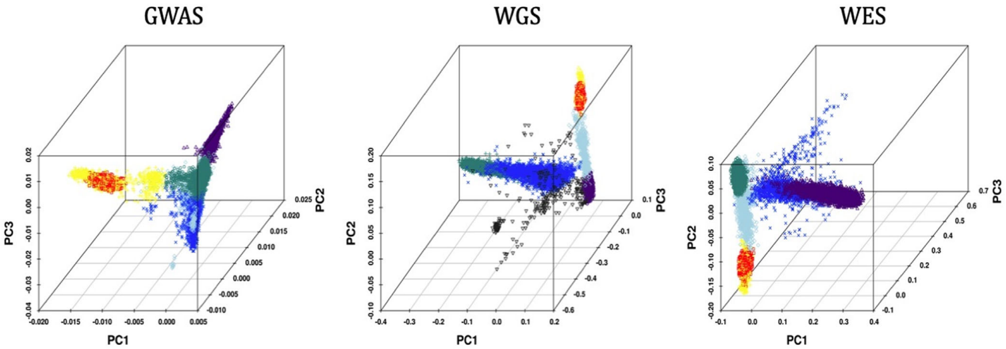
Ashkenazi Jews were identified by principal component analysis with Gaussian mixture models against an AJ reference GWAS (3,096 selected; 2,452 after exclusions) in ADGC/GR@ACE GWAS (n = 42,682), ADSP WGS (n = 16,815), and WES (n = 20,504); ADMIXTURE was used to assess robustness. Association testing combined GWAS + WGS for genome-wide analyses and all three datasets for exome-wide analyses, using logistic regression with an additive model and covariates for sex, age, and first four PCs; thresholds were p = 5.0 × 10⁻⁸ for GW and p = 2.74 × 10⁻⁷ for EW, with gene-based rare-variant tests by SKAT-O in RVTESTS. Differential expression was evaluated in brain tissue from ROSMAP, Mayo Clinic Study of Aging, and FHS/BU ADRC, with results combined by METAL.
Limitations
Stated: the sample size is small compared with other AD GWAS in heterogeneous EA samples; stringent PC boundaries excluded some individuals with substantial AJ ancestry; per-cohort imputation may have poorly imputed infrequent variants, which were then excluded by QC; GW sample size was further reduced because part of the data came from WES; larger AJ samples are needed. Evident from the text: findings are from a founder population and may not generalize, and independent AJ replication is called for but not presented; case-control data were drawn from multiple cohorts with different ascertainment and genotyping.
Model-written summary. Check it against the paper before relying on it.
Integrity signals
Registry
Cites
Statistics
Figures


Verification
Claims the paper makes
0 Valid · 0 Not valid · 24 Not checked · 39 Own results and interpretations
A result the paper reports from its own data — it cites no other source for it, so there is none to check. The quote shows it is in the paper.
In the paper
“these included the same APOE and TREM2 variants (p = 4.52 × 10 -52 and p = 2.64 × 10 -10 , respectively)”
§ Novel loci for Alzheimer's disease identified by a genome-wide association study in Ashkenazi Jews > 3.2 Genetic Associations with previously known and novel AD loci
plainstates an association- Asserted: passes — The authors put it forward as true.
- Checkable: passes — It can be checked against evidence.
- Load-bearing: unclear — It is unclear whether the paper’s conclusions depend on it.
- Based: passes — The paper gives a reason why it holds.
A result the paper states — it cites no source for it, so there is none to check. The quote shows it is in the paper.
In the paper
“associations that were significant in the AJ sample had effect sizes larger than in the EA GWAS”
§ Novel loci for Alzheimer's disease identified by a genome-wide association study in Ashkenazi Jews > 3.2 Genetic Associations with previously known and novel AD loci
plainstates an association- Asserted: passes — The authors put it forward as true.
- Checkable: passes — It can be checked against evidence.
- Load-bearing: unclear — It is unclear whether the paper’s conclusions depend on it.
- Based: passes — The paper gives a reason why it holds.
A result the paper reports from its own data — it cites no other source for it, so there is none to check. The quote shows it is in the paper.
In the paper
“The differences were at least 9-fold for the variants at the RAB3B, HFM1, NCO1, TRAPPC8, and OR7C2 loci”
§ Novel loci for Alzheimer's disease identified by a genome-wide association study in Ashkenazi Jews > 3.2 Genetic Associations with previously known and novel AD loci
plainstates an association- Asserted: passes — The authors put it forward as true.
- Checkable: passes — It can be checked against evidence.
- Load-bearing: passes — The paper’s conclusions depend on it.
- Based: passes — The paper gives a reason why it holds.
A result the paper reports from its own data — it cites no other source for it, so there is none to check. The quote shows it is in the paper.
In the paper
“associations for 44 of the 57 loci (77.2%) with results in the AJ data set, including all nominally significant ones, had the same effect direc-tion and similar odds ratios”
§ Novel loci for Alzheimer's disease identified by a genome-wide association study in Ashkenazi Jews > 3.2 Genetic Associations with previously known and novel AD loci
plainstates an association- Asserted: passes — The authors put it forward as true.
- Checkable: passes — It can be checked against evidence.
- Load-bearing: passes — The paper’s conclusions depend on it.
- Based: passes — The paper gives a reason why it holds.
A result the paper reports from its own data — it cites no other source for it, so there is none to check. The quote shows it is in the paper.
In the paper
“rs760573036 between SPOCK3 and ANXA10 (p = 6.32 × 10 -8 )”
§ Novel loci for Alzheimer's disease identified by a genome-wide association study in Ashkenazi Jews > Abstract
plainstates an associationn = 1,355 ·- Asserted: passes — The authors put it forward as true.
- Checkable: passes — It can be checked against evidence.
- Load-bearing: passes — The paper’s conclusions depend on it.
- Based: passes — The paper gives a reason why it holds.
30 more claims
Create a free account to see all 63 claims and every source verdict.
- The quote only partly states this claim. 2
- It may state two separate claims as one. 18
- Probably not a substantial claim. 14
Self-check
Percentages, sums and reported differences re-computed from the paper’s own numbers.
Each contradiction between two passages listed here was confirmed by an independent check.
Rated minor: it would not touch a result — a value no result rests on, a p-value that stays on the same side of the significance level, or a conflict that is clerical, resolved elsewhere in the paper, or outside its own findings.
In the paper
“frontal cortex tissue from 208 participants (64 autopsy-confirmed AD cases and 129 controls)”
§ Novel loci for Alzheimer's disease identified by a genome-wide association study in Ashkenazi Jews > 2.5 Differential gene expression
Reported 208 · recomputed 193
Rated minor: it would not touch a result — a value no result rests on, a p-value that stays on the same side of the significance level, or a conflict that is clerical, resolved elsewhere in the paper, or outside its own findings.
In the paper
§ Novel loci for Alzheimer's disease identified by a genome-wide association study in Ashkenazi Jews > 3.2 Genetic Associations with previously known and novel AD loci
“the ε4 variant (rs49358, p = 3.95 × 10 -54 )”
§ Novel loci for Alzheimer's disease identified by a genome-wide association study in Ashkenazi Jews > 3.3 Differential gene expression at AD-associated loci
“APOE rs429358 19:44908684 exonic C T 0.30 0.12 0.16 3.07 3.95 x 10 -54”
Rated minor: it would not touch a result — a value no result rests on, a p-value that stays on the same side of the significance level, or a conflict that is clerical, resolved elsewhere in the paper, or outside its own findings.
In the paper
§ Novel loci for Alzheimer's disease identified by a genome-wide association study in Ashkenazi Jews > 3.2 Genetic Associations with previously known and novel AD loci
“associations for 44 of the 57 loci (77.2%) with results in the AJ data set, including all nominally significant ones, had the same effect direc-tion and similar odds ratios.”
§ Novel loci for Alzheimer's disease identified by a genome-wide association study in Ashkenazi Jews > 4.1 Novel AD loci identified in Ashkenazi Jews
“a similar pattern of association for SNPs at 82% (47/57) of the GWS loci identified by GWAS in a sample of ≈789,000 EAs.”
Citations
Cites
Scikit-learn: Machine Learning in Python
Pedregosa, F., Varoquaux, G., Gramfort, A., Michel, V., Thirion, B., Grisel, O., Blondel, M., Müller, A., Nothman, J., Louppe, G., et al. (2012) · arXiv · doi:10.48550/arxiv.1201.0490 · Cited by 71,016
PLINK: a tool set for whole-genome association and population-based linkage analyses.
Purcell, S., Neale, B., Todd-Brown, K., Thomas, L., Ferreira, M. A. R., Bender, D., Maller, J., Sklar, P., de Bakker, P. I. W., Daly, M. J., et al. (2007) · The American Journal of Human Genetics · doi:10.1086/519795 · Cited by 34,089
Principal components analysis corrects for stratification in genome-wide association studies
Price, A. L., Patterson, N. J., Plenge, R. M., Weinblatt, M. E., Shadick, N. A., & Reich, D. (2006) · Nature Genetics · doi:10.1038/ng1847 · Cited by 10,248
Fast model-based estimation of ancestry in unrelated individuals
Alexander, D. H., Novembre, J., & Lange, K. (2009) · Genome Research · doi:10.1101/gr.094052.109 · Cited by 9,898
Scikit-learn: Machine Learning in Python
(2011) · Journal of Machine Learning Research · doi:10.5555/1953048.2078195 · Cited by 8,539
METAL: fast and efficient meta-analysis of genomewide association scans
Willer, C. J., Li, Y., & Abecasis, G. R. (2010) · Bioinformatics · doi:10.1093/bioinformatics/btq340 · Cited by 5,205
Meta-Analysis of 74,046 Individuals Identifies 11 New Susceptibility Loci for Alzheimer’s Disease
(EADI), E. A. D. I., Lambert, J.-C., (GERAD), G. A. E. R. I. A. D., Alzheimer's Disease Genetic Consortium (ADGC), (CHARGE), C. F. H. A. A. R. I. G. E., Ibrahim-Verbaas, C. A., Harold, D., Naj, A. C., Sims, R., Bellenguez, C., et al. (2013) · Nature Genetics · doi:10.1038/ng.2802 · Cited by 4,336 · cited 2×
“37 RAB3B encodes one of four closely related small GTP-binding proteins (Rab3A, Rab3B, Rab3C, and Rab3D) that are believed to be involved in presynaptic vesicle trafficking and priming steps for regulating synaptic transmission and plasticity, an idea supported by patch-clamp electrophysiology…”
BackgroundSelf-citationAlzheimer Disease Genetics Consortium (ADGC), Kunkle, B. W., The European Alzheimer’s Disease Initiative (EADI), Cohorts for Heart and Aging Research in Genomic Epidemiology Consortium (CHARGE), Genetic and Environmental Risk in AD/Defining Genetic, P. A. E. R. F. A. D. C. (., Grenier-Boley, B., Sims, R., Bis, J. C., Damotte, V., Naj, A. C., et al. (2019) · Nature Genetics · doi:10.1038/s41588-019-0358-2 · Cited by 2,946
Self-citationLocusZoom: regional visualization of genome-wide association scan results
Pruim, R. J., Welch, R. P., Sanna, S., Teslovich, T. M., Chines, P. S., Gliedt, T. P., Boehnke, M., Abecasis, G. R., & Willer, C. J. (2010) · Bioinformatics · doi:10.1093/bioinformatics/btq419 · Cited by 2,707 · cited 1×
“32 gene expression analysis are described elsewhere.”
New insights into the genetic etiology of Alzheimer’s disease and related dementias
Bellenguez, C., Küçükali, F., Jansen, I. E., Kleineidam, L., Moreno-Grau, S., Amin, N., Naj, A. C., Campos-Martin, R., Grenier-Boley, B., Andrade, V., et al. (2022) · Nature Genetics · doi:10.1038/s41588-022-01024-z · Cited by 2,498
Self-citation
Cited by
Ali, M., Timsina, J., Western, D., Liu, M., Beric, A., Budde, J., Do, A., Heo, G., Wang, L., Gentsch, J., et al. (2025) · Neuron · doi:10.1016/j.neuron.2025.02.014 · Cited by 61
Self-citationThe impact of rare genetic variants on Alzheimer disease
De Deyn, L., & Sleegers, K. (2025) · Nature Reviews Neurology · doi:10.1038/s41582-025-01062-1 · Cited by 47
“58) 36 .”
Alzheimer's Disease Sequencing Project release 4 whole genome sequencing dataset
Leung, Y. Y., Lee, W., Kuzma, A. B., Nicaretta, H. I., Valladares, O., Gangadharan, P., Qu, L., Zhao, Y., Ren, Y., Cheng, P., et al. (2025) · Alzheimer s & Dementia · doi:10.1002/alz.70237 · Cited by 46
Self-citationGenetics of Alzheimer’s Disease in the African American Population
Logue, M. W., Dasgupta, S., & Farrer, L. A. (2023) · Journal of Clinical Medicine · doi:10.3390/jcm12165189 · Cited by 32
Self-citationSPOCK: Master regulator of malignant tumors (Review)
Xiao, M., Xue, J., & Jin, E. (2024) · Molecular Medicine Reports · doi:10.3892/mmr.2024.13355 · Cited by 20
“…at the SPOCK3 promoter region closely associates with heightened expression levels observed across various carcinomas. epigenetic control mechanisms involving histone acetylation alongside long non‑coding rnas demonstrate pivotal roles during developmental stages within cerebral tissue (26).”
Background
Metadata
- Authors
- Li, D., Farrell, J. J., Mez, J., Martin, E. R., Bush, W. S., Ruiz, A., Boada, M., de Rojas, I., Mayeux, R., Haines, J. L., Vance, M. A. P., Wang, L., Schellenberg, G. D., Lunetta, K. L., & Farrer, L. A.
- Affiliations
- Boston University (US)
- University of Miami (US)
- Case Western Reserve University (US)
- Research Center and Memory Clinic ACE Alzheimer Center Barcelona Universitat Internacional de Catalunya Barcelona Spain
- Instituto de Salud Carlos III (ES)
- Columbia University Irving Medical Center (US)
- Dr. John T. Macdonald Foundation University of Miami Miami Florida USA
- Penn Neurodegeneration Genomics Center, Department of Pathology and Laboratory Medicine University of Pennsylvania Philadelphia Pennsylvania USA
- University of Pennsylvania (US)
- Corresponding author
- Farrer, Lindsay A.
- ORCID
- Venue
- Alzheimer's & Dementia
- Publisher
- Wiley
- Published
- 2023-06
- Volume
- 19
- Issue
- 12
- Pages
- 5550-5562
- ISSN
- 1552-5260 (ISSN-L)
- 1552-5279
- PMC
- PMC10689571
- OpenAlex
- W4378953218
- Semantic Scholar
- 7582c508d36f67f61a7a85f2c000ba7b7ade9df4
- Cited by
- 8
- References
- 62
- Citations by year
- 2026: 1 · 2025: 4 · 2024: 2 · 2023: 1
- FWCI
- 0.69
- Type
- journal article
- Language
- en
- Open access
- hybrid
- doi.org
- Licence
- Locations
- Alzheimer s & Dementia (publishedVersion, cc-by-nc-nd)
- PubMed (publishedVersion)
- PubMed Central (acceptedVersion)
- Funders
- National Institute on Aging (U01 AG032984, R01‐AG048927, U54‐AG052427, U01‐AG058654, U01‐AG032984, RF1‐AG057519, U01‐AG062602, U19‐AG068753, P30‐AG072878)
- Topics
- Life Sciences › Neuroscience › Cellular and Molecular Neuroscience › Alzheimer's disease research and treatments
- Life Sciences › Biochemistry, Genetics and Molecular Biology › Genetics › Genetic Associations and Epidemiology
- Health Sciences › Medicine › Psychiatry and Mental health › Dementia and Cognitive Impairment Research
- Keywords
- Alzheimer's disease, Ashkenazi Jews
- MeSH terms
- Alzheimer Disease, Ethnicity, Humans, Jews, Genetic Predisposition to Disease, Polymorphism, Single Nucleotide, Genome-Wide Association Study
About these checks
Registry, retraction, Cites and statistics results are computed, not judged, with one exception: a printed reference that no index lists is read once by a model before it counts as a citation error. Claims are extracted by a model and kept only when their quote appears verbatim in the text; each cited source is then checked, with a model’s help, for whether it says what the claim relies on. Those verdicts can be wrong — read the claim’s quote and the cited source before relying on one.
A language model drew the claims from the paper on 2026-11-28, under version 3 of the claim definition (model deepseek-v4.1-flash, prompt extract-v3).
A second model labelled each claim on 2026-11-28 (model jev-1.13-20260917, definition revision gold-guideline-v0.2).
Statistics and arithmetic are recomputed, not judged.
Confidence bands are shown only for fields calibrated on our annotated test set. None is calibrated yet, so no band is shown.
What counts as a claim ›How we measure confidence ›How we check this ›
Are you an author, or do you see a problem with this page? Request a review
How to cite
Cite CoChat for the checks on this page, and the paper for its own findings.
- This page
- CoChat. (2026). Citation check: Novel loci for Alzheimer's disease identified by a genome‐wide association study in Ashkenazi Jews. https://app.cochat.ai/papers/10.1002/alz.13117
- The paper
- Li, D., Farrell, J. J., Mez, J., Martin, E. R., Bush, W. S., Ruiz, A., Boada, M., de Rojas, I., Mayeux, R., Haines, J. L., Vance, M. A. P., Wang, L., Schellenberg, G. D., Lunetta, K. L., & Farrer, L. A. (2023). Novel loci for Alzheimer's disease identified by a genome‐wide association study in Ashkenazi Jews. Alzheimer's & Dementia. https://doi.org/10.1002/alz.13117
Data sources
Bibliographic data: Semantic Scholar, OpenAlex, Crossref.
Contains information from the Semantic Scholar Academic Graph Datasets, made available under the ODC Attribution License (ODC-BY 1.0).
Semantic Scholar’s data is described in: Kinney, R., et al. (2023). The Semantic Scholar Open Data Platform. arXiv:2301.10140.
