

Alzheimer's disease genetic pathways impact cerebrospinal fluid biomarkers and imaging endophenotypes in non‐demented individuals
Open accessThe DOI matches its Crossref record; 70 of the 70 references it cites were found in a registry or an index; none of the 60 sources its claims cite is checked for support yet.
Abstract
INTRODUCTION: Unraveling how Alzheimer's disease (AD) genetic risk is related to neuropathological heterogeneity, and whether this occurs through specific biological pathways, is a key step toward precision medicine. METHODS: We computed pathway‐specific genetic risk scores (GRSs) in non‐demented individuals and investigated how AD risk variants predict cerebrospinal fluid (CSF) and imaging biomarkers reflecting AD pathology, cardiovascular, white matter integrity, and brain connectivity. RESULTS: CSF amyloidbeta and phosphorylated tau were related to most GRSs. Inflammatory pathways were associated with cerebrovascular disease, whereas quantitative measures of white matter lesion and microstructure integrity were predicted by clearance and migration pathways. Functional connectivity alterations were related to genetic variants involved in signal transduction and synaptic communication. DISCUSSION: This study reveals distinct genetic risk profiles in association with specific pathophysiological aspects in predementia stages of AD, unraveling the biological substrates of the heterogeneity of AD‐associated endophenotypes and promoting a step forward in disease understanding and development of personalized therapies. Highlights: Polygenic risk for Alzheimer's disease encompasses six biological pathways that can be quantified with pathway‐specific genetic risk scores, and differentially relate to cerebrospinal fluid and imaging biomarkers. Inflammatory pathways are mostly related to cerebrovascular burden. White matter health is associated with pathways of clearance and membrane integrity, whereas functional connectivity measures are related to signal transduction and synaptic communication pathways.
Overview
CoChat Summary
TL;DR
In non-demented EPAD participants, global and pathway-specific Alzheimer’s disease genetic risk scores were associated with CSF Aβ1-42 and p-tau181, and distinct pathways related to cerebrovascular, white matter, and functional connectivity imaging phenotypes. The findings suggest APOE-dependent risk mainly tracks core AD CSF biomarkers, while non-APOE inflammatory, clearance, migration, and signal transduction pathways map onto specific predementia endophenotypes.
Key findings
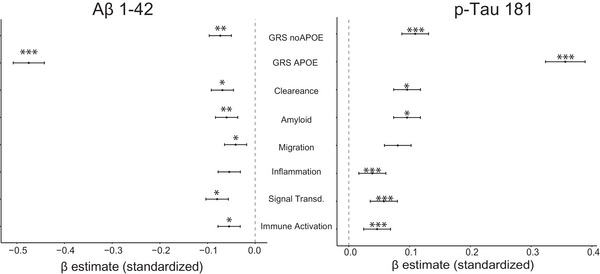
- In 1738 non-demented participants (58.5% A−T−, 25.1% A+T−, 9.2% A+T+, 7.2% A−T+), GRSAPOE was associated with lower CSF Aβ1-42 (β = −0.48, FDR p < 0.001) and higher p-tau181 (β = 0.36, FDR p < 0.001); GRSnoAPOE showed smaller associations (Aβ1-42 β = −0.07; p-tau181 β = 0.11; both FDR p < 0.001).
- All six pathway-GRSs were associated with CSF Aβ1-42 (all FDR p < 0.05) except migration (trend, p = 0.08), and all were associated with p-tau181 (all FDR p < 0.05) except inflammation (trend, p = 0.08).
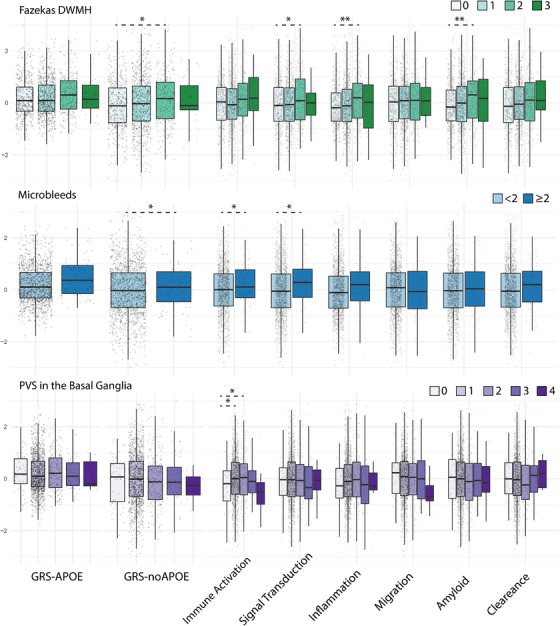
- Inflammatory/immune pathways related to cSVD: for example, DWMH Fazekas 2 vs 0 was associated with inflammation (OR = 1.29, p < 0.01), and CMBs >2 with immune activation (OR = 1.32, p = 0.02) and signal transduction (OR = 1.31, p = 0.04).
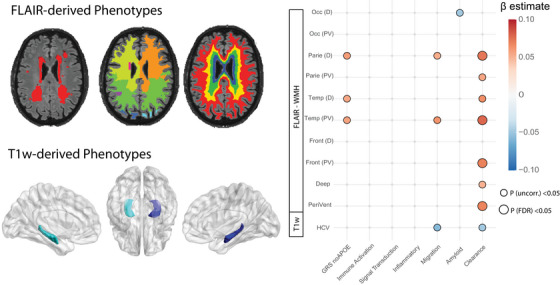
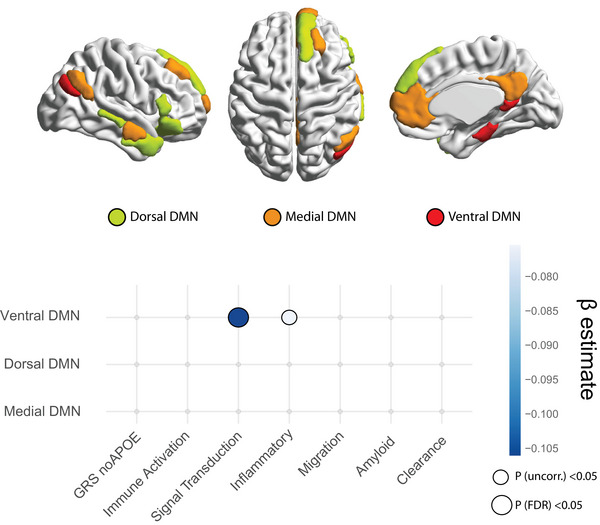
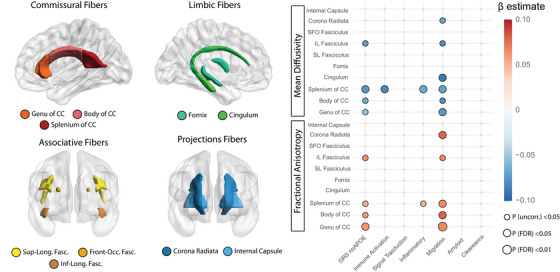
- Quantitative imaging: higher clearance pathway-GRS was associated with higher WMH volumes in most regions; lower ventral DMN functional connectivity was associated with higher signal transduction pathway-GRS; migration pathway-GRS was associated with higher FA in commissural ROIs/corona radiata and lower MD in cingulum/genu/splenium.
Methods
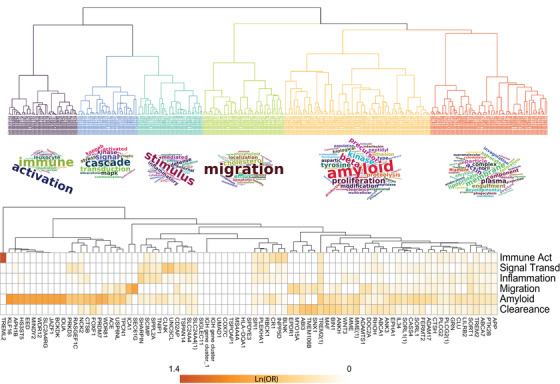
- EPAD multicenter study; 1835 participants, final n = 1738 after genetic QC; 126 A−T+ (SNAP) participants were used only for AT-group comparison and excluded from subsequent analyses, leaving 1612. GRSs were built from 85 AD/related-dementia variants, with and without APOE (rs7412, rs429358); pathway-GRSs were derived via variant-gene and gene-pathway mapping (snpXplorer/gprofiler2/GO), yielding six clusters: immune activation (27 SNPs), signal transduction (48), inflammation (52), migration (47), amyloid (50), and clearance (70).
- CSF Aβ1-42 and p-tau181 were measured on Roche cobas Elecsys; AT cutoffs were Aβ1-42 <1000 pg/mL and p-tau >27 pg/mL. Imaging included T1w/FLAIR/T2w/T2* and subsets with rs-fMRI and DWI; outcomes included hippocampal volume, WMH volumes, cSVD radiological scores, WM FA/MD in 10 tracts, and DMN functional connectivity.
- Linear, multinomial, and logistic models were corrected for age, sex, and five principal components; GRSnoAPOE/pathway models were also corrected for APOE ε4; p-tau models were also corrected for Aβ1-42; imaging models were adjusted for AT status and scanner type; Benjamini–Hochberg FDR correction was applied.
Limitations
- Stated: GRSs were based on a reference GWAS using an “Alzheimer’s disease and related dementias” phenotype; the pathway method did not constrain genes to one cluster, so some pathway-GRSs were correlated; only one gene per SNP was considered, as reported in the original GWAS; future work should assess independent pathway contributions and cell-type expression.
- Stated/evident: analyses used baseline data in non-demented EPAD participants, so temporal or causal direction is not established; imaging sample sizes were smaller than the genetic sample (e.g., n = 1334 WMH, n = 790 DWI, n = 776 rs-fMRI), and non-European ancestry individuals were excluded, limiting generalizability.
- Evident: some reported associations were trend-level (e.g., migration with Aβ1-42, inflammation with p-tau181, GRSAPOE/inflammation with CMBs), and hippocampal volume associations did not survive FDR correction.
Model-written summary. Check it against the paper before relying on it.
Integrity signals
Registry
Cites
Statistics
Figures
Verification
Claims the paper makes
0 Valid · 0 Not valid · 47 Not checked · 104 Own results and interpretations
A result the paper reports from its own data — it cites no other source for it, so there is none to check. The quote shows it is in the paper.
In the paper
“Inflammatory pathways were associated with cerebrovascular disease, whereas quantitative measures of white matter lesion and microstructure integrity were predicted by clearance and migration pathways.”
§ Alzheimer's disease genetic pathways impact cerebrospinal fluid biomarkers and imaging endophenotypes in non‐demented individuals > Abstract > RESULTS
plainstates an association- Asserted: passes — The authors put it forward as true.
- Checkable: passes — It can be checked against evidence.
- Load-bearing: passes — The paper’s conclusions depend on it.
- Based: passes — The paper gives a reason why it holds.
A result the paper reports from its own data — it cites no other source for it, so there is none to check. The quote shows it is in the paper.
In the paper
“Regarding the pathway‐GRSs, the A−T+ group had significantly higher scores in the immune activation (OR = 1.29; CI = 1.05–1.58; p = 0.015), signal transduction (OR = 1.42; CI = 1.17–1.74; p = 0.001), and inflammatory (OR = 1.32; CI = 1.09–1.61; p = 0.014) pathway‐GRSs compared to A−T−.”
§ Alzheimer's disease genetic pathways impact cerebrospinal fluid biomarkers and imaging endophenotypes in non‐demented individuals > RESULTS > Genetic risk and pathways determine AD CSF biomarkers
plainstates an association- Asserted: passes — The authors put it forward as true.
- Checkable: passes — It can be checked against evidence.
- Load-bearing: passes — The paper’s conclusions depend on it.
- Based: passes — The paper gives a reason why it holds.
A result the paper reports from its own data — it cites no other source for it, so there is none to check. The quote shows it is in the paper.
In the paper
“Briefly, participants with a Fazekas DWMH score of 2 had higher scores in GRSnoAPOE (OR = 1.24; CI = 1.03–1.47; p = 0.02) and in pathway‐GRSs of signal transduction (OR = 1.26; CI = 1.05–1.50; p = 0.01), inflammation (OR = 1.29; CI = 1.08–1.53; p < 0.01), and amyloid (OR = 1.24; CI = 1.04–1.49; p < 0.01), compared to Fazekas DWMH = 0.”
§ Alzheimer's disease genetic pathways impact cerebrospinal fluid biomarkers and imaging endophenotypes in non‐demented individuals > RESULTS > Pathways of inflammation determine cSVD radiological indices
plainstates an association- Asserted: passes — The authors put it forward as true.
- Checkable: passes — It can be checked against evidence.
- Load-bearing: passes — The paper’s conclusions depend on it.
- Based: passes — The paper gives a reason why it holds.
A result the paper reports from its own data — it cites no other source for it, so there is none to check. The quote shows it is in the paper.
In the paper
“Finally, CMBs (>2) were significantly higher in GRSnoAPOE (OR = 1.54; CI = 1.02–2.32; p = 0.04) and in pathway‐GRSs of immune activation (OR = 1.32; CI = 1.03–1.70; p = 0.02) and signal transduction (OR = 1.31; CI = 1.02–1.68; p = 0.04).”
§ Alzheimer's disease genetic pathways impact cerebrospinal fluid biomarkers and imaging endophenotypes in non‐demented individuals > RESULTS > Pathways of inflammation determine cSVD radiological indices
plainstates an association- Asserted: passes — The authors put it forward as true.
- Checkable: passes — It can be checked against evidence.
- Load-bearing: passes — The paper’s conclusions depend on it.
- Based: passes — The paper gives a reason why it holds.
84 more claims
Create a free account to see all 151 claims and to verify the 60 references still open.
- It may state two separate claims as one. 20
- Probably not a substantial claim. 48
Self-check
Percentages, sums and reported differences re-computed from the paper’s own numbers.
Each contradiction between two passages listed here was confirmed by an independent check.
Rated major: it would touch a result — a value a result rests on, reported and recomputed p-values on opposite sides of the significance level, two passages that conflict with no sign which is right, or a cited work retracted before this paper was published.
In the paper
§ Alzheimer's disease genetic pathways impact cerebrospinal fluid biomarkers and imaging endophenotypes in non‐demented individuals > RESULTS > Distinct genetic pathways regulate quantitative imaging biomarkers
“Lower FC within the ventral DMN was associated with higher scores in the pathway‐GRSs of signal transduction.”
§ Alzheimer's disease genetic pathways impact cerebrospinal fluid biomarkers and imaging endophenotypes in non‐demented individuals > DISCUSSION
“The signal transduction pathway‐GRS, involving synaptic function and intracellular communication, was related to rs‐fMRI as reduced FC in the dorsal portion of the DMN.”
Rated minor: it would not touch a result — a value no result rests on, a p-value that stays on the same side of the significance level, or a conflict that is clerical, resolved elsewhere in the paper, or outside its own findings.
In the paper
§ Alzheimer's disease genetic pathways impact cerebrospinal fluid biomarkers and imaging endophenotypes in non‐demented individuals > DISCUSSION
“We showed that all GRSs and pathway‐GRSs were significantly associated with CSF p‐tau181 levels, independently of CSF Aβ1‐42.”
§ Alzheimer's disease genetic pathways impact cerebrospinal fluid biomarkers and imaging endophenotypes in non‐demented individuals > RESULTS > Genetic risk and pathways determine AD CSF biomarkers
“All pathway‐GRSs were also significantly associated with CSF p‐tau181, even when correcting for CSF Aβ1‐42 (all FDR adjusted p < 0.05), except for the inflammation pathway that showed a trend‐level association (FDR adjusted p = 0.08).”
Rated minor: it would not touch a result — a value no result rests on, a p-value that stays on the same side of the significance level, or a conflict that is clerical, resolved elsewhere in the paper, or outside its own findings.
In the paper
§ Alzheimer's disease genetic pathways impact cerebrospinal fluid biomarkers and imaging endophenotypes in non‐demented individuals > METHODS > Radiological assessment
“Cortical microbleeds (CMBs) were classified as ≥2 or <2.”
§ Alzheimer's disease genetic pathways impact cerebrospinal fluid biomarkers and imaging endophenotypes in non‐demented individuals > RESULTS > Pathways of inflammation determine cSVD radiological indices
“Finally, CMBs (>2) were significantly higher in GRSnoAPOE (OR = 1.54; CI = 1.02–2.32; p = 0.04)”
Citations
Cites
Gene Ontology: tool for the unification of biology
Ashburner, M., Ball, C. A., Blake, J. A., Botstein, D., Butler, H., Cherry, J. M., Davis, A. P., Dolinski, K., Dwight, S. S., Eppig, J. T., et al. (2000) · Nature Genetics · doi:10.1038/75556 · Cited by 43,206
The organization of the human cerebral cortex estimated by intrinsic functional connectivity
Thomas Yeo, B. T., Krienen, F. M., Sepulcre, J., Sabuncu, M. R., Lashkari, D., Hollinshead, M., Roffman, J. L., Smoller, J. W., Zöllei, L., Polimeni, J. R., et al. (2011) · Journal of Neurophysiology · doi:10.1152/jn.00338.2011 · Cited by 9,182
Wardlaw, J. M., Smith, E. E., Biessels, G. J., Cordonnier, C., Fazekas, F., Frayne, R., Lindley, R. I., O'Brien, J. T., Barkhof, F., Benavente, O. R., et al. (2013) · The Lancet Neurology · doi:10.1016/s1474-4422(13)70124-8 · Cited by 5,544
Self-citationMR signal abnormalities at 1.5 T in Alzheimer's dementia and normal aging
Fazekas, F., Chawluk, J., Alavi, A., Hurtig, H., & Zimmerman, R. (1987) · American Journal of Roentgenology · doi:10.2214/ajr.149.2.351 · Cited by 5,334
Raudvere, U., Kolberg, L., Kuzmin, I., Arak, T., Adler, P., Peterson, H., & Vilo, J. (2019) · Nucleic Acids Research · doi:10.1093/nar/gkz369 · Cited by 5,045
An Information-Theoretic Definition of Similarity
Lin, D. (1998) · International Conference on Machine Learning · Cited by 4,541
Next-generation genotype imputation service and methods
Das, S., Forer, L., Schönherr, S., Sidore, C., Locke, A. E., Kwong, A., Vrieze, S. I., Chew, E. Y., Levy, S., McGue, M., et al. (2016) · Nature Genetics · doi:10.1038/ng.3656 · Cited by 3,808
Scheltens, P., Blennow, K., Breteler, M. M. B., de Strooper, B., Frisoni, G. B., Salloway, S., & Van der Flier, W. M. (2016) · The Lancet · doi:10.1016/s0140-6736(15)01124-1 · Cited by 3,125
Self-citationNew insights into the genetic etiology of Alzheimer’s disease and related dementias
Bellenguez, C., Küçükali, F., Jansen, I. E., Kleineidam, L., Moreno-Grau, S., Amin, N., Naj, A. C., Campos-Martin, R., Grenier-Boley, B., Andrade, V., et al. (2022) · Nature Genetics · doi:10.1038/s41588-022-01024-z · Cited by 2,498
Self-citationTutorial: a guide to performing polygenic risk score analyses
Choi, S. W., Mak, T. S.-H., & O’Reilly, P. F. (2020) · Nature Protocols · doi:10.1038/s41596-020-0353-1 · Cited by 1,946
Cited by
Towards cascading genetic risk in Alzheimer’s disease
Altmann, A., Aksman, L. M., Oxtoby, N. P., Young, A. L., ADNI, Weiner, M., Aisen, P., Petersen, R., Weiner, M., Aisen, P., et al. (2024) · Brain · doi:10.1093/brain/awae176 · Cited by 18
Self-citationPathway‐based polygenic risk of Alzheimer's disease highlights immune genes in cognitive decline
Romic, E., Karlsson, I., Karalija, N., Adolfsson, A. N., Adolfsson, R., & Kauppi, K. (2026) · Alzheimer s & Dementia Translational Research & Clinical Interventions · doi:10.1002/trc2.70209 · Cited by 6
Massa, F., Orso, B., Cesari, F. D., Pelagotti, V., Garbarino, S., Raffa, S., Mattioli, P., Argenti, L., Lombardo, L., Losa, M., et al. (2025) · Alzheimer s Research & Therapy · doi:10.1186/s13195-025-01893-6 · Cited by 5
Self-citationEarly detection of Alzheimer’s disease using small RNAs. Results from the EPAD cohort
Sikosek, T., Heuvelman, M., Mika, J., Kahraman, M., Jehn, J., Frank, M., Daniel-Moreno, A., Ceiler, J., Skottke, J., Sánchez-Delgado, M., et al. (2025) · The Journal of Prevention of Alzheimer s Disease · doi:10.1016/j.tjpad.2025.100257 · Cited by 5
Self-citationChandler, H. L., Wheeler, J., Escott‐Price, V., Murphy, K., & Lancaster, T. M. (2024) · Alzheimer s & Dementia · doi:10.1002/alz.14455 · Cited by 5
Genius, P., Calle, M. L., Rodríguez‐Fernández, B., Minguillón, C., Cacciaglia, R., Garrido-Martín, D., Esteller, M., Navarro, A., Gispert, J. D., Vilor‐Tejedor, N., et al. (2025) · Alzheimer s & Dementia · doi:10.1002/alz.14490 · Cited by 5
Self-citationAdvancing global dementia research through equity and inclusion
Vilor‐Tejedor, N., Danso, S., Albanus, R. D., Billingsley, K. J., Evans, T. E., Lee, L. Y., Wang, S., Jiang, J., Liu, H., Ross, J., et al. (2026) · Alzheimer s & Dementia · doi:10.1002/alz.71069 · Cited by 3
Self-citationWhite‐Matter Structural Connectivity and Alzheimer's Disease: A Mendelian Randomization Study
Liu, S., & Geng, D. (2025) · Brain and Behavior · doi:10.1002/brb3.70286 · Cited by 2
Lorenzini, L., Tranfa, M., ten Kate, M., den Braber, A., Vermunt, L., Duits, F. H., Lageman, S. B., de Leeuw, D. M., Teunissen, C. E., Garbarino, S., et al. (2026) · Neurology · doi:10.1212/wnl.0000000000214675 · Cited by 1
Self-citationMorbelli, S. D., Brendel, M., Tolboom, N., Drzezga, A. E., Janelidze, S., Joie, R. L., Roccatagliata, L., Agosta, F., Arbizu, J., Boccalini, C., et al. (2026) · The EANM Journal · doi:10.1016/j.eanmj.2026.100250
Self-citationBengs, B. D., Swerdlow, R. H., Burns, J., Slawson, C. M., McCoy, M., & Sardiu, M. E. (2026) · Journal of the Neurological Sciences · doi:10.1016/j.jns.2026.125812
Unschuld, P. G. (2026) · Advances in magnetic resonance technology and applications · doi:10.1016/b978-0-443-21425-7.00014-2
Bazemore, K., Iqbal, T., Kuzma, A. B., Grant, S. F. A., Schellenberg, G. D., Wang, L., Chesi, A., Jin, J., & Naj, A. C. (2026) · medRxiv · doi:10.64898/2026.05.25.26353905
Valentim, C., Denecke, J., Frerich, S., Betthauser, T. J., Li, Y., Ahmadi, R., Franzmeier, N., (ADNI), A. D. N. I., Malik, R., & Ewers, M. (2026) · Alzheimer s & Dementia · doi:10.1002/alz.71939
Self-citationQiao, M., Bhattarai, P., Yılmaz, E., Rookyard, A. W., Das, L. N., Jain, A., Reyes‐Dumeyer, D., Lee, A., Lantigua, R., Medrano, M. Z., et al. (2026) · medRxiv · doi:10.64898/2026.07.08.26357565
Kumar, A., Pichet Binette, A., Bali, D., Janelidze, S., Stomrud, E., Palmqvist, S., Vogel, J. W., Hansson, O., & Mattsson-Carlgren, N. (2025) · Brain Communications · doi:10.1093/braincomms/fcaf353 · Cited by 3
Tranfa, M., Pieperhoff, L., Pontillo, G., Luckett, E. S., Collij, L. E., Oliveira, T. G., Tesi, N., Vilor-Tejedor, N., Altmann, A., Roccatagliata, L., et al. (2025) · Alzheimer's Research & Therapy · doi:10.1186/s13195-025-01888-3 · Cited by 2
Self-citation
Metadata
- Authors
- Lorenzini, L., Collij, L. E., Tesi, N., Vilor‐Tejedor, N., Ingala, S., Blennow, K., Foley, C., Frisoni, G. B., Haller, S., Holstege, H., van der van der Lee, S., Martinez‐Lage, P., Marioni, R. E., McCartney, D. L., O’ Brien, J., Oliveira, T. G., Payoux, P., Reinders, M., Ritchie, C., Scheltens, P., Schwarz, A. J., Sudre, C. H., Waldman, A. D., Wolz, R., Chatelat, G., Ewers, M., Wink, A. M., Mutsaerts, H. J. M. M., Gispert, J. D., Visser, P. J., Tijms, B. M., Altmann, A., & Barkhof, F.
- Affiliations
- Amsterdam Neuroscience (NL)
- Lund University (SE)
- Universitat Pompeu Fabra (ES)
- Copenhagen University Hospital (DK)
- Sahlgrenska University Hospital (SE)
- Amersham Hospital (GB)
- University of Geneva (CH)
- Uppsala University (SE)
- Vrije Universiteit Amsterdam (NL)
- Genomics of Neurodegenerative Diseases and Aging, Human Genetics Vrije Universiteit Amsterdam Amsterdam The Netherlands
- Centro de Investigación y Terapias Avanzadas, Neurología, CITA‐Alzheimer Foundation San Sebastián Spain
- Institute of Genetics and Cancer (GB)
- Department of Psychiatry School of Clinical Medicine University of Cambridge Cambridge UK
- University of Minho (PT)
- Inserm (FR)
- Delft University of Technology (NL)
- Western General Hospital (GB)
- Takeda Pharmaceuticals Ltd. Cambridge Massachusetts USA
- King's College London (GB)
- Imperial College London (GB)
- Ixico (United Kingdom) (GB)
- German Center for Neurodegenerative Diseases (DE)
- Ghent University (BE)
- Karolinska Institutet (SE)
- Centre for Medical Image Computing Department of Medical Physics and Biomedical Engineering University College London London UK
- Amsterdam UMC (NL)
- Corresponding author
- Lorenzini, Luigi
- ORCID
- Lorenzini, Luigi
- Venue
- Alzheimer's & Dementia
- Publisher
- Wiley
- Published
- 2024-07-29
- Volume
- 20
- Issue
- 9
- Pages
- 6146-6160
- ISSN
- 1552-5260 (ISSN-L)
- 1552-5279
- PMC
- PMC11497686
- OpenAlex
- W4401091455
- Semantic Scholar
- 6dbd2e64f99db476004f872b0584a27a47e99311
- Cited by
- 17
- References
- 70
- Citations by year
- 2026: 9 · 2025: 6 · 2024: 2
- FWCI
- 2.03
- Type
- journal article
- Language
- en
- Update notices
- erratum (2024-12-30)
- Open access
- hybrid
- doi.org
- Licence
- Locations
- Alzheimer s & Dementia (publishedVersion, cc-by-nc-nd)
- PubMed Central (publishedVersion, cc-by-nc-nd)
- PubMed (publishedVersion)
- Research Publications (Maastricht University) (publishedVersion, cc-by-nc-nd)
- Amsterdam UMC (VU Amsterdam) - Institutional Repository (publishedVersion, other-oa)
- Edinburgh Research Explorer (University of Edinburgh) (publishedVersion, cc-by-nc-nd)
- EUR Research Repository (Erasmus University Rotterdam) (publishedVersion, cc-by-nc-nd)
- RECERCAT (Consorci de Serveis Universitaris de Catalunya) (publishedVersion, cc-by-nc-nd)
- Repositori digital de la UPF (Universitat Pompeu Fabra) (publishedVersion, cc-by-nc-nd)
- HAL (submittedVersion, cc-by-nc-nd)
- UCL Discovery (University College London) (submittedVersion, cc-by-nc-nd)
- DZNE Pub (submittedVersion, cc-by-nc-nd)
- Apollo (University of Cambridge) (submittedVersion, cc-by-nc-nd)
- Uppsala University Publications (Uppsala University) (submittedVersion, other-oa)
- Lund University Publications (Lund University) (submittedVersion)
- CINECA IRIS Institutial Research Information System (University of Genoa) (submittedVersion, other-oa)
- Funders
- European Federation of Pharmaceutical Industries and Associations (115736)
- Topics
- Life Sciences › Neuroscience › Cellular and Molecular Neuroscience › Alzheimer's disease research and treatments
- Health Sciences › Medicine › Psychiatry and Mental health › Dementia and Cognitive Impairment Research
- Life Sciences › Biochemistry, Genetics and Molecular Biology › Genetics › Genetic Associations and Epidemiology
- Keywords
- Alzheimer's disease, polygenic risk score
- MeSH terms
- Aged, Alzheimer Disease, Brain, Female, Humans, Magnetic Resonance Imaging, Male, Middle Aged, Biomarkers, Amyloid beta-Peptides, tau Proteins, Genetic Predisposition to Disease, Endophenotypes, White Matter
About these checks
Registry, retraction, Cites and statistics results are computed, not judged, with one exception: a printed reference that no index lists is read once by a model before it counts as a citation error. Claims are extracted by a model and kept only when their quote appears verbatim in the text; each cited source is then checked, with a model’s help, for whether it says what the claim relies on. Those verdicts can be wrong — read the claim’s quote and the cited source before relying on one.
A language model drew the claims from the paper on 2026-11-26, under version 3 of the claim definition (model deepseek-v4.1-flash, prompt extract-v3).
A second model labelled each claim on 2026-11-26 (model jev-1.13-20260917, definition revision gold-guideline-v0.2).
Statistics and arithmetic are recomputed, not judged.
Confidence bands are shown only for fields calibrated on our annotated test set. None is calibrated yet, so no band is shown.
What counts as a claim ›How we measure confidence ›How we check this ›
Are you an author, or do you see a problem with this page? Request a review
Data sources
Bibliographic data: Semantic Scholar, OpenAlex, Crossref.
Contains information from the Semantic Scholar Academic Graph Datasets, made available under the ODC Attribution License (ODC-BY 1.0).
Semantic Scholar’s data is described in: Kinney, R., et al. (2023). The Semantic Scholar Open Data Platform. arXiv:2301.10140.
