

Emergence of Function and Selection from Recursively Programmed Polymerisation Reactions in Mineral Environments
Open accessPublished version of a preprint
The DOI matches its Crossref record; 27 of the 27 references it cites were found in a registry or an index.
Abstract
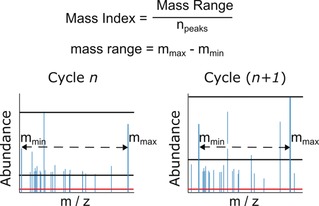
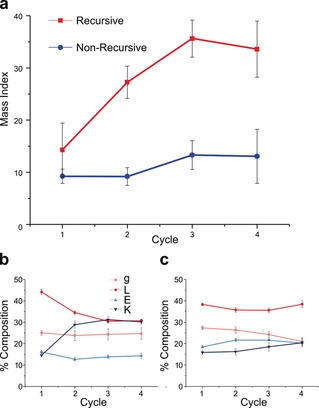
Living systems are characterised by an ability to sustain chemical reaction networks far‐from‐equilibrium. It is likely that life first arose through a process of continual disruption of equilibrium states in recursive reaction networks, driven by periodic environmental changes. Herein, we report the emergence of proto‐enzymatic function from recursive polymerisation reactions using amino acids and glycolic acid. Reactions were kept out of equilibrium by diluting products 9:1 in fresh starting solution at the end of each recursive cycle, and the development of complex high molecular weight species is explored using a new metric, the Mass Index, which allows the complexity of the system to be explored as a function of cycle. This process was carried out on a range of different mineral environments. We explored the hypothesis that disrupting equilibrium via recursive cycling imposes a selection pressure and subsequent boundary conditions on products. After just four reaction cycles, product mixtures from recursive reactions exhibit greater catalytic activity and truncation of product space towards higher‐molecular‐weight species compared to non‐recursive controls.
Overview
The claims and statistics of this paper haven’t been checked yet.
Free: it reads the open-access text and checks the first 5 claims that cite a source we can check. Create a free account to check every claim.
Integrity signals
Registry
Cites
Statistics
Figures


Verification
Claims the paper makes
The claims and statistics of this paper haven’t been checked yet.
Free: it reads the open-access text and checks the first 5 claims that cite a source we can check. Create a free account to check every claim.
Claims other papers make about this one
Each is checked against this paper’s own text: does it say what the citing paper says it does?
The source backs part of the claim, not all of it — or backs it for a different population, condition or comparison.
In the citing paper
“Indeed, equilibrium disruption by cyclic (recursive) processes is the most promising way to assemble chemical systems in the out-of-equilibrium dynamic state that characterizes biological phenomena.54,55”
From The protometabolic nature of prebiotic chemistry (2023) · cites this paper as [55]
Experimental — accuracy not yet measured
Self-check
Percentages, sums and reported differences re-computed from the paper’s own numbers.
The self-check needs the paper’s full text.
Citations
Cites
Using circular dichroism spectra to estimate protein secondary structure
Greenfield, N. J. (2006) · Nature Protocols · doi:10.1038/nprot.2006.202 · Cited by 4,014
Synthesis of activated pyrimidine ribonucleotides in prebiotically plausible conditions.
Powner, M. W., Gerland, B., & Sutherland, J. D. (2009) · Nature · doi:10.1038/nature08013 · Cited by 1,383
Prebiotic Systems Chemistry: New Perspectives for the Origins of Life
Ruiz-Mirazo, K., Briones, C., & de la Escosura, A. (2014) · Chemical Reviews · doi:10.1021/cr2004844 · Cited by 930
Hershko, A., Ciechanover, A., Heller, H., Haas, A. L., & Rose, I. A. (1980) · Proceedings of the National Academy of Sciences · doi:10.1073/pnas.77.4.1783 · Cited by 765
Sreerama, N., Venyaminov, S. Y. U., & Woody, R. W. (1999) · Protein Science · doi:10.1110/ps.8.2.370 · Cited by 708
Lahav, N., White, D., & Chang, S. (1978) · Science · doi:10.1126/science.663639 · Cited by 381
Forsythe, J. G., Yu, S., Mamajanov, I., Grover, M. A., Krishnamurthy, R., Fernández, F. M., & Hud, N. V. (2015) · Angewandte Chemie International Edition · doi:10.1002/anie.201503792 · Cited by 324
A High-Yielding, Strictly Regioselective Prebiotic Purine Nucleoside Formation Pathway
Becker, S., Thoma, I., Deutsch, A., Gehrke, T., Mayer, P., Zipse, H., & Carell, T. (2016) · Science · doi:10.1126/science.aad2808 · Cited by 238
Mamajanov, I., MacDonald, P. J., Ying, J., Duncanson, D. M., Dowdy, G. R., Walker, C. A., Engelhart, A. E., Fernández, F. M., Grover, M. A., Hud, N. V., et al. (2014) · Macromolecules · doi:10.1021/ma402256d · Cited by 115
Prebiotic network evolution: six key parameters
Nghe, P., Hordijk, W., Kauffman, S. A., Walker, S. I., Schmidt, F. J., Kemble, H., Yeates, J. A. M., & Lehman, N. (2015) · Molecular BioSystems · doi:10.1039/c5mb00593k · Cited by 113
Cited by
Prebiotic Peptides: Molecular Hubs in the Origin of Life
Frenkel-Pinter, M., Samanta, M., Ashkenasy, G., & Leman, L. J. (2020) · Chemical Reviews · doi:10.1021/acs.chemrev.9b00664 · Cited by 354
Root of the Tree: The Significance, Evolution, and Origins of the Ribosome
Bowman, J. C., Petrov, A. S., Frenkel-Pinter, M., Penev, P. I., & Williams, L. D. (2020) · Chemical Reviews · doi:10.1021/acs.chemrev.9b00742 · Cited by 197
Frenkel-Pinter, M., Haynes, J. W., C, M., Petrov, A. S., Burcar, B. T., Krishnamurthy, R., Hud, N. V., Leman, L. J., & Williams, L. D. (2019) · Proceedings of the National Academy of Sciences · doi:10.1073/pnas.1904849116 · Cited by 128
“Moreover, cationic depsipeptides could have exhibited ligand binding and/or catalytic activities such as aldol condensation, Michael addition, and ester aminolysis (8, 74 – 79).”
Symmetry breaking and chiral amplification in prebiotic ligation reactions
Deng, M., Yu, J., & Blackmond, D. G. (2024) · Nature · doi:10.1038/s41586-024-07059-y · Cited by 94
“Alternative approaches include wet–dry cycling 16 or mineral catalysis 17,18 .”
Water and Life: The Medium is the Message
Frenkel-Pinter, M., Rajaei, V., Glass, J. B., Hud, N. V., & Williams, L. D. (2021) · Journal of Molecular Evolution · doi:10.1007/s00239-020-09978-6 · Cited by 71
Metadata
- Authors
- Doran, D., Abul‐Haija, Y. M., & Cronin, L.
- Affiliations
- University of Glasgow (GB)
- Corresponding author
- Cronin, Leroy
- Venue
- Angewandte Chemie International Edition
- Publisher
- Wiley
- Published
- 2019-07-12
- Volume
- 58
- Issue
- 33
- Pages
- 11253-11256
- ISSN
- 1433-7851 (ISSN-L)
- 1521-3773
- PMC
- PMC6772075
- OpenAlex
- W2950437817
- Cited by
- 39
- References
- 27
- Citations by year
- 2026: 3 · 2025: 6 · 2024: 3 · 2023: 4 · 2022: 5 · 2021: 11 · 2020: 4 · 2019: 2
- FWCI
- 2.94
- Type
- journal article
- Language
- en
- Open access
- hybrid
- doi.org
- Licence
- Locations
- Angewandte Chemie International Edition (publishedVersion, cc-by)
- ChemRxiv (acceptedVersion, cc-by-nc-nd)
- PubMed Central (publishedVersion, cc-by)
- PubMed (publishedVersion)
- ENLIGHTEN (Jurnal Bimbingan dan Konseling Islam) (acceptedVersion, cc-by-sa)
- Figshare (submittedVersion, cc-by-nc-nd)
- Funders
- Engineering and Physical Sciences Research Council (EP/P00153X/1, EP/J015156/1, EP/K021966/1, EP/K038885/1, EP/L015668/1, EP/L023652/1)
- Biotechnology and Biological Sciences Research Council (BB/M011267/1)
- H2020 European Research Council (670467 SMART-POM)
- Horizon 2020 Framework Programme (MADONNA project 766975)
- Topics
- Physical Sciences › Physics and Astronomy › Astronomy and Astrophysics › Origins and Evolution of Life
- Life Sciences › Biochemistry, Genetics and Molecular Biology › Molecular Biology › RNA and protein synthesis mechanisms
- Life Sciences › Biochemistry, Genetics and Molecular Biology › Genetics › Evolution and Genetic Dynamics
- Keywords
- origin of life, amino acids, glycolic acid, mineral surfaces, selection pressure, mass index, high molecular weight polymers, catalytic activity
About these checks
Registry, retraction, Cites and statistics results are computed, not judged, with one exception: a printed reference that no index lists is read once by a model before it counts as a citation error. Claims are extracted by a model and kept only when their quote appears verbatim in the text; each cited source is then checked, with a model’s help, for whether it says what the claim relies on. Those verdicts can be wrong — read the claim’s quote and the cited source before relying on one.
Statistics and arithmetic are recomputed, not judged.
Confidence bands are shown only for fields calibrated on our annotated test set. None is calibrated yet, so no band is shown.
What counts as a claim ›How we measure confidence ›How we check this ›
Are you an author, or do you see a problem with this page? Request a review
How to cite
Cite CoChat for the checks on this page, and the paper for its own findings.
- This page
- CoChat. (2026). Citation check: Emergence of Function and Selection from Recursively Programmed Polymerisation Reactions in Mineral Environments. https://app.cochat.ai/papers/10.1002/anie.201902287
- The paper
- Doran, D., Abul‐Haija, Y. M., & Cronin, L. (2019). Emergence of Function and Selection from Recursively Programmed Polymerisation Reactions in Mineral Environments. Angewandte Chemie International Edition. https://doi.org/10.1002/anie.201902287
Data sources
Bibliographic data: Semantic Scholar, OpenAlex, Crossref.
Contains information from the Semantic Scholar Academic Graph Datasets, made available under the ODC Attribution License (ODC-BY 1.0).
Semantic Scholar’s data is described in: Kinney, R., et al. (2023). The Semantic Scholar Open Data Platform. arXiv:2301.10140.
