

Out‐of‐Equilibrium Self‐Replication Allows Selection for Dynamic Kinetic Stability in a System of Competing Replicators
Open accessThe DOI matches its Crossref record; the references it cites are not checked yet.
Abstract
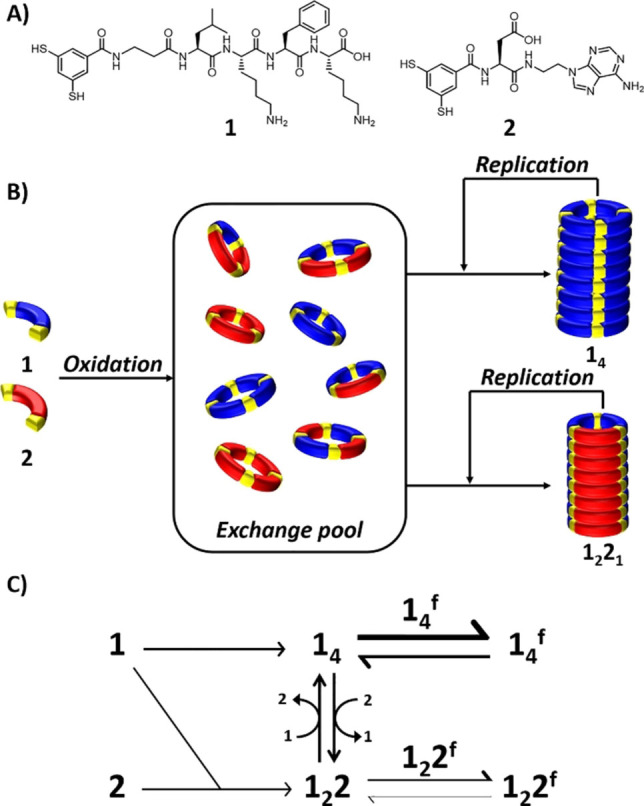
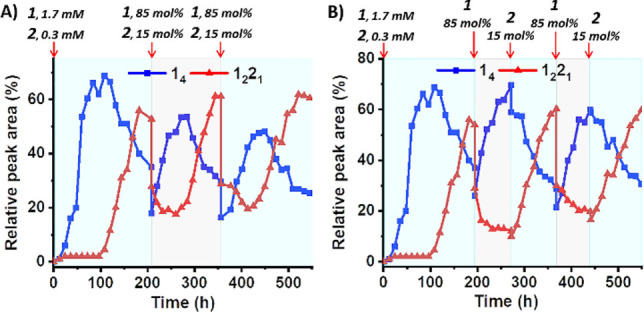
Among the key characteristics of living systems are their ability to self‐replicate and the fact that they exist in an open system away from equilibrium. Herein, we show how the outcome of the competition between two self‐replicators, differing in size and building block composition, is different depending on whether the experiments are conducted in a closed vial or in an open and out‐of‐equilibrium replication–destruction regime. In the closed system, the slower replicator eventually prevails over the faster competitor. In a replication‐destruction regime, implemented through a flow system, the outcome of the competition is reversed and the faster replicator dominates. The interpretation of the experimental observations is supported by a mass‐action‐kinetics model. These results represent one of the few experimental manifestations of selection among competing self‐replicators based on dynamic kinetic stability and pave the way towards Darwinian evolution of abiotic systems.
Overview
The claims and statistics of this paper haven’t been checked yet.
Free: it reads the open-access text and checks the first 5 claims that cite a source we can check. Create a free account to check every claim.
Integrity signals
Registry
Cites
Statistics
Figures



Verification
Claims the paper makes
The claims and statistics of this paper haven’t been checked yet.
Free: it reads the open-access text and checks the first 5 claims that cite a source we can check. Create a free account to check every claim.
Self-check
Percentages, sums and reported differences re-computed from the paper’s own numbers.
The self-check needs the paper’s full text.
Citations
The citation lists are queued
They are fetched later and appear here then.
References 63 · Cited by 60
Research works printed but not linked: 1
- Pascal R., 2017, Synlett, 28, 30
Metadata
- Authors
- Liu, B., Wu, J., Geerts, M., Markovitch, O., Pappas, C. G., Liu, K., & Otto, S.
- Affiliations
- University of Groningen (NL)
- Corresponding author
- Otto, Sijbren
- Venue
- Angewandte Chemie International Edition
- Publisher
- Wiley
- Published
- 2022-03-07
- Volume
- 61
- Issue
- 18
- Pages
- e202117605-e202117605
- ISSN
- 1433-7851 (ISSN-L)
- 1521-3773
- PMC
- PMC9314957
- OpenAlex
- W4213275557
- Semantic Scholar
- a0d2b7600fb598b9e51d9e24aac5bc1cd8450b5b
- Cited by
- 60
- References
- 63
- Citations by year
- 2026: 8 · 2025: 12 · 2024: 19 · 2023: 13 · 2022: 7
- FWCI
- 5.01
- Type
- journal article
- Language
- en
- Open access
- hybrid
- doi.org
- Licence
- Locations
- Angewandte Chemie International Edition (publishedVersion, cc-by-nc)
- PubMed Central (publishedVersion, cc-by-nc)
- PubMed (publishedVersion)
- University of Groningen research database (University of Groningen / Centre for Information Technology) (publishedVersion, cc-by-nc)
- University of Groningen research database (University of Groningen / Centre for Information Technology) (submittedVersion, cc-by-nc)
- Funders
- Horizon 2020 Framework Programme (AdG 741774, MCIF 745805-DSR, MCIF 786350-PSR)
- Ministerie van Onderwijs, Cultuur en Wetenschap (024.001.035)
- China Scholarship Council
- Topics
- Physical Sciences › Physics and Astronomy › Astronomy and Astrophysics › Origins and Evolution of Life
- Life Sciences › Biochemistry, Genetics and Molecular Biology › Genetics › Evolution and Genetic Dynamics
- Physical Sciences › Chemistry › Organic Chemistry › Supramolecular Chemistry and Complexes
- Keywords
- self-replication, nonequilibrium systems, selection, open systems, flow systems
- MeSH terms
- Kinetics
About these checks
Registry, retraction, Cites and statistics results are computed, not judged, with one exception: a printed reference that no index lists is read once by a model before it counts as a citation error. Claims are extracted by a model and kept only when their quote appears verbatim in the text; each cited source is then checked, with a model’s help, for whether it says what the claim relies on. Those verdicts can be wrong — read the claim’s quote and the cited source before relying on one.
Statistics and arithmetic are recomputed, not judged.
Confidence bands are shown only for fields calibrated on our annotated test set. None is calibrated yet, so no band is shown.
What counts as a claim ›How we measure confidence ›How we check this ›
Are you an author, or do you see a problem with this page? Request a review
How to cite
Cite CoChat for the checks on this page, and the paper for its own findings.
- This page
- CoChat. (2026). Citation check: Out‐of‐Equilibrium Self‐Replication Allows Selection for Dynamic Kinetic Stability in a System of Competing Replicators. https://app.cochat.ai/papers/10.1002/anie.202117605
- The paper
- Liu, B., Wu, J., Geerts, M., Markovitch, O., Pappas, C. G., Liu, K., & Otto, S. (2022). Out‐of‐Equilibrium Self‐Replication Allows Selection for Dynamic Kinetic Stability in a System of Competing Replicators. Angewandte Chemie International Edition. https://doi.org/10.1002/anie.202117605
Data sources
Bibliographic data: Semantic Scholar, OpenAlex, Crossref.
Contains information from the Semantic Scholar Academic Graph Datasets, made available under the ODC Attribution License (ODC-BY 1.0).
Semantic Scholar’s data is described in: Kinney, R., et al. (2023). The Semantic Scholar Open Data Platform. arXiv:2301.10140.
