

The DOI matches its Crossref record; 1 of the 1 references it cites were found in a registry or an index.
Identification of histological threshold concepts in health sciences curricula: Students' perception
Open accessAbstract
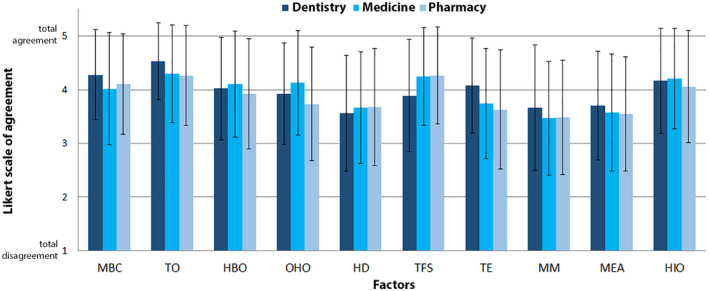
Students' metacognitive skills and perceptions are considered important variables for high‐quality learning. In this study, students' perceptions were used to identify histological threshold concepts (integrative, irreversible, transformative, and troublesome) in three health sciences curricula. A specific questionnaire was developed and validated to characterize students' perceptions of histological threshold concepts. A sample of 410 undergraduate students enrolled in the dentistry, medicine, and pharmacy degree programs participated in the study. Concepts assessed in the study were clustered to ten categories (factors) by exploratory and confirmatory factor analysis. Concepts linked to tissue organization and tissue functional states received the highest scores from students in all degree programs, suggesting that the process of learning histology requires the integration of both static concepts related to the constituent elements of tissues and dynamic concepts such as stem cells as a tissue renewal substrate, or the euplasic, proplasic and retroplasic states of tissues. The complexity of integrating static and dynamic concepts may pose a challenging barrier to the comprehension of histology. In addition, several differences were detected among the students in different degree programs. Dentistry students more often perceived morphostructural concepts as threshold concepts, whereas medical students highlighted concepts related to two‐dimensional microscopic identification. Lastly, pharmacy students identified concepts related to tissue general activity as critical for the comprehension and learning of histology. The identification of threshold concepts through students' perceptions is potentially useful to improve the teaching and learning process in health sciences curricula.
Overview
The claims and statistics of this paper haven’t been checked yet.
Run the check — free, no account needed. It reads the open-access text and checks the sources it cites.
Integrity signals
Registry
Cites
Statistics
Figures
Verification
Claims the paper makes
The claims and statistics of this paper haven’t been checked yet.
Run the check — free, no account needed. It reads the open-access text and checks the sources it cites.
Claims other papers make about this one
Each is checked against this paper’s own text: does it say what the citing paper says it does?
The source backs part of the claim, not all of it — or backs it for a different population, condition or comparison.
In the citing paper
“For example, undergraduate medical students with greater metacognitive awareness have been shown to be more adept at identifying threshold concepts that are key to understanding a topic (Martin- Piedra et al.,2022)”
From Promoting metacognition in an allied health anatomy course (2023) · cites this paper as Martin-Piedra et al., 2022
Experimental — accuracy not yet measured
Self-check
Percentages, sums and reported differences re-computed from the paper’s own numbers.
The self-check needs the paper’s full text.
Citations
Cites
Efklides, A. (2011) · Educational Psychologist · doi:10.1080/00461520.2011.538645 · Cited by 1,211
Research works printed but not linked: 93
- 10.1007/s12098-020-03327-7 · DOI
- 10.4103/japtr.JAPTR_336_18 · DOI
- 10.4067/S0717-95022020000100038 · DOI
- 10.4067/S0717-95022020000300634 · DOI
- 10.1080/02763877.2016.1121070 · DOI
- 10.1152/advan.00008.2012 · DOI
- 10.1016/j.joen.2020.09.012 · DOI
- 10.1007/s10734-012-9542-3 · DOI
- 10.1016/bs.pbr.2018.10.015 · DOI
- 10.3390/ma13071692 · DOI
- Bollen KA, 1989, Structural Equations with Latent Variables, 514, 10.1002/9781118619179 · DOI
- 10.1002/ase.53 · DOI
- 10.3138/jvme.0315-035R1 · DOI
- 10.1007/s11409-014-9120-4 · DOI · Paper page
- 10.1016/j.dental.2020.09.011 · DOI
- 10.1186/s12909-018-1227-x · DOI
- 10.1186/1472-6920-14-46 · DOI
- 10.1002/ase.1386 · DOI
- 10.1002/ase.1291 · DOI
- 10.1002/term.2039 · DOI
- Carstensen A, 2008, Threshold Concepts within the Disciplines, 143, 10.1163/9789460911477_012 · DOI
- 10.1042/CS20180155 · DOI
- 10.1007/978-3-030-47483-6_5 · DOI
- 10.1080/13562510500239141 · DOI
- Cohen J, 1988, Statistical Power Analysis for the Behavioral Sciences, 579
- Collett T, 2017, Using audio diaries to identify threshold concepts in ‘softer’ disciplines: A focus on medical education, Pract Evid Scholarship Teach Learn High Educ, 12, 99
- Cousin G, 2009, Researching Learning in Higher Education: An Introduction to Contemporary Methods and Approaches, 272, 10.4324/9780203884584 · DOI
- 10.1002/ca.23720 · DOI
- 10.1080/03075070701685148 · DOI
- 10.1016/j.transproceed.2019.08.014 · DOI
- 10.1163/9789460911477_003 · DOI
- 10.1007/BF03173165 · DOI
- Eurell JA, 1999, Clinical cases as a teaching tool in veterinary histology, J Vet Med Educ, 26, 1
- 10.1080/03098265.2012.654467 · DOI
- 10.1002/term.2397 · DOI
- 10.1136/bmjopen-2017-016487 · DOI
- 10.1007/s10439-005-9038-8 · DOI
- 10.1002/jdd.12490 · DOI
- Hair JF, 1995, Multivariate Data Analysis: With Readings, 745
- 10.1093/ajcp/aqaa162 · DOI
- 10.3390/cells9112497 · DOI
- Kerr JB, 2010, Functional Histology, 520
- 10.1080/07294360.2018.1450360 · DOI
- 10.1016/j.path.2018.02.009 · DOI
- Lang NP, 2015, Clinical Periodontology and Implant Dentistry, 1480
- 10.1187/cbe.14-04-0066 · DOI
- Lowe JS, 2019, Stevens & Lowe's Human Histology, 440
- 10.1016/j.nepr.2018.09.008 · DOI
- 10.3138/jvme.1114-107R · DOI
- 10.1089/ten.tea.2019.0247 · DOI
- Martin E, 1987, Student Learning: Research in education and Cognitive Psychology, 155
- Martindale L, 2015, Threshold concepts in research and evidence‐based practice: Investigating troublesome learning for undergraduate nursing students
- 10.1126/scitranslmed.aav7756 · DOI
- 10.1177/0897190013515709 · DOI
- McKillop A, 2014, The power of synergy: An academic/clinical partnership for transformational change, Adv Nurs, 2014, 605835
- Meyer J, 2003, Threshold Concepts and Troublesome Knowledge: Linkage to Ways of Thinking and Practising within the Disciplines. Occasional Report 4, 12
- 10.1007/s10734-004-6779-5 · DOI
- Mezirow J, 1990, Fostering Critical Reflection in Adulthood: A Guide to Transformative and Emancipatory Learning, 1
- 10.3138/jvme.34.2.177 · DOI
- 10.1002/ase.1353 · DOI
- 10.1002/ca.23002 · DOI
- Nanci A, 2018, Ten Cate's Oral Histology: Development, Structure, and Function, 352
- 10.1080/13562517.2016.1221810 · DOI
- 10.1080/0142159X.2019.1687868 · DOI
- 10.3390/pharmaceutics12040312 · DOI
- 10.1038/s41598-020-62580-0 · DOI
- 10.5012/jkcs.2014.58.1.126 · DOI
- Pawlina W, 2020, Histology: A Text and Atlas with Correlated Cell and Molecular Biology, 1045
- 10.1186/s12912-020-00434-w · DOI
- 10.15694/mep.2018.0000176.1 · DOI
- 10.1002/term.2951 · DOI
- 10.1007/s00428-020-02908-3 · DOI
- 10.15568/am.2017.800.or05 · DOI
- 10.1089/ten.tec.2018.0213 · DOI
- 10.1089/ten.tea.2018.0007 · DOI
- 10.1016/j.mehy.2020.110099 · DOI
- Serbanescu R, 2017, Identifying threshold concepts in physics: Too many to count!, Pract Evid Scholarship Teach Learn High Educ, 12, 378
- 10.1002/ase.1252 · DOI
- 10.1152/advan.00071.2014 · DOI
- Shulman LS, 2005, Pedagogies of uncertainty, Liberal Educ, 91, 18
- 10.1371/journal.pone.0214950 · DOI
- 10.1111/eje.12466 · DOI
- 10.4276/030802211X13153015305592 · DOI
- 10.1016/j.cptl.2018.03.018 · DOI
- 10.1016/j.tvjl.2015.04.033 · DOI
- 10.1007/s00404-016-4106-x · DOI
- 10.1071/HC15027 · DOI
- 10.3389/fpsyg.2018.01985 · DOI
- Walder A, 2014, The concept of pedagogical innovation in higher education, Educ J, 3, 195
- 10.1186/s12909-016-0560-1 · DOI
- 10.1038/s41536-019-0065-8 · DOI
- 10.1021/acsami.0c18070 · DOI
- 10.1080/0729436032000168487 · DOI
Cited by
Sorted by citations
Promoting metacognition in an allied health anatomy course
Cale, A. S., Hoffman, L. A., & McNulty, M. A. (2023) · Anatomical Sciences Education · doi:10.1002/ase.2218 · Cited by 35
Metadata
- Authors
- Martin‐Piedra, M. A., Saavedra‐Casado, S., Santisteban‐Espejo, A., Campos, F., Chato‐Astrain, J., Garcia‐Garcia, O. D., Sanchez‐Porras, D., Luna del Castillo, J. D. D., Rodriguez, I. A., & Campos, A.
- Affiliations
- Tissue Engineering Group Department of Histology Faculty of Medicine University of Granada Granada Spain
- Universidad de Granada (ES)
- Universidad de Cádiz (ES)
- Department of Biostatistics Faculty of Medicine University of Granada Granada Spain
- Department of Histology B Faculty of Dentistry National University of Cordoba Cordoba Argentina
- Venue
- Anatomical Sciences Education
- Publisher
- Wiley
- Published
- 2022-02-08
- Volume
- 16
- Issue
- 1
- Pages
- 171-182
- ISSN
- 1935-9772 (ISSN-L)
- 1935-9780
- PMC
- PMC10078720
- OpenAlex
- W4207048479
- Cited by
- 8
- References
- 1
- Citations by year
- 2026: 3 · 2024: 2 · 2023: 1 · 2022: 2
- FWCI
- 1.10
- Type
- journal article
- Language
- en
- Open access
- hybrid
- doi.org
- Licence
- Locations
- Anatomical Sciences Education (publishedVersion, cc-by)
- PubMed Central (publishedVersion, cc-by)
- PubMed (publishedVersion)
- RISalud Institutional Health Repository of Andalucía (submittedVersion)
- RODIN (Universidad de Cádiz) (submittedVersion, cc-by-nc-nd)
- Institutional Repository of the University of Granada (University of Granada) (submittedVersion, cc-by)
- Funders
- Universidad de Granada (19‐30, 19‐31)
- Topics
- Social Sciences › Education › Innovations in Medical Education
- Physical Sciences › Engineering › Biomedical Engineering › Anatomy and Medical Technology
- Social Sciences › Education › Science Education and Pedagogy
- Keywords
- threshold concepts, histology education, student perceptions, dental students, medical students, pharmacy students, tissue organization, stem cells, tissue renewal, microscopic identification, metacognition
- MeSH terms
- Anatomy, Curriculum, Humans, Learning, Perception, Students, Medical
About these checks
Registry, retraction, Cites and statistics results are computed, not judged, with one exception: a printed reference that no index lists is read once by a model before it counts as a citation error. Claims are extracted by a model and kept only when their quote appears verbatim in the text; each cited source is then checked, with a model’s help, for whether it says what the claim relies on. Those verdicts can be wrong — read the claim’s quote and the cited source before relying on one.
Statistics and arithmetic are recomputed, not judged.
Confidence bands are shown only for fields calibrated on our annotated test set. None is calibrated yet, so no band is shown.
What counts as a claim ›How we measure confidence ›How we check this ›
Are you an author, or do you see a problem with this page? Request a review
