

The DOI matches its Crossref record; 35 of the 35 references it cites were found in a registry or an index.
G‐type Halohydrin Dehalogenases Catalyze Ring Opening Reactions of Cyclic Epoxides with Diverse Anionic Nucleophiles**
Open accessPublished version of a preprint
Abstract
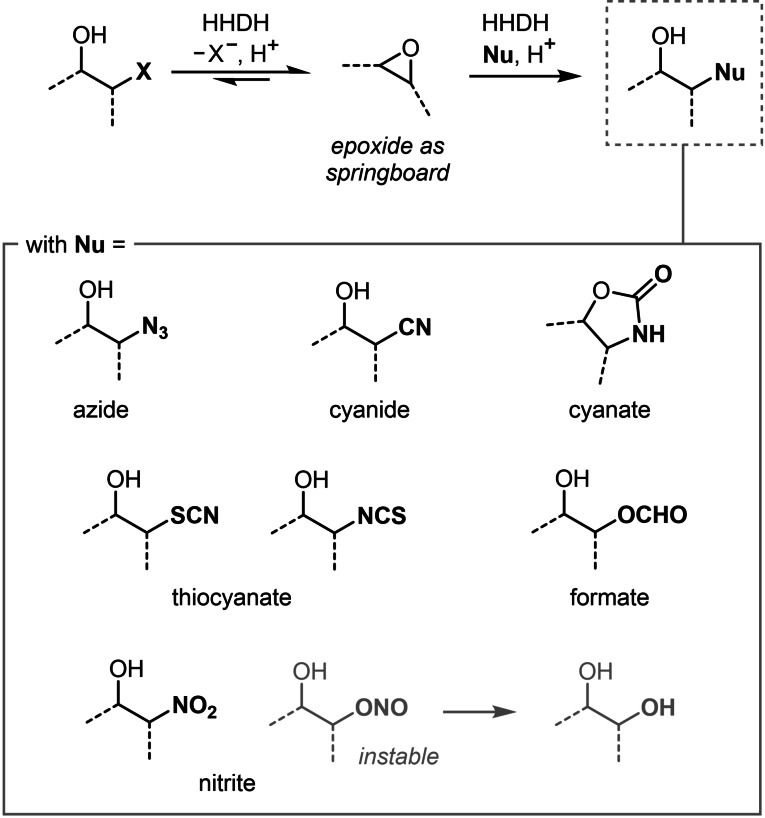
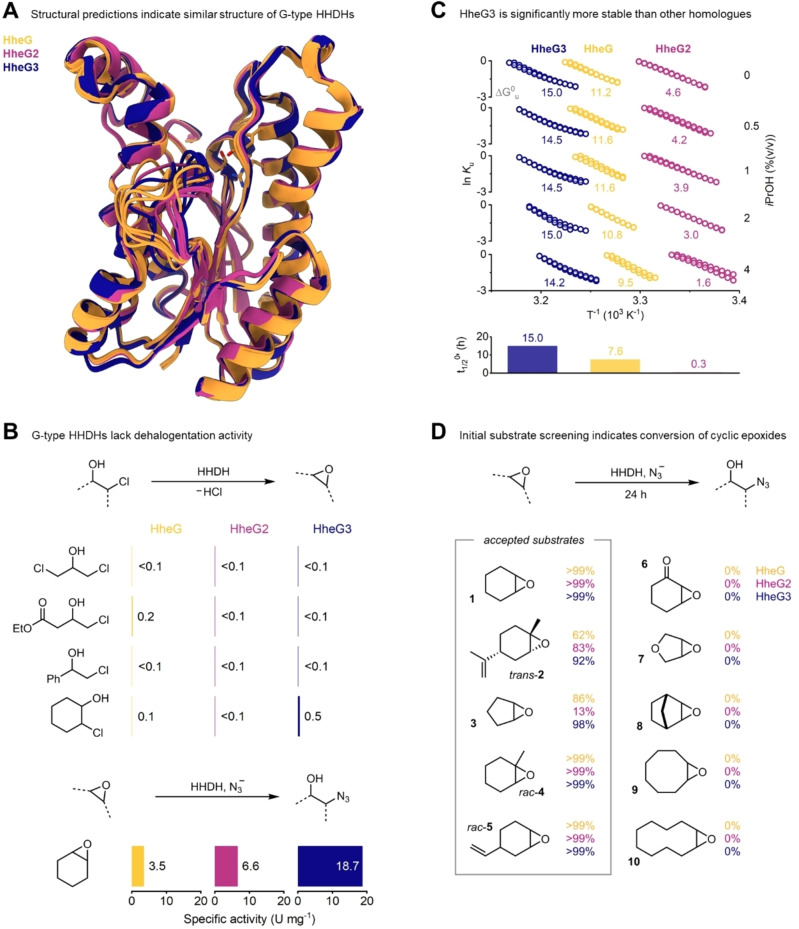
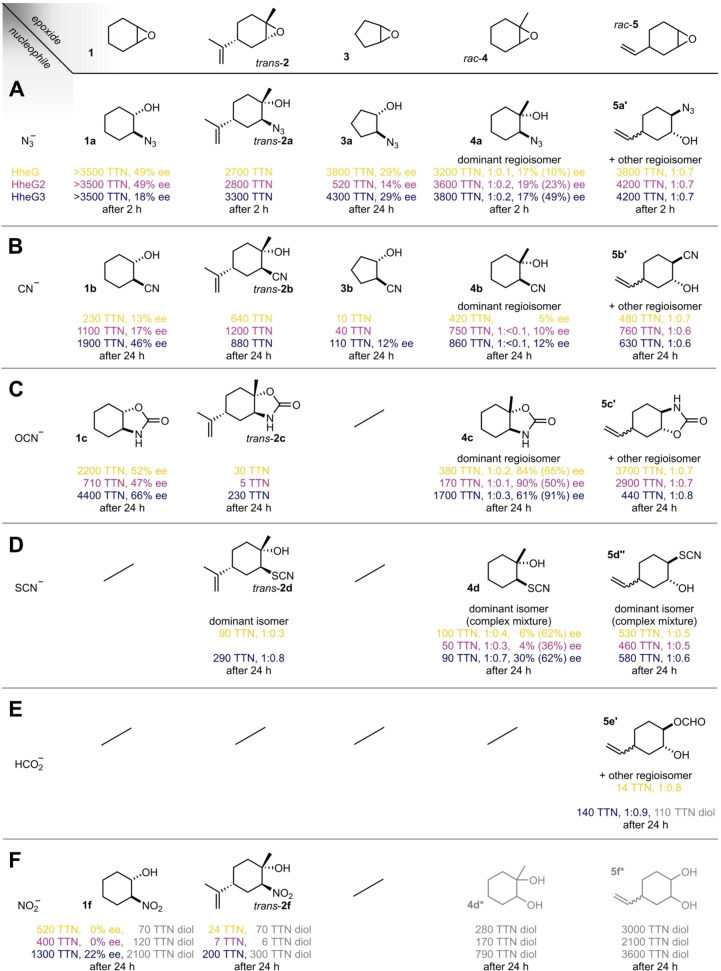
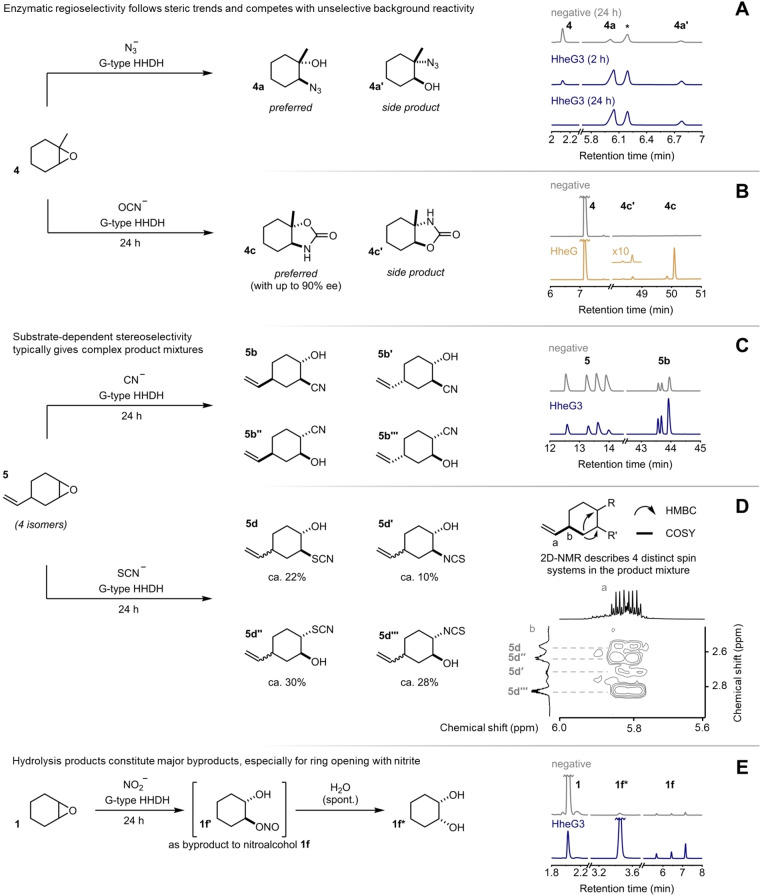
Halohydrin dehalogenases are promiscuous biocatalysts, which enable asymmetric ring opening reactions of epoxides with various anionic nucleophiles. However, despite the increasing interest in such asymmetric transformations, the substrate scope of G‐type halohydrin dehalogenases toward cyclic epoxides has remained largely unexplored, even though this subfamily is the only one known to display activity with these sterically demanding substrates. Herein, we report on the exploration of the substrate scope of the two G‐type halohydrin dehalogenases HheG and HheG2 and a newly identified, more thermostable member of the family, HheG3, with a variety of sterically demanding cyclic epoxides and anionic nucleophiles. This work shows that, in addition to azide and cyanide, these enzymes facilitate ring‐opening reactions with cyanate, thiocyanate, formate, and nitrite, significantly expanding the known repertoire of accessible transformations.
Overview
The claims and statistics of this paper haven’t been checked yet.
Run the check — free, no account needed. It reads the open-access text and checks the sources it cites.
Integrity signals
Registry
Cites
Statistics
Figures
Verification
Claims the paper makes
The claims and statistics of this paper haven’t been checked yet.
Run the check — free, no account needed. It reads the open-access text and checks the sources it cites.
Self-check
Percentages, sums and reported differences re-computed from the paper’s own numbers.
The self-check needs the paper’s full text.
Citations
Cites
Highly accurate protein structure prediction with AlphaFold
Jumper, J., Evans, R., Pritzel, A., Green, T., Figurnov, M., Ronneberger, O., Tunyasuvunakool, K., Bates, R., Žídek, A., Potapenko, A., et al. (2021) · Nature · doi:10.1038/s41586-021-03819-2 · Cited by 43,764
Ror2 signaling regulates Golgi structure and transport through IFT20 for tumor invasiveness
Nishita, M., Park, S.-Y., Nishio, T., Kamizaki, K., Wang, Z., Tamada, K., Takumi, T., Hashimoto, R., Otani, H., Pazour, G. J., et al. (2017) · Scientific Reports · doi:10.1038/s41598-016-0028-x · Cited by 15,947
ColabFold - Making protein folding accessible to all
Mirdita, M., Schütze, K., Moriwaki, Y., Heo, L., Ovchinnikov, S., & Steinegger, M. (2021) · doi:10.1101/2021.08.15.456425 · Cited by 9,391
Kavanagh, K. L., Jörnvall, H., Persson, B., & Oppermann, U. (2008) · Cellular and Molecular Life Sciences · doi:10.1007/s00018-008-8588-y · Cited by 908
Improving catalytic function by ProSAR-driven enzyme evolution
Fox, R. J., Davis, S. C., Mundorff, E. C., Newman, L. M., Gavrilovic, V., Ma, S. K., Chung, L. M., Ching, C., Tam, S., Muley, S., et al. (2007) · Nature Biotechnology · doi:10.1038/nbt1286 · Cited by 543
Determination of Trace Amounts of Chlorine in Naphtha
Bergmann, J. G., & Sanik, J. (1957) · Analytical Chemistry · doi:10.1021/ac60122a018 · Cited by 466
A green-by-design biocatalytic process for atorvastatin intermediate
Ma, S. K., Gruber, J., Davis, C., Newman, L., Gray, D., Wang, A., Grate, J., Huisman, G. W., & Sheldon, R. A. (2010) · Green Chem. · doi:10.1039/b919115c · Cited by 440
The road to fully programmable protein catalysis
Lovelock, S. L., Crawshaw, R., Basler, S., Levy, C., Baker, D. A., Hilvert, D., & Green, A. P. (2022) · Nature · doi:10.1038/s41586-022-04456-z · Cited by 388
Bacterial degradation of xenobiotic compounds: evolution and distribution of novel enzyme activities
Janssen, D. B., Dinkla, I. J. T., Poelarends, G. J., & Terpstra, P. (2005) · Environmental Microbiology · doi:10.1111/j.1462-2920.2005.00966.x · Cited by 268
Vlieg, J. E. T. V. H., Tang, L., Spelberg, J. H. L., et al. (2001) · Journal of Bacteriology · doi:10.1128/jb.183.17.5058-5066.2001 · Cited by 183
Research works printed but not linked: 3
- 10.1038/s41592-022-01488-1 · DOI · Paper page
- Arabnejad H., 2017, Protein Eng. Des. Sel., 30, 175
- Wang H., 2022, Angew. Chem., 202205790
Metadata
- Authors
- Solarczek, J., Kaspar, F., Bauer, P., & Schallmey, A.
- Affiliations
- Technische Universität Braunschweig (DE)
- Technische Universität Berlin (DE)
- Amedes Genetics (Germany) (DE)
- Corresponding author
- Schallmey, Anett
- Venue
- Chemistry – A European Journal
- Publisher
- Wiley
- Published
- 2022-11-14
- Volume
- 28
- Issue
- 72
- Pages
- e202202343-e202202343
- ISSN
- 0947-6539 (ISSN-L)
- 1521-3765
- PMC
- PMC10099379
- OpenAlex
- W4303986034
- Cited by
- 21
- References
- 35
- Citations by year
- 2026: 5 · 2025: 5 · 2024: 7 · 2023: 2 · 2022: 2
- FWCI
- 1.31
- Type
- journal article
- Language
- en
- Open access
- hybrid
- doi.org
- Licence
- Locations
- Chemistry - A European Journal (publishedVersion, cc-by)
- ChemRxiv (acceptedVersion, cc-by)
- PubMed Central (publishedVersion, cc-by)
- PubMed (publishedVersion)
- DepositOnce (submittedVersion, cc-by)
- Technische Universität Berlin – Universitätsbibliothek (cc-by)
- Funders
- Deutsche Forschungsgemeinschaft (SCHA 1745/2-2, 492196858)
- Topics
- Life Sciences › Biochemistry, Genetics and Molecular Biology › Molecular Biology › Enzyme Catalysis and Immobilization
- Physical Sciences › Chemistry › Organic Chemistry › Asymmetric Synthesis and Catalysis
- Life Sciences › Biochemistry, Genetics and Molecular Biology › Biotechnology › Enzyme Production and Characterization
- Keywords
- epoxide ring opening, anionic nucleophiles, asymmetric biocatalysis, cyanate, thiocyanate, azide, cyanide, nitrite, formate, thermostable enzymes, substrate scope
- MeSH terms
- Catalysis, Epoxy Compounds, Hydrolases, Nitrites
About these checks
Registry, retraction, Cites and statistics results are computed, not judged, with one exception: a printed reference that no index lists is read once by a model before it counts as a citation error. Claims are extracted by a model and kept only when their quote appears verbatim in the text; each cited source is then checked, with a model’s help, for whether it says what the claim relies on. Those verdicts can be wrong — read the claim’s quote and the cited source before relying on one.
Statistics and arithmetic are recomputed, not judged.
Confidence bands are shown only for fields calibrated on our annotated test set. None is calibrated yet, so no band is shown.
What counts as a claim ›How we measure confidence ›How we check this ›
Are you an author, or do you see a problem with this page? Request a review
How to cite
Cite CoChat for the checks on this page, and the paper for its own findings.
- This page
- CoChat. (2026). Citation check: G‐type Halohydrin Dehalogenases Catalyze Ring Opening Reactions of Cyclic Epoxides with Diverse Anionic Nucleophiles**. https://app.cochat.ai/papers/10.1002/chem.202202343
- The paper
- Solarczek, J., Kaspar, F., Bauer, P., & Schallmey, A. (2022). G‐type Halohydrin Dehalogenases Catalyze Ring Opening Reactions of Cyclic Epoxides with Diverse Anionic Nucleophiles**. Chemistry – A European Journal. https://doi.org/10.1002/chem.202202343
Data sources
Bibliographic data: Semantic Scholar, OpenAlex, Crossref.
Contains information from the Semantic Scholar Academic Graph Datasets, made available under the ODC Attribution License (ODC-BY 1.0).
Semantic Scholar’s data is described in: Kinney, R., et al. (2023). The Semantic Scholar Open Data Platform. arXiv:2301.10140.
