

The DOI matches its Crossref record.
Rainfall seasonality predicts the germination behavior of a tropical dry‐forest vine
Open accessAbstract
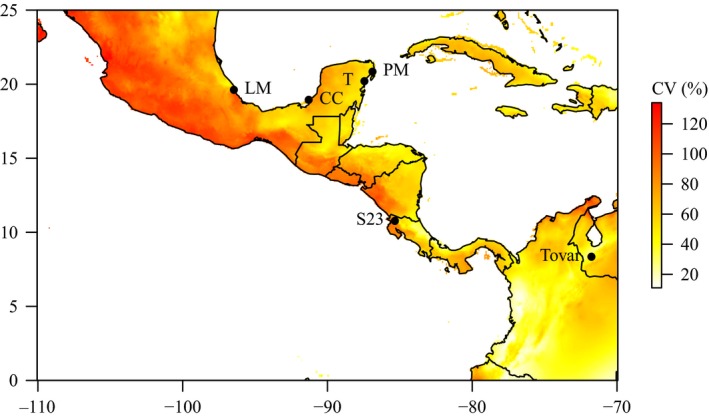
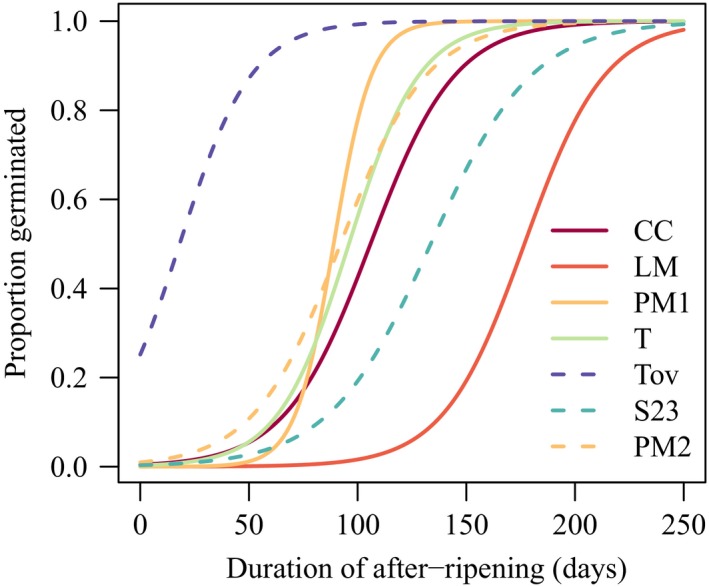
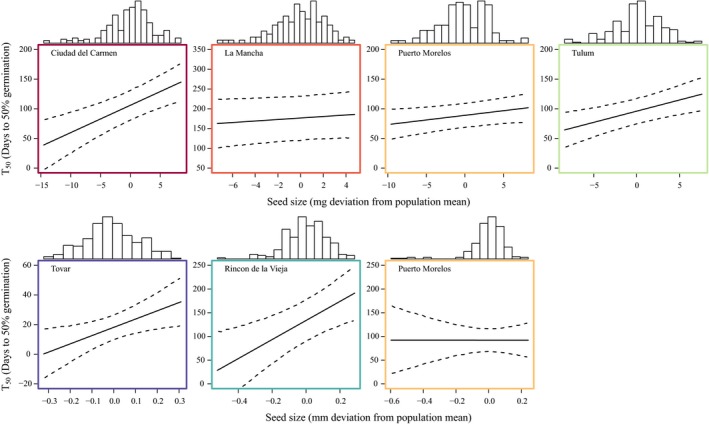
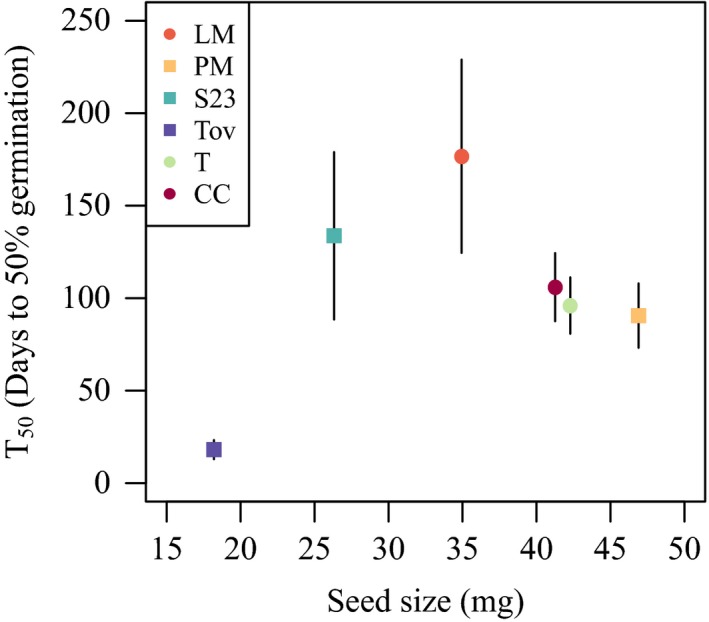
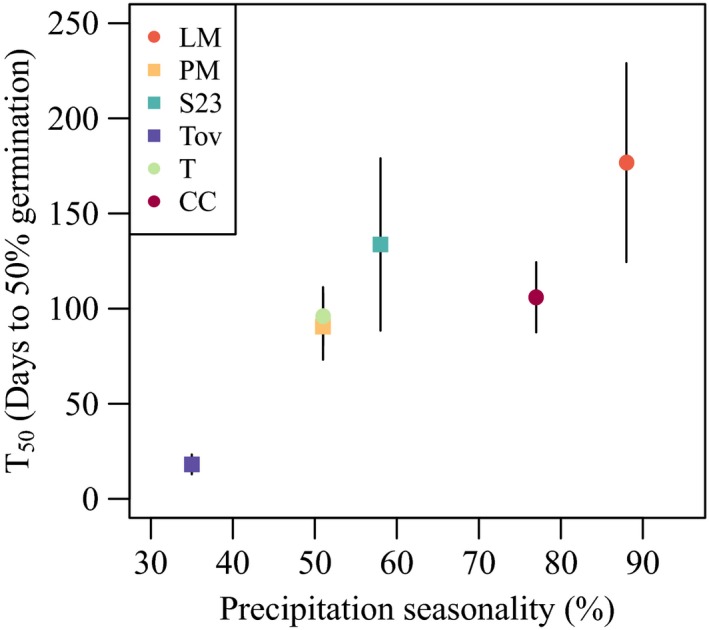
Seed dormancy is considered to be an adaptive strategy in seasonal and/or unpredictable environments because it prevents germination during climatically favorable periods that are too short for seedling establishment. Tropical dry forests are seasonal environments where seed dormancy may play an important role in plant resilience and resistance to changing precipitation patterns. We studied the germination behavior of seeds from six populations of the Neotropical vine Dalechampia scandens (Euphorbiaceae) originating from environments of contrasting rainfall seasonality. Seeds produced by second greenhouse‐generation plants were measured and exposed to a favorable wet environment at different time intervals after capsule dehiscence and seed dispersal. We recorded the success and the timing of germination. All populations produced at least some dormant seeds, but seeds of populations originating from more seasonal environments required longer periods of after‐ripening before germinating. Within populations, larger seeds tended to require longer after‐ripening periods than did smaller seeds. These results indicate among‐population genetic differences in germination behavior and suggest that these populations are adapted to local environmental conditions. They also suggest that seed size may influence germination timing within populations. Ongoing changes in seasonality patterns in tropical dry forests may impose strong selection on these traits.
Overview
The claims and statistics of this paper haven’t been checked yet.
Run the check — free, no account needed. It reads the open-access text and checks the sources it cites.
Integrity signals
Registry
Cites
Statistics
Figures
Verification
Claims the paper makes
The claims and statistics of this paper haven’t been checked yet.
Run the check — free, no account needed. It reads the open-access text and checks the sources it cites.
Claims other papers make about this one
Each is checked against this paper’s own text: does it say what the citing paper says it does?
The source backs part of the claim, not all of it — or backs it for a different population, condition or comparison.
In the citing paper
“Semi-arid and periodically wet (i.e., rainy season) conditions can significantly impact both seeding plant and insect diversity and abundance [94-98].”
From The ecology of Archaeopteryx (2026) · cites this paper as [98]
Experimental — accuracy not yet measuredThe source backs part of the claim, not all of it — or backs it for a different population, condition or comparison.
In the citing paper
“The semi-arid climate accompanied by ephemeral bouts of rainfall suggests seasonal bursts of seed germination, leading to intervals of potential seedy and herbaceous food resources, often referred to as periods of 'green up' [94, 97, 98].”
From The ecology of Archaeopteryx (2026) · cites this paper as [98]
Experimental — accuracy not yet measured
Self-check
Percentages, sums and reported differences re-computed from the paper’s own numbers.
The self-check needs the paper’s full text.
Citations
Cites
No references could be resolved yet.
Research works printed but not linked: 42
- 10.1088/1748-9326/aa5968 · DOI
- 10.1002/j.1537-2197.1982.tb13391.x · DOI
- 10.2307/2399053 · DOI
- Baskin C. C., 2014, Seeds. Ecology, biogeography, and evolution of dormancy and germination
- Baskin J. M., 2004, A classification system for seed dormancy, Seed Science Research, 14, 5196, 10.1079/SSR2003150 · DOI
- 10.1111/j.1469-8137.1993.tb03808.x · DOI
- 10.1086/303314 · DOI
- 10.1098/rstb.2008.0291 · DOI
- 10.1146/annurev-ecolsys-102209-144715 · DOI
- 10.1093/aob/mcy006 · DOI
- 10.1038/nclimate1907 · DOI
- 10.1111/j.1469-8137.2006.01787.x · DOI
- 10.2307/2258961 · DOI
- 10.2307/1942493 · DOI
- 10.1111/ele.12241 · DOI
- 10.1002/joc.1276 · DOI
- 10.1093/genetics/130.1.195 · DOI
- 10.1111/j.1654-1103.2005.tb02396.x · DOI
- 10.1002/j.1537-2197.1995.tb12643.x · DOI
- 10.1111/j.0022-0477.2004.00884.x · DOI
- 10.1111/j.1365-2435.2008.01477.x · DOI
- 10.1111/jeb.12692 · DOI
- 10.3732/ajb.92.5.842 · DOI
- 10.3732/ajb.1500126 · DOI
- 10.1111/mec.13061 · DOI
- R Core Team, 2018, R: A language and environment for statistical computing
- 10.1111/jvs.12531 · DOI
- 10.1098/rstb.1996.0113 · DOI
- 10.1111/nph.14498 · DOI
- 10.1017/S0960258507708127 · DOI
- 10.1007/BF02270911 · DOI
- 10.1016/j.flora.2011.05.001 · DOI
- 10.1017/S0960258511000286 · DOI
- 10.1111/jeb.12378 · DOI
- 10.1111/j.0014-3820.2006.tb01865.x · DOI
- 10.2307/3235760 · DOI
- 10.1093/aob/mcw161 · DOI
- 10.1146/annurev.es.24.110193.000441 · DOI
- 10.1890/06-1495 · DOI
- 10.1086/284795 · DOI
- 10.2307/2261184 · DOI
- 10.1093/aob/mcs194 · DOI
Cited by
Sorted by citations
O’Connor, J. K., & Clark, A. D. (2026) · Discover Ecology · doi:10.1007/s44396-026-00026-z
Metadata
- Authors
- Martins, A. A., Opedal, Ø. H., Armbruster, W. S., & Pélabon, C.
- Affiliations
- Norwegian University of Science and Technology (NO)
- University of Helsinki (FI)
- University of Alaska Fairbanks (US)
- Corresponding author
- Martins, Adriana A.
- Venue
- Ecology and Evolution
- Publisher
- Wiley
- Published
- 2019-04-04
- Volume
- 9
- Issue
- 9
- Pages
- 5196-5205
- ISSN
- 2045-7758 (ISSN-L)
- PMC
- PMC6509399
- OpenAlex
- W2921774583
- Cited by
- 16
- References
- 0
- Citations by year
- 2026: 2 · 2025: 5 · 2024: 1 · 2023: 1 · 2022: 4 · 2021: 2 · 2019: 1
- FWCI
- 1.29
- Type
- journal article
- Language
- en
- Open access
- gold
- doi.org
- Licence
- Locations
- Ecology and Evolution (publishedVersion, cc-by)
- PubMed Central (publishedVersion, cc-by)
- PubMed (publishedVersion)
- Työväentutkimus Vuosikirja (submittedVersion)
- Lund University Publications (Lund University) (submittedVersion)
- Funders
- Norges Forskningsråd (223257)
- Topics
- Life Sciences › Agricultural and Biological Sciences › Plant Science › Seed Germination and Physiology
- Life Sciences › Agricultural and Biological Sciences › Forestry › Seedling growth and survival studies
- Physical Sciences › Environmental Science › Nature and Landscape Conservation › Ecology and Vegetation Dynamics Studies
- Keywords
- seed dormancy, germination timing, precipitation seasonality, Dalechampia scandens, tropical dry forest, after-ripening, seed size, Euphorbiaceae, vines, rainfall variability, local adaptation
About these checks
Registry, retraction, Cites and statistics results are computed, not judged, with one exception: a printed reference that no index lists is read once by a model before it counts as a citation error. Claims are extracted by a model and kept only when their quote appears verbatim in the text; each cited source is then checked, with a model’s help, for whether it says what the claim relies on. Those verdicts can be wrong — read the claim’s quote and the cited source before relying on one.
Statistics and arithmetic are recomputed, not judged.
Confidence bands are shown only for fields calibrated on our annotated test set. None is calibrated yet, so no band is shown.
What counts as a claim ›How we measure confidence ›How we check this ›
Are you an author, or do you see a problem with this page? Request a review
How to cite
Cite CoChat for the checks on this page, and the paper for its own findings.
- This page
- CoChat. (2026). Citation check: Rainfall seasonality predicts the germination behavior of a tropical dry‐forest vine. https://app.cochat.ai/papers/10.1002/ece3.5108
- The paper
- Martins, A. A., Opedal, Ø. H., Armbruster, W. S., & Pélabon, C. (2019). Rainfall seasonality predicts the germination behavior of a tropical dry‐forest vine. Ecology and Evolution. https://doi.org/10.1002/ece3.5108
