

The DOI matches its Crossref record; its reference list is not available.
Population genetics of Bull Trout ( Salvelinus confluentus ) in the upper Athabasca River basin
Open accessPublished version of a preprint
Abstract
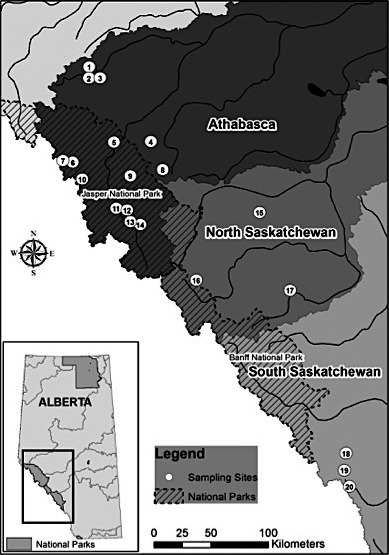
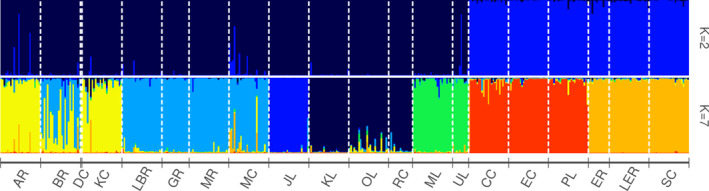
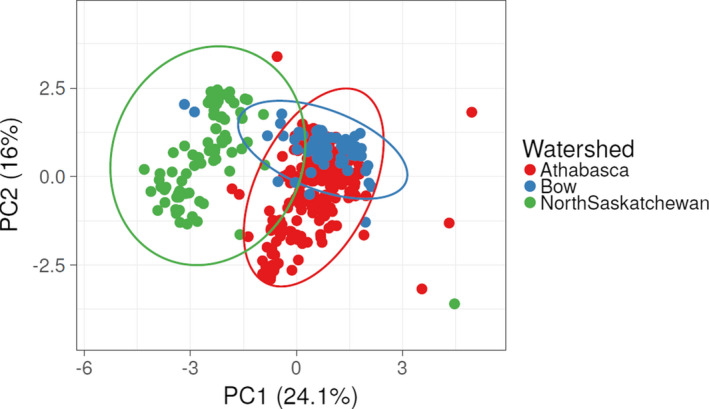
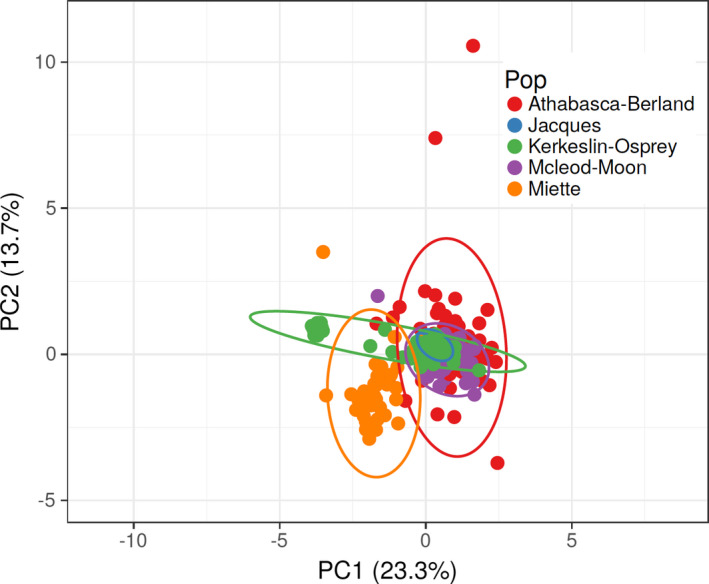
Freshwater ecosystems are negatively impacted by a variety of anthropogenic stressors, with concomitant elevated rates of population decline for freshwater aquatic vertebrates. Because reductions in population size and extent can negatively impact genetic diversity and gene flow, which are vital for sustained local adaptation, it is important to measure these characteristics in threatened species that may yet be rescued from extinction. Across its native range, Bull Trout ( Salvelinus confluentus ) extent and abundance are in decline due to historic overharvest, invasive non‐native species, and habitat loss. In Alberta's Eastern Slope region, populations at the range margin have progressively been lost, motivating us to better understand the amount and distribution of genetic variation in headwater habitats and some downstream sites where they continue to persist. Across this region, we sampled 431 Bull Trout from 20 sites in the Athabasca and Saskatchewan River basins and assayed 10 microsatellite loci to characterize within‐ and among‐population genetic variation. The Saskatchewan and Athabasca River basins contained similar levels of heterozygosity but were differentiated from one another. Within the Athabasca River basin, five genetically differentiated clusters were found. Despite the evidence for genetic differentiation, we did not observe significant isolation‐by‐distance patterns among these sites. Our findings of ample genetic diversity and no evidence for hybridization with non‐native Brook Trout in headwater habitats provide motivation to ameliorate downstream habitats and remove anthropogenic barriers to connectivity towards the goal of long‐term persistence of this species.
Overview
The claims and statistics of this paper haven’t been checked yet.
Run the check — free, no account needed. It reads the open-access text and checks the sources it cites.
Integrity signals
Registry
Cites
Statistics
Figures
Verification
Claims the paper makes
The claims and statistics of this paper haven’t been checked yet.
Run the check — free, no account needed. It reads the open-access text and checks the sources it cites.
Self-check
Percentages, sums and reported differences re-computed from the paper’s own numbers.
The self-check needs the paper’s full text.
Citations
No citation lists for this paper
No citation lists for this paper yet — checked again daily.
References 65 · Cited by 3
Research works printed but not linked: 5
- COSEWIC, 2012, Assessment and status report on the Bull Trout (Salvelinus confluentus) in Canada
- COSEWIC, 2018, COSEWIC guidelines for recognizing designatable units, viewed 14 September 2020
- 10.1111/j.1365-294X.2005.02553.x · DOI
- McPhail J. D., 1986, Zoogeography of the freshwater fishes of Cascadia (the Columbia River and rivers north to the Stikine)
- R Core Team, 2020, A language and environment for statistical computing
Metadata
- Authors
- Carroll, E. K. T., & Vamosi, S. M.
- Affiliations
- University of Calgary (CA)
- Corresponding author
- Carroll, Emma K. T.
- Venue
- Ecology and Evolution
- Publisher
- Wiley
- Published
- 2021-09-30
- Volume
- 11
- Issue
- 21
- Pages
- 14509-14520
- ISSN
- 2045-7758 (ISSN-L)
- PMC
- PMC8571605
- OpenAlex
- W3203851482
- Cited by
- 3
- References
- 65
- Citations by year
- 2025: 1 · 2023: 1 · 2021: 1
- FWCI
- 0.28
- Type
- journal article
- Language
- en
- Open access
- gold
- doi.org
- Licence
- Locations
- Ecology and Evolution (publishedVersion, cc-by)
- bioRxiv (Cold Spring Harbor Laboratory) (acceptedVersion)
- Europe PMC (PubMed Central) (publishedVersion, other-oa)
- PubMed Central (publishedVersion, cc-by)
- PubMed (publishedVersion)
- DOAJ (DOAJ: Directory of Open Access Journals) (submittedVersion, cc-by-sa)
- Funders
- Canadian Network for Research and Innovation in Machining Technology, Natural Sciences and Engineering Research Council of Canada
- Alberta Conservation Association
- Alberta Society of Professional Biologists
- Topics
- Life Sciences › Biochemistry, Genetics and Molecular Biology › Genetics › Genetic diversity and population structure
- Physical Sciences › Environmental Science › Nature and Landscape Conservation › Fish Ecology and Management Studies
- Life Sciences › Agricultural and Biological Sciences › Aquatic Science › Fish Biology and Ecology Studies
- Keywords
- bull trout, Salvelinus confluentus, population genetics, genetic diversity, microsatellite markers, genetic differentiation, isolation by distance, introduced species, freshwater fish conservation, Athabasca River Basin, Saskatchewan River Basin, range margin populations, gene flow, habitat connectivity
About these checks
Registry, retraction, Cites and statistics results are computed, not judged, with one exception: a printed reference that no index lists is read once by a model before it counts as a citation error. Claims are extracted by a model and kept only when their quote appears verbatim in the text; each cited source is then checked, with a model’s help, for whether it says what the claim relies on. Those verdicts can be wrong — read the claim’s quote and the cited source before relying on one.
Statistics and arithmetic are recomputed, not judged.
Confidence bands are shown only for fields calibrated on our annotated test set. None is calibrated yet, so no band is shown.
What counts as a claim ›How we measure confidence ›How we check this ›
Are you an author, or do you see a problem with this page? Request a review
How to cite
Cite CoChat for the checks on this page, and the paper for its own findings.
- This page
- CoChat. (2026). Citation check: Population genetics of Bull Trout ( Salvelinus confluentus ) in the upper Athabasca River basin. https://app.cochat.ai/papers/10.1002/ece3.8110
- The paper
- Carroll, E. K. T., & Vamosi, S. M. (2021). Population genetics of Bull Trout ( Salvelinus confluentus ) in the upper Athabasca River basin. Ecology and Evolution. https://doi.org/10.1002/ece3.8110
Data sources
Bibliographic data: Semantic Scholar, OpenAlex, Crossref.
Contains information from the Semantic Scholar Academic Graph Datasets, made available under the ODC Attribution License (ODC-BY 1.0).
Semantic Scholar’s data is described in: Kinney, R., et al. (2023). The Semantic Scholar Open Data Platform. arXiv:2301.10140.
