

The DOI matches its Crossref record; 36 of the 37 references it cites were found in a registry or an index.
Attitude, awareness, and knowledge of telemedicine among medical students: a systematic review of cross-sectional studies
Open accessAbstract
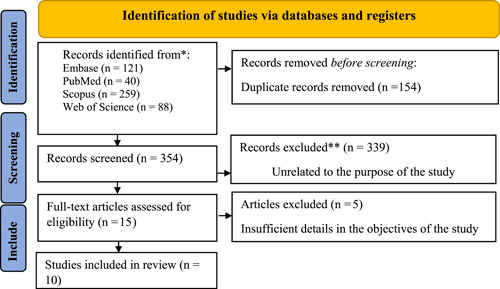
Background and Aims: The success of every new technology depends on numerous factors, including specialists' knowledge and perceptions of the concept, acquired attitude skills, and work environments. This systematic review aimed to examine medical students' knowledge, attitudes, and perceptions of telemedicine. Methods: Studies were obtained from the PubMed, Embase, Scopus, and Web of Science databases on June 9, 2022. We followed the Preferred Reporting Items for Systematic Reviews and Meta‐Analyses guidelines. Cross‐sectional studies that examined medical students' knowledge, attitude, and perceptions of telemedicine approaches were considered inclusion criteria. Titles and abstracts were independently screened based on eligibility criteria. Articles that did not meet the inclusion criteria were excluded from this review. After that, the complete texts were retrieved and screened by two separate researchers based on the eligibility criteria. Disputes were resolved by discussion. The same checklist was used for data extraction. To assess the quality of the studies entering this study, the Joanna Briggs Institute Critical Appraisal Checklist for analytical cross‐sectional studies was used. Results: In total, 10 eligible articles were found through this review. The sample size of the studies ranged from 60 to 3312 participants, or 6172 participants on the whole. The medical students' attitudes toward telemedicine were evaluated in eight included studies. Many of these studies (seven cases) reported positive and promising perspectives on telemedicine. However, in one study, participants revealed moderate attitudes toward online health information and online health experience sharing (p < 0.05). Students' knowledge of the telemedicine approach was evaluated in eight included studies. Many of these studies (five cases) reported that students possessed an extensively poor knowledge of telemedicine's uses. In three other studies, two reported moderate and one disclosed desirable levels of students' knowledge. All the included studies attributed medical students' poor knowledge to the lack of, and thus failure of, educational courses in this field. Conclusion: The evidence obtained from this review reveals that medical students possess positive and promising attitudes toward telemedicine technology for education, treatment, and care. However, their knowledge levels were extremely insufficient, and many had not passed any educational courses in this respect. Such results can foreground the health and education policymakers' obligations for planning, training, and empowering digital health and telemedicine literacy among medical students as the primary players in social health.
Overview
The claims and statistics of this paper haven’t been checked yet.
Run the check — free, no account needed. It reads the open-access text and checks the sources it cites.
Integrity signals
Registry
Cites
Statistics
Figures
Verification
Claims the paper makes
The claims and statistics of this paper haven’t been checked yet.
Run the check — free, no account needed. It reads the open-access text and checks the sources it cites.
Claims other papers make about this one
Each is checked against this paper’s own text: does it say what the citing paper says it does?
The cited source says what the claim attributes to it.
In the citing paper
“Furthermore, previous research has typically examined isolated technologies (eg, AI in radiology [1415], EHRs [16], or telemedicine [17]) or local contexts (eg, studies conducted in Canada [14], the United Kingdom [15], Vietnam [18], or Finland [19]), offering fragmented insights into how students engage with dHealth more broadly.”
From Evolving Medical Students’ Digital Health Perceptions and Intentions: Insights From a Prepandemic and Postpandemic Survey Study (2025) · cites this paper as [17]
The check wasn’t confident either way, so it gives no verdict — never disputed.
In the citing paper
“No existing questionnaire fully captured the variables included in our research model. Therefore, we adapted survey items from previously validated instruments in related contexts [17], modifying them to better align with our study’s focus.”
From Evolving Medical Students’ Digital Health Perceptions and Intentions: Insights From a Prepandemic and Postpandemic Survey Study (2025) · cites this paper as [17]
Experimental — accuracy not yet measured
Self-check
Percentages, sums and reported differences re-computed from the paper’s own numbers.
The self-check needs the paper’s full text.
Citations
Cites
Preferred reporting items for systematic reviews and meta-analyses: the PRISMA Statement.
(2009) · PubMed Central · Cited by 44,859
Dermyshi, E., Wang, Y., Yan, C., Hong, W., Qiu, G., Gong, X., & Zhang, T. (2017) · Neonatology · doi:10.1159/000454668 · Cited by 24,586
Liberati, A., Altman, D. G., Tetzlaff, J., Mulrow, C., Gøtzsche, P. C., Ioannidis, J. P. A., Clarke, M., Devereaux, P. J., Kleijnen, J., & Moher, D. (2009) · Journal of Clinical Epidemiology · doi:10.1016/j.jclinepi.2009.06.006 · Cited by 10,578
Moher, D. (2009) · Journal of Chinese Integrative Medicine · doi:10.3736/jcim20090918 · Cited by 909
Wootton, R. (2001) · BMJ · doi:10.1136/bmj.323.7312.557 · Cited by 715
Golinelli, D., Boetto, E., Carullo, G., Nuzzolese, A. G., Landini, M. P., & Fantini, M. P. (2020) · Journal of Medical Internet Research · doi:10.2196/22280 · Cited by 638
Ryu, S. (2012) · Healthcare Informatics Research · doi:10.4258/hir.2012.18.2.153 · Cited by 422
A systematic review of providers’ attitudes toward telemental health via videoconferencing.
Connolly, S. L., Miller, C. J., Lindsay, J. A., & Bauer, M. S. (2020) · Clinical Psychology: Science and Practice · doi:10.1111/cpsp.12311 · Cited by 389
Perceptions of Digital Health Education Among European Medical Students: Mixed Methods Survey
Machleid, F., Kaczmarczyk, R., Johann, D., Balčiūnas, J., Atienza-Carbonell, B., von Maltzahn, F., & Mosch, L. (2020) · Journal of Medical Internet Research · doi:10.2196/19827 · Cited by 190
Unmuting Medical Students’ Education: Utilizing Telemedicine During the COVID-19 Pandemic and Beyond
Iancu, A., Kemp, M. T., & Alam, H. B. (2020) · Journal of Medical Internet Research · doi:10.2196/19667 · Cited by 158
Research works printed but not linked: 1
- Golinelli D, 2020, How the COVID‐19 pandemic is favoring the adoption of digital technologies in healthcare: a literature review, MedRxiv
Cited by
Sorted by citations
Emerging Digital Technologies in Healthcare with a Spotlight on Cybersecurity: A Narrative Review
Arafa, A., Sheerah, H. A., & Alsalamah, S. (2023) · Information · doi:10.3390/info14120640 · Cited by 57
Liu, L., Fu, M., wu, J., Wang, H., Zhao, J., Chen, P., Cao, J., Zhang, W., Lin, Q., & Li, L. (2024) · BMC Medical Education · doi:10.1186/s12909-024-06075-w · Cited by 34
Ghaddaripouri, K., Ghaddaripouri, M., Mousavi, A. S., Baigi, S. F. M., Sarsari, M. R., Kemmak, F. D., & Habibi, M. R. M. (2024) · Health Science Reports · doi:10.1002/hsr2.1893 · Cited by 21
Self-citationThe digital readiness of future physicians: nurturing the post-pandemic medical education
Marsilio, M., Calcaterra, V., Infante, G., Pisarra, M., & Zuccotti, G. (2024) · BMC Health Services Research · doi:10.1186/s12913-024-11365-6 · Cited by 24
Alshammari, A., Alanazi, M. F., & Bahari, G. (2024) · Nurse Education Today · doi:10.1016/j.nedt.2024.106359 · Cited by 15
Barriers and facilitators of provision of telemedicine in Nigeria: A systematic review
Cole, O. K., Abubakar, M. M., Isah, A., Sule, S. H., & Ukoha-Kalu, B. O. (2025) · PLOS Digital Health · doi:10.1371/journal.pdig.0000934 · Cited by 21
Baigi, S. F. M., Kimiafar, K., Ghaddaripouri, K., Mehneh, M. R., Mousavi, A. S., & Sarbaz, M. (2023) · Journal of Education and Health Promotion · doi:10.4103/jehp.jehp_1586_22 · Cited by 14
Self-citationShibabaw, A. A., Chereka, A. A., Walle, A. D., Demsash, A. W., Dube, G. N., Dubale, A. T., Kassie, S. Y., Kitil, G. W., Jember, M. Z., Gebeyehu, C. D., et al. (2024) · PLoS ONE · doi:10.1371/journal.pone.0301044 · Cited by 13
Habibi, M. R. M., Abadi, F. M., Tabesh, H., Vakili-Arki, H., Abu–Hanna, A., Ghaddaripouri, K., & Eslami, S. (2024) · Health Science Reports · doi:10.1002/hsr2.2160 · Cited by 12
Self-citationBaigi, S. F. M., Sarbaz, M., Darroudi, A., & Kimiafar, K. (2025) · Health Science Reports · doi:10.1002/hsr2.71046 · Cited by 14
Barnawi, N. A., Al-Otaibi, H., Alkhudairy, A. I. M., Alajlan, M. S., Alajlan, R., Alay, S., Alqahtani, S. S., Bushnak, I., & Abolfotouh, M. A. (2024) · International Journal of General Medicine · doi:10.2147/ijgm.s452641 · Cited by 10
Veikkolainen, P., Tuovinen, T., Kulmala, P., Jarva, E., Juntunen, J., Tuomikoski, A., Männistö, M., Pihlajasalo, T., & Reponen, J. (2025) · JMIR Medical Education · doi:10.2196/67423 · Cited by 7
Albahri, A. H., Alnaqbi, S. A., Alnaqbi, S. A., & Shorbagi, S. (2023) · BMC Medical Education · doi:10.1186/s12909-023-04859-0 · Cited by 8
Novel educational strategies to improve the telemedicine clinical skills of medical students
Greengold, J., Spahic, H., Serwint, J. R., Dlhosh, S., Barouch, L. A., Gattamorta, K. A., Pahwa, A. K., & Hughes, H. (2025) · Primary Health Care Research & Development · doi:10.1017/s1463423625000040 · Cited by 5
Saleh, O. A., Massalha, L., & Halperin, O. (2025) · JMIR Medical Education · doi:10.2196/67804 · Cited by 5
Moeini, S., Honarvar, M. R., Aarabi, M., Kabir, M. J., & Aarabi, M. (2025) · BMC Medical Education · doi:10.1186/s12909-025-08409-8 · Cited by 5
Awareness and Attitude Toward Telemedicine of Students at University of Paramedical Sciences
Ghaddaripouri, K., Baigi, S. F. M., Hashemi, S. A., Dokhtfaroughi, S. S., Kemmak, F. D., & Habibi, M. R. M. (2024) · Frontiers in Health Informatics · doi:10.30699/fhi.v13i0.572 · Cited by 6
Self-citationBaigi, S. F. M., Sarbaz, M., Rad, D. S., Nazary‐Moghadam, S., Heravian, J., Ghaddaripouri, K., Aval, R. N., & Kimiafar, K. (2025) · Health Science Reports · doi:10.1002/hsr2.70237 · Cited by 4
Self-citationRingeval, M., Raymond, L., Pomey, M.-P., & Paré, G. (2025) · Journal of Medical Internet Research · doi:10.2196/64804 · Cited by 4
Noel, N. B., Noel, M. B., Yila, E., Nkala, C. A.-L., & Banwat, M. (2024) · PubMed Central · doi:10.60787/nmj-64-6-373 · Cited by 3
Gholamzadeh, M., Abtahi, H., Safdari, R., Haghshenas, E., Gharabaghi, M. A., & Rahimi, B. (2025) · Health Science Reports · doi:10.1002/hsr2.70321 · Cited by 3
White, N. S., Franklin, S. S., Juliet, N., Amalanathan, S. A. M., Kanagaraj, P., & Babu, K. R. (2024) · Journal of Education and Health Promotion · doi:10.4103/jehp.jehp_290_24 · Cited by 2
Kemmak, F. D., Marouzi, P., Sarbaz, M., Baigi, S. F. M., Sheykhotayefeh, M., & Kimiafar, K. (2025) · Health Science Reports · doi:10.1002/hsr2.70345 · Cited by 2
Ghaddaripouri, K., Molavi, R., Montazeryan, S., Kharaghani, M. S., Soudejani, F. T., Vafamand, M., & Erfannia, L. (2026) · Healthcare Technology Letters · doi:10.1049/htl2.70065 · Cited by 2
Self-citationLevai, C. M., Nussbaum, L. A., Cojocaru, A., Popa, D. I., Tomescu, A. M., & Jugănaru, I. (2026) · Healthcare · doi:10.3390/healthcare14050570 · Cited by 2
Marouzi, P., Baigi, S. F. M., Fereydouni, F., Rabbani, Z. H., Haghighi, B., & Shariati-Moghaddam, R. (2026) · Health Science Reports · doi:10.1002/hsr2.72097 · Cited by 2
Hawa, N. I., Soesilo, T. E. B., & Nuraeni, N. (2023) · International Journal of Telemedicine and Applications · doi:10.1155/2023/4669985 · Cited by 2
A Comparative Study of Minimum Data Set of Speech Therapy: A Systematic Literature Review
Kimiafar, K., Sarbaz, M., Rad, D. S., Mousavi, A. S., Mehneh, M. R., Kemmak, F. D., Baigi, S. F. M., & Esmaeili, M. (2023) · Frontiers in Health Informatics · doi:10.30699/fhi.v12i0.511 · Cited by 2
Kimiafar, K., Baigi, S. F. M., Rad, D. S., Ranjbar, E., Sarbaz, M., & Esmaeili, M. (2024) · Frontiers in Health Informatics · doi:10.30699/fhi.v13i0.513 · Cited by 2
Awareness of Healthcare Faculty Students on Telehealth: A Mixed Methods Study
Aytimur, D., Mandıracıoğlu, A., Batı, A. H., & Gövsa, F. (2024) · European Journal of Therapeutics · doi:10.58600/eurjther2256 · Cited by 1
Ye, F., Cai, Q., Gong, X., Ren, J., Sun, R., Liu, C., Wang, X., & Qiao, Y. (2025) · Global Medical Education · doi:10.1515/gme-2024-0022 · Cited by 1
Sexual Abuse in Street Children: A Systematic Review and Meta-Analysis
Mahmoodi, M., Sharifi, H. P., Zahedi, R., Malekmohammadi, N., Sharafoddin, M., Salarpour, E., Bazrafshan, A., Jandaghi, A., Najafi, M., & Chegeni, M. (2026) · Sexuality & Culture · doi:10.1007/s12119-025-10497-z · Cited by 1
Altınışık, G., Karaca, O., Süner, A., Taşbakan, M. S., & Sertöz, R. (2026) · BMC Medical Education · doi:10.1186/s12909-025-08444-5 · Cited by 1
Preparing Medical Students for Virtual Care: Perceptions of Adoption
Holtz, B., Ford, S., Iddrisu, N., Wendling, A. L., & Hirko, K. A. (2026) · Telemedicine Journal and e-Health · doi:10.1177/15305627261470983 · Cited by 1
Sarbaz, M., Baigi, S. F. M., Salehzade, Z., Aval, R. N., Esmaeili, M., & Kimiafar, K. (2024) · Journal of Health Administration · doi:10.61186/jha.27.3.1 · Cited by 1
Gibbs, J. H. (2026) · Research Square · doi:10.21203/rs.3.rs-10961744/v1 · Cited by 1
Implementation and Evaluation of a Telepsychiatry Pilot Curriculum for Medical Students
Conroy, C. P., Joshi, K., Gieson, M. T. V., Bailey, A. M., & Goldhirsh, J. L. (2024) · Journal of Technology in Behavioral Science · doi:10.1007/s41347-023-00379-2
Knowledge of Nursing Students Towards Tele-nursing Care: A Cross-Sectional Study
Matrok, L., Faleh, R., Sultan, A., Rahil, S., Masoud, A. M. O., & Rashed, A. B. (2023) · doi:10.59287/nmsr.1246
Kimiafar, K., Sarbaz, M., Darroudi, A., Mousavi, A. S., Mehneh, M. R., Baigi, S. F. M., & Esmaeili, M. (2024) · Frontiers in Health Informatics · doi:10.30699/fhi.v13i0.516
Shareef, S. M., Goud, B. P., Domalapally, B., & Tadvi, N. A. (2024) · Cureus · doi:10.7759/cureus.57712
Mamahit, R. R., & Ali, M. M. (2024) · Eduvest - Journal Of Universal Studies · doi:10.59188/eduvest.v4i7.1606
Ghahramani, P., Kiani, B., Norouzkhani, N., Khoshkangin, A., Kheirdoust, A., & Habibi, M. R. M. (2025) · Health Science Reports · doi:10.1002/hsr2.71137
Baigi, S. F. M., Sarbaz, M., Ghaddaripouri, K., Kemmak, F. D., Mehneh, M. R., Aval, R. N., & Kimiafar, K. (2025) · Journal of Education and Health Promotion · doi:10.4103/jehp.jehp_507_24
Self-citationPrivacy protection for fog computing and IoT-based technology in smart healthcare systems
Taherdoost, H. (2025) · Elsevier eBooks · doi:10.1016/b978-0-443-33439-9.00009-x
Fog computing and internet of things technology in hospital information systems management
Taherdoost, H. (2025) · Elsevier eBooks · doi:10.1016/b978-0-443-33441-2.00001-x
Albahri, A. H., Alnaqbi, S. A., Alnaqbi, S. A., & Shorbagi, S. (2024) · Figshare · doi:10.6084/m9.figshare.26644027
Marsilio, M., Calcaterra, V., Infante, G., Pisarra, M., & Zuccotti, G. (2024) · Figshare · doi:10.6084/m9.figshare.26488299
Marsilio, M., Calcaterra, V., Infante, G., Pisarra, M., & Zuccotti, G. (2024) · Figshare · doi:10.6084/m9.figshare.26488422
Treteanu, A. R., Busnatu, Ș., Șerbănoiu, L. I., Năstasă, I., & Andronic, O. (2026) · Health Science Reports · doi:10.1002/hsr2.72695
Adedeji, A., Doğan, H., Adedoyin, F. F., & Heward, M. (2026) · Health Policy and Technology · doi:10.1016/j.hlpt.2026.101277
Dashtbani, S., Ramesh, H., Norouzkhani, N., Saghebi, A., Khoshkangin, A., & Habibi, M. R. M. (2026) · Health Science Reports · doi:10.1002/hsr2.73103
Transforming lupus self-care education with mobile health: A systematic review
Salimi, E., Kemmak, A. R., Dokhtfaroughi, S. S., Heidari, A. E., Salari, S., & Habibi, M. R. M. (2026) · Journal of Education and Health Promotion · doi:10.4103/jehp.jehp_442_25
Rekenyi, V., Szepesi, C. I., Horváth, N., & Kolozsvári, L. R. (2026) · Healthcare · doi:10.3390/healthcare14193256
Thi, H. V., Nguyen, H. L., Anh, N. D. N., Bui, P. A., Nguyen, Q.-A. T., Nguyen, T.-Q., & Chu, D.-T. (2026) · Educación Médica · doi:10.1016/j.edumed.2026.101244
Metadata
- Authors
- Ghaddaripouri, K., Mousavi Baigi, S. F., Abbaszadeh, A., & Mazaheri Habibi, M. R.
- Affiliations
- Varastegan Institute for Medical Sciences (IR)
- Department of Health Information Technology School of Paramedical and Rehabilitation Sciences Mashhad University of Medical Sciences Mashhad Iran
- Aja University of Medical Sciences (IR)
- Department of Health Information Technology Varastegan Institute for Medical Sciences Mashhad Iran
- ORCID
- Venue
- Health Science Reports
- Publisher
- Wiley
- Published
- 2023-03
- Volume
- 6
- Issue
- 3
- Pages
- e1156-e1156
- ISSN
- 2398-8835 (ISSN-L)
- PMC
- PMC10042283
- OpenAlex
- W4361019207
- Cited by
- 54
- References
- 37
- Citations by year
- 2026: 13 · 2025: 15 · 2024: 19 · 2023: 7
- FWCI
- 2.72
- Type
- journal article
- Language
- en
- Open access
- gold
- doi.org
- Licence
- Locations
- Health Science Reports (publishedVersion, cc-by-nc-nd)
- PubMed Central (publishedVersion, cc-by-nc-nd)
- PubMed (publishedVersion)
- DOAJ (DOAJ: Directory of Open Access Journals) (submittedVersion, cc-by-sa)
- Funders
- Mashhad University of Medical Sciences
- Student Research Committee, Tabriz University of Medical Sciences
- Topics
- Health Sciences › Medicine › Public Health, Environmental and Occupational Health › Telemedicine and Telehealth Implementation
- Social Sciences › Education › Innovations in Medical Education
- Health Sciences › Medicine › Geriatrics and Gerontology › Technology Use by Older Adults
- Keywords
- telemedicine, medical students, attitudes toward telemedicine, telehealth education, digital health literacy, online health information
About these checks
Registry, retraction, Cites and statistics results are computed, not judged, with one exception: a printed reference that no index lists is read once by a model before it counts as a citation error. Claims are extracted by a model and kept only when their quote appears verbatim in the text; each cited source is then checked, with a model’s help, for whether it says what the claim relies on. Those verdicts can be wrong — read the claim’s quote and the cited source before relying on one.
Statistics and arithmetic are recomputed, not judged.
Confidence bands are shown only for fields calibrated on our annotated test set. None is calibrated yet, so no band is shown.
What counts as a claim ›How we measure confidence ›How we check this ›
Are you an author, or do you see a problem with this page? Request a review
