

The DOI matches its Crossref record; 1 of the 1 references it cites were found in a registry or an index.
Early career researchers and mental health: Observational study of challenge and wellbeing
Abstract
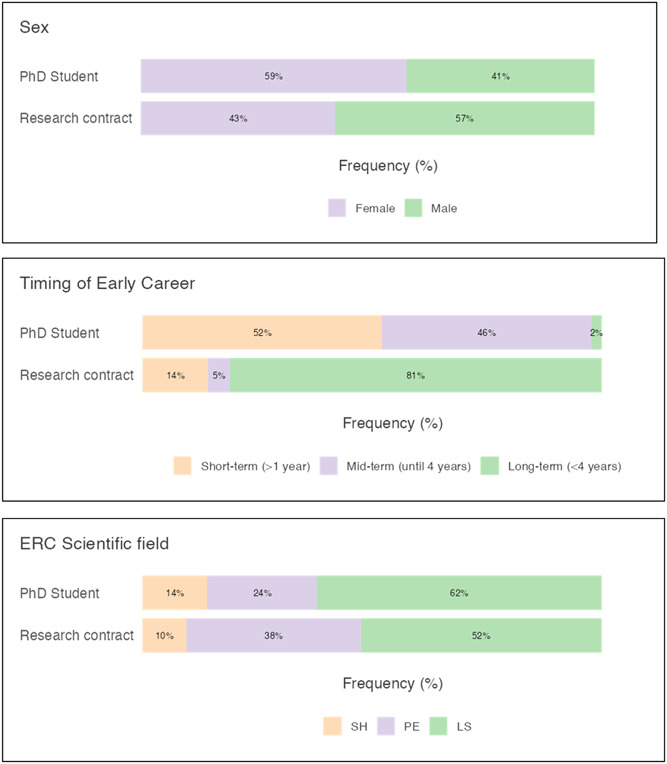
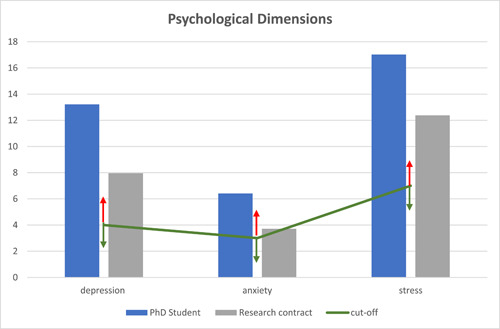
Background: Early career researchers (ECRs) are a strategic sector in the academic community because they represent a scientific incubator for future academic scholars. Recently, growing evidence suggests that relevant doctoral researchers work under elevated levels of stress and frustration and that this has a significant impact on their personal health and research output and their future career development. This study aimed to analyse the well‐being and mental health within ECR, focusing on coping strategies for stress, and to contribute and exploit a conceptual framework tailored to the academic context considering the specifics and challenges of academia. Methods: Participants were 134 young early career academics (mean age = 30.6; SD = 4.38; range = 25–40 years) enrolled via institutional email. A 94‐item questionnaire was created using Survey Monkey and distributed between October and December 2022. The survey assessment was based on three parts: (1) sociodemographic data, (2) psychological assessment, and (3) research skills design. Results: Our findings highlighted a general trend toward negative psychological dimensions in ECRs: PhD students and research contracts appeared to be stressed, anxious, and depressed. Moreover, they had segmented ECRs: PhD students showed higher levels of depression, anxiety, and stress than research contracts, highlighting reduced positive outcomes in psychological dimensions, as well as lower ability to manage emotional experiences and then to be perseverant for long‐term goals and motivation. Our findings highlight that mental health in ECRs is a challenge that needs to be addressed in academia. Conclusions: New and innovative ways of encouraging help‐seeking must be developed and implemented to address policy changes, communication activities, training, and health‐promotion activities through the circulation of experience, sharing actions, and strategies to foster healthy academics by raising awareness, implementing interventions, or engaging professionals concerning mental health in academia.
Overview
The claims and statistics of this paper haven’t been checked yet.
Run the check — free, no account needed. It reads the open-access text and checks the sources it cites.
Integrity signals
Registry
Cites
Statistics
Figures
Verification
Claims the paper makes
The claims and statistics of this paper haven’t been checked yet.
Run the check — free, no account needed. It reads the open-access text and checks the sources it cites.
Claims other papers make about this one
Each is checked against this paper’s own text: does it say what the citing paper says it does?
In the citing paper
“Second, postdoctoral ECRs made up less than 3% of the overall sample5,52,57,66,68,87–93, yet they face slightly different challenges than doctoral students, and thus, more research should be dedicated to this group.”
From Prevalence and severity of mental health problems in early-career researchers: a systematic review and meta-analysis (2026) · cites this paper as [89]
Self-check
Percentages, sums and reported differences re-computed from the paper’s own numbers.
The self-check needs the paper’s full text.
Citations
Cites
Relationships among positive emotions, coping, resilience and mental health
Gloria, C. T., & Steinhardt, M. A. (2016) · Stress and Health · doi:10.1002/smi.2589 · Cited by 530
Research works printed but not linked: 15
- 10.12688/f1000research.5878.1 · DOI
- 10.12688/wellcomeopenres.15832.1 · DOI
- 10.1073/pnas.1121429109 · DOI · Paper page
- 10.1016/j.paid.2014.11.053 · DOI
- 10.1080/0142159X.2022.2102471 · DOI
- 10.52095/gpa.2023.6210.1066 · DOI
- 10.1016/j.placenta.2021.10.013 · DOI
- 10.1038/d41586-020-03235-y · DOI
- World Medical Association. WMA DECLARATION OF HELSINKI [Internet].2008. Available from:https://www.wma.net/policies-post/wma-declaration-of-helsinki-ethical-principles-for-medical-research-involving-human-subjects/ · DOI
- 10.1016/j.comppsych.2015.04.005 · DOI · Paper page
- Lausi G, 2020, Development of the DERS‐20 among the Italian population: a study for a short form of the difficulties in emotion regulation scale. Mediterranean, J Clin Psychol, 8, 2020
- Sulla F, 2018, 2018 IEEE International Symposium on Medical Measurements and Applications (MeMeA) [Internet], 1
- 10.1080/01443410802366298 · DOI
- 10.1007/s40596-014-0041-y · DOI · Paper page
- Kismihók G, 2022, Italian translation of researcher mental health and well‐being manifesto ‐ manifesto per la salute mentale e il benessere dei ricercatori [Internet], Zenodo
Cited by
Sorted by citations
Dreisoerner, A., Goetz, V., Frohnmayer, D., Tran, U. S., Voracek, M., & Nater, U. M. (2026) · Nature Human Behaviour · doi:10.1038/s41562-026-02505-5 · Cited by 2
Metadata
- Authors
- Cilli, E., Ranieri, J., Guerra, F., & Di Giacomo, D.
- Venue
- Health Science Reports
- Publisher
- Wiley
- Published
- 2023-11
- Volume
- 6
- Issue
- 11
- ISSN
- 2398-8835
- PMC
- PMC10661320
- Cited by
- 24
- References
- 1
- Language
- en
About these checks
Registry, retraction, Cites and statistics results are computed, not judged, with one exception: a printed reference that no index lists is read once by a model before it counts as a citation error. Claims are extracted by a model and kept only when their quote appears verbatim in the text; each cited source is then checked, with a model’s help, for whether it says what the claim relies on. Those verdicts can be wrong — read the claim’s quote and the cited source before relying on one.
Statistics and arithmetic are recomputed, not judged.
Confidence bands are shown only for fields calibrated on our annotated test set. None is calibrated yet, so no band is shown.
What counts as a claim ›How we measure confidence ›How we check this ›
Are you an author, or do you see a problem with this page? Request a review
