

The DOI matches its Crossref record; 66 of the 67 references it cites were found in a registry or an index; none of the 38 sources its claims cite is checked for support yet.
Effects of maternal education on maternal and perinatal outcomes: An individual participant data meta‐analysis of 2 356 402 pregnancies
Open accessAbstract
Background: Maternal and perinatal mortality remain critical indicators of global health inequity. In 2020, an estimated 287 000 women died from preventable causes related to pregnancy, and in 2021, approximately 2.3 million neonatal deaths occurred within the first 28 days of life. A recently defined risk group, small vulnerable newborns (SVNs, including preterm, low birth weight, and small‐for‐gestational‐age infants), highlights the compounded vulnerability of certain newborns. Maternal education is a key social determinant of health, yet its effect on maternal and perinatal outcomes across global settings remains insufficiently quantified. Aims: The primary aim of this study was to quantify the association between maternal education level and adverse maternal and perinatal outcomes. The secondary aim was to evaluate whether these associations vary by country income level. Methods: We conducted an individual participant data (IPD) meta‐analysis using data from the International Prediction of Pregnancy Complications (IPPIC) Network. Eligible studies included those reporting maternal and perinatal outcomes stratified by at least two levels of maternal education (informal/primary, secondary, tertiary). Primary outcomes were maternal mortality, preeclampsia, stillbirth, and SVNs. Associations were estimated using a two‐step random‐effects IPD meta‐analysis adjusted for maternal age and ethnicity. Odds ratios (ORs) and 95% confidence intervals (CIs) were reported. Results: Compared to tertiary education, women with secondary education had a 27% higher risk of maternal death (OR 1.27, 95% CI 0.38; 4.30), and those with informal or primary education had approximately double the risk (OR 2.51, 95% CI 0.23; 26.95). Risk of stillbirth was also twofold higher in lower education groups. These association remained significant in analyses restricted to high‐income countries. Discussion: Women with lower levels of education are at substantially greater risk of adverse maternal and perinatal outcomes. These findings reinforce the need for education‐focused policy and health system strategies to reduce maternal and neonatal mortality, particularly in settings with high educational inequality.
Overview
CoChat Summary
TL;DR
In an IPD meta-analysis of 2,356,402 singleton pregnancies from 23 IPPIC cohorts, lower maternal education was associated with higher risks of stillbirth and small vulnerable newborns, but not preeclampsia or maternal death. The stillbirth association persisted in high-income countries, while the SVN association did not.
Key findings
- Maternal death: compared with tertiary education, secondary education had RR 1.27 (95% CI 0.38–4.30) and informal/primary education had RR 2.51 (95% CI 0.23–26.95); neither was statistically significant.
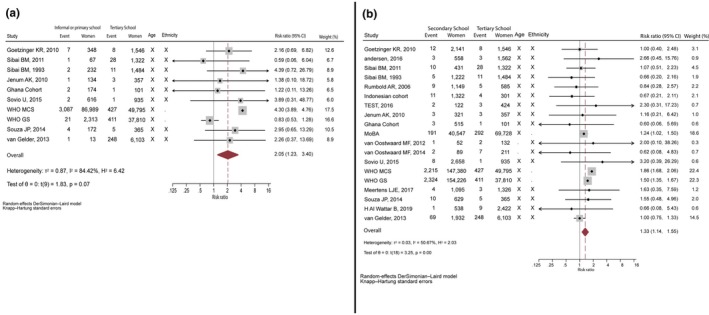
- Stillbirth: secondary education had RR 1.25 (95% CI 1.09–1.43) and informal/primary education had RR 2.03 (95% CI 1.27–3.24), compared with tertiary education.
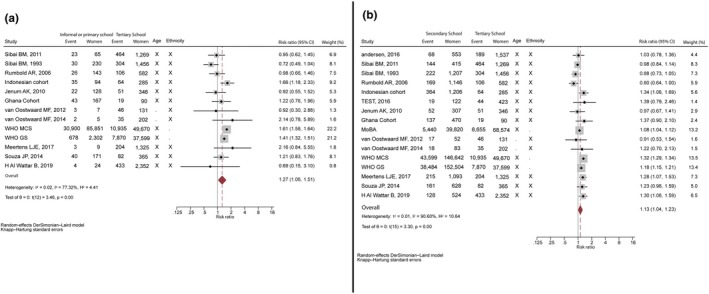
- Small vulnerable newborn: secondary education had RR 1.12 (95% CI 1.03–1.22) and informal/primary education had RR 1.20 (95% CI 1.01–1.44).
- Preeclampsia: no statistically significant differences; Table 1 reports RR 1.05 (95% CI 0.97–1.15) for secondary and RR 1.12 (95% CI 0.89–1.41) for informal/primary education.
Methods
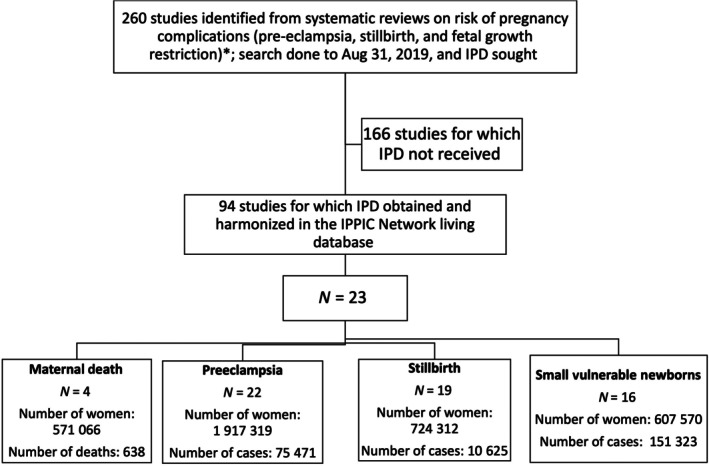
- Two-step random-effects individual participant data meta-analysis using the International Prediction of Pregnancy Complications (IPPIC) Network; 23 cohorts, 2,356,402 women with singleton pregnancies.
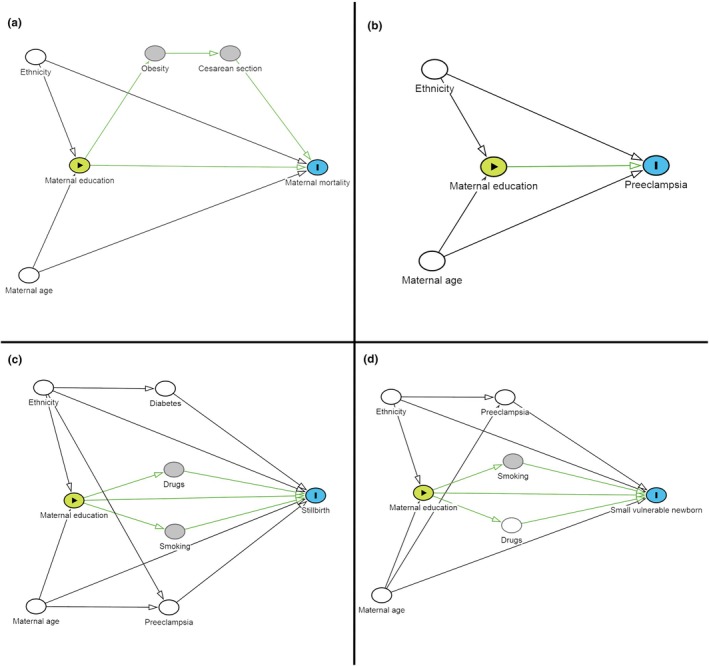
- Maternal education harmonized as informal/primary (≤6 years), secondary (7–12 years), and tertiary (>12 years), with tertiary as reference; models adjusted for maternal age and ethnicity.
- Multiple imputation with 10 datasets for missing data; within-cohort generalized linear models with log link, pooled using DerSimonian–Laird random-effects and Hartung–Knapp standard errors; reported risk ratios with 95% CIs, I², and τ².
Limitations
- The paper states: analysis was confined to IPPIC cohorts with shared IPD, potentially introducing exclusion bias; some cohorts had high missing data; temporal changes and varying stillbirth definitions may affect estimates; unmeasured confounding remains possible; risk-of-bias assessment was performed by a single reviewer.
- Evident from the text: maternal death estimates are very imprecise because of low event frequency; the text and Table 1 disagree on the secondary-education preeclampsia RR (text reports 1.25 [1.09–1.43], table reports 1.05 [0.97–1.15]).
Model-written summary. Check it against the paper before relying on it.
Integrity signals
Registry
Cites
Statistics
Figures
Verification
Claims the paper makes
0 Valid · 0 Not valid · 20 Not checked · 66 Own results and interpretations
A result the paper reports from its own data — it cites no other source for it, so there is none to check. The quote shows it is in the paper.
In the paper
“For stillbirth, we found a dose–response relationship between educational level and the risk of stillbirth, with a twofold increased risk of stillbirth for women with lower levels of education and a 25% increased risk in women with secondary education; that is also the case when our analysis is limited to high‐income countries.”
§ Effects of maternal education on maternal and perinatal outcomes: An individual participant data meta‐analysis of 2 356 402 pregnancies > DISCUSSION
plainstates an association- Asserted: passes — The authors put it forward as true.
- Checkable: passes — It can be checked against evidence.
- Load-bearing: passes — The paper’s conclusions depend on it.
- Based: passes — The paper gives a reason why it holds.
A result the paper reports from its own data — it cites no other source for it, so there is none to check. The quote shows it is in the paper.
In the paper
“Maternal death | Secondary school | 4 | 454 | 389 001 | 96 | 109 700 | 1.27 (0.38; 4.30) | 0.575 | 63.8 | 0.19”
§ Effects of maternal education on maternal and perinatal outcomes: An individual participant data meta‐analysis of 2 356 402 pregnancies > RESULTS > Maternal outcomes
plain- Asserted: passes — The authors put it forward as true.
- Checkable: passes — It can be checked against evidence.
- Load-bearing: unclear — It is unclear whether the paper’s conclusions depend on it.
- Based: passes — The paper gives a reason why it holds.
A result the paper reports from its own data — it cites no other source for it, so there is none to check. The quote shows it is in the paper.
In the paper
“Our data shows that women with lower education have a significantly higher risk of having an SVN, especially those from low‐ and middle‐income countries.”
§ Effects of maternal education on maternal and perinatal outcomes: An individual participant data meta‐analysis of 2 356 402 pregnancies > DISCUSSION
plainstates an association- Asserted: passes — The authors put it forward as true.
- Checkable: passes — It can be checked against evidence.
- Load-bearing: passes — The paper’s conclusions depend on it.
- Based: passes — The paper gives a reason why it holds.
A result the paper reports from its own data — it cites no other source for it, so there is none to check. The quote shows it is in the paper.
In the paper
“Pre‐eclampsia | Secondary school | 23 | 33 547 | 1 204 074 | 22 902 | 785 857 | 1.05 (0.97; 1.15) | 0.228 | 83.5 | 0.02”
§ Effects of maternal education on maternal and perinatal outcomes: An individual participant data meta‐analysis of 2 356 402 pregnancies > RESULTS > Maternal outcomes
plain- Asserted: passes — The authors put it forward as true.
- Checkable: passes — It can be checked against evidence.
- Load-bearing: unclear — It is unclear whether the paper’s conclusions depend on it.
- Based: passes — The paper gives a reason why it holds.
A result the paper reports from its own data — it cites no other source for it, so there is none to check. The quote shows it is in the paper.
In the paper
“Stillbirth | Secondary school | 19 | 7390 | 442 288 | 2092 | 196 837 | 1.25 (1·09; 1.43) | 0.003 | 54.1 | 0.03”
- Also stated in: § Perinatal outcomes · plain
“We found a 25% increased risk of stillbirth for women with secondary education compared with women with tertiary studies (RR 1.25 CI [1.09; 1.43])”
§ Effects of maternal education on maternal and perinatal outcomes: An individual participant data meta‐analysis of 2 356 402 pregnancies > RESULTS > Maternal outcomes
plainstates an association- Asserted: passes — The authors put it forward as true.
- Checkable: passes — It can be checked against evidence.
- Load-bearing: passes — The paper’s conclusions depend on it.
- Based: passes — The paper gives a reason why it holds.
- Also stated in: § Perinatal outcomes · plain
44 more claims
Create a free account to see all 86 claims and to verify the 36 references still open.
- Probably not a substantial claim. 32
- It may state two separate claims as one. 18
Self-check
Percentages, sums and reported differences re-computed from the paper’s own numbers.
Each contradiction between two passages listed here was confirmed by an independent check.
Rated major: it would touch a result — a value a result rests on, reported and recomputed p-values on opposite sides of the significance level, two passages that conflict with no sign which is right, or a cited work retracted before this paper was published.
In the paper
§ Effects of maternal education on maternal and perinatal outcomes: An individual participant data meta‐analysis of 2 356 402 pregnancies > Abstract > Results
“These association remained significant in analyses restricted to high‐income countries.”
§ Effects of maternal education on maternal and perinatal outcomes: An individual participant data meta‐analysis of 2 356 402 pregnancies > RESULTS > Perinatal outcomes
“Confirming the association between maternal education and maternal death was not possible because of the number of studies excluded, and the results for preeclampsia and maternal education were consistent with our previous results. It is to be noted that while analyzed only for high‐income countries, the association between maternal education and SVN was not consistent with the previous results.”
Rated minor: it would not touch a result — a value no result rests on, a p-value that stays on the same side of the significance level, or a conflict that is clerical, resolved elsewhere in the paper, or outside its own findings.
In the paper
§ Effects of maternal education on maternal and perinatal outcomes: An individual participant data meta‐analysis of 2 356 402 pregnancies > RESULTS > Maternal outcomes
“We did not found differences for the risk of preeclampsia in women with informal or primary school (RR 1.12, 95% CI [0.86; 1.41]) or secondary school education (RR 1.25 CI [1.09; 1.43]) when comparing them with women with university schooling (Table 1).”
§ Effects of maternal education on maternal and perinatal outcomes: An individual participant data meta‐analysis of 2 356 402 pregnancies > RESULTS > Maternal outcomes
“| Pre‐eclampsia | Secondary school | 23 | 33 547 | 1 204 074 | 22 902 | 785 857 | 1.05 (0.97; 1.15) | 0.228 | 83.5 | 0.02 |”
Rated minor: it would not touch a result — a value no result rests on, a p-value that stays on the same side of the significance level, or a conflict that is clerical, resolved elsewhere in the paper, or outside its own findings.
In the paper
§ Effects of maternal education on maternal and perinatal outcomes: An individual participant data meta‐analysis of 2 356 402 pregnancies > Abstract > Results
“Risk of stillbirth was also twofold higher in lower education groups.”
§ Effects of maternal education on maternal and perinatal outcomes: An individual participant data meta‐analysis of 2 356 402 pregnancies > RESULTS > Perinatal outcomes
“We found a 25% increased risk of stillbirth for women with secondary education compared with women with tertiary studies (RR 1.25 CI [1.09; 1.43]) and a twofold increase of risk of stillbirth (RR 2.03 CI [1.27; 3.24]) in women with informal or primary schooling”
Rated minor: it would not touch a result — a value no result rests on, a p-value that stays on the same side of the significance level, or a conflict that is clerical, resolved elsewhere in the paper, or outside its own findings.
In the paper
§ Effects of maternal education on maternal and perinatal outcomes: An individual participant data meta‐analysis of 2 356 402 pregnancies > RESULTS
“Seventeen studies reported data from high‐income countries, 13 , 26 , 27 , 28 , 29 , 30 , 31 , 32 , 33 , 34 , 35 , 36 , 37 , 38 , 39 , 40 , 41 one from a high–middle income country, 42 one from a middle‐income country, 47 one from a low‐income country, 43 and two studies reported data from multiple countries from different income levels. 44 , 45”
§ Effects of maternal education on maternal and perinatal outcomes: An individual participant data meta‐analysis of 2 356 402 pregnancies > RESULTS
“The IPPIC IPD Network's database included 23 cohorts that reported maternal education level and at least one of the adverse maternal and or perinatal outcomes of interest.”
Rated minor: it would not touch a result — a value no result rests on, a p-value that stays on the same side of the significance level, or a conflict that is clerical, resolved elsewhere in the paper, or outside its own findings.
In the paper
§ Effects of maternal education on maternal and perinatal outcomes: An individual participant data meta‐analysis of 2 356 402 pregnancies > Abstract > Results
“women with secondary education had a 27% higher risk of maternal death (OR 1.27, 95% CI 0.38; 4.30), and those with informal or primary education had approximately double the risk (OR 2.51, 95% CI 0.23; 26.95).”
§ Effects of maternal education on maternal and perinatal outcomes: An individual participant data meta‐analysis of 2 356 402 pregnancies > RESULTS > Maternal outcomes
“No statistically significant differences were found on the risk of maternal death from women with secondary school (RR 1.27, 95% CI [0.38; 4.30]) or informal or primary school education (RR 2.51, 95% CI [0.23; 26.95]) when comparing them with women with tertiary schooling.”
1 more finding
Create a free account to see every finding of this check.
Citations
Cites
Meta-analysis in clinical trials
DerSimonian, R., & Laird, N. (1986) · Controlled Clinical Trials · doi:10.1016/0197-2456(86)90046-2 · Cited by 39,552
Quantifying heterogeneity in a meta‐analysis
Higgins, J. P. T., & Thompson, S. G. (2002) · Statistics in Medicine · doi:10.1002/sim.1186 · Cited by 36,763
Multiple Imputation for Nonresponse in Surveys
Rubin, D. B. (1987) · Wiley Series in Probability and Statistics · doi:10.1002/9780470316696 · Cited by 20,701
The United Nations Development Programme
Oestreich, J. E. (2017) · Oxford University Press eBooks · doi:10.1093/acprof:oso/9780190637347.003.0003 · Cited by 4,875
Causal Diagrams for Epidemiologic Research
Greenland, S., Pearl, J., & Robins, J. M. (1999) · Epidemiology · doi:10.1097/00001648-199901000-00008 · Cited by 3,728
Major risk factors for stillbirth in high-income countries: a systematic review and meta-analysis
Flenady, V., Koopmans, L., Middleton, P., Frøen, J. F., Smith, G. C., Gibbons, K., Coory, M., Gordon, A., Ellwood, D., McIntyre, H. D., et al. (2011) · The Lancet · doi:10.1016/s0140-6736(10)62233-7 · Cited by 1,247
The Relationship Between Education and Health: Reducing Disparities Through a Contextual Approach
Zajacova, A., & Lawrence, E. M. (2018) · Annual Review of Public Health · doi:10.1146/annurev-publhealth-031816-044628 · Cited by 1,205
Cohort Profile Update: The Norwegian Mother and Child Cohort Study (MoBa).
Magnus, P., Birke, C., Vejrup, K., Haugan, A., Alsaker, E., Daltveit, A., Handal, M., Haugen, M., Høiseth, G., Knudsen, G., et al. (2016) · International Journal of Epidemiology · doi:10.1093/ije/dyw029 · Cited by 936
Maternal Mortality From Preeclampsia/Eclampsia
Ghulmiyyah, L., & Sibai, B. M. (2012) · Seminars in Perinatology · doi:10.1053/j.semperi.2011.09.011 · Cited by 893
Neonatal and perinatal mortality: country, regional and global estimates.
Lander, T. (2006) · Cited by 799
Research works printed but not linked: 2
- 2023, World Health Statistics 2023: Monitoring Health for the SDGs, Sustainable Development Goals
- 2015, The World's Women 2015. Trends and Statistics
Cited by
Positive Mental Health, Anxiety and Prenatal Bonding: A Contextual Approach
Ballesteros-Andrés, L. X., González, R. L., Rodríguez‐Rojo, I. C., García-Sastre, M., Cuesta‐Lozano, D., González, J. L. G., Martínez‐Hortelano, J. A., & Peñacoba, C. (2025) · Healthcare · doi:10.3390/healthcare13243300 · Cited by 3
He, J., Kassanjee, R., Movo, A., Walters, M. K., Brewer, E. D., Sorensen, R. J. D., Hay, S. I., Murray, C., Ad, F., Aravkin, A. Y., et al. (2026) · Archives of Pediatrics and Adolescent Medicine · doi:10.1001/jamapediatrics.2026.1235 · Cited by 1
Seymour, R. J., & Charles, S. J. (2025) · Evidence-Based Nursing · doi:10.1136/ebnurs-2025-104353
Khudor, A. J., Moga, M., Dimienescu, O. G., Nicolau, A. C., Arvătescu, C. A., & Hogea, M. D. (2025) · Journal of Clinical Medicine · doi:10.3390/jcm15010139
Itha, M., Pegu, B., VijayaLakshmi, B., Ramasamy, N., & Keepanasseril, A. (2026) · Cureus · doi:10.7759/cureus.104917
Postpartum as the Dominant Period of Maternal Death in Indonesia: Analysis of Survey Results
Suarni, L., Aliyanto, W., Pranajaya, R., & Sono, S. (2026) · Jurnal Kesehatan · doi:10.26630/jk.v17i1.5650
Henyk–Berezovska, S. O., Kitsera, N., Lukyanenko, N., Kech, N. R., Teneta, M., Helner, N. V., Drobchak, M., Bakum, K., & Hlohus, V. (2026) · CHILD`S HEALTH · doi:10.22141/2224-0551.21.3.2026.1953
Giri, K. E., Sumiati, S., & Kurniawati, Y. (2026) · Jurnal Manajemen Informasi Kesehatan (Health Information Management) · doi:10.51851/jmik.v11i1.941
Gashugi, Y., & Marthe, U. (2026) · Annals of Medicine and Surgery · doi:10.1097/ms9.0000000000005241
Haerani, A., Pramatirta, A. Y., & Sutrisno, W. A. (2026) · Indonesian Journal of Obstetrics & Gynecology Science · doi:10.24198/obgynia.v9i2.1170
Alfaro, J. C. S. (2026) · MediCiego · doi:10.5281/zenodo.22032488
Has the decline ended? A concerning shift in infant mortality trends in Europe: an urgent analysis
Romero-Arana, A., Arroyo-Bello, E., Rodríguez-Gómez, P., Abad-Valle, J., Navarro, E. C., González-Tejerina, B., Álvarez-Gómez, E., & Salgado, J. G. (2026) · Journal of Global Health · doi:10.7189/jogh.16.04247
Yıldız, A. G., Demir, D., Kurt, A., Ayhan, H., Mert, Ş. A., & Aksakal, S. E. (2026) · MIDDLE BLACK SEA JOURNAL OF HEALTH SCIENCE · doi:10.19127/mbsjohs.1981827
Ünal, E. (2026) · Acibadem Universitesi Saglik Bilimleri Dergisi · doi:10.31067/acusaglik.1944747
Kusumawardani, D. A., & Fadila, N. I. (2026) · JNKI (Jurnal Ners dan Kebidanan Indonesia) (Indonesian Journal of Nursing and Midwifery) · doi:10.21927/jnki.2026.14(3).440-464
Villasmil, E. J. R., & Mejía-Montilla, J. (2026) · Revista Repertorio de Medicina y Cirugía · doi:10.31260/repertmedcir.01217372.1889
Nabisubi, P., Kintu, T. M., Atwine, M. T., Bumba, J., Muwonge, L., Agasi, H., Kiberu, D., Okwir, J., Kakembo, F. E., Jjingo, D., et al. (2026) · Frontiers in Global Women s Health · doi:10.3389/fgwh.2026.1803064
Ganancial, F. S., & Hsieh, V. C. (2026) · Journal of Global Health · doi:10.7189/jogh.16.04324
Laceração e integridade vaginal em partos normais: uma análise de fatores associados
Beviláqua, J. C., Ferreira, E. D. S., Esteche, C. M. G. D. C. E., de Melo, L. P. T., Rodrigues, D. P., Ferreira, G. R. O. N., & Duho, A. Y. A. (2026) · Online Brazilian Journal of Nursing · doi:10.17665/1676-4285.20266927
Németh, K., Lantos, T., & Nyári, T. (2026) · Children · doi:10.3390/children13101356
Metadata
- Authors
- Bello‐Álvarez, L., Fernández‐Félix, B. M., Allotey, J., Thangaratinam, S., & Zamora, J.
- Affiliations
- Escuela de Doctorado, Doctorado en Epidemiología y Salud Pública Universidad Autónoma de Madrid Madrid España
- Unidad de Bioestadística Clínica, Hospital Ramón y Cajal (IRYCIS), CIBERESP Madrid España
- WHO Collaborating Centre for Global Women's Health, Institute of Metabolism and Systems Research University of Birmingham Birmingham UK
- University of Liverpool (GB)
- Instituto Ramón y Cajal de Investigación Sanitaria (ES)
- ORCID
- Venue
- International Journal of Gynecology & Obstetrics
- Publisher
- Wiley
- Published
- 2025-07-28
- Volume
- 172
- Issue
- 2
- Pages
- 886-895
- ISSN
- 0020-6695 (ISSN-L)
- 0020-7292
- 1879-3479
- PMC
- PMC12790673
- OpenAlex
- W4412694805
- Cited by
- 20
- References
- 67
- Citations by year
- 2026: 17 · 2025: 3
- FWCI
- 3.46
- Type
- journal article
- Language
- en
- Open access
- hybrid
- doi.org
- Licence
- Locations
- International Journal of Gynecology & Obstetrics (publishedVersion, cc-by-nc-nd)
- PubMed (publishedVersion)
- PubMed Central (publishedVersion, cc-by-nc-nd)
- University of Birmingham Research Portal (University of Birmingham) (publishedVersion, cc-by-nc-nd)
- Biblos-e Archivo (Universidad Autónoma de Madrid) (submittedVersion, public-domain)
- Funders
- Instituto de Salud Carlos III (PI24/1406, PI24/0416)
- Topics
- Health Sciences › Medicine › Pediatrics, Perinatology and Child Health › Global Maternal and Child Health
- Health Sciences › Medicine › Pediatrics, Perinatology and Child Health › Maternal and Neonatal Healthcare
- Health Sciences › Medicine › Obstetrics and Gynecology › Maternal and Perinatal Health Interventions
- Keywords
- maternal education, maternal mortality, perinatal outcomes, stillbirth, preeclampsia, low birth weight, preterm birth, social determinants of health, educational inequality, country income level, neonatal mortality
- MeSH terms
- Educational Status, Female, Humans, Infant, Newborn, Infant, Small for Gestational Age, Maternal Mortality, Pregnancy, Pregnancy Complications, Pregnancy Outcome, Global Health, Stillbirth, Perinatal Mortality
About these checks
Registry, retraction, Cites and statistics results are computed, not judged, with one exception: a printed reference that no index lists is read once by a model before it counts as a citation error. Claims are extracted by a model and kept only when their quote appears verbatim in the text; each cited source is then checked, with a model’s help, for whether it says what the claim relies on. Those verdicts can be wrong — read the claim’s quote and the cited source before relying on one.
A language model drew the claims from the paper on 2026-11-13, under version 3 of the claim definition (model deepseek-v4.1-flash, prompt extract-v3).
A second model labelled each claim on 2026-11-13 (model jev-1.13-20260917, definition revision gold-guideline-v0.2).
Statistics and arithmetic are recomputed, not judged.
Confidence bands are shown only for fields calibrated on our annotated test set. None is calibrated yet, so no band is shown.
What counts as a claim ›How we measure confidence ›How we check this ›
Are you an author, or do you see a problem with this page? Request a review
Data sources
Bibliographic data: Semantic Scholar, OpenAlex, Crossref.
Contains information from the Semantic Scholar Academic Graph Datasets, made available under the ODC Attribution License (ODC-BY 1.0).
Semantic Scholar’s data is described in: Kinney, R., et al. (2023). The Semantic Scholar Open Data Platform. arXiv:2301.10140.
