

The DOI matches its Crossref record.
Double arcsine transform not appropriate for meta‐analysis
Abstract
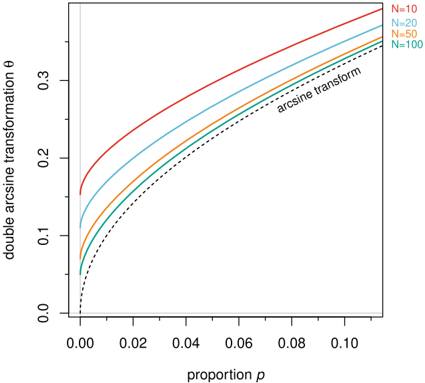
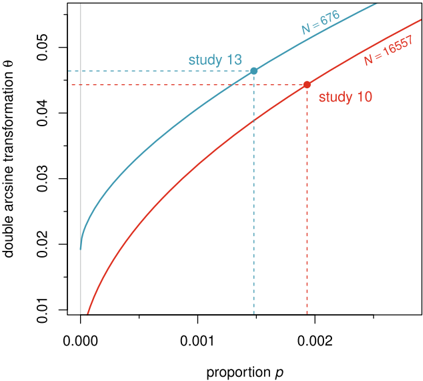
The variance‐stabilizing Freeman–Tukey double arcsine transform was originally proposed for inference on single proportions. Subsequently, its use has been suggested in the context of meta‐analysis of proportions. While some erratic behavior has been observed previously, here we point out and illustrate general issues of monotonicity and invertibility that make this transform unsuitable for meta‐analysis purposes.
Overview
The claims and statistics of this paper haven’t been checked yet.
Run the check — free, no account needed. It reads the open-access text and checks the sources it cites.
Integrity signals
Registry
Cites
Statistics
Figures
Verification
Claims the paper makes
The claims and statistics of this paper haven’t been checked yet.
Run the check — free, no account needed. It reads the open-access text and checks the sources it cites.
Claims other papers make about this one
Each is checked against this paper’s own text: does it say what the citing paper says it does?
In the citing paper
“which has been proved to generate more adequate results than the double arcsine transformation when dealing with varying sample sizes228,229”
From Prevalence and severity of mental health problems in early-career researchers: a systematic review and meta-analysis (2026) · cites this paper as [228]
In the citing paper
“Hence, prevalence rates were transformed prior to analysis, using the single (not double) arcsine transformation to stabilize the variance, which has been proved to generate more adequate results than the double arcsine transformation when dealing with varying sample sizes228,229:transformedES=ASIN(√ES),transformedvar=1/4n.”
From Prevalence and severity of mental health problems in early-career researchers: a systematic review and meta-analysis (2026) · cites this paper as [228]
Self-check
Percentages, sums and reported differences re-computed from the paper’s own numbers.
The self-check needs the paper’s full text.
Citations
Cites
No references could be resolved yet.
Research works printed but not linked: 14
- 10.1214/aoms/1177729756 · DOI
- 10.1016/j.spl.2009.04.010 · DOI
- 10.1002/jrsm.1348 · DOI · Paper page
- 10.1093/biomet/35.3‐4.246 · DOI · Paper page
- 10.2307/2983678 · DOI
- Eisenhart C, 1947, Selected Techniques of Statistical Analysis for Scientific and Industrial Research and Production Management Engineering, 395
- Freeman MF, 1949, Transformation Related to the Angular and the Square Root. Memorandum Report 24, Statistical Research Group
- 10.1093/biomet/43.1‐2.235 · DOI
- 10.1080/00031305.1978.10479283 · DOI
- 10.1002/hsr2.178 · DOI
- 10.1136/jech‐2013‐203104 · DOI · Paper page
- 10.1111/jebm.12445 · DOI
- 10.1097/EDE.0000000000001232 · DOI · Paper page
- 10.1007/s11606‐021‐07098‐5 · DOI
Cited by
Sorted by citations
Dreisoerner, A., Goetz, V., Frohnmayer, D., Tran, U. S., Voracek, M., & Nater, U. M. (2026) · Nature Human Behaviour · doi:10.1038/s41562-026-02505-5 · Cited by 2
Metadata
- Authors
- Röver, C., & Friede, T.
- Venue
- Research Synthesis Methods
- Publisher
- Wiley
- Published
- 2022-07-22
- Volume
- 13
- Issue
- 5
- Pages
- 645-648
- ISSN
- 1759-2879
- 1759-2887
- Cited by
- 31
- References
- 0
- Language
- en
- Funders
- Deutsche Forschungsgemeinschaft (FR 3070/3‐1)
About these checks
Registry, retraction, Cites and statistics results are computed, not judged, with one exception: a printed reference that no index lists is read once by a model before it counts as a citation error. Claims are extracted by a model and kept only when their quote appears verbatim in the text; each cited source is then checked, with a model’s help, for whether it says what the claim relies on. Those verdicts can be wrong — read the claim’s quote and the cited source before relying on one.
Statistics and arithmetic are recomputed, not judged.
Confidence bands are shown only for fields calibrated on our annotated test set. None is calibrated yet, so no band is shown.
What counts as a claim ›How we measure confidence ›How we check this ›
Are you an author, or do you see a problem with this page? Request a review
