

The DOI matches its Crossref record; 39 of the 39 references it cites were found in a registry or an index.
100‐Layer Error‐Free 5D Optical Data Storage by Ultrafast Laser Nanostructuring in Glass
Open accessAbstract
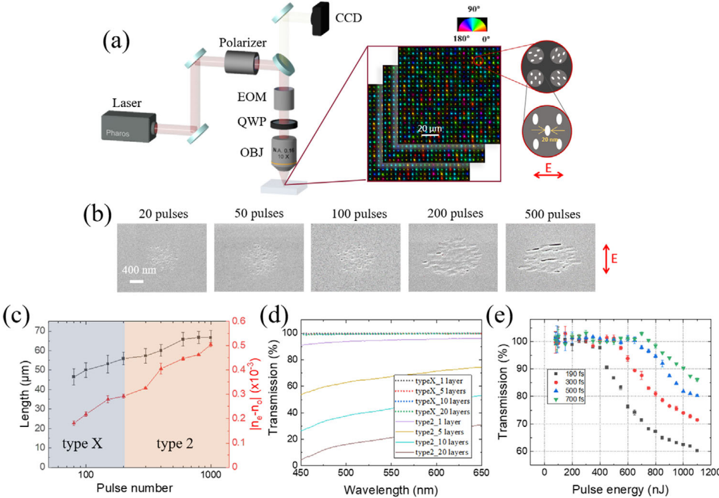
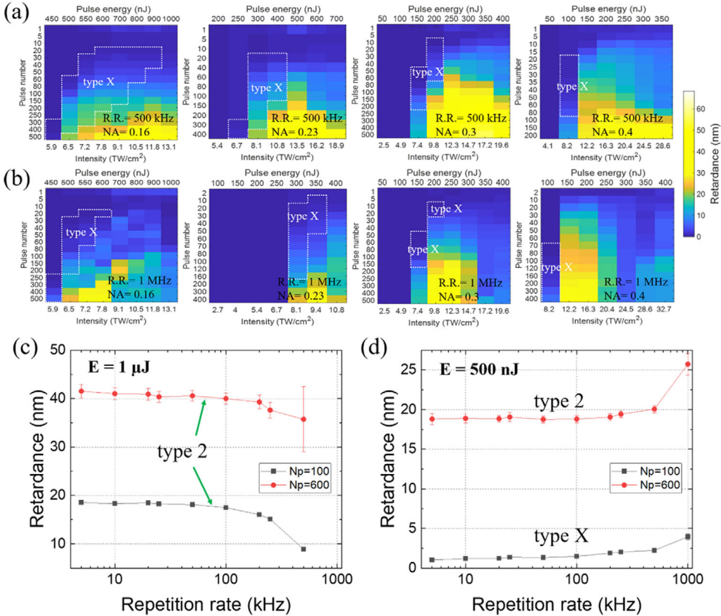
The demand for energy efficient data storage technologies with high capacity and long life span is increasingly growing due to the explosion of digital information in modern society. Here, a 5D optical data storage with high capacity and ultralong lifetime is realized by femtosecond‐laser‐induced anisotropic nanopore structures (type X modification) in silica glass. The ultrahigh transmission of this birefringent modification, >99% in the visible range, allows recording and retrieving thousands of layers of multibit digital data practically. Type X formation is associated with moderate free carrier density produced close to the energy threshold of avalanche ionization. Higher retardance with increased repetition rate at low pulse energy is attributed to accumulation of defects (nonbridging oxygen hole centers), enabling rapid imprinting of voxels by megahertz‐rate pulses. Data recording of 7 bits per voxel, i.e., 2 5 azimuth angles and 2 2 retardance levels is experimentally demonstrated with readout error as small as 0.6%. Furthermore, “The Hitchhiker's Guide to the Galaxy” by Douglas Adams is optically recorded with a data writing speed of 8 kB s−1 in 100 layers of voxels and the proven data readout accuracy of 100%.
Overview
The claims and statistics of this paper haven’t been checked yet.
Free: it reads the open-access text and checks the first 5 claims that cite a source we can check. Create a free account to check every claim.
Integrity signals
Registry
Cites
Statistics
Figures



Verification
Claims the paper makes
The claims and statistics of this paper haven’t been checked yet.
Free: it reads the open-access text and checks the first 5 claims that cite a source we can check. Create a free account to check every claim.
Claims other papers make about this one
Each is checked against this paper’s own text: does it say what the citing paper says it does?
The source backs part of the claim, not all of it — or backs it for a different population, condition or comparison.
In the citing paper
“The resulting weak modifications allow us to improve density substantially beyond reported approaches because they exhibit low scattering and cross-talk and so enable data writing and reading from more than 300 layers10,25,27 (see section ‘Reading and decoding data’).”
From Laser writing in glass for dense, fast and efficient archival data storage (2026) · cites this paper as [25]
Experimental — accuracy not yet measuredThe cited source says what the claim attributes to it.
In the citing paper
“Existing works are limited in throughput and efficiency, in part because many rely on multiple laser pulses per voxel10,24–26.”
From Laser writing in glass for dense, fast and efficient archival data storage (2026) · cites this paper as [25]
Self-check
Percentages, sums and reported differences re-computed from the paper’s own numbers.
The self-check needs the paper’s full text.
Citations
Cites
Femtosecond laser micromachining in transparent materials
Gattass, R. R., & Mazur, E. (2008) · Nature Photonics · doi:10.1038/nphoton.2008.47 · Cited by 3,247
Femtosecond, picosecond and nanosecond laser ablation of solids
Chichkov, B. N., Momma, C., Nolte, S., Alvensleben, F., & Tünnermann, A. (1996) · Applied Physics A Materials Science & Processing · doi:10.1007/bf01567637 · Cited by 3,066
Three-Dimensional Optical Storage Memory
Parthenopoulos, D. A., & Rentzepis, P. M. (1989) · Science · doi:10.1126/science.245.4920.843 · Cited by 1,608
Self-Organized Nanogratings in Glass Irradiated by Ultrashort Light Pulses
Shimotsuma, Y., Kazansky, P. G., Qiu, J., & Hirao, K. (2003) · Physical Review Letters · doi:10.1103/physrevlett.91.247405 · Cited by 1,292
Self-citationLaser-Induced Damage in Dielectrics with Nanosecond to Subpicosecond Pulses
Stuart, B. C., Feit, M. D., Rubenchik, A. M., Shore, B. W., & Perry, M. D. (1995) · Physical Review Letters · doi:10.1103/physrevlett.74.2248 · Cited by 1,277
Five-dimensional optical recording mediated by surface plasmons in gold nanorods
Zijlstra, P., Chon, J. W. M., & Gu, M. (2009) · Nature · doi:10.1038/nature08053 · Cited by 1,234
Three-dimensional optical storage inside transparent materials
Glezer, E. N., Milosavljevic, M., Huang, L., Finlay, R. J., Her, T.-H., Callan, J. P., & Mazur, E. (1996) · Optics Letters · doi:10.1364/ol.21.002023 · Cited by 985
Properties and structure of vitreous silica. I
Brückner, R. (1970) · Journal of Non-Crystalline Solids · doi:10.1016/0022-3093(70)90190-0 · Cited by 917
Volume Holographic Storage and Retrieval of Digital Data
Heanue, J. F., Bashaw, M. C., & Hesselink, L. (1994) · Science · doi:10.1126/science.265.5173.749 · Cited by 604
Seemingly Unlimited Lifetime Data Storage in Nanostructured Glass
Zhang, J., Gecevičius, M., Beresna, M., & Kazansky, P. G. (2014) · Physical Review Letters · doi:10.1103/physrevlett.112.033901 · Cited by 414
Self-citation
Cited by
A 3D nanoscale optical disk memory with petabit capacity
Zhao, M., Wen, J., Hu, Q., Wei, X., Zhong, Y., Ruan, H., & Gu, M. (2024) · Nature · doi:10.1038/s41586-023-06980-y · Cited by 153
“…intensity and polarization states of the light utilizes the nature of plasmonic properties of metallic nanorods 7,8 and the birefringence of a nanograting in fused quartz 10,11 , which lack the on–off switching property like the principle of stimulated emission depletion (STED) microscopy 19–26 .”
BackgroundMethodUltrafast Laser Direct Writing Nanogratings and their Engineering in Transparent Materials
Yao, H., Pugliese, D., Lancry, M., & Dai, Y. (2024) · Laser & Photonics Reviews · doi:10.1002/lpor.202300891 · Cited by 115
Femtosecond laser-induced periodic structures: mechanisms, techniques, and applications
Zhang, Y., Jiang, Q., Long, M., Han, R., Cao, K., Zhang, S., Feng, D., Jia, T., Sun, Z., Qiu, J., et al. (2022) · Opto-Electronic Science · doi:10.29026/oes.2022.220005 · Cited by 114
Zhang, B., Wang, Z., Tan, D., & Qiu, J. (2023) · PhotoniX · doi:10.1186/s43074-023-00101-8 · Cited by 78
“e 100-layer optical data storage with nanopores in fused silica [182].”
BackgroundTailoring chiral optical properties by femtosecond laser direct writing in silica
Lu, J., Tian, J. R., Poumellec, B., Garcia‐Caurel, E., Ossikovski, R., Zeng, X., & Lancry, M. (2023) · Light Science & Applications · doi:10.1038/s41377-023-01080-y · Cited by 56
Metadata
- Authors
- Wang, H., Lei, Y., Wang, L., Sakakura, M., Yu, Y., Shayeganrad, G., & Kazansky, P. G.
- Affiliations
- University of Southampton (GB)
- Optoelectronics Research Centre University of Southampton Southampton SO17 1BJ UK
- Corresponding author
- Wang, Huijun
- Venue
- Laser & Photonics Reviews
- Publisher
- Wiley
- Published
- 2022-01-23
- Volume
- 16
- Issue
- 4
- ISSN
- 1863-8880 (ISSN-L)
- 1863-8899
- OpenAlex
- W4207037892
- Cited by
- 123
- References
- 39
- Citations by year
- 2026: 31 · 2025: 28 · 2024: 26 · 2023: 26 · 2022: 12
- FWCI
- 12.34
- Type
- journal article
- Language
- en
- Open access
- hybrid
- doi.org
- Licence
- Locations
- Laser & Photonics Review (publishedVersion, cc-by)
- ePrints Soton (University of Southampton) (acceptedVersion)
- Funders
- H2020 European Research Council (789116)
- Topics
- Physical Sciences › Engineering › Industrial and Manufacturing Engineering › Laser Material Processing Techniques
- Physical Sciences › Materials Science › Materials Chemistry › Phase-change materials and chalcogenides
- Physical Sciences › Materials Science › Electronic, Optical and Magnetic Materials › Nonlinear Optical Materials Studies
- Keywords
- femtosecond laser nanostructuring, fused silica, birefringence, non-bridging oxygen hole centers, free carrier concentration, avalanche ionization, megahertz repetition rate
About these checks
Registry, retraction, Cites and statistics results are computed, not judged, with one exception: a printed reference that no index lists is read once by a model before it counts as a citation error. Claims are extracted by a model and kept only when their quote appears verbatim in the text; each cited source is then checked, with a model’s help, for whether it says what the claim relies on. Those verdicts can be wrong — read the claim’s quote and the cited source before relying on one.
Statistics and arithmetic are recomputed, not judged.
Confidence bands are shown only for fields calibrated on our annotated test set. None is calibrated yet, so no band is shown.
What counts as a claim ›How we measure confidence ›How we check this ›
Are you an author, or do you see a problem with this page? Request a review
How to cite
Cite CoChat for the checks on this page, and the paper for its own findings.
- This page
- CoChat. (2026). Citation check: 100‐Layer Error‐Free 5D Optical Data Storage by Ultrafast Laser Nanostructuring in Glass. https://app.cochat.ai/papers/10.1002/lpor.202100563
- The paper
- Wang, H., Lei, Y., Wang, L., Sakakura, M., Yu, Y., Shayeganrad, G., & Kazansky, P. G. (2022). 100‐Layer Error‐Free 5D Optical Data Storage by Ultrafast Laser Nanostructuring in Glass. Laser & Photonics Reviews. https://doi.org/10.1002/lpor.202100563
Data sources
Bibliographic data: Semantic Scholar, OpenAlex, Crossref.
Contains information from the Semantic Scholar Academic Graph Datasets, made available under the ODC Attribution License (ODC-BY 1.0).
Semantic Scholar’s data is described in: Kinney, R., et al. (2023). The Semantic Scholar Open Data Platform. arXiv:2301.10140.
