

The DOI matches its Crossref record; 2 of the 2 references it cites were found in a registry or an index.
Effect of vitamin D supplementation on clinical outcomes in adult patients with COVID‐19: A GRADE‐assessed systematic review and meta‐analysis of randomized controlled trials
Open accessAbstract
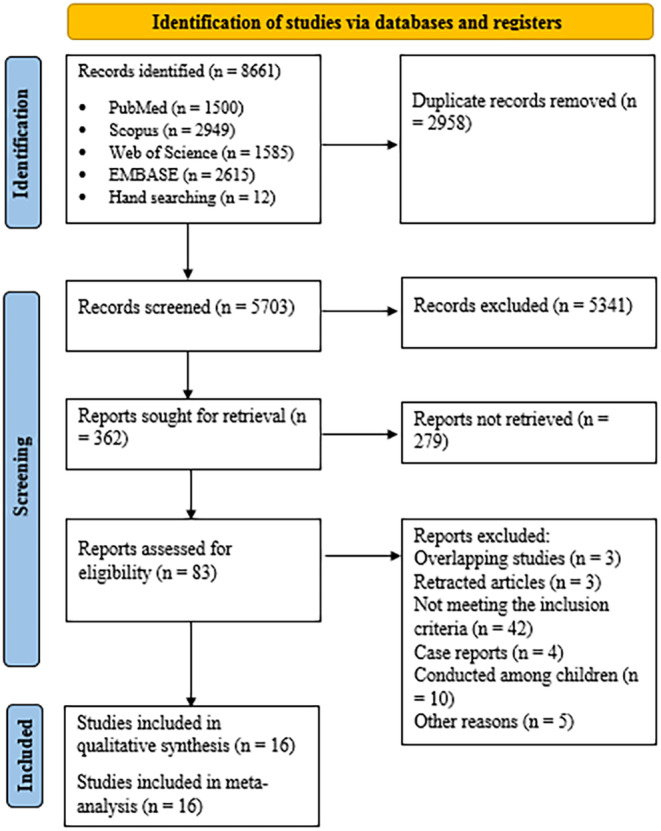
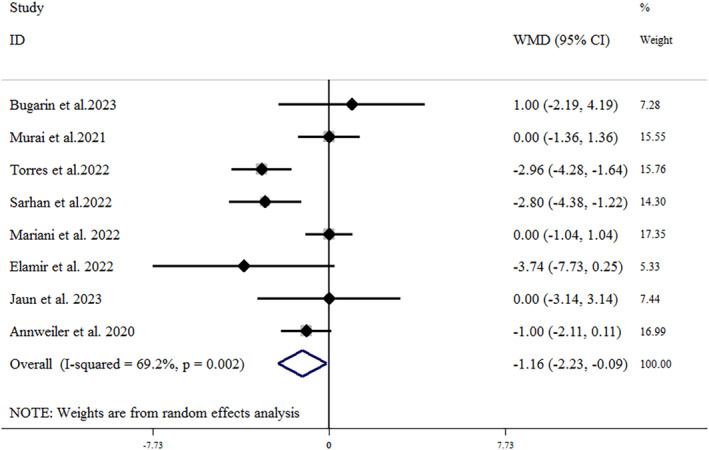
The COVID‐19 pandemic has emerged as a major global health crisis. Vitamin D, a crucial fat‐soluble vitamin, has been recommended for COVID‐19 patients, though evidence of its effectiveness is inconsistent. This systematic literature review and meta‐analysis aimed to evaluate the impact of vitamin D supplementation on COVID‐19‐related outcomes. A comprehensive search was conducted across PubMed, Scopus, Web of Science, Embase, and Cochrane databases. Primary outcomes included mortality and hospital length of stay, while secondary outcomes encompassed C‐reactive protein (CRP), ferritin, D‐dimer, hemoglobin (Hb) concentrations, and lymphocyte, neutrophil, and platelet counts. Data analysis was performed using Stata™ Version 14. A total of 16 trials were analyzed. The meta‐analysis revealed that vitamin D supplementation significantly reduced hospital length of stay (mean difference = −1.16; 95% confidence interval [CI]: −2.23, −0.09; p = .033) with significant heterogeneity (I2 = 69.2%, p = .002). Subgroup analysis showed a more pronounced reduction in studies with vitamin D dosages ≤10 000 international units (IU) (mean difference = −1.27; 95% CI: −1.96, −0.57; p < .001) and in patients over 60 years old (mean difference = −1.84; 95% CI: −2.53, −1.14; p < .001). Additionally, vitamin D significantly reduced CRP concentrations in older adults (>60 years) (mean difference = −1.13; 95% CI: −2.07, −0.18; p = .019). No significant changes were found in ferritin, D‐dimer, Hb concentrations, or in lymphocyte, neutrophil, and platelet counts (p > .05). In conclusion, while vitamin D supplementation did not significantly affect most COVID‐19‐related biomarkers, however, it reduces the length of hospital stay.
Overview
The claims and statistics of this paper haven’t been checked yet.
Run the check — free, no account needed. It reads the open-access text and checks the sources it cites.
Integrity signals
Registry
Cites
Statistics
Figures
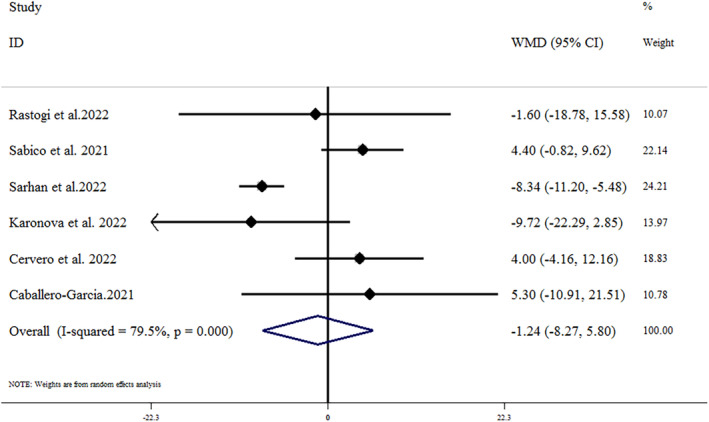
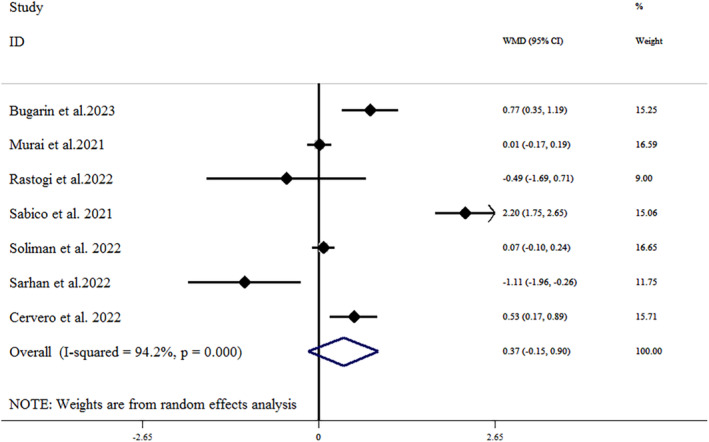
Verification
Claims the paper makes
The claims and statistics of this paper haven’t been checked yet.
Run the check — free, no account needed. It reads the open-access text and checks the sources it cites.
Claims other papers make about this one
Each is checked against this paper’s own text: does it say what the citing paper says it does?
The source backs part of the claim, not all of it — or backs it for a different population, condition or comparison.
In the citing paper
“This NMA and current evidence suggest therapeutic supplementation with VD,173 VC,4,174 and zinc16 may outperform preventive supplementation in reducing RTI duration or symptom severity”
From Comparative effectiveness of oral nutritional supplements in preventing respiratory tract infections among adults: a systematic review and network meta-analysis (2025) · cites this paper as [173]
Experimental — accuracy not yet measured
Self-check
Percentages, sums and reported differences re-computed from the paper’s own numbers.
The self-check needs the paper’s full text.
Citations
Cites
GRADE: an emerging consensus on rating quality of evidence and strength of recommendations
Guyatt, G. H., Oxman, A. D., Vist, G. E., Kunz, R., Falck-Ytter, Y., Alonso-Coello, P., & Schünemann, H. J. (2008) · BMJ · doi:10.1136/bmj.39489.470347.ad · Cited by 23,305
Page, M. J., Moher, D., Bossuyt, P. M., Boutron, I., Hoffmann, T. C., Mulrow, C. D., Shamseer, L., Tetzlaff, J. M., Akl, E. A., Brennan, S. E., et al. (2021) · BMJ · doi:10.1136/bmj.n160 · Cited by 13,262 · cited 2×
“27 From the included studies, two studies were conducted in Egypt, two studies in Brazil, three studies in Spain, and one study each in Croatia, Switzerland, India, Argentina, Israel, Russia, Saudi Arabia, Mexico, and France.”
BackgroundResult
Research works printed but not linked: 59
- 10.4081/monaldi.2020.1292 · DOI
- Shafieipour S, 2023, Gastrointestinal bleeding: prevalence, etiology, and outcomes in COVID‐19 inpatients, GOVARESH, 28, 30
- 10.4084/MJHID.2023.059 · DOI
- 10.37201/req/158.2021 · DOI
- 10.3390/ph14060520 · DOI
- 10.1002/ptr.6873 · DOI
- 10.30699/ijmm.17.2.243 · DOI
- 10.1093/advances/nmaa125 · DOI
- 10.1038/s41430-020-0634-3 · DOI
- De Flora S, 2021, Antioxidants and COVID‐19, J Prev Med Hyg, 62, 13185
- 10.3390/medicina56080386 · DOI
- 10.1016/j.ejmech.2022.114175 · DOI
- 10.1080/20469047.2023.2171759 · DOI
- 10.2147/JIR.S363840 · DOI
- 10.3390/nu12061626 · DOI
- 10.1016/S2213-8587(21)00051-6 · DOI · Paper page
- 10.1097/MD.0000000000017252 · DOI
- 10.12688/f1000research.131730.1 · DOI
- 10.1007/s40475-021-00236-3 · DOI
- 10.3389/fmed.2023.1121256 · DOI
- 10.1210/me.2013-1146 · DOI
- Jaun F, 2023, Effect of single high dose vitamin D substitution in hospitalized COVID‐19 patients with vitamin D deficiency on length of hospital stay, Biomedicine, 11, 1277
- 10.3390/nu15051234 · DOI
- 10.1080/14787210.2022.2035217 · DOI
- 10.3389/fimmu.2022.1023903 · DOI
- 10.1136/bmj.d5928 · DOI · Paper page
- 10.1111/jebm.12018 · DOI
- 10.1136/bmj.315.7109.629 · DOI · Paper page
- 10.3389/fphar.2022.863587 · DOI
- 10.1136/postgradmedj-2020-139065 · DOI
- 10.1016/j.biopha.2022.112965 · DOI
- 10.1177/20101058211041405 · DOI
- 10.3390/medicina58101358 · DOI
- 10.1371/journal.pone.0267918 · DOI
- 10.1016/j.bone.2021.116175 · DOI
- 10.3390/nu14132602 · DOI
- 10.1001/jama.2020.26848 · DOI
- 10.3390/nu13072170 · DOI
- 10.3390/jcm10112378 · DOI
- 10.1371/journal.pmed.1003999 · DOI
- 10.1016/j.jsbmb.2020.105751 · DOI
- 10.3390/medicina57101079 · DOI
- 10.1530/EJE-20-0665 · DOI
- 10.1016/S2213-8587(20)30183-2 · DOI
- 10.1136/thoraxjnl-2014-206680 · DOI
- 10.1016/j.clnu.2021.03.001 · DOI
- 10.1016/j.mayocp.2021.01.001 · DOI
- 10.1111/ijcp.13908 · DOI
- 10.1177/1753425917719143 · DOI
- 10.1038/ki.1991.296 · DOI
- 10.1016/j.jsbmb.2010.03.034 · DOI
- 10.1002/rmv.2159 · DOI
- 10.1080/14787210.2021.1941871 · DOI
- 10.1007/s11154-021-09707-4 · DOI
- 10.1016/j.virusres.2020.198235 · DOI
- 10.1016/j.ijid.2020.05.055 · DOI
- 10.18632/aging.102999 · DOI
- 10.1002/jmv.25871 · DOI
- 10.26633/RPSP.2020.72 · DOI
Cited by
Sorted by citations
Zhu, Z., Zhu, X., Chu, Y., Zhang, B., & Chen, Y. (2025) · EClinicalMedicine · doi:10.1016/j.eclinm.2025.103479 · Cited by 4
Metadata
- Authors
- Ghoreshi, Z., Charostad, J., Arefinia, N., Nakhaie, M., Rezaei Zadeh Rukerd, M., & Salajegheh, F.
- Affiliations
- University of Jiroft (IR)
- Shahid Sadoughi University of Medical Sciences and Health Services (IR)
- Kerman University of Medical Sciences (IR)
- Gastroenterology and Hepatology Research Center, Institute of Basic and Clinical Physiology Sciences Kerman University of Medical Sciences Kerman Iran
- Corresponding author
- Salajegheh, Faranak
- ORCID
- Venue
- Pharmacology Research & Perspectives
- Publisher
- Wiley
- Published
- 2024-09-30
- Volume
- 12
- Issue
- 5
- Pages
- e70013-e70013
- ISSN
- 2052-1707 (ISSN-L)
- PMC
- PMC11442836
- OpenAlex
- W4403045273
- Cited by
- 6
- References
- 2
- Citations by year
- 2026: 2 · 2025: 4
- FWCI
- 0.45
- Type
- journal article
- Language
- en
- Open access
- gold
- doi.org
- Licence
- Locations
- Pharmacology Research & Perspectives (publishedVersion, cc-by-nc-nd)
- PubMed Central (publishedVersion, cc-by-nc-nd)
- PubMed (publishedVersion)
- DOAJ (DOAJ: Directory of Open Access Journals) (submittedVersion, cc-by-sa)
- Topics
- Health Sciences › Medicine › Endocrinology, Diabetes and Metabolism › Vitamin D Research Studies
- Health Sciences › Medicine › Infectious Diseases › COVID-19 Clinical Research Studies
- Health Sciences › Nursing › Nutrition and Dietetics › Vitamin C and Antioxidants Research
- Keywords
- vitamin D supplementation, COVID-19 pandemic, length of hospital stay, mortality, C-reactive protein, ferritin, D-dimer, older adults, vitamin D dosage, inflammatory markers
- MeSH terms
- COVID-19, SARS-CoV-2, COVID-19 Drug Treatment, Adult, C-Reactive Protein, Ferritins, Fibrin Fibrinogen Degradation Products, Humans, Length of Stay, Vitamin D, Vitamins, Randomized Controlled Trials as Topic, Treatment Outcome, Dietary Supplements
About these checks
Registry, retraction, Cites and statistics results are computed, not judged, with one exception: a printed reference that no index lists is read once by a model before it counts as a citation error. Claims are extracted by a model and kept only when their quote appears verbatim in the text; each cited source is then checked, with a model’s help, for whether it says what the claim relies on. Those verdicts can be wrong — read the claim’s quote and the cited source before relying on one.
Statistics and arithmetic are recomputed, not judged.
Confidence bands are shown only for fields calibrated on our annotated test set. None is calibrated yet, so no band is shown.
What counts as a claim ›How we measure confidence ›How we check this ›
Are you an author, or do you see a problem with this page? Request a review
