

The DOI matches its Crossref record; 1 of the 1 references it cites were found in a registry or an index.
Development and Qualification of Physiologically Based Pharmacokinetic Models for Drugs With Atypical Distribution Behavior: A Desipramine Case Study
Open accessAbstract
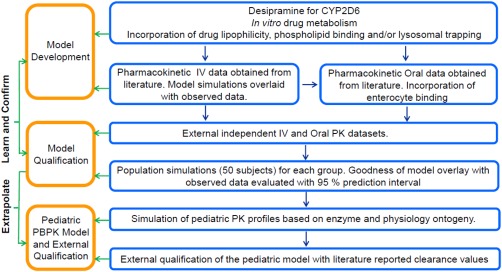
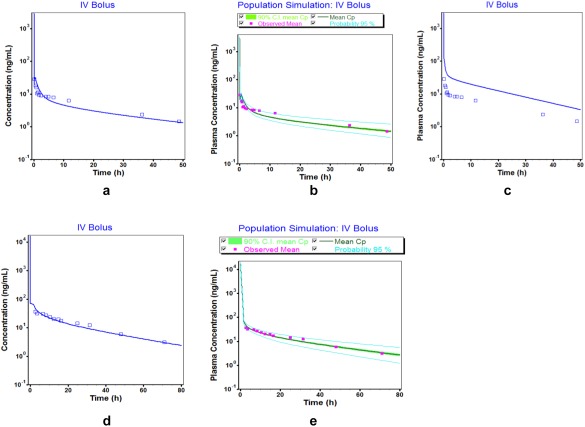
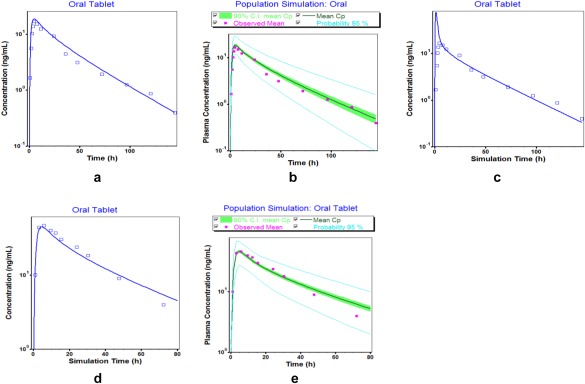
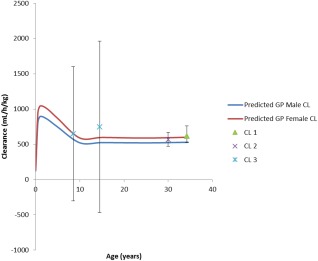
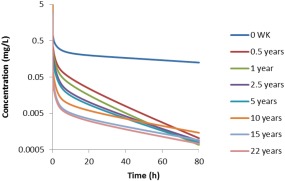
Desipramine is a secondary tricyclic amine, which is primarily metabolized by cytochrome 2D6. It shows a high volume of distribution (Vss) (10–50 L/kg) due to its high lipophilicity, unspecific phospholipid binding, and lysosomal trapping. The objective of this study was to develop and qualify a physiologically based pharmacokinetic (PBPK) model for desipramine, which accounts for the high Vss of the drug following intravenous and oral administration of doses up to 100 mg. The model also accounts for the extended time to reach maximum concentration after oral dosing due to enterocyte trapping. Once developed and qualified in adults, we characterized the dynamic changes in metabolism and pharmacokinetics of desipramine after birth by scaling the system‐specific parameters of the model from adults to pediatrics. The developed modeling strategy provides a prototypical workflow that can also be applied to other drugs with similar properties and a high volume of distribution.
Overview
The claims and statistics of this paper haven’t been checked yet.
Run the check — free, no account needed. It reads the open-access text and checks the sources it cites.
Integrity signals
Registry
Cites
Statistics
Figures
Verification
Claims the paper makes
The claims and statistics of this paper haven’t been checked yet.
Run the check — free, no account needed. It reads the open-access text and checks the sources it cites.
Claims other papers make about this one
Each is checked against this paper’s own text: does it say what the citing paper says it does?
The source backs part of the claim, not all of it — or backs it for a different population, condition or comparison.
In the citing paper
“The adjustment of BPR to account for phospholipid binding as well as lysosomal trapping of basic lipophilic compounds is currently an empirical fit and exploits the observation that acidic phospholipid content is highest in tissues with high lysosomal volumes [53].”
From Physiologically Based Pharmacokinetic Modelling for First-In-Human Predictions: An Updated Model Building Strategy Illustrated with Challenging Industry Case Studies (2019) · cites this paper as [53]
Experimental — accuracy not yet measuredThe source backs part of the claim, not all of it — or backs it for a different population, condition or comparison.
In the citing paper
“In other cases, measured input data for BPR have been empirically adjusted to match predictions to observed distribution [53].”
From Physiologically Based Pharmacokinetic Modelling for First-In-Human Predictions: An Updated Model Building Strategy Illustrated with Challenging Industry Case Studies (2019) · cites this paper as [53]
Experimental — accuracy not yet measured
Self-check
Percentages, sums and reported differences re-computed from the paper’s own numbers.
The self-check needs the paper’s full text.
Citations
Cites
(1996) · American Journal of Psychiatry · doi:10.1176/ajp.153.9.1147 · Cited by 228
Research works printed but not linked: 39
- 10.2165/00003088-199018050-00002 · DOI
- 10.1023/A:1006949816036 · DOI
- 10.1038/clpt.1982.50 · DOI
- 10.1007/BF00558386 · DOI
- 10.1038/clpt.1986.13 · DOI
- 10.1056/NEJM199108293250907 · DOI
- 10.1097/00004583-198909000-00022 · DOI
- Scahill L., 2014, A placebo‐controlled study of guanfacine in the treatment of children with tic disorders and attention deficit hyperactivity disorder., 158, 1067
- 10.1097/00004583-199307000-00013 · DOI
- Swanson J.R., 1997, Death of two subjects due to imipramine and desipramine metabolite accumulation during chronic therapy: a review of the literature and possible mechanisms, J. For. Sci., 42, 335
- 10.1002/jcph.555 · DOI
- 10.1111/j.1600-0773.1995.tb01050.x · DOI
- 10.1111/j.1600-0773.1997.tb00285.x · DOI
- 10.1111/j.1460-9592.2010.03323.x · DOI
- 2013, GastroPlus Manual, version 8.5
- 10.1016/0169-409X(96)00009-9 · DOI
- 10.1021/mp4003392 · DOI
- 10.1046/j.1365-2125.1997.00591.x · DOI
- 10.1038/clpt.1988.66 · DOI
- 10.1038/clpt.1988.50 · DOI
- 10.1016/S0009-9236(97)90062-X · DOI
- 10.1038/clpt.1986.221 · DOI
- 10.1038/psp.2014.45 · DOI
- 10.1208/s12248-013-9555-6 · DOI
- 10.1592/phco.19.9.746.31539 · DOI
- 10.1111/j.1365-2125.2004.02225.x · DOI
- 10.1093/toxsci/66.2.185 · DOI
- 10.1002/(SICI)1520-6017(200001)89:1<16::AID-JPS3>3.0.CO;2-E · DOI
- 10.1002/1520-6017(200104)90:4<436::AID-JPS1002>3.0.CO;2-P · DOI
- 10.1002/jps.20073 · DOI · Paper page
- 10.1002/jps.20322 · DOI · Paper page
- 10.1002/jps.20502 · DOI
- 10.1007/s11095-006-9210-3 · DOI · Paper page
- 10.1211/jpp.61.05.0002 · DOI
- 10.1002/bdd.1776 · DOI
- 10.1002/psp4.33 · DOI · Paper page
- 10.1080/15287390490273550 · DOI
- 10.1038/psp.2013.55 · DOI
- 10.2165/11592640-000000000-00000 · DOI
Cited by
Sorted by citations
Miller, N. A., Reddy, M. B., Heikkinen, A. T., Lukacova, V., & Parrott, N. (2019) · Clinical Pharmacokinetics · doi:10.1007/s40262-019-00741-9 · Cited by 142
Self-citation
Metadata
- Authors
- Samant, T., Lukacova, V, & Schmidt, S.
- Affiliations
- University of Florida (US)
- Simulations Plus (United States) (US)
- Corresponding author
- Schmidt, S
- ORCID
- Schmidt, S
- Venue
- CPT: Pharmacometrics & Systems Pharmacology
- Publisher
- Wiley
- Published
- 2017-04-11
- Volume
- 6
- Issue
- 5
- Pages
- 315-321
- ISSN
- 2163-8306 (ISSN-L)
- PMC
- PMC5697013
- OpenAlex
- W2606308747
- Cited by
- 22
- References
- 1
- Citations by year
- 2026: 2 · 2025: 3 · 2024: 1 · 2023: 2 · 2021: 1 · 2020: 6 · 2019: 3 · 2018: 2 · 2017: 2
- FWCI
- 3.88
- Type
- journal article
- Language
- en
- Open access
- gold
- doi.org
- Licence
- Locations
- CPT Pharmacometrics & Systems Pharmacology (publishedVersion, cc-by-nc)
- PubMed Central (publishedVersion, cc-by-nc)
- PubMed (publishedVersion)
- Topics
- Health Sciences › Medicine › Pediatrics, Perinatology and Child Health › Pharmaceutical studies and practices
- Life Sciences › Pharmacology, Toxicology and Pharmaceutics › Pharmacology › Pharmacogenetics and Drug Metabolism
- Physical Sciences › Mathematics › Statistics and Probability › Statistical Methods in Clinical Trials
- Keywords
- desipramine, physiologically based pharmacokinetic modeling, lysosomal trapping, phospholipid binding, lipophilicity, pediatric pharmacokinetics, allometric scaling, model qualification
- MeSH terms
- Adult, Antidepressive Agents, Tricyclic, Child, Desipramine, Humans, Models, Biological, Tissue Distribution
About these checks
Registry, retraction, Cites and statistics results are computed, not judged, with one exception: a printed reference that no index lists is read once by a model before it counts as a citation error. Claims are extracted by a model and kept only when their quote appears verbatim in the text; each cited source is then checked, with a model’s help, for whether it says what the claim relies on. Those verdicts can be wrong — read the claim’s quote and the cited source before relying on one.
Statistics and arithmetic are recomputed, not judged.
Confidence bands are shown only for fields calibrated on our annotated test set. None is calibrated yet, so no band is shown.
What counts as a claim ›How we measure confidence ›How we check this ›
Are you an author, or do you see a problem with this page? Request a review
How to cite
Cite CoChat for the checks on this page, and the paper for its own findings.
- This page
- CoChat. (2026). Citation check: Development and Qualification of Physiologically Based Pharmacokinetic Models for Drugs With Atypical Distribution Behavior: A Desipramine Case Study. https://app.cochat.ai/papers/10.1002/psp4.12180
- The paper
- Samant, T., Lukacova, V, & Schmidt, S. (2017). Development and Qualification of Physiologically Based Pharmacokinetic Models for Drugs With Atypical Distribution Behavior: A Desipramine Case Study. CPT: Pharmacometrics & Systems Pharmacology. https://doi.org/10.1002/psp4.12180
