

The DOI matches its Crossref record; 2 of the 2 references it cites were found in a registry or an index.
The Role of Lexical Frequency in Syntactic Ambiguity Resolution
Open accessAbstract
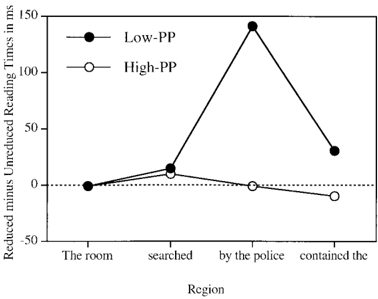
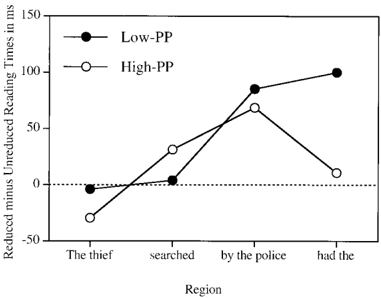
The role of lexical frequency in syntactic ambiguity resolution was explored in two self-paced reading studies of ambiguous reduced relative clauses. Recent constraint-based models of syntactic ambiguity resolution have proposed that for a reduced relative clause (e.g., “The room searched by the police was . . .”), both the participle and past tense forms of the ambiguous verb (“searched”) are made available in parallel and that local syntactic and semantic information are used to resolve the ambiguity within a parallel constraint-satisfaction process (MacDonald, Pearlmutter, & Seidenberg, 1994a; Trueswell, Tanenhaus, & Garnsey, 1994). A crucial prediction of these models is that the frequency with which the verb is used as a participle form in the language should affect a reader's ability to consider the relative clause alternative. This prediction was confirmed in two self-paced reading experiments that directly manipulated participle frequency while controlling for the degree of contextual constraint. Implications for constraint-based lexicalist accounts of sentence comprehension are discussed.
Overview
The claims and statistics of this paper haven’t been checked yet.
Run the check — free, no account needed. It reads the open-access text and checks the sources it cites.
Integrity signals
Registry
Cites
Statistics
Figures
Verification
Claims the paper makes
The claims and statistics of this paper haven’t been checked yet.
Run the check — free, no account needed. It reads the open-access text and checks the sources it cites.
Claims other papers make about this one
Each is checked against this paper’s own text: does it say what the citing paper says it does?
In the citing paper
“Thus, the ambiguityis stronglyconstrained bythe frequencywith which the ambiguous verb occurs in transitive and passive structures, of which reduced relative clauses are a special type (MacDonald, 1994; MacDonald, Pearlmutter, & Seidenberg, 1994; Trueswell, 1996).”
From FREQUENCY EFFECTS IN LANGUAGE PROCESSING: A Review with Implications for Theories of Implicit and Explicit Language Acquisition (2002) · cites this paper as Trueswell, 1996
Self-check
Percentages, sums and reported differences re-computed from the paper’s own numbers.
The self-check needs the paper’s full text.
Citations
Cites
FREQUENCY ANALYSIS OF ENGLISH USAGE: LEXICON AND GRAMMAR
Francis, W. N., Kučera, H., & Mackie, A. W. (1983) · Medical Entomology and Zoology · Cited by 2,310
Burchfield, R. (1985) · Journal of English Linguistics · doi:10.1177/007542428501800107 · Cited by 1,254
Research works printed but not linked: 22
- structures. In J. R. Hayes (Ed.) Cognition and the FRAZIER, L. (1987). Sentence processing: A tutorial re- development of language. New York: John Wiley view. In M. Coltheart (Ed.), Attention and perfor- and Sons. mance XII. Hillsdale, NJ: Lawrence Erlbaum Associ-
- BOLAND, J. E., TANENHAUS, M. K., GARNSEY, S. M., & ates. CARLSON, G. (1995). Verb argument structure in FRAZIER, L. (1989). Against lexical generation of syntax. parsing and interpretation: Evidence from wh-ques- In W. Marslen-Wilson (Ed.), Lexical representation tions. Journal of Memory and Language, 34, 774- and process. Cambridge, MA: MIT Press. 806.
- sitional phrases. Journal of Memory and Language, FRAZIER, L., & RAYNER, K. (1982). Making and correct- 33, 251-283. ing errors during sentence comprehension: Eye
- BRITT, M. A., PERFETTI, C. A., GARROD, S., & RAYNER, movements in the analysis of structurally ambiguous K. (1992). Parsing and discourse: Context effects and sentences. Cognitive Psychology, 14, 178-210. their limits. Journal of Memory and Language, 31, 293-314.
- JULIANO, C., & TABOR, W. (1995). Frequency-contrast and grammatical representation: The case of fre- BURGESS, C. (1991). Interaction of semantic, syntactic and visual factors in syntactic ambiguity resolution. quency by regularity interactions. Paper presented at the 8th Annual CUNY Conference on Human Sen- Ph.D. dissertation, Department of Psychology, Uni- versity of Rochester, Rochester, NY. tence Processing. Tucson, AZ.
- JULIANO, C., & TANENHAUS, M. K. (1993). Contingent course influences during parsing are delayed. Cogni- tion, 45, 109-139. frequency effects in syntactic ambiguity resolution. In Proceedings of the 15th annual conference of the RAYNER, K., PACHT, J. M., & DUFFY, S. A. (1994). Effects Cognitive Science Society. Hillsdale, NJ: Lawrence of prior encounter and discourse bias on the pro- Erlbaum Associates. cessing of lexically ambiguous words: Evidence from eye fixations. Journal of Memory and Language, 33, JUST, M. A., CARPENTER, P. A., & WOOLLEY, J. (1982). Paradigms and processes in reading comprehension. 527-544. Journal of Experimental Psychology, General, 111, SEIDENBERG, M. S., & MCCLELLAND, J. L. (1989). A 228-238. distributed developmental model of word recognition and naming. Psychological Review, 96, 523-568.
- MACDONALD, M. C. (1994). Probabilistic constraints and syntactic ambiguity resolution. Language and Cogni-SERENO, S. C., PACHT, J. M., & RAYNER, K. (1992). The tive Processes, 9, 157-201. effect of meaning frequency on processing lexically ambiguous words: Evidence from eye fixations. Psy- MACDONALD, M. C., PEARLMUTTER, N. J., & SEIDEN- BERG, M. S. (1994a). The lexical nature of syntactic chological Science, 3(5), 296-299.
- ambiguity resolution. Psychological Review, 101, SIMPSON, G., & BURGESS, B. (1985). Activation and selec- 676-703. tion processes in the recognition of ambiguous words. Journal of Experimental Psychology: Human
- as lexical ambiguity resolution. In C. Clifton, L. Fra-SIMPSON, G. B., & KRUEGER, M. A. (1991). Selective zier, & K. Rayner (Eds.), Perspectives on sentence access of homograph meanings in sentence context. processing. Hillsdale, NJ: Lawrence Erlbaum Asso- Journal of Memory and Language, 30, 627-643.
- ciates. SPIVEY-KNOWLTON, M. J., & SEDIVY, J. (1995). Resolving MARSLEN-WILSON, W. D., & TYLER, L. K. (1987). attachment ambiguities with multiple constraints. Against modularity. In J. Garfield (Ed.), Modularity Cognition, 55, 227-267. in knowledge representations and natural language SPIVEY-KNOWLTON, M. J., TRUESWELL, J. C., & TANEN- understanding. Cambridge, MA: MIT Press.
- MCCLELLAND, J. L. (1987). The case for interactionism in resolution. Canadian Journal of Psychology, 47, language processing.
- In M. Coltheart (Ed.), Attention 276-309.
- NI, W., & CRAIN, S. (1990). How to resolve structural Journal of Verbal Learning and Verbal Behavior, ambiguities. In Proceedings of the 20th annual meet- 18, 645-659. ing of the North Eastern Linguistic Society.
- Amherst, TABOSSI, P. (1988). Accessing lexical ambiguity in differ- MA: Graduate Student Linguistics Association. ent types of sentential contexts. Journal of Memory
- PEARLMUTTER, N. J., & MACDONALD, M. C. (1992). Gar- and Language, 27, 324-340. den-paths in ''simple'' sentences. Paper presented TABOSSI, P., COLOMBO, L., JOB., R. (1987). Accessing at the Fifth Annual CUNY Conference on Human lexical ambiguity: Effects of context and dominance. Sentence Processing. New York, NY. Psychological Research, 49(2-3), 161-167.
- Moscovitch (Eds.) Attention and performance XV. Hillsdale, NJ: Lawrence Erlbaum Associates.
- PLAUT, D. C., MCCLELLAND, J. L., SEIDENBERG, M. S., & PATTERSON, K. E. (1996). Understanding Normal and TABOSSI, P., & ZARDON, F. (1993). Processing ambiguous Impaired Word Reading: Computational Principles words in context. Journal of Memory and Language, of Quasi-Regular Domains. Psychological Review, 32(3), 359-372. 103, 56-115.
- TANENHAUS, M. K., LEIMAN, J., & SEIDENBERG, M. S. RAYNER, K., CARLSON, M., & FRAZIER, L. (1983). The (1979). Evidence for multiple stages in the pro- interaction of syntax and semantics during sentence cessing of ambiguous words in syntactic contexts. processing. Journal of Verbal Learning and Verbal Journal of Verbal Learning and Verbal Behavior, Behavior, 22, 358-374. 18, 427-440.
- RAYNER, K., & FRAZIER, L. (1989). Selectional mecha-TANENHAUS, M. K., SPIVEY-KNOWLTON, M. J., EBER- nisms in reading lexically ambiguous words. Journal HARD, K. M., & SEDIVY, J. C. (1995). Interpretation of Experimental Psychology: Learning, Memory and of visual and linguistic information in spoken lan- Cognition, 5, 779-790. guage comprehension. Science, 268, 1632-1634.
- RAYNER, K., GARROD, S., & PERFETTI, C. A. (1992). Dis- a lexicalist framework for constraint-based syntactic resolution. Journal of Memory and Language, 33, 285-318.
- ambiguity resolution. In C. Clifton, K. Rayner, & L. Frazier (Eds.), Perspectives on sentence processing. TRUESWELL, J. C., TANENHAUS, M. K., & KELLO, C. (1993). Verb-specific constraints in sentence pro- Hillsdale, NJ: Lawrence Erlbaum Associates.
- TRUESWELL, J. C., & TANENHAUS, M. K. (1991). Tense, cessing: Separating effects of lexical preference from garden-paths. Journal of Experimental Psychology: temporal context and syntactic ambiguity resolution. Language and Cognitive Processes, 6, 303-338. Learning, Memory and Cognition, 19(3), 528-553.
Cited by
Sorted by citations
Barsalou, L. W. (2008) · Annual Review of Psychology · doi:10.1146/annurev.psych.59.103006.093639 · Cited by 5,936
Linguistic complexity: locality of syntactic dependencies
Gibson, E. (1998) · Cognition · doi:10.1016/s0010-0277(98)00034-1 · Cited by 2,537
Ellis, N. C. (2002) · Studies in Second Language Acquisition · doi:10.1017/s0272263102002024 · Cited by 2,230
The P600 as an index of syntactic integration difficulty
Kaan, E., Harris, A., Gibson, E., & Holcomb, P. (2000) · Language and Cognitive Processes · doi:10.1080/016909600386084 · Cited by 993
Modeling the Influence of Thematic Fit (and Other Constraints) in On-line Sentence Comprehension
McRae, K., Spivey-Knowlton, M. J., & Tanenhaus, M. K. (1998) · Journal of Memory and Language · doi:10.1006/jmla.1997.2543 · Cited by 763
Redundancy and reduction: Speakers manage syntactic information density
Jaeger, T. F. (2010) · Cognitive Psychology · doi:10.1016/j.cogpsych.2010.02.002 · Cited by 728
Human simulations of vocabulary learning.
Gillette, J., Gleitman, H., Gleitman, L., & Lederer, A. (1999) · Cognition · doi:10.1016/s0010-0277(99)00036-0 · Cited by 644
The kindergarten-path effect: studying on-line sentence processing in young children
Trueswell, J. C., Алексеевна, С. И., Hill, N. M., & Logrip, M. L. (1999) · Cognition · doi:10.1016/s0010-0277(99)00032-3 · Cited by 695
Self-citationThe effects of common ground and perspective on domains of referential interpretation
Hanna, J. E., Tanenhaus, M. K., & Trueswell, J. C. (2003) · Journal of Memory and Language · doi:10.1016/s0749-596x(03)00022-6 · Cited by 532
Self-citationConsequences of the Serial Nature of Linguistic Input for Sentenial Complexity
Grodner, D. J., & Gibson, E. A. F. (2005) · Cognitive Science · doi:10.1207/s15516709cog0000_7 · Cited by 470
Breheny, R., Katsos, N., & Williams, J. N. (2005) · Cognition · doi:10.1016/j.cognition.2005.07.003 · Cited by 454
Shake, rattle, 'n' roll: the representation of motion in language and cognition.
Papafragou, A., Massey, C. M., & Gleitman, L. (2002) · Cognition · doi:10.1016/s0010-0277(02)00046-x · Cited by 299
Diessel, H. (2019) · Cambridge University Press eBooks · doi:10.1017/9781108671040 · Cited by 517
Agreement Processes in Sentence Comprehension
Pearlmutter, N. J., Garnsey, S. M., & Bock, K. (1999) · Journal of Memory and Language · doi:10.1006/jmla.1999.2653 · Cited by 410
Effect of Ambiguity and Lexical Availability on Syntactic and Lexical Production
Ferreira, V. S., & Dell, G. S. (2000) · Cognitive Psychology · doi:10.1006/cogp.1999.0730 · Cited by 402
Propose but verify: Fast mapping meets cross-situational word learning
Trueswell, J. C., Medina, T. N., Hafri, A., & Gleitman, L. R. (2012) · Cognitive Psychology · doi:10.1016/j.cogpsych.2012.10.001 · Cited by 398
Self-citationProbabilistic Modeling in Psycholinguistics: Linguistic Comprehension and Production
Jurafsky, D. (2003) · The MIT Press eBooks · doi:10.7551/mitpress/5582.003.0006 · Cited by 357
Spivey, M. J. (2002) · Cognitive Psychology · doi:10.1016/s0010-0285(02)00503-0 · Cited by 353
A Probabilistic Constraints Approach to Language Acquisition and Processing
Seidenberg, M. S., & MacDonald, M. C. (1999) · Cognitive Science · doi:10.1207/s15516709cog2304_8 · Cited by 335
Snedeker, J., & Trueswell, J. (2004) · Cognitive Psychology · doi:10.1016/j.cogpsych.2004.03.001 · Cited by 372
Self-citationThe role of discourse context in the processing of a flexible word-order language
KAISER, E., & Trueswell, J. C. (2004) · Cognition · doi:10.1016/j.cognition.2004.01.002 · Cited by 314
Self-citationProcessing of relative clauses is made easier by frequency of occurrence
Reali, F., & Christiansen, M. H. (2006) · Journal of Memory and Language · doi:10.1016/j.jml.2006.08.014 · Cited by 308
Priming ditransitive structures in comprehension
Arai, M., van Gompel, R. P. G., & Scheepers, C. (2006) · Cognitive Psychology · doi:10.1016/j.cogpsych.2006.07.001 · Cited by 307
The Neural Bases of Sentence Comprehension: a fMRI Examination of Syntactic and Lexical Processing
Keller, T. A. (2001) · Cerebral Cortex · doi:10.1093/cercor/11.3.223 · Cited by 304
Spivey, M. J., & Tanenhaus, M. K. (1998) · Journal of Experimental Psychology Learning Memory and Cognition · doi:10.1037//0278-7393.24.6.1521 · Cited by 297
Knowledge of grammar, knowledge of usage: Syntactic probabilities affect pronunciation variation
Gahl, S., & Garnsey, S. M. (2004) · Language · doi:10.1353/lan.2004.0185 · Cited by 287
The Effect of Thematic Roles on Pronoun Use and Frequency of Reference Continuation
Arnold, J. E. (2001) · Discourse Processes · doi:10.1207/s15326950dp3102_02 · Cited by 250
The Information Conveyed by Words in Sentences
Hale, J. (2003) · Journal of Psycholinguistic Research · doi:10.1023/a:1022492123056 · Cited by 293
Selective Integration of Linguistic Knowledge in Adult Second Language Learning
Jiang, N. (2007) · Language Learning · doi:10.1111/j.1467-9922.2007.00397.x · Cited by 294
The Coordinated Interplay of Scene, Utterance, and World Knowledge: Evidence From Eye Tracking
Knoeferle, P., & Crocker, M. W. (2006) · Cognitive Science · doi:10.1207/s15516709cog0000_65 · Cited by 279
Individual differences in online spoken word recognition: Implications for SLI
McMurray, B., Samelson, V. M., Lee, S. H., & Tomblin, J. B. (2009) · Cognitive Psychology · doi:10.1016/j.cogpsych.2009.06.003 · Cited by 277
Constraints on sentence comprehension
Gibson, E. A. F., & Pearlmutter, N. J. (1998) · Trends in Cognitive Sciences · doi:10.1016/s1364-6613(98)01187-5 · Cited by 276
Adjunct Attachment Is Not a Form of Lexical Ambiguity Resolution
Traxler, M. J., Pickering, M. J., & Clifton, C. (1998) · Journal of Memory and Language · doi:10.1006/jmla.1998.2600 · Cited by 265
January, D., Trueswell, J. C., & Thompson-Schill, S. L. (2009) · Journal of Cognitive Neuroscience · doi:10.1162/jocn.2008.21179 · Cited by 236
Self-citationRöder, B., Stock, O., Neville, H. J., Bien, S., & Rösler, F. (2002) · NeuroImage · doi:10.1006/nimg.2001.1026 · Cited by 236
Statistical Learning Using Real-World Scenes
Brady, T. F., & Oliva, A. (2008) · Psychological Science · doi:10.1111/j.1467-9280.2008.02142.x · Cited by 243
The processing role of structural constraints on interpretation of pronouns and anaphors.
Badecker, W., & Straub, K. A. (2002) · Journal of Experimental Psychology Learning Memory and Cognition · doi:10.1037//0278-7393.28.4.748 · Cited by 221
Ambiguity in sentence processing
Altmann, G. (1998) · Trends in Cognitive Sciences · doi:10.1016/s1364-6613(98)01153-x · Cited by 219
Bemis, D., & Liina Pylkkänen, A. (2012) · Cerebral Cortex · doi:10.1093/cercor/bhs170 · Cited by 226
Ambiguity Resolution in Sentence Processing: Evidence against Frequency-Based Accounts
Pickering, M. J., Traxler, M. J., & Crocker, M. W. (2000) · Journal of Memory and Language · doi:10.1006/jmla.2000.2708 · Cited by 212
How to Prune a Garden Path by Nipping It in the Bud: Fast Priming of Verb Argument Structure
Trueswell, J. C., & Kim, A. E. (1998) · Journal of Memory and Language · doi:10.1006/jmla.1998.2565 · Cited by 213
Self-citationTabor, W., Juliano, C., & Tanenhaus, M. K. (1997) · Language and Cognitive Processes · doi:10.1080/016909697386853 · Cited by 198
This construction needs learned.
Kaschak, M. P., & Glenberg, A. M. (2004) · Journal of Experimental Psychology General · doi:10.1037/0096-3445.133.3.450 · Cited by 190
Syntactic priming in written production: Evidence for rapid decay
Branigan, H. P., Pickering, M. J., & Cleland, A. A. (1999) · Psychonomic Bulletin & Review · doi:10.3758/bf03212972 · Cited by 183
The Centrality of Metrical Structure in Signaling Information Structure: A Probabilistic Perspective
Calhoun, S. (2010) · Language · doi:10.1353/lan.0.0197 · Cited by 176
Reanalysis in Sentence Processing: Evidence against Current Constraint-Based and Two-Stage Models
van Gompel, R. P. G., Pickering, M. J., & Traxler, M. J. (2001) · Journal of Memory and Language · doi:10.1006/jmla.2001.2773 · Cited by 176
The use of thematic role information in parsing: Syntactic processing autonomy revisited
Clifton, C. (2003) · Journal of Memory and Language · doi:10.1016/s0749-596x(03)00070-6 · Cited by 175
Ungrammaticality detection and garden path strength: Evidence for serial parsing
Meng, M., & Bader, M. (2000) · Language and Cognitive Processes · doi:10.1080/016909600750040580 · Cited by 166
Constraint Satisfaction Accounts of Lexical and Sentence Comprehension
MacDonald, M. C., & Seidenberg, M. S. (2006) · Elsevier eBooks · doi:10.1016/b978-012369374-7/50016-x · Cited by 153
Linear Optimality Theory as a Model of Gradience in Grammar
Keller, F. (2006) · Oxford University Press eBooks · doi:10.1093/acprof:oso/9780199274796.003.0014 · Cited by 147
Pickering, M. J., & van Gompel, R. P. G. (2006) · Elsevier eBooks · doi:10.1016/b978-012369374-7/50013-4 · Cited by 147
Discourse Factors That Influence Online Reading of Metaphor and Irony
Pexman, P. M., Ferretti, T. R., & Katz, A. N. (2000) · Discourse Processes · doi:10.1207/s15326950dp2903_2 · Cited by 141
The role of entrenchment in children’s and adults’ performance on grammaticality judgment tasks
Theakston, A. (2003) · Cognitive Development · doi:10.1016/j.cogdev.2003.08.001 · Cited by 139
Hurewitz, F., Brown‐Schmidt, S., Thorpe, K., Gleitman, L. R., & Trueswell, J. C. (2000) · Journal of Psycholinguistic Research · doi:10.1023/a:1026468209238 · Cited by 132
Self-citationInferring gender from name phonology.
Cassidy, K. W., Kelly, M. H., & Sharoni, L. J. (1999) · Journal of Experimental Psychology General · doi:10.1037//0096-3445.128.3.362 · Cited by 129
Dynamical Models of Sentence Processing
Tabor, W., & Tanenhaus, M. K. (1999) · Cognitive Science · doi:10.1016/s0364-0213(99)00013-0 · Cited by 129
The Relationship between Syntactic and Semantic Processes in Sentence Comprehension
Boland, J. E. (1997) · Language and Cognitive Processes · doi:10.1080/016909697386808 · Cited by 125
Wide-Coverage Probabilistic Sentence Processing
Crocker, M. W., & Brants, T. (2000) · Journal of Psycholinguistic Research · doi:10.1023/a:1026560822390 · Cited by 125
A Bayesian Model Predicts Human Parse Preference and Reading Times in Sentence Processing
Narayanan, S., & Jurafsky, D. (2002) · The MIT Press eBooks · doi:10.7551/mitpress/1120.003.0012 · Cited by 112
The use of verb-specific information for prediction in sentence processing
Arai, M., & Keller, F. (2012) · Language and Cognitive Processes · doi:10.1080/01690965.2012.658072 · Cited by 103
Diessel, H. (2023) · Cambridge University Press eBooks · doi:10.1017/9781009327848 · Cited by 115
Comprehension of elided structure: Evidence from sluicing
Dickey, M. W., & Bunger, A. (2010) · Language and Cognitive Processes · doi:10.1080/01690961003691074 · Cited by 103
Frequency processing: a twenty-five year perspective
Zacks, R. T., & Hasher, L. (2002) · Oxford University Press eBooks · doi:10.1093/acprof:oso/9780198508632.003.0002 · Cited by 104
Processing of Morphological and Semantic Cues in Russian and German
Kempe, V. (1999) · Language and Cognitive Processes · doi:10.1080/016909699386329 · Cited by 100
The Grammar Network: How Linguistic Structure Is Shaped by Language Use
Diessel, H. (2019) · Cited by 100
Rules Versus Statistics: Insights From a Highly Inflected Language
Mirković, J., Seidenberg, M. S., & Joanisse, M. F. (2011) · Cognitive Science · doi:10.1111/j.1551-6709.2011.01174.x · Cited by 98
Fenlon, J., Schembri, A., Rentelis, R., Vinson, D., & Cormier, K. (2014) · Lingua · doi:10.1016/j.lingua.2014.02.003 · Cited by 97
Propose but Verify: Fast Mapping Meets Cross-Situational Word Learning
Trueswell, J. C., Medina, T. N., Hafri, A., & Gleitman, L. R. (2012) · PsycEXTRA Dataset · doi:10.1037/e502412013-278 · Cited by 97
Self-citationOn understanding idiomatic language: The salience hypothesis assessed by ERPs
Laurent, J., Denhières, G., Passerieux, C., Iakimova, G., & Hardy-Baylé, M. C. (2006) · Brain Research · doi:10.1016/j.brainres.2005.10.076 · Cited by 95
Cohn, A. C. (2006) · Oxford University Press eBooks · doi:10.1093/acprof:oso/9780199274796.003.0002 · Cited by 94
Diessel, H., & Hilpert, M. (2016) · Oxford University Press eBooks · doi:10.1093/acrefore/9780199384655.013.120 · Cited by 103
Event templates in the lexical representations of verbs
McKoon, G., & Macfarland, T. (2002) · Cognitive Psychology · doi:10.1016/s0010-0285(02)00004-x · Cited by 92
A connectionist model of sentence comprehension and production
Rohde, D. L. T., & Plaut, D. C. (2002) · Cited by 92
The language machine: Psycholinguistics in review
Altmann, G. T. M. (2001) · British Journal of Psychology · doi:10.1348/000712601162130 · Cited by 91
Unrestricted Race: A New Model of Syntactic Ambiguity Resolution
van Gompel, R. P. G., Pickering, M. J., & Traxler, M. J. (2000) · Elsevier eBooks · doi:10.1016/b978-008043642-5/50029-2 · Cited by 88
The Effects of Thematic Fit and Discourse Context on Syntactic Ambiguity Resolution
Binder, K. S., Duffy, S. A., & Rayner, K. (2001) · Journal of Memory and Language · doi:10.1006/jmla.2000.2754 · Cited by 88
Disambiguation Preferences in Noun Phrase Conjunction Do Not Mirror Corpus Frequency
Gibson, E. A. F., & Schütze, C. T. (1999) · Journal of Memory and Language · doi:10.1006/jmla.1998.2612 · Cited by 89
Probabilistic Grammars as Models of Gradience in Language Processing
Crocker, M. W., & Keller, F. (2006) · Oxford University Press eBooks · doi:10.1093/acprof:oso/9780199274796.003.0012 · Cited by 77
Verb Frame Frequency as a Predictor of Verb Bias
Lapata, M., Keller, F., & Walde, S. S. I. (2001) · Journal of Psycholinguistic Research · doi:10.1023/a:1010473708413 · Cited by 77
Lee, C. L. (2007) · Brain and Language · doi:10.1016/j.bandl.2007.06.002 · Cited by 77
A Probabilistic Model of Semantic Plausibility in Sentence Processing
Padó, U., Crocker, M. W., & Keller, F. (2009) · Cognitive Science · doi:10.1111/j.1551-6709.2009.01033.x · Cited by 75
Statistical Features and Perceived Similarity of Folk Melodies
Eerola, T., Jäärvinen, T., Louhivuori, J., & Toiviainen, P. (2001) · Music Perception An Interdisciplinary Journal · doi:10.1525/mp.2001.18.3.275 · Cited by 98
Gibson, E. A. F. (2006) · Journal of Memory and Language · doi:10.1016/j.jml.2005.12.005 · Cited by 69
Albright, A., & Hayes, B. (2006) · Oxford University Press eBooks · doi:10.1093/acprof:oso/9780199274796.003.0010 · Cited by 66
Prosodic Influence on Syntactic Judgements
Kitagawa, Y., Fodor, J. D., Vogel, R., & Schlesewsky, M. (2006) · Oxford University Press eBooks · doi:10.1093/acprof:oso/9780199274796.003.0017 · Cited by 64
Individual Differences in Sentence Processing
Farmer, T. A., Misyak, J. B., & Christiansen, M. H. (2012) · Cambridge University Press eBooks · doi:10.1017/cbo9781139029377.018 · Cited by 65
Stochastic HPSG Parse Disambiguation using the Redwoods Corpus
Toutanova, K., Manning, C. D., Flickinger, D., & Oepen, S. (2005) · Research on Language and Computation · doi:10.1007/s11168-005-1288-y · Cited by 61
Effects of Processing Difficulty on Judgements of Acceptability
Fanselow, G., & FRISCH, S. (2006) · Oxford University Press eBooks · doi:10.1093/acprof:oso/9780199274796.003.0015 · Cited by 59
Hoen, M., Pachot‐Clouard, M., Segebarth, C. M., & Dominey, P. F. (2006) · Cortex · doi:10.1016/s0010-9452(08)70398-8 · Cited by 60
Managing Ambiguity in Reference Generation: The Role of Surface Structure
Khan, I. H., van Deemter, K., & Ritchie, G. (2011) · Topics in Cognitive Science · doi:10.1111/j.1756-8765.2011.01167.x · Cited by 59
Frequency and lexical specificity in grammar: A critical review
Diessel, H. (2016) · De Gruyter eBooks · doi:10.1515/9783110346916-009 · Cited by 61
Pronoun ambiguity resolution in Greek: Evidence from monolingual adults and children
Papadopoulou, D., Peristeri, E., Plemenou, E., Marinis, T., & Tsimpli, I. M. (2014) · Lingua · doi:10.1016/j.lingua.2014.09.006 · Cited by 58
Lingering effects of disfluent material on comprehension of garden path sentences
Lau, E. F., & Ferreira, F. (2005) · Language and Cognitive Processes · doi:10.1080/01690960444000142 · Cited by 56
Sentence and Text Comprehension: Roles of Linguistic Structure
Clifton, C., & Duffy, S. A. (2001) · Annual Review of Psychology · doi:10.1146/annurev.psych.52.1.167 · Cited by 56
Language Comprehension and Production
Rebecca Treiman, A., Clifton, C., Meyer, A. S., & Wurm, L. H. (2003) · Wiley eBooks · doi:10.1002/0471264385.wei0419 · Cited by 61
Effects of age, animacy and activation order on sentence production
Altmann, L. J. P., & Kemper, S. J. (2005) · Language and Cognitive Processes · doi:10.1080/0169096054400006 · Cited by 56
Gradedness and Optionality in Mature and Developing Grammars
Sorace, A. (2006) · Oxford University Press eBooks · doi:10.1093/acprof:oso/9780199274796.003.0006 · Cited by 54
Meaning through syntax: Language comprehension and the reduced relative clause construction.
McKoon, G., & Ratcliff, R. (2003) · Psychological Review · doi:10.1037/0033-295x.110.3.490 · Cited by 54
Nakatani, K., & Gibson, E. A. F. (2008) · Linguistics · doi:10.1515/ling.2008.003 · Cited by 54
Double Agreement: Role Identification in Hungarian
Pléh, C., & MacWhinney, B. (1997) · Language and Cognitive Processes · doi:10.1080/016909697386916 · Cited by 52
Metadata
- Authors
- Trueswell, J. C.
- Affiliations
- University of Pennsylvania (US)
- Corresponding author
- Trueswell, John C.
- ORCID
- Trueswell, John C.
- Venue
- Journal of Memory and Language
- Publisher
- Elsevier BV
- Published
- 1996-08
- Volume
- 35
- Issue
- 4
- Pages
- 566-585
- ISSN
- 0749-596X (ISSN-L)
- OpenAlex
- W2087315543
- Cited by
- 277
- References
- 2
- Citations by year
- 2026: 1 · 2025: 2 · 2024: 3 · 2023: 4 · 2022: 7 · 2021: 6 · 2020: 9 · 2019: 26 · 2018: 3 · 2017: 5 · 2016: 9 · 2015: 3 · 2014: 9 · 2013: 4 · 2012: 11
- FWCI
- 7.31
- Type
- journal article
- Language
- en
- Open access
- hybrid
- doi.org
- Licence
- Locations
- Journal of Memory and Language (publishedVersion, cc-by-nc-nd)
- Topics
- Life Sciences › Neuroscience › Cognitive Neuroscience › Neurobiology of Language and Bilingualism
- Social Sciences › Arts and Humanities › Language and Linguistics › Syntax, Semantics, Linguistic Variation
- Social Sciences › Psychology › Developmental and Educational Psychology › Reading and Literacy Development
- Keywords
- word frequency, syntactic ambiguity resolution, reduced relative clauses, constraint-based modeling, constraint satisfaction, sentence comprehension, self-paced reading, verb forms
About these checks
Registry, retraction, Cites and statistics results are computed, not judged, with one exception: a printed reference that no index lists is read once by a model before it counts as a citation error. Claims are extracted by a model and kept only when their quote appears verbatim in the text; each cited source is then checked, with a model’s help, for whether it says what the claim relies on. Those verdicts can be wrong — read the claim’s quote and the cited source before relying on one.
Statistics and arithmetic are recomputed, not judged.
Confidence bands are shown only for fields calibrated on our annotated test set. None is calibrated yet, so no band is shown.
What counts as a claim ›How we measure confidence ›How we check this ›
Are you an author, or do you see a problem with this page? Request a review
