

Lovecraftian Horror in Story-Driven Games: Narrative Design Challenges and Solutions
Open accessThe DOI matches its Crossref record; 18 of the 18 references it cites were found in a registry or an index; none of the 8 sources its claims cite is checked for support yet.
Abstract
. Cosmic horror, or Lovecraftian horror, is an important subgenre in horror fiction, which is concerned with the horror of the unknowable and incom-prehensible. In cosmic horror, the thin veil of human sense-making through which we ordinarily perceive the world is inevitably destroyed through a confrontation with a deep and terrible truth about the universe. For the story protagonists, the encounter with the true nature of things practically always results in madness or death, or at least denial of the events that took place. While cosmic horror originates in literature, significant works exist also in films, graphic novels and games. However, while many games include elements from cosmic horror, the themes and genre conventions of cosmic horror mean that it is far from trivial for games to engage genuinely with the genre. This paper explores the potential for games to capture the feelings of experience of a Lovecraft story authentically via their mechanics and design. We give an overview of the genre conventions of literary cosmic horror and identify six narrative design “challenges” where the genre conventions of narrative-driven games appear to be directly incompatible with those of literary cosmic horror. For each challenge, we discuss the depth and nature of the seemingly irreconcilable differences and use examples from narrative horror games (Lovecraftian and otherwise) to identify potential solutions. Can games and cosmic horror really be mixed? And, if so, how?
Overview
CoChat Summary
TL;DR
This paper identifies six narrative design challenges where conventions of story-driven games conflict with literary cosmic horror, and discusses game examples and design workarounds. It argues some conflicts can be reconciled by inverting game conventions, while others—especially Euclidean game-engine space—remain hard to overcome.
Key findings
- The paper identifies six challenges: agency, opponents can be defeated, winning is possible, knowledge is good, prolonged survival of the playable character, and Euclidean space.
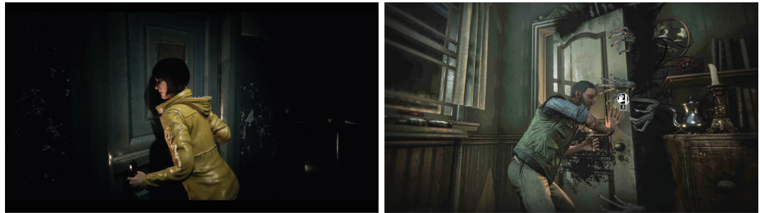
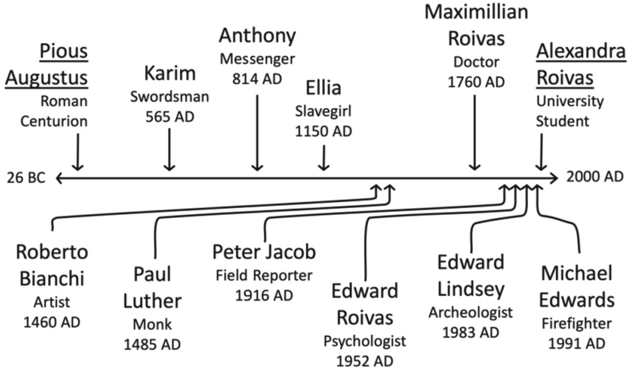
- It finds potential solutions in removing combat, using multiple equally powerful antagonists, decoupling narrative defeat from gameplay victory (e.g., *The Land of Pain*; *Call of Cthulhu: Dark Corners of the Earth*), making games short (*The Land of Pain* 3–4 h; *The Terrible Old Man* 20–30 min), using multiple playable characters (*Eternal Darkness: Sanity's Requiem* has 12 characters, only one prevails; *Song of Horror* has six playable characters), and permadeath (*Infra Arcana*).
- As of 14 June 2023, a Steam search for “Lovecraftian” returned 1163 results, with 620 games specifically tagged as “Lovecraftian”; the paper argues many borrow surface elements rather than engage deeply with cosmic dread.
- Pursuing knowledge can be made compatible with cosmic horror if it leads to a dismal ending, but the author is not aware of games that punish knowledge pursuit with an extra-horrible ending; Euclidean space is called perhaps the biggest obstacle, with current engines limited to simple perception tricks or fourth-wall breaks.
Methods
- Conceptual/design analysis rather than empirical study: the paper compares literary cosmic horror conventions with conventions of story-driven games and identifies six apparent incompatibilities.
- It draws on a selection of horror games, Lovecraftian and otherwise, from the last three decades as examples, including *Quake*, *Call of Cthulhu: Dark Corners of the Earth*, *Eternal Darkness: Sanity's Requiem*, *Song of Horror*, *The Land of Pain*, *The Terrible Old Man*, *Silent Hill 2*, *Fatal Frame 2*, *Chrono Trigger*, and *Infra Arcana*.
- For each challenge, it discusses why the conflict seems irreconcilable and uses game examples to identify potential solutions or workarounds.
Limitations
- The paper does not present a formal limitations section; it acknowledges that for punishing knowledge pursuit it is “not aware of any games that do this,” and that current engines allow only limited escapes from Euclidean space via perception tricks or fourth-wall breaks.
- Evident from the text: there is no systematic sample, empirical player study, or quantitative evaluation; the game examples are selective and interpreted by the author.
- Evident from the text: the discussion focuses on story-driven horror games, so the findings may not generalize to other game genres or non-narrative games, and the proposed solutions are not formally tested.
Model-written summary. Check it against the paper before relying on it.
Integrity signals
Registry
Cites
Statistics
Figures
Verification
Claims the paper makes
0 Valid · 8 Not valid · 9 Not checked · 42 Own results and interpretations
A result the paper reports from its own data — it cites no other source for it, so there is none to check. The quote shows it is in the paper.
In the paper
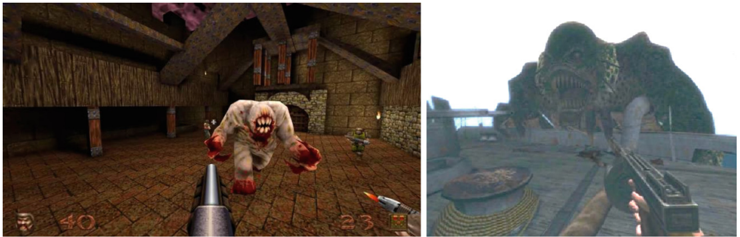
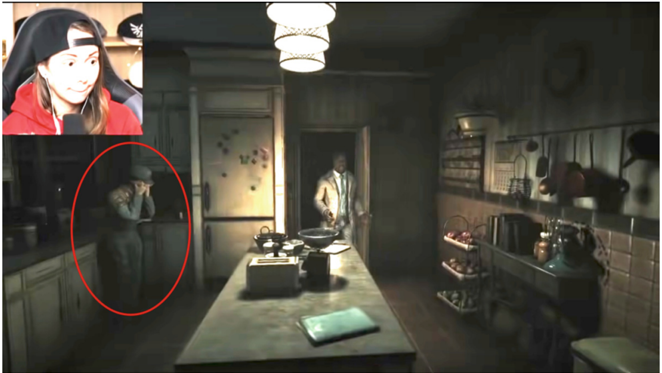
“Many games with Lovecraftian elements, such as the classic game Quake (1996), features killable enemies with Lovecraftian design, rather than the undefeatable undying monsters that are one of the hallmarks of literary cosmic horror (Fig. 2 left).”
§ Lovecraftian Horror in Story-Driven Games: Narrative Design Challenges and Solutions > 3.2 Opponents Can Be Defeated
plain- Asserted: passes — The authors put it forward as true.
- Checkable: passes — It can be checked against evidence.
- Load-bearing: passes — The paper’s conclusions depend on it.
- Based: passes — The paper gives a reason why it holds.
A result the paper states — it cites no source for it, so there is none to check. The quote shows it is in the paper.
In the paper
“We have identified six characteristics of games (in particular, story-driven games) that appear to be in direct conflict with the genre conventions of cosmic horror.”
§ Lovecraftian Horror in Story-Driven Games: Narrative Design Challenges and Solutions > 3 Challenges for Cosmic Horror in Gaming
hedgedstates an association- Asserted: passes — The authors put it forward as true.
- Checkable: passes — It can be checked against evidence.
- Load-bearing: passes — The paper’s conclusions depend on it.
- Based: passes — The paper gives a reason why it holds.
- Rests on an assumption not shown here.
A result the paper states — it cites no source for it, so there is none to check. The quote shows it is in the paper.
In the paper
“Survival horror games, like the Silent Hill series, frequently feature game mechanics that emphasise danger and powerlessness, even when they are not Lovecraftian, and these are straightforward to use also in Lovecraftian games.”
§ Lovecraftian Horror in Story-Driven Games: Narrative Design Challenges and Solutions > 3.1 Agency
plainstates an association- Asserted: passes — The authors put it forward as true.
- Checkable: passes — It can be checked against evidence.
- Load-bearing: unclear — It is unclear whether the paper’s conclusions depend on it.
- Based: passes — The paper gives a reason why it holds.
A result the paper states — it cites no source for it, so there is none to check. The quote shows it is in the paper.
In the paper
“Through the repeated (but non-fatal) defeats, the game emphasises the antagonist's power.”
§ Lovecraftian Horror in Story-Driven Games: Narrative Design Challenges and Solutions > 3.2 Opponents Can Be Defeated
plainstates a causeSingle case- Asserted: passes — The authors put it forward as true.
- Checkable: passes — It can be checked against evidence.
- Load-bearing: unclear — It is unclear whether the paper’s conclusions depend on it.
- Based: passes — The paper gives a reason why it holds.
A result the paper states — it cites no source for it, so there is none to check. The quote shows it is in the paper.
In the paper
“Call of Cthulhu: Dark Corners of the Earth also features the destruction of the playable character (through madness and suicide) at the end.”
§ Lovecraftian Horror in Story-Driven Games: Narrative Design Challenges and Solutions > 3.3 Winning is Possible
plain- Asserted: passes — The authors put it forward as true.
- Checkable: passes — It can be checked against evidence.
- Load-bearing: passes — The paper’s conclusions depend on it.
- Based: passes — The paper gives a reason why it holds.
9 more claims
Create a free account to see all 59 claims and every source verdict.
- Probably not a substantial claim. 36
- It may state two separate claims as one. 20
- The quote only partly states this claim. 1
Self-check
Percentages, sums and reported differences re-computed from the paper’s own numbers.
Each contradiction between two passages listed here was confirmed by an independent check.
Rated minor: it would not touch a result — a value no result rests on, a p-value that stays on the same side of the significance level, or a conflict that is clerical, resolved elsewhere in the paper, or outside its own findings.
In the paper
§ Lovecraftian Horror in Story-Driven Games: Narrative Design Challenges and Solutions > 3.5 (Prolonged) Survival of the Playable Character
“Song of Horror (2019) uses a similar approach”
§ Lovecraftian Horror in Story-Driven Games: Narrative Design Challenges and Solutions > 3.1 Agency
“Figure 1 shows two examples from Song of Horror (2020)”
Rated minor: it would not touch a result — a value no result rests on, a p-value that stays on the same side of the significance level, or a conflict that is clerical, resolved elsewhere in the paper, or outside its own findings.
In the paper
§ Lovecraftian Horror in Story-Driven Games: Narrative Design Challenges and Solutions > 2 Cosmic Horror Conventions from Literature
“as Dan Hassler-Forest observes in his analysis of the TV series Lovecraft Country (2020) [22].”
§ Lovecraftian Horror in Story-Driven Games: Narrative Design Challenges and Solutions > References
“21. Hassler-Forest, D.: Lovecraft country: horror, race, and the dark other.”
Rated minor: it would not touch a result — a value no result rests on, a p-value that stays on the same side of the significance level, or a conflict that is clerical, resolved elsewhere in the paper, or outside its own findings.
In the paper
§ Lovecraftian Horror in Story-Driven Games: Narrative Design Challenges and Solutions > References
“21. Smith, P.: Re-visioning romantic-era gothicism: an introduction to key works and themes in the study of HP Lovecraft.”
§ Lovecraftian Horror in Story-Driven Games: Narrative Design Challenges and Solutions > References
“21. Hassler-Forest, D.: Lovecraft country: horror, race, and the dark other.”
Citations
Cites
Carroll, N. (2007) · Philosophical Studies · doi:10.1007/s11098-007-9097-9 · Cited by 142
Procedural Puzzle Generation: A Survey
Kegel, B. D., & Haahr, M. (2019) · IEEE Transactions on Games · doi:10.1109/tg.2019.2917792 · Cited by 85
Self-citationFrom beyond: H. P. Lovecraft and the place of horror
Kneale, J. (2005) · Cultural Geographies · doi:10.1191/1474474005eu353oa · Cited by 57
Procedural Generation of Narrative Puzzles in Adventure Games: The Puzzle-Dice System
Fernández-Vara, C., & Thomson, A. (2012) · doi:10.1145/2538528.2538538 · Cited by 41
”Naked and on Fire”: Examining Player Agency Experiences in Narrative-Focused Gameplay
Carstensdottir, E., Kleinman, E., Williams, R., & Seif El-Nasr, M. S. (2021) · Proceedings of the 2021 CHI Conference on Human Factors in Computing Systems · doi:10.1145/3411764.3445540 · Cited by 28
DiGRA '15 - Proceedings of the 2015 DiGRA International Conference
Braad, E., & Degens, N. (2015) · Digital Games Research Association · Cited by 26
Agency and the Art of Interactive Digital Storytelling
Knoller, N. (2010) · Lecture notes in computer science · doi:10.1007/978-3-642-16638-9_38 · Cited by 23
Smith, P. (2011) · Literature Compass · doi:10.1111/j.1741-4113.2011.00838.x · Cited by 14
The culture of permadeath: Roguelikes and Terror Management Theory
Parker, R. (2017) · Journal of Gaming & Virtual Worlds · doi:10.1386/jgvw.9.2.123_1 · Cited by 13
H.P. Lovecraft: a Horror in Higher Dimensions
Hull, T. C. (2006) · Math Horizons · doi:10.1080/10724117.2006.11974625 · Cited by 10
Playing with Vision: Sight and Seeing as Narrative and Game Mechanics in Survival Horror
Haahr, M. (2018) · Lecture notes in computer science · doi:10.1007/978-3-030-04028-4_20 · Cited by 10
Self-citationStorygameness: Understanding Repeat Experience and the Desire for Closure in Storygames
Mitchell, A., Kway, L., & Lee, B. J. (2020) · doi:10.26503/dl.v2020i1.1246 · Cited by 8
Información jurídica relativa a la convención de las Naciones Unidas sobre el derecho del mar
Nations, U. (2015) · Derecho del mar boletín .../Derecho del mar boletín · doi:10.18356/fa44ed9c-es · Cited by 2
Gibson, G. (2023) · Palgrave studies in adaptation and visual culture · doi:10.1007/978-3-031-13765-5_8 · Cited by 2
Head Games: Adapting Lovecraft Beyond Survival Horror
Flanagan, K. M. (2023) · Palgrave studies in adaptation and visual culture · doi:10.1007/978-3-031-13765-5_15 · Cited by 2
Lovecraft Country: Horror, Race, and the Dark Other
Hassler‐Forest, D. (2023) · Palgrave studies in adaptation and visual culture · doi:10.1007/978-3-031-13765-5_11 · Cited by 2
Cthulhoo-Dooby-Doo!: The Re-animation of Lovecraft (and Racism) Through Subcultural Capital
Knopf, C. M. (2023) · Palgrave studies in adaptation and visual culture · doi:10.1007/978-3-031-13765-5_9 · Cited by 1
Conveying Cosmicism: Visual Interpretations of Lovecraft
Janicker, R. (2023) · Palgrave studies in adaptation and visual culture · doi:10.1007/978-3-031-13765-5_4 · Cited by 1
Research works printed but not linked: 9
- Burleson, D.R.: On lovecraft's themes: touching the glass. In: David, E., Joshi, S.T. (eds.) Schultz, pp. 135-147. A Centennial Anthology of Essays in Honor of H. P. Lovecraft. Fairleigh Dickinson University Press, An Epicure in the Terrible (1991)
- Ingwersen, M.:Monstrous geometries in the fiction of Hp Lovecraft. In: Places and Spaces of Monstrosity, pp. 45-55. Interdisciplinary Press, Oxford (2014)
- Johnson, S.: Everything bad is good for you: How today's popular culture is actually making us smarter. Penguin (2006)
- Lovecraft, H.P.: The Horror at Martin's Beach. In: Weird Tales, vol. 2, no. 4, pp. 75-76, 83, November 1923
- Lovecraft, H.P.: The Green Meadow. Spring. The Vagrant, pp. 188-195 (1927)
- Murray, J.H.: Hamlet on the Holodeck: The Future of Narrative in Cyberspace, updated edition. MIT Press (2017)
- Ralickas, V.: Art, cosmic horror, and the fetishizing gaze in the fiction of HP Lovecraft. J. Fant. Arts 19(3), 297-316 (2008)
- Ruhland, P.: What gaming gets wrong about Lovecraft. TechRaptor, April 2016. https://tec hraptor.net/gaming/opinions/what-gaming-gets-wrong-about-lovecraft 21. Smith, P.: Re-visioning romantic-era gothicism: an introduction to key works and themes in the study of HP Lovecraft. Literat. Compass 8(11), 830-839 (2011)
- Sederholm, C., Weinstock, J.A.: Introduction: Lovecraft now. J. Fant. Arts 26(3), 444 (2015)
Cited by
ISAKOV, A. (2026) · Studia Philologica · doi:10.28925/2412-2491.2026.2612
Metadata
- Authors
- Haahr, M.
- Affiliations
- Trinity College Dublin (IE)
- Corresponding author
- Haahr, Mads
- ORCID
- Haahr, Mads
- Venue
- Lecture Notes in Computer Science
- Publisher
- Springer Nature Switzerland
- Published
- 2023
- Pages
- 276-290
- ISSN
- 0302-9743 (ISSN-L)
- 1611-3349
- OpenAlex
- W4388016865
- Semantic Scholar
- 44ca47872957c6d857d2dfe872333e88ced100f6
- Cited by
- 1
- References
- 18
- Citations by year
- 2026: 1
- FWCI
- 0.95
- Type
- conference paper
- Language
- en
- Open access
- green
- hdl.handle.net
- Licence
- cc-by-nc-sa
- www.springernature.com/gp/researchers/text-and-data-mining (tdm)
- www.springernature.com/gp/researchers/text-and-data-mining (vor)
- Locations
- Lecture notes in computer science (publishedVersion)
- Trinity's Access to Research Output (TARA) (Trinity College Dublin) (submittedVersion, cc-by-nc-sa)
- Topics
- Social Sciences › Sociology and Political Science › Digital Games and Media
- Physical Sciences › Computer Science › Artificial Intelligence › Artificial Intelligence in Games
- Social Sciences › Cultural Studies › Gothic Literature and Media Analysis
- Keywords
- cosmic horror, Lovecraftian horror, narrative games, narrative design, genre conventions, horror games, game mechanics, madness
About these checks
Registry, retraction, Cites and statistics results are computed, not judged, with one exception: a printed reference that no index lists is read once by a model before it counts as a citation error. Claims are extracted by a model and kept only when their quote appears verbatim in the text; each cited source is then checked, with a model’s help, for whether it says what the claim relies on. Those verdicts can be wrong — read the claim’s quote and the cited source before relying on one.
A language model drew the claims from the paper on 2026-10-27, under version 3 of the claim definition (model deepseek-v4.1-flash, prompt extract-v3).
A second model labelled each claim on 2026-10-27 (model jev-1.13-20260917, definition revision gold-guideline-v0.2).
Statistics and arithmetic are recomputed, not judged.
Confidence bands are shown only for fields calibrated on our annotated test set. None is calibrated yet, so no band is shown.
What counts as a claim ›How we measure confidence ›How we check this ›
Are you an author, or do you see a problem with this page? Request a review
Data sources
Bibliographic data: Semantic Scholar, OpenAlex, Crossref.
Contains information from the Semantic Scholar Academic Graph Datasets, made available under the ODC Attribution License (ODC-BY 1.0).
Semantic Scholar’s data is described in: Kinney, R., et al. (2023). The Semantic Scholar Open Data Platform. arXiv:2301.10140.
