

Decidim, a Technopolitical Network for Participatory Democracy: Philosophy, Practice and Autonomy of a Collective Platform in the Age of Digital Intelligence
Open accessThe DOI matches its Crossref record; 63 of the 72 references it cites were found in a registry or an index, and 9 are not checked yet.
Abstract
This Open Access book explains the philosophy, design principles, and community organization of Decidim and provides essential insights into the platform.
Overview
The claims and statistics of this paper haven’t been checked yet.
Free: it reads the open-access text and checks the first 5 claims that cite a source we can check. Create a free account to check every claim.
Integrity signals
Registry
Cites
Statistics
Figures
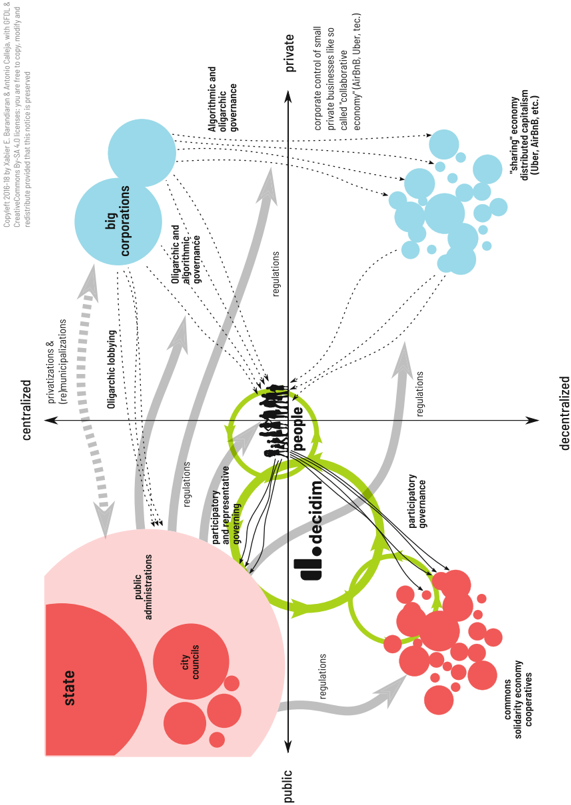
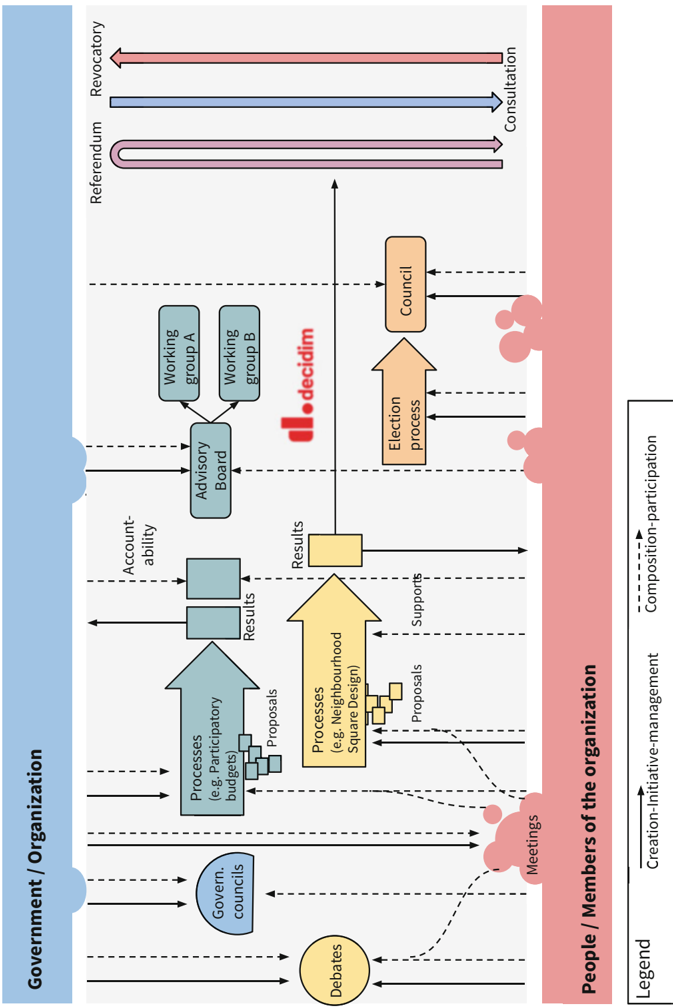
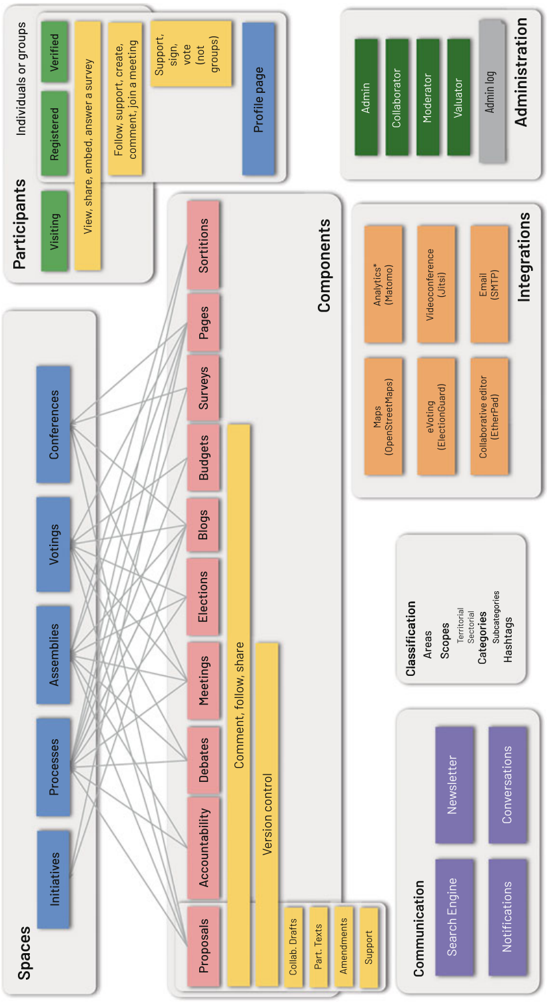
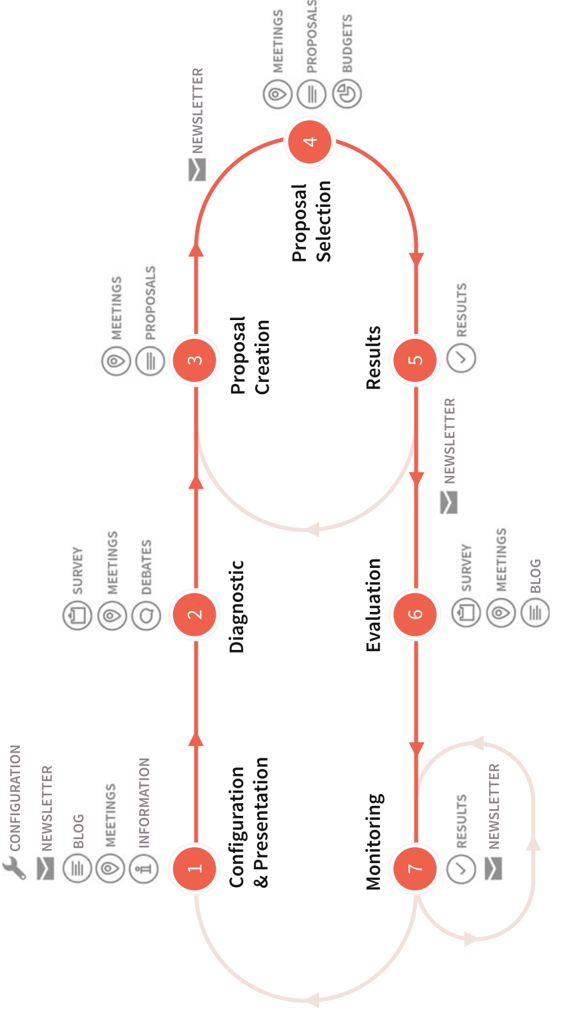
Verification
Claims the paper makes
The claims and statistics of this paper haven’t been checked yet.
Free: it reads the open-access text and checks the first 5 claims that cite a source we can check. Create a free account to check every claim.
Claims other papers make about this one
Each is checked against this paper’s own text: does it say what the citing paper says it does?
The source backs part of the claim, not all of it — or backs it for a different population, condition or comparison.
In the citing paper
“Digital infrastructures are an essential part of contemporary political processes, and they are especially useful for accelerating and scaling participatory democracy [Barandiaran et al., 2024, Berg and Hofmann, 2021].”
From Generative midtended cognition and Artificial Intelligence: thinging with thinging things (2025) · cites this paper as Barandiaran et al., 2024
Experimental — accuracy not yet measured
Self-check
Percentages, sums and reported differences re-computed from the paper’s own numbers.
The self-check needs the paper’s full text.
Citations
Cites
The publisher hasn’t deposited this paper’s reference list.
Research works printed but not linked: 96
- Abbate, J. (1999). Inventing the internet. The MIT Press. http://ieeexplore.ieee.org/lpdocs/epic03/ wrapper.htm?arnumber=570802
- Barandiaran, X. E. (2019). Tecnopolítica, municipalismo y radicalización democrática. In L. Roth, A. Monterde, & A. Calleja-López (Eds.), Ciudades Democráticas. La revuelta municipalista en el ciclo post-15M (pp. 173-207). Icaria. http://ciudadesdemocraticas.tecnopolitica.net/
- Barry, A. (2001). Political Machines: Governing a Technological Society. Athlone Press.
- Baudrillard, J. (1970). The consumer society: Myths and structures. SAGE.
- Benkler, Y. (2006). The Wealth of Networks: How Social Production Transforms Markets and Freedom. Yale University Press.
- Bevir, M. (2007). Encyclopedia of Governance (Vol. I). SAGE Publications.
- Blyth, M. (2013). Austerity: The History of a Dangerous Idea. Oxford University Press.
- Buchanan, J. M., & Tullock, G. (1962). The calculus of consent (Vol. 3). University of Michigan Press.
- Calleja-López, A. (2017). Since 15M: The technopolitical reassembling of democracy in Spain. [PhD Thesis, University of Exeter]. https://ore.exeter.ac.uk/repository/handle/10871/29295
- Castells, M. (2009). Communication Power. Oxford University Press.
- Chadwick, A. (2013). The Hybrid Media System: Politics and Power. Oxford University Press.
- Crouch, C. (2004). Post-democracy. Polity Press.
- della Porta, D. (2013). Can Democracy Be Saved?: Participation, Deliberation and Social Move- ments. John Wiley & Sons. 1 Decidim: A Brief Overview
- Della Porta, D., & Tarrow, S. G. (Eds.). (2005). Transnational protest and global activism. Rowman & Littlefield.
- Duménil, G., & Lévy, D. (2013). The Crisis of Neoliberalism: Harvard University Press.
- Earl, J., & Kimport, K. (2011). Digitally Enabled Social Change: Activism in the Internet Age. The MIT Press.
- Feenstra, R. A., Tormey, S., Casero-Ripollés, A., & Keane, J. (2017). Refiguring Democracy: The Spanish Political Laboratory. Routledge.
- Fuchs, C. (2008). Internet and Society: Social Theory in the Information Age. Routledge.
- Gerbaudo, P. (2012). Tweets and the Streets: Social Media and Contemporary activism. Pluto Press. https://library.oapen.org/bitstream/handle/20.500.12657/30772/642730.pdf?
- Gerbaudo, P. (2017). The Mask and the Flag: Populism, Citizenism, and Global Protest. Oxford University Press.
- Habermas, J. (1962). The Structural Transformation of the Public Sphere: An Inquiry Into a Category of Bourgeois Society. MIT Press.
- Hayek, F. A. V. (1944). The Road to Serfdom. University of Chicago Press.
- Hayek, F. A. V. (1945). The Use of Knowledge in Society. American Economic Review, 35(4), 519-530.
- Juris, J. S. (2008). Networking futures: The movements against corporate globalization. Duke University Press.
- Kelty, C. M. (2008). Two Bits. The Cultural Significance of Free Software. Duke University Press. https://twobits.net/pub/Kelty-TwoBits.pdf
- Mair, P. (2006). Ruling the Void. New Left Review, 42, 25-51.
- Maxigas, P. (2012). Hacklabs and hackerspaces: Tracing two genealogies. Journal of Peer Pro- duction, 2, Article 2. https://eprints.lancs.ac.uk/id/eprint/88024/
- Merton, R. K. (1942). Science and Technology in a Democratic Order. Journal of Legal and Political Sociology, 1, 115-126.
- Monterde, A. (2015). Emergencia, evolución y efectos del movimiento-red 15M (2011-2015). Una aproximación tecnopolítica [Ph.D. Thesis, Universitat Oberta de Catalunya]. In TDX (Tesis Doctorals en Xarxa). https://www.tdx.cat/handle/10803/327599
- O'Reilly, T. (2005, September 30). What Is Web 2.0? Design Patterns and Business Models for the Next Generation of Software. Www.Oreilly.Com. https://www.oreilly.com/pub/a/web2/archive/ what-is-web-20.html
- Peltzman, S. (1976). Toward a more general theory of regulation. The Journal of Law and Economics, 19(2), 211-240.
- Piketty, T. (2013). Capital in the Twenty-First Century. Harvard University Press.
- Pitkin, H. F. (1967). The Concept of Representation. University of California Press.
- Roth, L., Monterde, A., & Calleja-López, A. (Eds.). (2019). Ciudades Democráticas. La revuelta municipalista en el ciclo post-15M. Icaria. http://ciudadesdemocraticas.tecnopolitica.net/
- Sennett, R. (1977). The Fall of Public Man. Cambridge University Press.
- Srnicek, N. (2016). Platform Capitalism. Polity Press.
- Van Reybrouck, D. (2018). Against Elections. Seven Stories Press.
- Vila-Viñas, D., & Barandiaran, X. E. (Eds.). (2015). Buen conocer/FLOK Society: Modelos sostenibles y políticas públicas para una economía social del conocimiento común y abierto en Ecuador. IAEN-CIESPAL. http://book.floksociety.org/ec/
- Althusser, L. (1970). Ideology and ideological state apparatuses (notes towards an investigation). In A. Sharma & A. Gupta, The Anthropology of the State: A Reader (pp. 86-98).
- Barandiaran, X. E., Calleja-López, A., & Cozzo, E. (2020). Defining Collective Identities in Technopolitical Interaction Networks. Frontiers in Psychology, 11. https://doi.org/https://doi. org/10.3389/fpsyg.2020.01549 · DOI
- Barber, B. R. (1984). Strong democracy: Participatory politics for a new age. University of California Press.
- Bevir, M. (2007). Encyclopedia of Governance (Vol. I). SAGE Publications.
- Bourdieu, P. (1983). Political representation: Elements for a theory of the political field. In Language and symbolic power (pp. 171-202). Polity Press. https://monoskop.org/ images/4/43/Bourdieu_Pierre_Language_and_Symbolic_Power_1991.pdf
- Bourdieu, P. (1986). The Forms of Capital. In The sociology of economic life (pp. 78-92). Routledge.
- Calleja-López, A. (2017). Since 15 M: The technopolitical reassembling of democracy in Spain. [PhD Thesis, University of Exeter]. https://ore.exeter.ac.uk/repository/handle/10871/29295
- DeBrunner, A. (1947). Δημoκρατία. In Festschrift für Edouard Tièche (pp. 11-24). Verlag Herbert Lang & CIE.
- Di Paolo, E., Cuffari, E. C., & De Jaegher, H. (2018). Linguistic bodies: The continuity between life and language. The MIT Press.
- Earl, J., & Kimport, K. (2011). Digitally Enabled Social Change: Activism in the Internet Age. The MIT Press.
- Feenberg, A. (1995). Alternative Modernity: The Technical Turn in Philosophy and Social Theory. University of California Press.
- Fuchs, C. (2008). Internet and Society: Social Theory in the Information Age. Routledge.
- Gaonkar, D. P. (Ed.). (2001). Alternative Modernities. Duke University Press.
- Gerber, E. R. (1999). The Populist Paradox: Interest Group Influence and the Promise of Direct Legislation. Princeton University Press.
- Gerber, E. R., & Lupia, A. (1995). Campaign Competition and Policy Responsiveness in Direct Legislation Elections. Political Behavior, 17(3), 287-306.
- Habermas, J. (1976). Legitimation crisis. Polity Press.
- Habermas, J. (1981). The Theory of Communicative Action: Reason and the Rationalization of Society (T. McCarthy, Trans.; Vol. 1). Polity Press.
- Hacker, K., & van Dijk, J. (2000). Digital Democracy: Issues of Theory and Practice. SAGE. https://doi.org/https://doi.org/10.4135/9781446218891 · DOI · Paper page
- Hardin, G. (1968). The Tragedy of the Commons. Science, 162(3859), 1243-1248.
- Hardt, M., & Negri, A. (2009). Commonwealth. Harvard University Press.
- Harvey, D. (2003). The new imperialism. Oxford University Press.
- Held, D. (2006). Models of Democracy. Polity Press.
- Hufty, M. (2011). Investigating policy processes: The Governance Analytical Frame-work (GAF) [Application/pdf]. In U. M. Wiesmann & H. Hurni (Eds.), Research for sustainable develop- ment: Foundations, experiences, and perspectives (Vol. 6, pp. 403-424). Geographica Bernensia. http://boris.unibe.ch/68343/
- Lathrop, D., & Ruma, L. (2010). Open Government: Collaboration, transparency, and participa- tion in practice. O'Reilly Media, Inc.
- List, C., & Pettit, P. (2011). Group Agency: The Possibility, Design, and Status of Corporate Agents (P. Pettit, Ed.). New York: Oxford University Press.
- Manin, B. (1997). The Principles of Representative Government. Cambridge University Press. https://doi.org/https://doi.org/10.1017/CBO9780511659935 · DOI · Paper page
- Mann, M. (2012). The Sources of Social Power: Volume 1: A History of Power from the Beginning to AD 1760 (second ed., Vol. 1). Cambridge University Press. https://doi.org/10.1017/ CBO9781139381307 · DOI · Paper page
- Massumi, B. (2015). Politics of Affect. John Wiley & Sons.
- Matsusaka, J. G. (2008). For the Many or the Few: The Initiative, Public Policy, and American Democracy. University of Chicago Press.
- McDonald, K. (2002). From Solidarity to Fluidarity: Social movements beyond 'collective identity'-the case of globalization conflicts. Social Movement Studies, 1(2), 109-128.
- Monterde, A., Calleja-López, A., Aguilera, M., Barandiaran, X. E., & Postill, J. (2015). Multitu- dinous identities: A qualitative and network analysis of the 15 M collective identity. Informa- tion, Communication & Society, 18(8), 930-950. https://doi.org/https://doi.org/10.1080/ 1369118X.2015.1043315 · DOI
- Ostrom, E. (1990). Governing the Commons: The Evolution of Institutions for Collective Action. Cambridge University Press.
- Pitkin, H. F. (1967). The Concept of Representation. University of California Press.
- Pollitt, C., & Bouckaert, G. (2017). Public Management Reform: A Comparative Analysis -Into the Age of Austerity. Oxford University Press.
- Rancière, J. (1999). Disagreement: Politics and Philosophy. University of Minnesota Press.
- Rosanvallon, P. (2011). Democratic Legitimacy: Impartiality, Reflexivity, Proximity (A. Goldhammer, Trans.). Princeton University Press.
- Smith, D. A., & Tolbert, C. J. (2004). Educated by Initiative: The Effects of Direct Democracy on Citizens and Political Organizations in the American States. University of Michigan Press.
- Smith, M. A. (2002). Ballot Initiatives and the Democratic Citizen. The Journal of Politics, 64(3), 892-903.
- Tkacz, N. (2012). From open source to open government: A critique of open politics. Ephemera: Theory and Politics in Organization, 12(4), 386-405.
- Calleja-López, A. (2017). Since 15M: The technopolitical reassembling of democracy in Spain. [PhD Thesis, University of Exeter]. https://ore.exeter.ac.uk/repository/handle/10871/29295
- Feenberg, A. (1999). Questioning Technology. Routledge.
- Freeman, J. (1972). The Tyranny of Structurelessness. Berkeley Journal of Sociology, 17, 151-164.
- Gurstein, M. B. (2011a). Open data: Empowering the empowered or effective data use for everyone? First Monday, 16(2). https://doi.org/https://doi.org/10.5210/fm.v16i2.3316 · DOI · Paper page
- Kelty, C. M. (2008). Two Bits. The Cultural Significance of Free Software. Duke University Press. https://twobits.net/pub/Kelty-TwoBits.pdf
- Lessig, L. (2016). Free Culture. Lulu Press, Inc.
- Pérez-Verdugo, M., & Barandiaran, X. E. (2023). Personal autonomy and (digital) technology. An enactive sensorimotor framework. Submitted to Philosophy & Technology (under Review). Pre-Print Available at https://psyarxiv.com/y8mga/. https://doi.org/10.31234/osf.io/y8mga · DOI
- Tehranian, J. (2015). The New ©ensorship. Iowa Law Review, 101(1), 245-295.
- Toret, J., Calleja-López, A., Miró, Ó. M., Aragón, P., Aguilera, M., Barandiaran, X. E., Lumbreras, A., & Monterde, A. (2015). Tecnopolítica y 15 M: La potencia de las multitudes conectadas. Editorial UOC. ShareAlike 4.0 International License (http://creativecommons.org/licenses/by-sa/4.0/), which per- mits use, sharing, adaptation, distribution, and reproduction in any medium or format, as long as you give appropriate credit to the original author(s) and the source, provide a link to the Creative Commons license and indicate if changes were made. If you remix, transform, or build upon this chapter or a part thereof, you must distribute your contributions under the same license as the original. The images or other third party material in · DOI
- Calleja-López, A. (2017). Since 15 M: The technopolitical reassembling of democracy in Spain. [PhD Thesis, University of Exeter]. https://ore.exeter.ac.uk/repository/handle/10871/29295
- Sangüesa, R. (2013). La tecnocultura y su democratización: Ruido, límites y oportunidades de los Labs. Revista iberoamericana de ciencia tecnología y sociedad, 8(23), 259.282.
- Vila-Viñas, D., & Barandiaran, X. E. (Eds.). (2015). Buen conocer / FLOK Society: Modelos sostenibles y políticas públicas para una economía social del conocimiento común y abierto en Ecuador. IAEN-CIESPAL. http://book.floksociety.org/ec/
- Winner, L. (1986). Do Artifacts Have Politics? In The Whale and the Reactor: A Search for Limits in an Age of High Technology (pp. 19-39). University of Chicago Press. ShareAlike 4.0 International License (http://creativecommons.org/licenses/by-sa/4.0/), which per- mits use, sharing, adaptation, distribution, and reproduction in any medium or format, as long as you give appropriate credit to the original author(s) and the source, provide a link to the Creative Commons license and indicate if changes were made. If you remix, transform, or build upon this chapter or a part thereof, you must distribute your contributions under the same license as the original. The images or other third party material in
- Barber, B. R. (1984). Strong democracy: Participatory politics for a new age. University of California Press.
- Benkler, Y. (2006). The Wealth of Networks: How Social Production Transforms Markets and Freedom. Yale University Press.
- Calleja-López, A. (2017). Since 15M: The technopolitical reassembling of democracy in Spain. [PhD Thesis, University of Exeter]. https://ore.exeter.ac.uk/repository/handle/10871/29295
- Kauffman, S. A. (2000). Investigations. Oxford University Press US.
- Latour, B. (2005). Reassembling the social: An introduction to actor-network-theory. Oxford University Press.
- Siddarth, D., Ivliev, S., Siri, S., & Berman, P. (2020). Who Watches the Watchmen? A Review of Subjective Approaches for Sybil-resistance in Proof of Personhood Protocols (arXiv:2008.05300). arXiv. https://doi.org/10.48550/arXiv.2008.05300 ShareAlike 4.0 International License (http://creativecommons.org/licenses/by-sa/4.0/), which per- mits use, sharing, adaptation, distribution, and reproduction in any medium or format, as long as you give appropriate credit to the original author(s) and the source, provide a link to the Creative Commons license and indicate if changes were made. If you remix, transform, or build upon this chapter or a part thereof, you must distribute your contributions under the same license as the original. The images or other third party material in · DOI
Cited by
de la Torre, P. G., Pérez-Verdugo, M., & Barandiaran, X. E. (2025) · AI & Society · doi:10.1007/s00146-025-02400-z · Cited by 49
“Technology should be built (and used) to enhance human autonomy and promote human flourishing, and to create a more just and equitable society (for a concrete example, see Barandiaran et al. 2024).”
Self-citationde la Torre, P. G., Pérez-Verdugo, M., & Barandiaran, X. E. (2024) · arXiv · doi:10.48550/arxiv.2405.06478 · Cited by 19
“Technology should be built (and used) to enhance human autonomy and promote human flourishing, and to create a more just and equitable society (for a concrete example, see Barandiaran et al. 2024).”
Self-citationHuman-Centered AI in Placemaking: A Review of Technologies, Practices, and Impacts
Cardoso, P. J. S., & Rodrigues, J. M. F. (2025) · Applied Sciences · doi:10.3390/app15179245 · Cited by 24
Mkhitaryan, K., Sanamyan, A., Mnatsakanyan, M., Կ., Կ. Է., & Ratner, S. V. (2025) · Urban Science · doi:10.3390/urbansci9100389 · Cited by 25
Generative midtended cognition and Artificial Intelligence: thinging with thinging things
Barandiaran, X. E., & Pérez-Verdugo, M. (2025) · Synthese · doi:10.1007/s11229-025-04961-4 · Cited by 19
“11 Digital infrastructures are an essential part of contemporary political processes, and they are especially useful for accelerating and scaling participatory democracy [Barandiaran et al., 2024, Berg and Hofmann, 2021].”
Self-citationWhat roles can democracy labs play in co-creating democratic innovations for sustainability?
Campos, I. S., Fuchs, D. A., Repo, P., Jager, W., Klöckner, C. A., Wang, S., Lamas, D., Cots, F., Barchiesi, E., Löfström, E., et al. (2024) · Socio-Ecological Practice Research · doi:10.1007/s42532-024-00197-7 · Cited by 18
“Recent years have seen a surge in the development of innovative citizen-centric mechanisms for democratic participation, such as e-democracy, participatory budgeting, mini-publics and collaborative governance models (Barandiaran et al. 2024; Curato and Böker 2016).”
Sustainable Development Adopting Digital Intelligence Among University Students
Siripipatthanakul, S., Phuangsuwan, P., Siripipattanakul, S., Limna, P., Jaipong, P., & Chaiprakarn, S. (2025) · Lecture notes in networks and systems · doi:10.1007/978-981-96-2015-9_14 · Cited by 7
States of Solidarity: How to Build a Society
Prainsack, B. (2026) · doi:10.1093/9780198965336.001.0001 · Cited by 11
Chapter 10 175The future of climate assemblies
Elstub, S., & Escobar, O. (2025) · De Gruyter eBooks · doi:10.1515/9783111328393-016 · Cited by 2
Peiruza-Parga, J., Balcells, J., Borge, R., & Padró-Solanet, A. (2026) · Media and Communication · doi:10.17645/mac.11507 · Cited by 2
“The infrastructure is a public‐common, free, and open digital support, understood as a “technopolitical project” (Barandiaran et al., 2024, pp. 51–53).”
Artificial intelligence through the eyes of Hannah Arendt: fear, alienation, and empowerment
Ashruf, C. M. A. (2025) · AI & Society · doi:10.1007/s00146-025-02435-2 · Cited by 1
“These platforms enhance political participation beyond the conventional election cycles, supporting ongoing, structured engagement between governments and their constituents (Barandiaran et al. 2024).”
Collective User Experience and Autonomy: Friction and Appropriation through the MetaDecidim example
Pérez-Verdugo, M. (2025) · International Conference on Communities and Technologies (C&T) · doi:10.1145/3742800.3742829 · Cited by 1
Human Transformation and Generative Universality: Rethinking Citizenship in the Posthuman Age
Suzuki, S. (2025) · Paragrana · doi:10.1515/para-2025-0034 · Cited by 2
Opportunities of Digital Transformation in Local Autonomy: Successful Examples and Learnings
Dumitrescu, C. (2025) · European Union and its neighbours in a globalized world · doi:10.1007/978-3-032-06508-7_13 · Cited by 1
Deliberation and intra-party trade-offs in Barcelona en Comú
Kurban, H. C. (2026) · Party Politics · doi:10.1177/13540688261431650 · Cited by 1
Gausa, M., Canessa, N. V., & Centanaro, C. (2026) · Lecture notes in information systems and organisation · doi:10.1007/978-3-032-21842-1_5 · Cited by 1
Aljuhani, F., Adenle, Y. A., & Basheer, M. A. (2026) · Urban sustainability · doi:10.1007/978-981-92-1011-4_14 · Cited by 1
Ruohonen, J., & Hjerppe, K. (2025) · Lecture notes in computer science · doi:10.1007/978-3-031-88531-0_21 · Cited by 2
Bova, P. (2024) · Lecture notes in networks and systems · doi:10.1007/978-3-031-74679-6_28
Internet Voting Maturity Framework—Quantifying Maturity in Internet Voting Protocols
Barański, S., Biedermann, B., & Ellul, J. (2026) · Distributed Ledger Technologies Research and Practice · doi:10.1145/3797872 · Cited by 4
“Non-blockchain-based systems like Helios [2] and Decidim [7] operate with just an organizer, one central component, a set of key-holders, and auditors.”
Küçük, A. (2025) · Civil Szemle · doi:10.62560/csz.2025.04.6
Autonomy and Technology: From Instrumentalism to Technocomplexity
Calleja-López, A., Pérez-Verdugo, M., & Barandiaran, X. E. (2025) · SpringerBriefs in philosophy · doi:10.1007/978-3-032-05501-9_11 · Cited by 2
Self-citationThe role of the Digital Participatory Platforms in street experiment processes. Two cases from Italy
Pucci, P., Lanza, G., & Galbiati, G. (2025) · Journal of Urban Mobility · doi:10.1016/j.urbmob.2025.100171 · Cited by 3
Smart Policy for Inclusive Tech-Enabled Cities
Sharma, V. C., & Babber, K. (2026) · Lecture notes in civil engineering · doi:10.1007/978-981-95-3873-7_13
Solidarity and care: How to build a society
Prainsack, B. (2026) · Oxford University Press eBooks · doi:10.1093/9780198965336.003.0002 · Cited by 2
Prainsack, B. (2026) · Oxford University Press eBooks · doi:10.1093/9780198965336.002.0005
Prainsack, B. (2026) · Oxford University Press eBooks · doi:10.1093/9780198965336.003.0001
‘Unmaking Goliath’: Work and economic democracy
Prainsack, B. (2026) · Oxford University Press eBooks · doi:10.1093/9780198965336.003.0004
Prainsack, B. (2026) · Oxford University Press eBooks · doi:10.1093/9780198965336.002.0004
Solidarity in the climate governance: Representing future generations and non-human entities
Prainsack, B. (2026) · Oxford University Press eBooks · doi:10.1093/9780198965336.003.0003
States of solidarity: Democratic statehood in times of crisis
Prainsack, B. (2026) · Oxford University Press eBooks · doi:10.1093/9780198965336.003.0006
Data solidarity in the age of artificial intelligence (AI)
Prainsack, B. (2026) · Oxford University Press eBooks · doi:10.1093/9780198965336.003.0005
Correia, J. C. (2026) · Social Sciences · doi:10.3390/socsci15030166 · Cited by 3
Edwards-Schachter, M., & Li, C. (2026) · Frontiers in Political Science · doi:10.3389/fpos.2026.1792788
Kentsel Hizmetlerde Katılım: Atık Yönetimi Üzerinden Bir Model Önerisi
Tetikol, A. (2026) · Özgür Yayınları eBooks · doi:10.58830/ozgur.pub1252.c5090
Participation citoyenne métropolitaine : les plateformes et les dispositifs toulousains et lyonnais
Slobodova, O. (2024) · theses.fr (ABES) · doi:10.70675/d3e4db99z9161z4825z9a9bz29adbde46cca
What is participatory digital democracy?
Friesch, K., Fuchs, C., & Museba, J. (2026) · The Communication Review · doi:10.1080/10714421.2026.2691015
van Waarden, B. (2026) · AI & Society · doi:10.1007/s00146-026-03162-y
“…for example, is an open-source participation platform that enables citizens to propose, deliberate on, and vote for municipal policies, embedding ideals of transparency, reversibility, and shared governance into its technical architecture (Aragón et al. 2017; Barandiaran et al. 2024).”
Governance for Sustainability: Designing Policies for Tomorrow’s Urban Challenges
Narayan, S. C., Himanshu, Khatun, B., Suman, P., Raj, C. K., Kumar, D., & Choudhury, M. (2026) · Springer eBooks · doi:10.1007/978-3-032-18026-1_15
Knowledge, Power and the Learning City – Debates in Digital Knowledge and Learning
Lister, P. (2026) · Lecture notes in computer science · doi:10.1007/978-3-032-30041-6_4
Stanizzi, S. (2026) · AI Law Politics · doi:10.5709/alp-02.01.2026-06 · Cited by 1
Queluz, G. L. (2026) · Revista Brasileira de Estudos CTS · doi:10.67937/30861128.2026.70
Pliatsika, F., Salepaki, A., Topaloglou, L., Kanteler, D., & Kourkouridis, D. (2026) · Sustainability · doi:10.3390/su18199937
Amorim, D. P. D. L., & de Magalhães, I. G. (2026) · Revista Gestão & Tecnologia · doi:10.20397/2177-6652/2026.v26i3.3260
Everyday Urbanism in the Digital Age: Exploring Equity and Inclusion
Husukić, E., Zejnilović, E., & Grzesikowska, H. (2026) · Lecture notes in civil engineering · doi:10.1007/978-981-92-2006-9_14
Metadata
- Authors
- Barandiaran, X. E., Calleja-López, A., Monterde, A., & Romero, C.
- Affiliations
- University of the Basque Country (ES)
- Universitat Oberta de Catalunya (ES)
- Venue
- SpringerBriefs in Political Science
- Publisher
- Springer Nature Switzerland
- Published
- 2024
- ISSN
- 2191-5466 (ISSN-L)
- 2191-5474
- OpenAlex
- W4391023050
- Cited by
- 44
- References
- 0
- Citations by year
- 2026: 27 · 2025: 14 · 2024: 3
- FWCI
- 37.90
- Type
- book
- Language
- en
- Open access
- hybrid
- doi.org
- Licence
- cc-by-sa
- creativecommons.org/licenses/by-sa/4.0 (tdm)
- creativecommons.org/licenses/by-sa/4.0 (vor, 19 d)
- Locations
- SpringerBriefs in political science (publishedVersion, cc-by-sa)
- Funders
- Harvard University
- University of Oxford
- Eusko Jaurlaritza (IT1668-22, PID2019-104576GB-I00)
- Euskal Herriko Unibertsitatea
- Ministerio de Ciencia e Innovación (MCIN/AEI/10, 10.13039, / AEI/10, PID2019, PID2019-104576GB-I00, MCIN /AEI /10.13039)
- Universitat Oberta de Catalunya
- Agencia Estatal de Investigación (PID 2019-104576GB-I00, 13039, 10.13039, AEI/10, PID2019)
- Topics
- Social Sciences › Political Science and International Relations › E-Government and Public Services
- Social Sciences › Communication › Social Media and Politics
- Social Sciences › Political Science and International Relations › Political Theory and Democracy
- Keywords
- Decidim, participatory democracy, technology and politics, citizen participation, community organizations
About these checks
Registry, retraction, Cites and statistics results are computed, not judged, with one exception: a printed reference that no index lists is read once by a model before it counts as a citation error. Claims are extracted by a model and kept only when their quote appears verbatim in the text; each cited source is then checked, with a model’s help, for whether it says what the claim relies on. Those verdicts can be wrong — read the claim’s quote and the cited source before relying on one.
Statistics and arithmetic are recomputed, not judged.
Confidence bands are shown only for fields calibrated on our annotated test set. None is calibrated yet, so no band is shown.
What counts as a claim ›How we measure confidence ›How we check this ›
Are you an author, or do you see a problem with this page? Request a review
Data sources
Bibliographic data: Semantic Scholar, OpenAlex, Crossref.
Contains information from the Semantic Scholar Academic Graph Datasets, made available under the ODC Attribution License (ODC-BY 1.0).
Semantic Scholar’s data is described in: Kinney, R., et al. (2023). The Semantic Scholar Open Data Platform. arXiv:2301.10140.
