

The DOI matches its Crossref record.
The complex life of hydrodynamic modes
Abstract
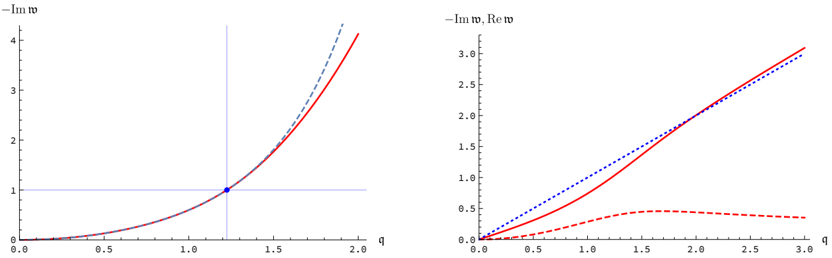
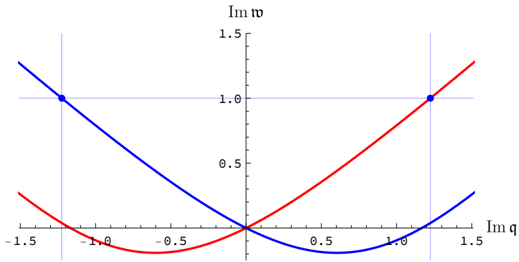
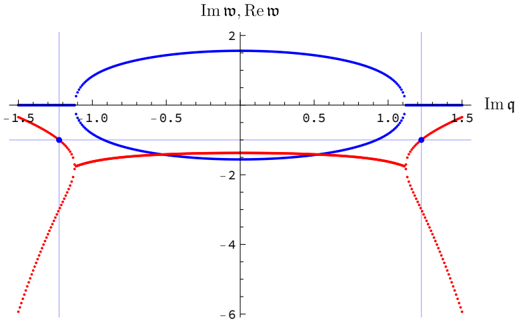
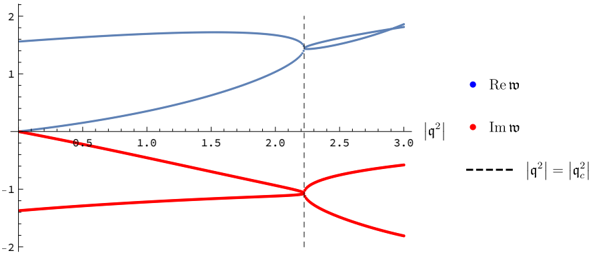
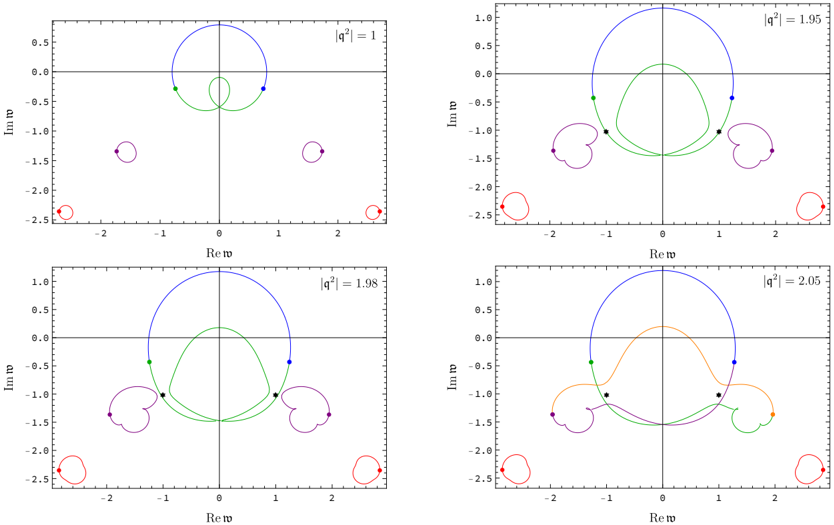
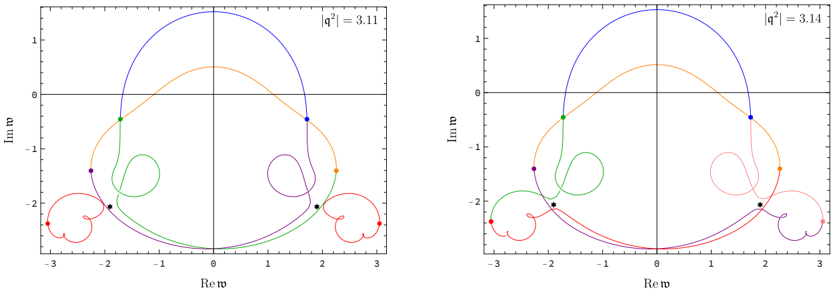
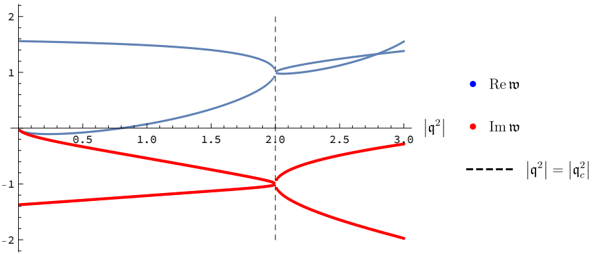
A bstract: We study analytic properties of the dispersion relations in classical hydrody- namics by treating them as Puiseux series in complex momentum. The radii of convergence of the series are determined by the critical points of the associated complex spectral curves. For theories that admit a dual gravitational description through holography, the critical points correspond to level-crossings in the quasinormal spectrum of the dual black hole. We illustrate these methods in N = 4 supersymmetric Yang-Mills theory in 3+1 dimensions, in a holographic model with broken translation symmetry in 2+1 dimensions, and in con- formal field theory in 1+1 dimensions. We comment on the pole-skipping phenomenon in thermal correlation functions, and show that it is not specific to energy density correlations.
Overview
The claims and statistics of this paper haven’t been checked yet.
Run the check — free, no account needed. It reads the open-access text and checks the sources it cites.
Integrity signals
Registry
Cites
Statistics
Figures
Verification
Claims the paper makes
The claims and statistics of this paper haven’t been checked yet.
Run the check — free, no account needed. It reads the open-access text and checks the sources it cites.
Claims other papers make about this one
Each is checked against this paper’s own text: does it say what the citing paper says it does?
In the citing paper
“In particular, the quantum corrections intertwine the tower of modes in a series of level-crossing events noticeably distinct from the level-touching events observed in the classical BTZ geometry [322].”
From Three-Dimensional Quantum Black Holes: A Primer (2024) · cites this paper as [322]
Self-check
Percentages, sums and reported differences re-computed from the paper’s own numbers.
The self-check needs the paper’s full text.
Citations
Cites
No references could be resolved yet.
Research works printed but not linked: 108
- L. Landau and E. Lifshits, Fluid mechanics, Pergamon Press, New York U.S.A. (1987).
- P. Kovtun, Lectures on hydrodynamic fluctuations in relativistic theories, J. Phys. A 45 (2012) 473001 [arXiv:1205.5040] [INSPIRE]. · arXiv
- R. Baier et al., Relativistic viscous hydrodynamics, conformal invariance and holography, JHEP 04 (2008) 100 [arXiv:0712.2451] [INSPIRE]. · DOI
- S. Bhattacharyya, Constraints on the second order transport coefficients of an uncharged fluid, JHEP 07 (2012) 104 [arXiv:1201.4654] [INSPIRE]. · arXiv
- S. Grozdanov and N. Kaplis, Constructing higher-order hydrodynamics: the third order, Phys. Rev. D 93 (2016) 066012 [arXiv:1507.02461] [INSPIRE]. · DOI
- Y. Pomeau and P. Resibois, Time dependent correlation functions and mode-mode coupling theories, Phys. Rept. 19 (1975) 63. · DOI
- M.H. Ernst and J.R. Dorfman, Nonanalytic dispersion relations for classical fluids, J. Stat. Phys. 12 (1975) 311. · DOI
- S. Grozdanov, P.K. Kovtun, A.O. Starinets and P. Tadić, Convergence of the gradient expansion in hydrodynamics, Phys. Rev. Lett. 122 (2019) 251601 [arXiv:1904.01018] [INSPIRE]. · DOI
- T. Kato, Perturbation theory for linear operators, Springer, Berlin, Germany (1980).
- J.D. Baker, D.E. Freund, R.N. Hill and J.D. Morgan III, Radius of convergence and analytic behavior of the 1/Z expansion, Phys. Rev. A 41 (1990) 1247. · DOI
- Y. Bu and M. Lublinsky, All order linearized hydrodynamics from fluid-gravity correspondence, Phys. Rev. D 90 (2014) 086003 [arXiv:1406.7222] [INSPIRE]. · DOI
- Y. Bu and M. Lublinsky, Linearized fluid/gravity correspondence: from shear viscosity to all order hydrodynamics, JHEP 11 (2014) 064 [arXiv:1409.3095] [INSPIRE]. · DOI
- A. Kurkela and U.A. Wiedemann, Analytic structure of nonhydrodynamic modes in kinetic theory, Eur. Phys. J. C 79 (2019) 776 [arXiv:1712.04376] [INSPIRE]. · DOI
- A. Buchel, M.P. Heller and J. Noronha, Entropy production, hydrodynamics and resurgence in the primordial quark-gluon plasma from holography, Phys. Rev. D 94 (2016) 106011 [arXiv:1603.05344] [INSPIRE]. · arXiv
- I. Aniceto, G. Basar and R. Schiappa, A primer on resurgent transseries and their asymptotics, Phys. Rept. 809 (2019) 1 [arXiv:1802.10441] [INSPIRE]. · DOI
- M.P. Heller, R.A. Janik and P. Witaszczyk, Hydrodynamic gradient expansion in gauge theory plasmas, Phys. Rev. Lett. 110 (2013) 211602 [arXiv:1302.0697] [INSPIRE]. · DOI
- M.P. Heller and M. Spalinski, Hydrodynamics beyond the gradient expansion: resurgence and resummation, Phys. Rev. Lett. 115 (2015) 072501 [arXiv:1503.07514] [INSPIRE]. · DOI
- G. Basar and G.V. Dunne, Hydrodynamics, resurgence and transasymptotics, Phys. Rev. D 92 (2015) 125011 [arXiv:1509.05046] [INSPIRE]. · arXiv
- I. Aniceto and M. Spalinśki, Resurgence in extended hydrodynamics, Phys. Rev. D 93 (2016) 085008 [arXiv:1511.06358] [INSPIRE]. · DOI
- W. Florkowski, R. Ryblewski and M. Spalinśki, Gradient expansion for anisotropic hydrodynamics, Phys. Rev. D 94 (2016) 114025 [arXiv:1608.07558] [INSPIRE]. · arXiv
- G.S. Denicol and J. Noronha, Divergence of the Chapman-Enskog expansion in relativistic kinetic theory, arXiv:1608.07869 [INSPIRE]. · arXiv
- W. Florkowski, M.P. Heller and M. Spalinski, New theories of relativistic hydrodynamics in the LHC era, Rept. Prog. Phys. 81 (2018) 046001 [arXiv:1707.02282] [INSPIRE]. · DOI
- M. Spalinśki, On the hydrodynamic attractor of Yang–Mills plasma, Phys. Lett. B 776 (2018) 468 [arXiv:1708.01921] [INSPIRE]. · DOI
- J. Casalderrey-Solana, N.I. Gushterov and B. Meiring, Resurgence and hydrodynamic attractors in Gauss-Bonnet holography, JHEP 04 (2018) 042 [arXiv:1712.02772] [INSPIRE]. · DOI
- M.P. Heller and V. Svensson, How does relativistic kinetic theory remember about initial conditions?, Phys. Rev. D 98 (2018) 054016 [arXiv:1802.08225] [INSPIRE]. · DOI
- B. Withers, Short-lived modes from hydrodynamic dispersion relations, JHEP 06 (2018) 059 [arXiv:1803.08058] [INSPIRE]. · DOI
- L.P. Kadanoff and P.C. Martin, Hydrodynamic equations and correlation functions, Ann. Phys. 24 (1963) 419. · DOI
- S. Grozdanov, K. Schalm and V. Scopelliti, Black hole scrambling from hydrodynamics, Phys. Rev. Lett. 120 (2018) 231601 [arXiv:1710.00921] [INSPIRE]. · DOI · Paper page
- M. Blake, H. Lee and H. Liu, A quantum hydrodynamical description for scrambling and many-body chaos, JHEP 10 (2018) 127 [arXiv:1801.00010] [INSPIRE]. · DOI
- M. Blake, R.A. Davison, S. Grozdanov and H. Liu, Many-body chaos and energy dynamics in holography, JHEP 10 (2018) 035 [arXiv:1809.01169] [INSPIRE]. · DOI · Paper page
- S. Grozdanov, On the connection between hydrodynamics and quantum chaos in holographic theories with stringy corrections, JHEP 01 (2019) 048 [arXiv:1811.09641] [INSPIRE]. · DOI
- R.A. Davison and B. Goutéraux, Momentum dissipation and effective theories of coherent and incoherent transport, JHEP 01 (2015) 039 [arXiv:1411.1062] [INSPIRE]. · DOI
- D.T. Son and A.O. Starinets, Minkowski space correlators in AdS/CFT correspondence: Recipe and applications, JHEP 09 (2002) 042 [hep-th/0205051] [INSPIRE]. · DOI · Paper page
- G. Policastro, D.T. Son and A.O. Starinets, From AdS/CFT correspondence to hydrodynamics, JHEP 09 (2002) 043 [hep-th/0205052] [INSPIRE]. · DOI
- M. Ammon and J. Erdmenger, Gauge/gravity duality, Cambridge University Press, Cambridge U.K.. (2015). · DOI · Paper page
- J. Casalderrey-Solana et al., Gauge/string duality, hot QCD and heavy ion collisions, arXiv:1101.0618 [INSPIRE]. · arXiv
- J. Zaanen, Y. Liu, Y. Sun and K. Schalm, Holographic duality in condensed matter physics, Cambridge University Press, Cambridge U.K.. (2015). · DOI
- S. Hartnoll, A. Lucas and S. Sachdev, Holographic quantum matter, MIT Press, U.S.A.. (2018).
- G. Policastro, D.T. Son and A.O. Starinets, From AdS/CFT correspondence to hydrodynamics. 2. Sound waves, JHEP 12 (2002) 054 [hep-th/0210220] [INSPIRE]. · DOI
- P.K. Kovtun and A.O. Starinets, Quasinormal modes and holography, Phys. Rev. D 72 (2005) 086009 [hep-th/0506184] [INSPIRE]. · DOI
- G. Festuccia and H. Liu, A Bohr-Sommerfeld quantization formula for quasinormal frequencies of AdS black holes, Adv. Sci. Lett. 2 (2009) 221 [arXiv:0811.1033]. · DOI
- J.F. Fuini, C.F. Uhlemann and L.G. Yaffe, Damping of hard excitations in strongly coupled N = 4 plasma, JHEP 12 (2016) 042 [arXiv:1610.03491] [INSPIRE]. · DOI
- P. Di Francesco, P. Mathieu and D. Senechal, Conformal field theory, Graduate Texts in Contemporary Physics, Springer, Germany (1997).
- C. Wall, Singular points of plane curves, Cambridge University Press, Cambridge U.K. (2004). · DOI
- P. Kovtun, First-order relativistic hydrodynamics is stable, JHEP 10 (2019) 034 [arXiv:1907.08191] [INSPIRE]. · DOI
- R.J. Walker, Algebraic curves, Princeton University Press, Princeton U.S.A. (1950).
- R. Sendra, F. Winkler and S. Pérez-Díaz, Rational algebraic curves: a computer algebra approach, Springer, Berlin Germany (2008). · DOI
- P. Kovtun, G.D. Moore and P. Romatschke, The stickiness of sound: An absolute lower limit on viscosity and the breakdown of second order relativistic hydrodynamics, Phys. Rev. D 84 (2011) 025006 [arXiv:1104.1586] [INSPIRE]. · DOI
- A. Parnachev and A. Starinets, The silence of the little strings, JHEP 10 (2005) 027 [hep-th/0506144] [INSPIRE]. · DOI
- M. Bhattacharya and C. Raman, Detecting level crossings without looking at the spectrum, Phys. Rev. Lett. 97 (2006) 140405 [physics/0604213]. · DOI
- T. Andrade and B. Withers, A simple holographic model of momentum relaxation, JHEP 05 (2014) 101 [arXiv:1311.5157] [INSPIRE]. · DOI
- R.C. Myers, A.O. Starinets and R.M. Thomson, Holographic spectral functions and diffusion constants for fundamental matter, JHEP 11 (2007) 091 [arXiv:0706.0162] [INSPIRE]. · DOI
- G. Hardy, Divergent series, Clarendon Press, Oxford U.K.. (1967).
- D.T. Son and A.O. Starinets, Viscosity, black holes, and quantum field theory, Ann. Rev. Nucl. Part. Sci. 57 (2007) 95 [arXiv:0704.0240]. · DOI
- A.O. Starinets, Quasinormal modes of near extremal black branes, Phys. Rev. D 66 (2002) 124013 [hep-th/0207133] [INSPIRE]. · arXiv
- S. Grozdanov and A.O. Starinets, Second-order transport, quasinormal modes and zero-viscosity limit in the Gauss-Bonnet holographic fluid, JHEP 03 (2017) 166 [arXiv:1611.07053] [INSPIRE]. · DOI
- A. Núñez and A.O. Starinets, AdS/CFT correspondence, quasinormal modes and thermal correlators in N = 4 SYM, Phys. Rev. D 67 (2003) 124013 [hep-th/0302026] [INSPIRE]. · arXiv
- R.A. Davison and A.O. Starinets, Holographic zero sound at finite temperature, Phys. Rev. D 85 (2012) 026004 [arXiv:1109.6343] [INSPIRE]. · DOI
- S. Grozdanov, N. Kaplis and A.O. Starinets, From strong to weak coupling in holographic models of thermalization, JHEP 07 (2016) 151 [arXiv:1605.02173] [INSPIRE]. · DOI
- S. Grozdanov and N. Poovuttikul, Generalized global symmetries in states with dynamical defects: The case of the transverse sound in field theory and holography, Phys. Rev. D 97 (2018) 106005 [arXiv:1801.03199] [INSPIRE]. · arXiv
- M. Baggioli and K. Trachenko, Maxwell interpolation and close similarities between liquids and holographic models, Phys. Rev. D 99 (2019) 106002 [arXiv:1808.05391] [INSPIRE]. · arXiv
- M. Baggioli and K. Trachenko, Low frequency propagating shear waves in holographic liquids, JHEP 03 (2019) 093 [arXiv:1807.10530] [INSPIRE]. · DOI
- S. Grozdanov, A. Lucas and N. Poovuttikul, Holography and hydrodynamics with weakly broken symmetries, Phys. Rev. D 99 (2019) 086012 [arXiv:1810.10016] [INSPIRE]. · DOI
- S. Grozdanov and A.O. Starinets, Adding new branches to the “Christmas tree” of the quasinormal spectrum of black branes, JHEP 04 (2019) 080 [arXiv:1812.09288] [INSPIRE]. · DOI
- N.I. Gushterov, A. O’Bannon and R. Rodgers, Holographic zero sound from spacetime-filling branes, JHEP 10 (2018) 076 [arXiv:1807.11327] [INSPIRE]. · DOI
- R.A. Davison, S.A. Gentle and B. Goutéraux, Slow relaxation and diffusion in holographic quantum critical phases, Phys. Rev. Lett. 123 (2019) 141601 [arXiv:1808.05659] [INSPIRE]. · DOI
- M. Baggioli, M. Vasin, V.V. Brazhkin and K. Trachenko, Gapped momentum states, arXiv:1904.01419 [INSPIRE]. · arXiv
- S. Bhattacharyya, V.E. Hubeny, S. Minwalla and M. Rangamani, Nonlinear fluid dynamics from gravity, JHEP 02 (2008) 045 [arXiv:0712.2456] [INSPIRE]. · DOI
- Y. Bu, M. Lublinsky and A. Sharon, Hydrodynamics dual to Einstein-Gauss-Bonnet gravity: all-order gradient resummation, JHEP 06 (2015) 162 [arXiv:1504.01370] [INSPIRE]. · DOI
- F.M. Haehl and M. Rozali, Effective field theory for chaotic CFTs, JHEP 10 (2018) 118 [arXiv:1808.02898] [INSPIRE]. · DOI · Paper page
- D. Birmingham, I. Sachs and S.N. Solodukhin, Conformal field theory interpretation of black hole quasinormal modes, Phys. Rev. Lett. 88 (2002) 151301 [hep-th/0112055] [INSPIRE]. · DOI · Paper page
- M. Blake, R.A. Davison and D. Vegh, Horizon constraints on holographic Green’s functions, arXiv:1904.12883 [INSPIRE]. · arXiv
- S. Datta, P. Kraus and B. Michel, Typicality and thermality in 2d CFT, JHEP 07 (2019) 143 [arXiv:1904.00668] [INSPIRE]. · DOI
- M. Edalati, J.I. Jottar and R.G. Leigh, Shear modes, criticality and extremal black holes, JHEP 04 (2010) 075 [arXiv:1001.0779] [INSPIRE]. · DOI
- M. Edalati, J.I. Jottar and R.G. Leigh, Holography and the sound of criticality, JHEP 10 (2010) 058 [arXiv:1005.4075] [INSPIRE]. · DOI
- D.K. Brattan and S.A. Gentle, Shear channel correlators from hot charged black holes, JHEP 04 (2011) 082 [arXiv:1012.1280] [INSPIRE]. · DOI
- R.A. Davison and N.K. Kaplis, Bosonic excitations of the AdS4 Reissner-Nordstrom black hole, JHEP 12 (2011) 037 [arXiv:1111.0660] [INSPIRE]. · DOI
- N.I. Gushterov, Quasinormal modes and correlators in the shear channel of spacetime-filling branes, arXiv:1807.11390 [INSPIRE]. · arXiv
- D.T. Son and A.O. Starinets, Hydrodynamics of r-charged black holes, JHEP 03 (2006) 052 [hep-th/0601157] [INSPIRE]. · DOI
- R.J. Anantua, S.A. Hartnoll, V.L. Martin and D.M. Ramirez, The Pauli exclusion principle at strong coupling: holographic matter and momentum space, JHEP 03 (2013) 104 [arXiv:1210.1590] [INSPIRE]. · DOI
- P. Betzios, U. Gürsoy, M. Järvinen and G. Policastro, Quasinormal modes of a strongly coupled nonconformal plasma and approach to criticality, Phys. Rev. D 97 (2018) 081901 [arXiv:1708.02252] [INSPIRE]. · DOI
- P. Betzios, U. Gürsoy, M. Järvinen and G. Policastro, Fluctuations in non-conformal holographic plasma at criticality, arXiv:1807.01718 [INSPIRE]. · arXiv
- J. Casalderrey-Solana, C.P. Herzog and B. Meiring, Holographic Bjorken flow at large-D, JHEP 01 (2019) 181 [arXiv:1810.02314] [INSPIRE]. · DOI
- S. Dubovsky, L. Hui, A. Nicolis and D.T. Son, Effective field theory for hydrodynamics: thermodynamics and the derivative expansion, Phys. Rev. D 85 (2012) 085029 [arXiv:1107.0731] [INSPIRE]. · DOI
- S. Grozdanov and J. Polonyi, Viscosity and dissipative hydrodynamics from effective field theory, Phys. Rev. D 91 (2015) 105031 [arXiv:1305.3670] [INSPIRE]. · arXiv
- P. Kovtun, G.D. Moore and P. Romatschke, Towards an effective action for relativistic dissipative hydrodynamics, JHEP 07 (2014) 123 [arXiv:1405.3967] [INSPIRE]. · DOI
- F.M. Haehl, R. Loganayagam and M. Rangamani, The fluid manifesto: emergent symmetries, hydrodynamics and black holes, JHEP 01 (2016) 184 [arXiv:1510.02494] [INSPIRE]. · DOI
- M. Crossley, P. Glorioso and H. Liu, Effective field theory of dissipative fluids, JHEP 09 (2017) 095 [arXiv:1511.03646] [INSPIRE]. · DOI
- F.M. Haehl, R. Loganayagam and M. Rangamani, Topological σ-models & dissipative hydrodynamics, JHEP 04 (2016) 039 [arXiv:1511.07809] [INSPIRE]. · arXiv
- P. Glorioso and H. Liu, The second law of thermodynamics from symmetry and unitarity, arXiv:1612.07705 [INSPIRE]. · arXiv
- K. Jensen, N. Pinzani-Fokeeva and A. Yarom, Dissipative hydrodynamics in superspace, JHEP 09 (2018) 127 [arXiv:1701.07436] [INSPIRE]. · DOI
- H. Liu and P. Glorioso, Lectures on non-equilibrium effective field theories and fluctuating hydrodynamics, PoS(TASI2017)008 [arXiv:1805.09331] [INSPIRE]. · arXiv
- T. Banks and A. Lucas, Emergent entropy production and hydrodynamics in quantum many-body systems, Phys. Rev. E 99 (2019) 022105 [arXiv:1810.11024] [INSPIRE]. · DOI
- X. Chen-Lin, L.V. Delacrétaz and S.A. Hartnoll, Theory of diffusive fluctuations, Phys. Rev. Lett. 122 (2019) 091602 [arXiv:1811.12540] [INSPIRE]. · DOI
- A. Buchel, J.T. Liu and A.O. Starinets, Coupling constant dependence of the shear viscosity in N = 4 supersymmetric Yang-Mills theory, Nucl. Phys. B 707 (2005) 56 [hep-th/0406264] [INSPIRE]. · DOI
- A. Buchel, Resolving disagreement for ηs in a CFT plasma at finite coupling, Nucl. Phys. B 803 (2008) 166 [arXiv:0805.2683] [INSPIRE]. · DOI
- S. Grozdanov and W. van der Schee, Coupling constant corrections in a holographic model of heavy ion collisions, Phys. Rev. Lett. 119 (2017) 011601 [arXiv:1610.08976] [INSPIRE]. · DOI
- J.A. McLennan, Convergence of the Chapman-Enskog expansion for the linearized Boltzmann equation, Phys. Fluids 8 (1965) 1580. · DOI
- P. Romatschke, Retarded correlators in kinetic theory: branch cuts, poles and hydrodynamic onset transitions, Eur. Phys. J. C 76 (2016) 352 [arXiv:1512.02641] [INSPIRE]. · DOI
- G.D. Moore, Stress-stress correlator in 𝜙4 theory: poles or a cut?, JHEP 05 (2018) 084 [arXiv:1803.00736] [INSPIRE]. · DOI
- S. Grozdanov, K. Schalm and V. Scopelliti, Kinetic theory for classical and quantum many-body chaos, Phys. Rev. E 99 (2019) 012206 [arXiv:1804.09182] [INSPIRE]. · DOI
- S. Krantz and H. Parks, The implicit function theorem: history, theory, and applications, Springer, Germany (2013). · DOI
- R.C. Gunning and H. Rossi, Analytic functions of several complex variables, Prentice-Hall, Englewood Cliffs U.S.A. (1965).
- V. Arnold, Huygens and Barrow, Newton and Hooke: pioneers in mathematical analysis and catastrophe theory from evolvents to quasicrystals, Birkhauser, Berlin Germany (1990). · DOI
- L. Landau and E. Lifshits, Mechanics, Pergamon Press, New York U.S.A. (1960).
- J. Lagrange, Sur le probléme de Kepler, Mém. Acad. Roy. Sci. 25 (1771) 204.
- P. Colwell, Solving Kepler’s equation over three centuries, Willmann-Bell, Richmond U.S.A. (1993).
- P. Laplace, Mémoire sur le développement de l’anomalie vrai et du rayon-vecteur elliptique, en séries ordonées suivant les puissances de l’excentricité, Mém. Acad. Roy. Sci. 6 (1823) 61.
Cited by
Sorted by citations
Three-Dimensional Quantum Black Holes: A Primer
Panella, E., Pedraza, J. F., & Svesko, A. (2024) · Universe · doi:10.3390/universe10090358 · Cited by 24
Metadata
- Authors
- Grozdanov, S., Kovtun, P. K., Starinets, A. O., & Tadić, P.
- Venue
- Journal of High Energy Physics
- Published
- 2019-11
- Volume
- 2019
- Issue
- 11
- ISSN
- 1029-8479
- Cited by
- 139
- References
- 0
- Language
- en
About these checks
Registry, retraction, Cites and statistics results are computed, not judged, with one exception: a printed reference that no index lists is read once by a model before it counts as a citation error. Claims are extracted by a model and kept only when their quote appears verbatim in the text; each cited source is then checked, with a model’s help, for whether it says what the claim relies on. Those verdicts can be wrong — read the claim’s quote and the cited source before relying on one.
Statistics and arithmetic are recomputed, not judged.
Confidence bands are shown only for fields calibrated on our annotated test set. None is calibrated yet, so no band is shown.
What counts as a claim ›How we measure confidence ›How we check this ›
Are you an author, or do you see a problem with this page? Request a review
