

Wnt/β-catenin-driven EMT regulation in human cancers
Open accessThe DOI matches its Crossref record; 237 of the 240 references it cites were found in a registry or an index.
Abstract
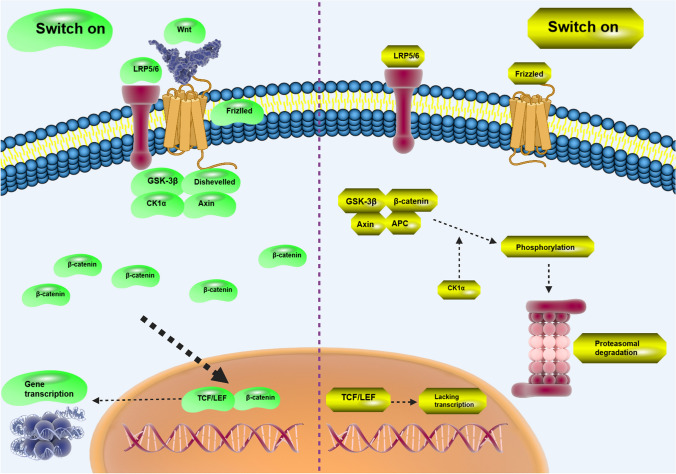
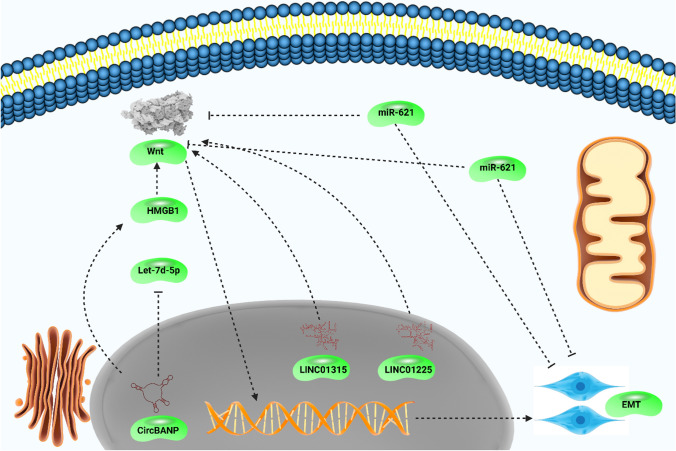
Metastasis accounts for 90% of cancer-related deaths among the patients. The transformation of epithelial cells into mesenchymal cells with molecular alterations can occur during epithelial–mesenchymal transition (EMT). The EMT mechanism accelerates the cancer metastasis and drug resistance ability in human cancers. Among the different regulators of EMT, Wnt/β-catenin axis has been emerged as a versatile modulator. Wnt is in active form in physiological condition due to the function of GSK-3β that destructs β-catenin, while ligand–receptor interaction impairs GSK-3β function to increase β-catenin stability and promote its nuclear transfer. Regarding the oncogenic function of Wnt/β-catenin, its upregulation occurs in human cancers and it can accelerate EMT-mediated metastasis and drug resistance. The stimulation of Wnt by binding Wnt ligands into Frizzled receptors can enhance β-catenin accumulation in cytoplasm that stimulates EMT and related genes upon nuclear translocation. Wnt/β-catenin/EMT axis has been implicated in augmenting metastasis of both solid and hematological tumors. The Wnt/EMT-mediated cancer metastasis promotes the malignant behavior of tumor cells, causing therapy resistance. The Wnt/β-catenin/EMT axis can be modulated by upstream mediators in which non-coding RNAs are main regulators. Moreover, pharmacological intervention, mainly using phytochemicals, suppresses Wnt/EMT axis in metastasis suppression. Graphical abstract
Overview
The claims and statistics of this paper haven’t been checked yet.
Free: it reads the open-access text and checks the first 5 claims that cite a source we can check. Create a free account to check every claim.
Integrity signals
Registry
Cites
Statistics
Figures
Verification
Claims the paper makes
The claims and statistics of this paper haven’t been checked yet.
Free: it reads the open-access text and checks the first 5 claims that cite a source we can check. Create a free account to check every claim.
Claims other papers make about this one
Each is checked against this paper’s own text: does it say what the citing paper says it does?
The source backs part of the claim, not all of it — or backs it for a different population, condition or comparison.
In the citing paper
“The inactivation of GSK3β disrupts the integrity and function of the destruction complex, thereby preventing β-catenin phosphorylation. As a result, unphosphorylated, stable β-catenin accumulates in the cytoplasm, translocates to the nucleus, and activates the transcription of its target genes, including c-Myc and Cyclin D1 [35, 46, 47, 52–55].”
From PPP1R18-mediated activation of Wnt/β-catenin and EMT is dependent on ERK signaling in clear cell renal cell carcinoma (2026) · cites this paper as [35]
Experimental — accuracy not yet measuredThe cited source says what the claim attributes to it.
In the citing paper
“EMT, a critical biological process by which tumor cells acquire motility and invasiveness, is a hallmark of metastasis and is frequently regulated by Wnt/β-catenin signaling [33–35].”
From PPP1R18-mediated activation of Wnt/β-catenin and EMT is dependent on ERK signaling in clear cell renal cell carcinoma (2026) · cites this paper as [35]
The cited source says what the claim attributes to it.
In the citing paper
“Likewise, the activation of the Wnt/β-catenin/EMT axis accounts for the invasive characteristics we observed, linking this signaling cascade to ccRCC metastasis [34, 35].”
From PPP1R18-mediated activation of Wnt/β-catenin and EMT is dependent on ERK signaling in clear cell renal cell carcinoma (2026) · cites this paper as [35]
Self-check
Percentages, sums and reported differences re-computed from the paper’s own numbers.
The self-check needs the paper’s full text.
Citations
Cites
3 retracted
Items 201–239 of 239
Lan, C., Liu, C., Nie, X., Lei, L., Xiao, Z.-X., Li, M., Tang, X.-N., Jia, M.-Y., & Xu, H. (2021) · Journal of Cancer · doi:10.7150/jca.62563 · Cited by 20
Liu, Y., Li, W., Luo, J., Wu, Y., Xu, Y., Chen, T., Zhang, W., & Fu, F. (2021) · Disease Markers · doi:10.1155/2021/3566749 · Cited by 19
Wu, S., Luo, C. H., Li, F., Hameed, N. U. F., Jin, Q.-Y., & Zhang, J. (2019) · Cancer Cell International · doi:10.1186/s12935-019-1040-6 · Cited by 19
Hsa_Circ_0098181 Suppresses Hepatocellular Carcinoma by Sponging miR-18a-3p and Targeting PPARA
Luo, Y., Tao, K.-G., Lu, Y., Li, B., Wu, K., Ding, C., Yan, F., Liu, Y., Lin, Y., Zhang, X., et al. (2022) · Frontiers in Pharmacology · doi:10.3389/fphar.2022.819735 · Cited by 19
Chen, X., Tu, J., Liu, C., Wang, L., & Yuan, X. (2022) · Life Sciences · doi:10.1016/j.lfs.2022.120941 · Cited by 18
Zhang, L., Mo, L., Tian, C.-C., Wang, T.-T., & Mi, S.-F. (2021) · Neoplasma · doi:10.4149/neo_2021_210103n2 · Cited by 18
Zheng, Y., Jia, H., Wang, P., Liu, L., Chen, Z., Xing, X., Wang, J., Tan, X., & Wang, C. (2022) · Cancer Gene Therapy · doi:10.1038/s41417-022-00517-7 · Cited by 17
Yuan, G., Liu, B., Han, W., & Zhao, D. (2019) · Translational Cancer Research · doi:10.21037/tcr.2019.06.20 · Cited by 17
Zhu, X., Xiang, Z., Zou, L., Chen, X., Peng, X., & Xu, D. (2021) · Journal of Cancer · doi:10.7150/jca.59595 · Cited by 17
Wu, S., Huang, J., Hui, K., Yue, Y., Gu, Y., Ning, Z., Wang, X., He, D., & Wu, K. (2018) · Oncology Reports · doi:10.3892/or.2018.6678 · Cited by 17
Fang, Q., Que, T., Liu, B., Dan, W., Wei, Y., Ren, B., Fan, Y., Hou, T., & Zeng, J. (2022) · Frontiers in Bioscience-Landmark · doi:10.31083/j.fbl2712335 · Cited by 16
Sun, Y., Lin, C., Ding, Q., & Dai, Y. (2021) · Digestive Diseases and Sciences · doi:10.1007/s10620-021-07226-5 · Cited by 15
Wu, X., Liu, H., Zhang, M., Ma, J., Qi, S., Tan, Q., Jiang, Y., Hong, Y., & Yan, L. (2022) · Journal of Biochemical and Molecular Toxicology · doi:10.1002/jbt.23037 · Cited by 15
Epidemiology of Viral Hepatitis and Liver Diseases in India.
Bhaumik, P. (2015) · PubMed Central · doi:10.5005/id-iournals-10018-1126 · Cited by 15
Huang, S., Zou, C., Xie, S., Wang, B., Linghu, X., Wang, Y., Xu, X., Huang, S., & Wa, Q. (2021) · Journal of Biomedical Nanotechnology · doi:10.1166/jbn.2021.3172 · Cited by 14
Wei, C., Jing, J., Zhang, Y., & Fang, L. (2019) · Pharmacology · doi:10.1159/000502400 · Cited by 14
Zhang, J., Shen, Q., Xia, L., Zhu, X., & Zhu, X. (2022) · Frontiers in Oncology · doi:10.3389/fonc.2022.889238 · Cited by 14
Göktürk, F., Kaya, D. E., & Arıkoğlu, H. (2021) · Bratislavské lekárske listy/Bratislava medical journal · doi:10.4149/bll_2021_020 · Cited by 14
Liu, X., He, Y., Tong, Y., Huang, Q., Shang, H., Chen, Z., & Tang, K. (2022) · Biochemical and Biophysical Research Communications · doi:10.1016/j.bbrc.2022.06.094 · Cited by 13
Targeting the Wnt signaling pathway for breast cancer bone metastasis therapy
Cui, J., Chen, H., Zhang, K., & Li, X. (2021) · Journal of Molecular Medicine · doi:10.1007/s00109-021-02159-y · Cited by 13
Liu, C., Deng, J., Wang, S., & Ren, L. (2022) · Clinical & Translational Oncology · doi:10.1007/s12094-022-02965-x · Cited by 13
Lv, F., Li, X., Wang, Y., & Hao, L. (2023) · Carcinogenesis · doi:10.1093/carcin/bgad003 · Cited by 13
Li, K., Zhan, X., Sun, J., Wang, T., Dong, H., Jing, F., Li, D., Cao, Y. Q., Liu, Y., Wang, L., et al. (2018) · Oncology Letters · doi:10.3892/ol.2018.8450 · Cited by 12
Department of Communicable Disease Control, Ministry of Health, Phnom Penh, Cambodia
Bhaumik, P. (2015) · Euroasian Journal of Hepato-Gastroenterology · doi:10.5005/jp-journals-10018-1126 · Cited by 11
Huang, G., Wu, Y., Du, Y., Gan, H., & Hao, S. (2022) · World Neurosurgery · doi:10.1016/j.wneu.2022.12.063 · Cited by 10
Yun, H., Han, G. H., Kim, J. J., Chung, J., Kim, J., & Cho, H. (2022) · Journal of Cellular and Molecular Medicine · doi:10.1111/jcmm.17557 · Cited by 10
Shao, Z., Wang, X., Li, Y., Hu, Y., & Li, K. (2022) · Frontiers in Molecular Biosciences · doi:10.3389/fmolb.2022.942636 · Cited by 10
Tsao, C., Li, J.-S., Lin, Y., Wu, S., Cha, T., & Liu, C. (2021) · Scientific Reports · doi:10.1038/s41598-020-80519-3 · Cited by 9
Shao, Z., Chang, Y., Hu, J., Wu, Y., & Zeng, C. (2020) · Cancer Biotherapy and Radiopharmaceuticals · doi:10.1089/cbr.2020.4044 · Cited by 9
Ni, H., Ji, D., Li, J., Zhao, Z., & Zuo, J. (2021) · International Journal of Biological Macromolecules · doi:10.1016/j.ijbiomac.2021.02.043 · Cited by 8
Han, X. W., Liu, H., Tang, X., & Zhao, Y. (2022) · Tissue and Cell · doi:10.1016/j.tice.2022.101973 · Cited by 8
Hong, J., Xie, Z., Yang, Z., Yang, F., Liao, H., Rao, S., & Huang, X. (2021) · Translational Cancer Research · doi:10.21037/tcr-20-3462 · Cited by 7
Chen, B., Gu, Y., Shen, H., Liu, Q., Wang, H., Li, Y., Liu, X., Liu, Y., Du, Q., Sun, H., et al. (2022) · Journal of Hepatocellular Carcinoma · doi:10.2147/jhc.s336452 · Cited by 7
Liu, Y., & Zhou, W. L. (2022) · Bioengineered · doi:10.1080/21655979.2022.2044275 · Cited by 7
Jin, W., & Wang, X. (2022) · PubMed · Cited by 7
Deng, H., Chen, G., & Zhang, J. (2022) · Journal of Complementary and Integrative Medicine · doi:10.1515/jcim-2022-0295 · Cited by 7
Chen, B., Gu, Y., Shen, H., et al. (2022) · Dove Medical Press (Taylor and Francis Group) · Cited by 6
Liu, J., Yuan, W., & Gong, D. (2022) · Journal of Oncology · doi:10.1155/2022/7274794 · Cited by 3
Xing, Y., Yi-le, H., Zou, H., Xie, H., Jiang, T., & Liu, L. (2022) · Toxicology in Vitro · doi:10.1016/j.tiv.2022.105456 · Cited by 1
Cited by
Wnt signaling pathways in biology and disease: mechanisms and therapeutic advances
Xue, C., Chu, Q., Shi, Q., Zeng, Y., Lu, J., & Li, L. (2025) · Signal Transduction and Targeted Therapy · doi:10.1038/s41392-025-02142-w · Cited by 281
Autophagy in cancer development, immune evasion, and drug resistance
Niu, X., You, Q., Hou, K., Tian, Y., Wei, P., Zhu, Y., Gao, B., Ashrafizadeh, M., Aref, A. R., Kalbasi, A., et al. (2025) · Drug Resistance Updates · doi:10.1016/j.drup.2024.101170 · Cited by 191
Self-citationGlaviano, A., Lau, H., Carter, L. M., Lee, E. H. C., Lam, H. Y., Okina, E., Tan, D. J. J., Tan, W., Ang, H. L., Carbone, D., et al. (2025) · Journal of Hematology & Oncology · doi:10.1186/s13045-024-01634-6 · Cited by 184
Wu, X., Que, H., Li, Q., & Wei, X. (2025) · Molecular Cancer · doi:10.1186/s12943-025-02363-1 · Cited by 178
Epithelial-mesenchymal transition
Zhang, C. X., Huang, R. Y., Sheng, G., & Thiery, J. P. (2025) · Cell · doi:10.1016/j.cell.2025.08.033 · Cited by 134
Metadata
- Authors
- Xue, W., Yang, L., Chen, C., Ashrafizadeh, M., Tian, Y., & Sun, R.
- Affiliations
- First Affiliated Hospital of Zhengzhou University (CN)
- Xian Yang Central Hospital (CN)
- Fudan University (CN)
- Benedictine University (US)
- Corresponding author
- Ashrafizadeh, Milad
- Tian, Yu
- Sun, Ranran
- Venue
- Cellular and Molecular Life Sciences
- Published
- 2024-02-09
- Volume
- 81
- Issue
- 1
- Pages
- 79-79
- ISSN
- 1420-682X (ISSN-L)
- 1420-9071
- PMC
- PMC10857981
- OpenAlex
- W4391691695
- Semantic Scholar
- 98fb3e091283e03cf5c3092f81a0f6c590245801
- Cited by
- 321
- References
- 240
- Citations by year
- 2026: 102 · 2025: 163 · 2024: 56
- FWCI
- 13.09
- Type
- journal article
- Language
- en
- Update notices
- expression_of_concern (2026-04-10)
- Open access
- gold
- doi.org
- Licence
- cc-by
- creativecommons.org/licenses/by/4.0 (tdm)
- creativecommons.org/licenses/by/4.0 (vor)
- Locations
- Cellular and Molecular Life Sciences (publishedVersion, cc-by)
- PubMed Central (publishedVersion, cc-by)
- PubMed (publishedVersion)
- Funders
- Young and Middle-aged Health Science and Technology Innovation Talents in 2020 (YXKC2020055)
- Medical Science and Technology Project of Henan Province (SBGJ202002077)
- Natural Science Foundation of Henan Province of China (202300410460)
- Topics
- Life Sciences › Biochemistry, Genetics and Molecular Biology › Molecular Biology › Wnt/β-catenin signaling in development and cancer
- Health Sciences › Medicine › Oncology › Cancer Cells and Metastasis
- Life Sciences › Biochemistry, Genetics and Molecular Biology › Molecular Biology › TGF-β signaling in diseases
- Keywords
- Wnt/β-catenin signaling, epithelial-mesenchymal transition, metastasis, drug resistance, GSK3β, Frizzled receptors, β-catenin nuclear translocation, non-coding RNA, phytochemicals, hematologic cancer, solid tumors
- MeSH terms
- Glycogen Synthase Kinase 3 beta, Cell Movement, Humans, Neoplasms, Gene Expression Regulation, Neoplastic, Cell Line, Tumor, beta Catenin, Epithelial-Mesenchymal Transition, Wnt Signaling Pathway
About these checks
Registry, retraction, Cites and statistics results are computed, not judged, with one exception: a printed reference that no index lists is read once by a model before it counts as a citation error. Claims are extracted by a model and kept only when their quote appears verbatim in the text; each cited source is then checked, with a model’s help, for whether it says what the claim relies on. Those verdicts can be wrong — read the claim’s quote and the cited source before relying on one.
Statistics and arithmetic are recomputed, not judged.
Confidence bands are shown only for fields calibrated on our annotated test set. None is calibrated yet, so no band is shown.
What counts as a claim ›How we measure confidence ›How we check this ›
Are you an author, or do you see a problem with this page? Request a review
Data sources
Bibliographic data: Semantic Scholar, OpenAlex, Crossref.
Contains information from the Semantic Scholar Academic Graph Datasets, made available under the ODC Attribution License (ODC-BY 1.0).
Semantic Scholar’s data is described in: Kinney, R., et al. (2023). The Semantic Scholar Open Data Platform. arXiv:2301.10140.
