

Crop adaptation to climate change as a consequence of long-term breeding
Open accessThe DOI matches its Crossref record; 93 of the 93 references it cites were found in a registry or an index.
Abstract
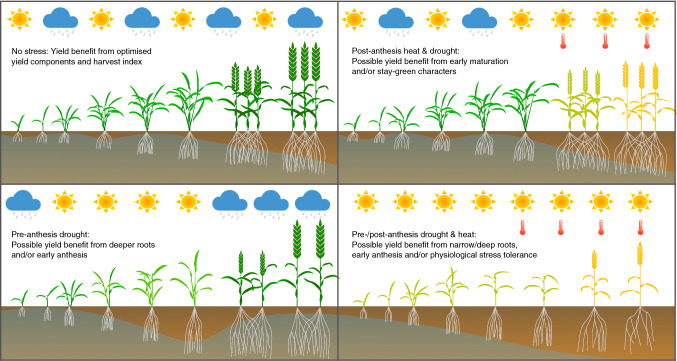
Major global crops in high-yielding, temperate cropping regions are facing increasing threats from the impact of climate change, particularly from drought and heat at critical developmental timepoints during the crop lifecycle. Research to address this concern is frequently focused on attempts to identify exotic genetic diversity showing pronounced stress tolerance or avoidance, to elucidate and introgress the responsible genetic factors or to discover underlying genes as a basis for targeted genetic modification. Although such approaches are occasionally successful in imparting a positive effect on performance in specific stress environments, for example through modulation of root depth, major-gene modifications of plant architecture or function tend to be highly context-dependent. In contrast, long-term genetic gain through conventional breeding has incrementally increased yields of modern crops through accumulation of beneficial, small-effect variants which also confer yield stability via stress adaptation. Here we reflect on retrospective breeding progress in major crops and the impact of long-term, conventional breeding on climate adaptation and yield stability under abiotic stress constraints. Looking forward, we outline how new approaches might complement conventional breeding to maintain and accelerate breeding progress, despite the challenges of climate change, as a prerequisite to sustainable future crop productivity.
Overview
The claims and statistics of this paper haven’t been checked yet.
Free: it reads the open-access text and checks the first 5 claims that cite a source we can check. Create a free account to check every claim.
Integrity signals
Registry
Cites
Statistics
Figures
Verification
Claims the paper makes
The claims and statistics of this paper haven’t been checked yet.
Free: it reads the open-access text and checks the first 5 claims that cite a source we can check. Create a free account to check every claim.
Claims other papers make about this one
Each is checked against this paper’s own text: does it say what the citing paper says it does?
The source backs part of the claim, not all of it — or backs it for a different population, condition or comparison.
In the citing paper
“With an understanding of the rates of change in the environment-type targets, and an understanding of the trait requirements for adaptation and performance in the different environment-types, tactical and strategic breeding programs can be designed that prioritise breeding objectives with knowledge of the projected changes (Chapman et al. 2012; Hammer et al. 2020; Snowdon et al. 2020).”
From Tackling G × E × M interactions to close on-farm yield-gaps: creating novel pathways for crop improvement by predicting contributions of genetics and management to crop productivity (2021) · cites this paper as Snowdon et al. 2020
Experimental — accuracy not yet measuredThe source backs part of the claim, not all of it — or backs it for a different population, condition or comparison.
In the citing paper
“For example, with advanced understanding of G × E × M interactions, breeders can adjust the design of the METs for one or more stages of the breeding program to enhance testing under different crop management regimes at any stage of the breeding program to create, identify and select new genotypes that demonstrate broad or specific adaptation to Environment–Management combinations that are import”
From Tackling G × E × M interactions to close on-farm yield-gaps: creating novel pathways for crop improvement by predicting contributions of genetics and management to crop productivity (2021) · cites this paper as Snowdon et al. 2020
Experimental — accuracy not yet measuredThe source backs part of the claim, not all of it — or backs it for a different population, condition or comparison.
In the citing paper
“With sufficient experience, and empirical results obtained from crop improvement programs designed to select for G–M technologies, comparisons can be made between the rates of improvement in on-farm crop productivity that can be achieved by directly selecting for G–M technologies relative to the current rates of improvement that are being achieved”
From Tackling G × E × M interactions to close on-farm yield-gaps: creating novel pathways for crop improvement by predicting contributions of genetics and management to crop productivity (2021) · cites this paper as Snowdon et al. 2020
Experimental — accuracy not yet measuredThe cited source says what the claim attributes to it.
In the citing paper
“Genotype-by-Environment-by-Management (G × E × M) interactions underpin many aspects of crop productivity.”
From Tackling G × E × M interactions to close on-farm yield-gaps: creating novel pathways for crop improvement by predicting contributions of genetics and management to crop productivity (2021) · cites this paper as Snowdon et al. 2020
The cited source says what the claim attributes to it.
In the citing paper
“Breeders and agronomists recognise the potential for Genotype-by-Environment-by-Management (G × E × M) interactions (Messina et al. 2009; Snowdon et al. 2020).”
From Tackling G × E × M interactions to close on-farm yield-gaps: creating novel pathways for crop improvement by predicting contributions of genetics and management to crop productivity (2021) · cites this paper as Snowdon et al. 2020
3 more claims about this paper
Create a free account to see every claim other papers make about this one.
Self-check
Percentages, sums and reported differences re-computed from the paper’s own numbers.
The self-check needs the paper’s full text.
Citations
Cites
The genetical theory of natural selection
Fisher, R. A. (1930) · doi:10.5962/bhl.title.27468 · Cited by 17,617
The Neutral Theory of Molecular Evolution
Kimura, M. (1979) · Scientific American · doi:10.1038/scientificamerican1179-98 · Cited by 7,666
Climate Trends and Global Crop Production Since 1980
Lobell, D. B., Schlenker, W., & Costa-Roberts, J. (2011) · Science · doi:10.1126/science.1204531 · Cited by 4,546 · cited 1×
“On the other hand, should severe yield repression imparted by severe drought and heat (Lobell et al. 2011) become the norm rather than the exception in important temperate cropping regions, breeding progress for these specific target traits must necessarily accelerate at a greater rate than…”
BackgroundUnderstanding: the Drought Phenomenon: The Role of Definitions
Wilhite, D. A., & Glantz, M. H. (1985) · Water International · doi:10.1080/02508068508686328 · Cited by 3,154 · cited 1×
“A distinction is made between regions showing temporary aberrations and those with permanent restrictions of rainfall, the latter is referred to as aridity (Wilhite and Glantz 2009).”
BackgroundClosing yield gaps through nutrient and water management
Mueller, N. D., Gerber, J. S., Johnston, M., Ray, D. K., Ramankutty, N., & Foley, J. A. (2012) · Nature · doi:10.1038/nature11420 · Cited by 2,827 · cited 1×
“Nevertheless, limitations to water and nutrient supply exacerbated by various kinds of drought are a major contributing factor to global yield gaps (Mueller et al. 2012).”
BackgroundGene networks involved in drought stress response and tolerance
Shinozaki, K., & Yamaguchi-Shinozaki, K. (2006) · Journal of Experimental Botany · doi:10.1093/jxb/erl164 · Cited by 2,632 · cited 2×
“For example, studies describing individual genes or gene networks purportedly conferring drought resistance in model and crop plants are very frequent (for reviews see Martignago et al. 2020; Shinozaki and Yamaguchi-Shinozaki 2006; Todaka et al. 2015); however, few examples exist for the achievement of significant gen…”
Climate variation explains a third of global crop yield variability
Ray, D. K., Gerber, J. S., MacDonald, G. K., & West, P. C. (2015) · Nature Communications · doi:10.1038/ncomms6989 · Cited by 2,046 · cited 1×
“Crop growth and performance are impacted by a complex interplay with a multitude of interacting environmental (E) and management factors (M), with climate variation explaining a considerable proportion of global crop yield variation (Ray et al. 2015).”
BackgroundImproving photosynthesis and crop productivity by accelerating recovery from photoprotection
Kromdijk, J., Głowacka, K., Leonelli, L., Gabilly, S. T., Iwai, M., Niyogi, K. K., & Long, S. P. (2016) · Science · doi:10.1126/science.aai8878 · Cited by 1,317 · cited 1×
“…pathway can significantly reduce the energy cost of photorespiration and considerably raise photosynthetic efficiency and plant biomass, while Kromdijk et al. (2016) achieved similarly positive effects on photosynthetic efficiency and biomass productivity by engineering photoprotective…”
BackgroundThe Contribution of Breeding to Yield Advances in maize (Zea mays L.)
Duvick, D. N. (2005) · Advances in Agronomy · doi:10.1016/s0065-2113(05)86002-x · Cited by 1,214 · cited 2×
“…et al. 2018; Fischer and Edmeades 2010; Peltonen-Sainio et al. 2009; Sanchez-Garcia et al. 2012), maize (Badu-Apraku et al. 2015; Ci et al. 2011; Duvick 2005; Russell 1991), rape-seed (Stahl et al. 2017, 2019), soybean (Rincker et al. 2014; Ustun et al. 2001), barley (Laidig et al. 2017), sugar…”
BackgroundThe Genetic Architecture of Quantitative Traits
Mackay, T. F. C. (2001) · Annual Review of Genetics · doi:10.1146/annurev.genet.35.102401.090633 · Cited by 1,106 · cited 2×
“On the other hand, QTL with larger effects, which contradict the infinitesimal model in breeding populations (Mackay 2001), are generally rapidly fixed for the most beneficial alleles in elite, adapted cultivars (e.”
Background
Research works printed but not linked: 1
- Borrell AK Hammer GL Douglas ACL Does maintaining green leaf area in Sorghum improve yield under drought? I Leaf Growth and Senescence Crop Sci 2000 40 1026 1037
Cited by
Breeding crops for drought-affected environments and improved climate resilience
Cooper, M., & Messina, C. D. (2023) · The Plant Cell · doi:10.1093/plcell/koac321 · Cited by 195
“…workable (GxM)xE solutions that can be evaluated and further improved over cycles of the breeding program as the environmental composition of the TPE shifts due to the effects of climate change (Voss-Fels et al., 2019a; Snowdon et al., 2020; Cooper et al., 2021a, 2021b, 2023; Technow et al., 2021).”
BackgroundInfluentialClimate change challenges plant breeding
Xiong, W., Reynolds, M. P., & Xu, Y. (2022) · Current Opinion in Plant Biology · doi:10.1016/j.pbi.2022.102308 · Cited by 193
Human-Centered AI in Smart Farming: Toward Agriculture 5.0
Holzinger, A., Fister, I., Fister, I., Kaul, H.-P., & Asseng, S. (2024) · IEEE Access · doi:10.1109/access.2024.3395532 · Cited by 182
“It is not merely a question of adapting to change, but of proactively innovating to anticipate and withstand future environmental disturbances [9], [10].”
BackgroundPlant responses to climate change, how global warming may impact on food security: a critical review
Janni, M., Maestri, E., Gullì, M., Marmiroli, M., & Marmiroli, N. (2024) · Frontiers in Plant Science · doi:10.3389/fpls.2023.1297569 · Cited by 160
Enhancing crop diversity for food security in the face of climate uncertainty
Zsögön, A., Peres, L. E. P., Xiao, Y., Yan, J., & Fernie, A. R. (2021) · The Plant Journal · doi:10.1111/tpj.15626 · Cited by 147
Cooper, M., Voss-Fels, K. P., Messina, C. D., Tang, T., & Hammer, G. L. (2021) · Theoretical and Applied Genetics · doi:10.1007/s00122-021-03812-3 · Cited by 119
“Further, with appropriate attention to design, results from METs across multiple breeding program stages and cycles can be combined to conduct meta-analyses and develop robust training data sets to support genomic prediction (Cooper et al.”
BackgroundMethodInfluentialBREEDIT: a multiplex genome editing strategy to improve complex quantitative traits in maize
Lorenzo, C. D., Debray, K., Herwegh, D., Develtere, W., Impens, L., Schaumont, D., Vandeputte, W., Aesaert, S., Coussens, G., de Boe, Y., et al. (2022) · The Plant Cell · doi:10.1093/plcell/koac243 · Cited by 115
Mullualem, D., Tsega, A., Mengie, T., Fentie, D., Kassa, Z., Fassil, A., Wondaferew, D., Gelaw, T. A., & Astatkie, T. (2024) · Heliyon · doi:10.1016/j.heliyon.2024.e32918 · Cited by 115
“D. Mullualem et al. and selecting genotypes that demonstrate high adaptability and stability under different environmental conditions, breeders can achieve rapid genetic progress before releasing them as cultivars [39,40].”
BackgroundRedesigning crop varieties to win the race between climate change and food security
Pixley, K. V., Cairns, J. E., López‐Ridaura, S., Ojiewo, C. O., Dawud, M. A., Drabo, I., Mindaye, T. T., Nebié, B., Asea, G., Das, B., et al. (2023) · Molecular Plant · doi:10.1016/j.molp.2023.09.003 · Cited by 108
Influence of Drought and Salt Stress on Durum Wheat Grain Quality and Composition: A Review
Santis, M. A. D., Soccio, M., Laus, M. N., & Flagella, Z. (2021) · Plants · doi:10.3390/plants10122599 · Cited by 107
“In terms of yield components, final grain number (per square meter and per spike) results as one of the most important yield components in determining final yield, especially under water stress conditions [37] also in interaction with nitrogen availability [32].”
BackgroundBreeding crops for climate resilience
Langridge, P., Braun, H. J., Hulke, B. S., Ober, E. S., & Prasanna, B. M. (2021) · Theoretical and Applied Genetics · doi:10.1007/s00122-021-03854-7 · Cited by 91
Extending the breeder’s equation to take aim at the target population of environments
Cooper, M., Powell, O. M., Gho, C., Tang, T., & Messina, C. D. (2023) · Frontiers in Plant Science · doi:10.3389/fpls.2023.1129591 · Cited by 73
“The effects of climate change on the environmental composition of the TPE and associated changes in trait contributions to yield and GxE interactions for current and future cropping systems represents one clear area for urgent consideration in the design of METs to address the MET-TPE alignment (Braun et al., 2010; Ch…”
BackgroundKrause, M., Sørensen, J. C. H., Petersen, I. L., Estrada, P. D., Cappello, C., Tlais, A. Z. A., Cagno, R. D., Ispiryan, L., Sahin, A. W., Arendt, E. K., et al. (2023) · Foods · doi:10.3390/foods12050919 · Cited by 66
“Furthermore, the changing climate makes crop failures and low harvest yields more likely [3], and global food security is in danger.”
BackgroundIncrease of Simultaneous Soybean Failures Due To Climate Change
Goulart, H. M. D., van der Wiel, K., Folberth, C., Boere, E., & van den Hurk, B. (2023) · Earth s Future · doi:10.1029/2022ef003106 · Cited by 60
“, 2019) to genetic modification of soybean cultivars (Snowdon et al., 2021), each having different consequences for soybean yields.”
BackgroundNew wheat breeding paradigms for a warming climate
Xiong, W., Reynolds, M. P., Montes, C., Crossa, J. L., Snapp, S. S., Akın, B., Mesut, K., Özdemir, F., Li, H., He, Z., et al. (2024) · Nature Climate Change · doi:10.1038/s41558-024-02069-0 · Cited by 58
“These forms of extreme weather are becoming more common and can be highly detrimental to crop yields, so is a priority topic for future studies 18 .”
Cooper, M., Messina, C. D., Tang, T., Gho, C., Powell, O. M., Podlich, D. W., Technow, F., & Hammer, G. L. (2022) · Plant Breeding Reviews · doi:10.1002/9781119874157.ch8 · Cited by 56
Nagdalian, A. A., Блинов, А. В., Siddiqui, S. A., Gvozdenko, A. A., Golik, A. B., Маглакелидзе, Д. Г., Rzhepakovsky, I. V., Kukharuk, M. J., Piskov, S., Ребезов, М. Б., et al. (2023) · Scientific Reports · doi:10.1038/s41598-023-33581-6 · Cited by 55
Ebmeyer, H., Fiedler‐Wiechers, K., & Hoffmann, C. M. (2021) · European Journal of Agronomy · doi:10.1016/j.eja.2021.126262 · Cited by 50
Chickpeas’ Tolerance of Drought and Heat: Current Knowledge and Next Steps
Karalija, E., Vergata, C., Basso, M. F., Negussu, M., Zaccai, M., Grossi‐de‐Sá, M. F., & Martinelli, F. (2022) · Agronomy · doi:10.3390/agronomy12102248 · Cited by 47
“The complex relationship between management and the environment explains a significant proportion of a crop’s trait variability [3,4].”
BackgroundLi, J., Liu, X., Chang, S., Chu, W., Lin, J., Zhou, H., Hu, Z., Zhang, M., Xin, M., Yao, Y., et al. (2024) · Science Advances · doi:10.1126/sciadv.adk4027 · Cited by 45
“Consequently, understanding the mechanisms and improving wheat tolerance to drought have been a high priority for research activities and wheat breeding programs ( 6 – 8 ).”
BackgroundPotential abiotic stress targets for modern genetic manipulation
Bowerman, A. F., Byrt, C. S., Roy, S. J., Whitney, S. M., Mortimer, J. C., Ankeny, R. A., Gilliham, M., Zhang, D., Millar, A. A., Rebetzke, G. J., et al. (2022) · The Plant Cell · doi:10.1093/plcell/koac327 · Cited by 44
Mgwenya, L. I., Agholor, I. A., Ludidi, N., Morepje, M. T., Sithole, M. Z., Msweli, N. S., & Thabane, V. N. (2025) · World · doi:10.3390/world6010016 · Cited by 43
“This is largely because organic farming and conservation agri-culture have been implemented, along with concurrent activity reduction [57].”
Shahid, S., Ali, Q., Ali, S., Al-Misned, F. A., & Maqbool, S. (2022) · Plants · doi:10.3390/plants11030466 · Cited by 40
Timing and Intensity of Heat and Drought Stress Determine Wheat Yield Losses in Germany
Riedesel, L., Möller, M., Horney, P., Golla, B., Piepho, H., Kautz, T., & Feike, T. (2022) · PLoS ONE · doi:10.1371/journal.pone.0288202 · Cited by 40
“Breeding progress alters the timing of crop developmental phases [84], resource use efficiency, including water use efficiency [85], and resistance levels against biotic [9] and abiotic stress [72].”
Pérez‐Méndez, N., Miguel‐Rojas, C., Jiménez-Berni, J. A., Gómez-Candón, D., Pérez‐de‐Luque, A., Fereres, E., Català-Forner, M., Villegas, D., & SILLERO, J. C. (2021) · Agronomy · doi:10.3390/agronomy12010075 · Cited by 37
“The most critical factor limiting rainfed cereal yields in the Mediterranean area is drought stress, understood as the negative impact that a water deficit causes on grain yield [3].”
BackgroundShamloo‐Dashtpagerdi, R., Aliakbari, M., Lindlöf, A., & Tahmasebi, S. (2022) · Planta · doi:10.1007/s00425-022-03885-4 · Cited by 36
“Therefore, it is critical to breed multiple-stress-tolerant crops with a sustainable yield to face this environmental situation (Snowdon et al. 2020).”
BackgroundModeling the Impact of Future Climate Change Impacts on Rainfed Durum Wheat Production in Algeria
Kourat, T., Smadhi, D., & Madani, A. (2022) · Climate · doi:10.3390/cli10040050 · Cited by 36
Alipour, H., Abdi, H., Rahimi, Y., & Bihamta, M. R. (2021) · Scientific Reports · doi:10.1038/s41598-021-96576-1 · Cited by 33
Carcedo, A. J. P., Mayor, L., Demarco, P., Morris, G. P., Lingenfelser, J., Messina, C. D., & Ciampitti, I. A. (2022) · Frontiers in Plant Science · doi:10.3389/fpls.2022.768610 · Cited by 33
Prado, K., Holland, B. L., Gardener, B. M., Lundquist, P. K., Santiago, J. P., VanBuren, R., & Rhee, S. Y. (2025) · Journal of Experimental Botany · doi:10.1093/jxb/eraf111 · Cited by 33
Vafa, Z. N., Sohrabi, Y., Mirzaghaderi, G., & Heidari, G. (2022) · Frontiers in Plant Science · doi:10.3389/fpls.2022.855090 · Cited by 31
“The decreased grain production of Sardari dry-land cultivar under drought stress may be due to early leaf aging and reduced green leaf area for photosynthesis in reproductive plants (Rozo-Ortega et al., 2021; Snowdon et al., 2021).”
BackgroundContributions of plant breeding to soil carbon storage: Retrospect and prospects
Poffenbarger, H., Castellano, M. J., Egli, D. B., Jaconi, A., & Moore, V. M. (2023) · Crop Science · doi:10.1002/csc2.20920 · Cited by 31
Blanchard-Gros, R., Bigot, S., Martìnez, J.-P., Lutts, S., Guerriero, G., & Quinet, M. (2021) · Plants · doi:10.3390/plants10081720 · Cited by 30
“Drought and heat stress are the most threatening abiotic stresses for crops and will be increasingly present in the context of global warming [36].”
BackgroundAhmad, N., Su, B., Ibrahim, S., Kuang, L., Tian, Z., Wang, X., Wang, H., & Dun, X. (2022) · International Journal of Molecular Sciences · doi:10.3390/ijms23147958 · Cited by 28
“Therefore, addressing the genetic architecture of low nitrogen stress tolerance and boosting rapeseed’s NUE is vital for the rapeseed’s economic competitiveness [8,9].”
BackgroundIdrissi, I. S. E., Kettani, R., Ferrahi, M., Nabloussi, A., Ziri, R., & Brhadda, N. (2023) · Journal of Agriculture and Food Research · doi:10.1016/j.jafr.2023.100696 · Cited by 28
Production status and research advancement on root rot disease of faba bean (Vicia faba L.) in China
Yu, H., Yang, F., Hu, C., Yang, X., Zheng, A., Wang, Y., Tang, Y., He, Y., & Lv, M. (2023) · Frontiers in Plant Science · doi:10.3389/fpls.2023.1165658 · Cited by 26
“3 billion tons) (FAOSTAT, 2022), the challenges posed by climate change and loss of quality and area of arable land are limiting crop production (Döös, 2002; Shi et al., 2016; Snowdon et al., 2021).”
BackgroundCould flooding undermine progress in building climate-resilient crops?
Ngumbi, E. (2024) · Trends in Plant Science · doi:10.1016/j.tplants.2024.07.017 · Cited by 25
An elite allele TaDT1-AhapI enhances drought tolerance via mediating autophagic pathways in wheat
Liu, X., Li, J., Zhang, C., Zhao, D., Peng, X., Yang, Q., Liu, Z., Miao, L., Chu, W., Lin, J., et al. (2025) · Nature Communications · doi:10.1038/s41467-025-61943-3 · Cited by 25
Johansson, E., Muneer, F., & Prade, T. (2023) · Sustainability · doi:10.3390/su151612349 · Cited by 24
Underground Ink: Printed Electronics Enabling Electrochemical Sensing in Soil
Chen, K., Kachhadiya, J., Muhtasim, S., Cai, S., Huang, J., & Andrews, J. B. (2024) · Micromachines · doi:10.3390/mi15050625 · Cited by 24
“Data-enabled insights can further improve the mechanistic modeling of crop responses to climate change [2], breeding for stress-tolerant varieties [3], and the advancement of intelligent and sustainable automated agricultural systems [4].”
BackgroundInnovative Approaches in the Breeding of Climate‐Resilient Crops
Cvejić, S., Jocić, S., Mitrović, B., Bekavac, G., Mirosavljević, M., Marjanović‐Jeromela, A., Zorić, M., Radanović, A., Kondić‐Špika, A., & Miladinović, D. (2022) · Wiley eBooks · doi:10.1002/9781119789789.ch6 · Cited by 23
Haq, S. A. U., Bashir, T., Roberts, T. H., & Husaini, A. M. (2023) · Molecular Biology Reports · doi:10.1007/s11033-023-09042-8 · Cited by 23
“Most crop plants thrive in suboptimal environmental circum-stances that limit their genetic potential in terms of growth and reproduction [13].”
Abelenda, J. A., Trabanco, N., del Olmo, I., Pozas, J., Martín‐Trillo, M., Gómez‐Garrido, J., Esteve‐Codina, A., Pernas, M., Jarillo, J. A., & Piñeiro, M. (2022) · Plant Cell & Environment · doi:10.1111/pce.14526 · Cited by 22
Environmental data provide marginal benefit for predicting climate adaptation
Li, F., Gates, D. J., Buckler, E. S., Hufford, M. B., Janzen, G. M., Rellán‐Álvarez, R., Rodríguez-Zapata, F., Navarro, J. A. R., Sawers, R. J. H., Snodgrass, S. J., et al. (2025) · PLoS Genetics · doi:10.1371/journal.pgen.1011714 · Cited by 22
“If populations are adapted along environmental gradients, then the frequencies of loci underlying adaptation may show correlations with those gradients.”
Chaves, S. F. D. S., Evangelista, J. S. P. C., Alves, R. S., Ferreira, F. M., Dias, L. A. D. S., Alves, R. M., Dias, K. O. D. G., & Bhering, L. L. (2022) · Tree Genetics & Genomes · doi:10.1007/s11295-022-01576-5 · Cited by 22
Leite, J. T., Júnior, A. T. D. A., Kamphorst, S. H., de Lima, V. J., dos Santos, D. R., de Oliveira, U. A., Azeredo, V. C., Pereira, J. L., Bispo, R. B., Schmidt, K. F. M., et al. (2022) · Plants · doi:10.3390/plants11172275 · Cited by 21
“Due to the increase in CO2 concentration and temperature, the scarcity and irregularity of rainfall represents the climactic event that most affects agriculture [3].”
BackgroundEnvironmental genomic selection to leverage polygenic local adaptation in barley landraces
Halpin-McCormick, A., Campbell, Q., Negrão, S., Morrell, P. L., Hübner, S., Neyhart, J., & Kantar, M. B. (2025) · Communications Biology · doi:10.1038/s42003-025-08045-4 · Cited by 21
Spatial Super Resolution of Real-World Aerial Images for Image-Based Plant Phenotyping
Aslahishahri, M., Stanley, K. G., Duddu, H., Shirtliffe, S. J., Vail, S. L., & Stavness, I. (2021) · Remote Sensing · doi:10.3390/rs13122308 · Cited by 19
“Breeding crop varieties that have both high yields and resilience to abiotic stress has the potential to overcome these challenges to global food production and stability [4].”
BackgroundCorlouer, E., Sauvage, C., Leveugle, M., Nési, N., & Laperche, A. (2024) · Theoretical and Applied Genetics · doi:10.1007/s00122-024-04664-3 · Cited by 19
“Breeding programs must therefore consider SY stability to breed for new varieties better adapted to fluctuating environments (Cooper et al. 2020; Snowdon et al. 2021).”
BackgroundJan, S. S., Khan, N. A., Asaf, S., Shahzad, R., Lubna, Imran, M., Bilal, S., Lee, I., & Al‐Harrasi, A. (2024) · Journal of Plant Growth Regulation · doi:10.1007/s00344-024-11394-9 · Cited by 19
“Global warming particularly endangers major crops in temperate regions, which are extremely vulnerable to rising temperatures (Snowdon et al. 2021).”
Winter Wheat Adaptation to Climate Change in Turkey
Kaya, Y. (2021) · Agronomy · doi:10.3390/agronomy11040689 · Cited by 19
“Vernalization +++ + [53,74] Photoperiod ++ + [40,56] Cold tolerance +++ + [16,75] Grain yield (Food security) ++++ +++++ [55] Grain quality +++ ++++ [65] Phenology + ++++ [76,77] Thermal time +++ + [41,78] Earliness + ++++ [45] Heat tolerance ++ +++++ [9,10,13,17] Drought tolerance ++++ +++++ [14,17,19] Waterlogging +…”
BackgroundOpportunities and avenues for achieving crop climate resilience
Zenda, T., Wang, N., Yan, X., Dong, A., Yang, Q., Zhong, Y., & Duan, H. (2023) · Environmental and Experimental Botany · doi:10.1016/j.envexpbot.2023.105414 · Cited by 19
Sheng, K., Xu, L., Wang, M., Lei, H., & Duan, A. (2022) · Frontiers in Plant Science · doi:10.3389/fpls.2022.1030763 · Cited by 18
“GN is a reliable indicator of dough elasticity and can be used to determine the proportional composition of grain proteins (Martre et al., 2003; Ferrise et al., 2015; Mefleh et al., 2020; Snowdon et al., 2021).”
MethodClosing the phenotyping gap with non-invasive belowground field phenotyping
Blanchy, G., Deroo, W., Swaef, T. D., Lootens, P., Quataert, P., Roldán-Ruíz, I., Versteeg, R., & Garré, S. (2025) · SOIL · doi:10.5194/soil-11-67-2025 · Cited by 18
“…(DCR)) is a commonly used geophysical technique to inject a current into a pair of electrodes and to measure the voltage in another pair, obtaining the electrical resistance of the bulk soil in the measurement volume The measurement volume varies with the distance between the four electrodes.”
The influence of genetic architecture on responses to selection under drought in rice
Ćalić, I., Groen, S. C., Choi, J. Y., Joly‐Lopez, Z., Hamann, E., Natividad, M. A., Dorph, K., Cabral, C. L. U., Torres, R. O., Vergara, G. V., et al. (2022) · Evolutionary Applications · doi:10.1111/eva.13419 · Cited by 19
Estimating genetic gains for tolerance to stress combinations in tropical maize hybrids
Menkir, A., Dieng, I., Meseka, S. K., Bossey, B., Mengesha, W., Muhyideen, O., Riberio, P. F., Coulibaly, M. M., Yacoubou, A., Bankole, F. A., et al. (2022) · Frontiers in Genetics · doi:10.3389/fgene.2022.1023318 · Cited by 17
“timing, duration, and severity of specific water deficits (Snowdon et al., 2021).”
BackgroundAwhari, D. P., Jamal, M. H., Muhammad, M. K. I., & Shahid, S. (2024) · Irrigation and Drainage · doi:10.1002/ird.2950 · Cited by 17
“Climate change can occasionally lead to new agricultural prospects, such as the capacity to cultivate new crops or lengthen growing seasons (Cooper & Messina, 2023; Razzaq et al., 2021; Snowdon et al., 2021; Van Etten et al., 2019).”
Wang, X., Zhao, P., Shi, X., Guo, X., Liu, Y., Hou, W., Cheng, M., Liu, X., Lai, X., Simmonds, J., et al. (2025) · The Plant Cell · doi:10.1093/plcell/koaf267 · Cited by 16
Schnurr, M. A., Rock, J. S., Kingiri, A. N., & Lieberman, S. E. (2022) · Current Opinion in Environmental Sustainability · doi:10.1016/j.cosust.2022.101216 · Cited by 16
Managing Crop Adaptation to Changing Environment
Bijlwan, A., Ranjan, R., Kumar, M., Gupta, S., & Jha, A. (2024) · Springer eBooks · doi:10.1007/978-981-97-1510-7_14 · Cited by 16
Plasticity of source-sink dynamics contributes to wheat yield stability
Wang, T.-C., Moritz, A., Mabrouk, M., Alegria, E. V., Arinalp, B., Ganji, E., Förter, L., Wittkop, B., Herzog, E., Snowdon, R. J., et al. (2026) · Nature Communications · doi:10.1038/s41467-026-72330-x · Cited by 15
“These factors further interact with the plant genotype (G), and the genotype-speci fi c strategies to dynamically acclimatize plant genotypes to given environmental conditions 10,11 , leading to higher-order G*E*M interactions, which must be considered in both breeding and agronomy 12,13 .”
Self-citationMassman, C., Meints, B. M., Hernandez, J., Kunze, K. H., Hayes, P. M., Sorrells, M. E., Smith, K. P., Dawson, J. C., & Gutiérrez, L. (2021) · Crop Science · doi:10.1002/csc2.20686 · Cited by 15
Bui, H., Greenhalgh, R., Gill, G. S., Ji, M., Kurlovs, A. H., Ronnow, C., Lee, S., Ramirez, R. A., & Clark, R. M. (2021) · Frontiers in Plant Science · doi:10.3389/fpls.2021.693088 · Cited by 15
“Among abiotic factors, drought stress, which is often associated with elevated temperatures, is especially important, and is projected to become more so in many regions under current climate change projections (Snowdon et al. 2020).”
BackgroundBreeding progress is a major contributor to improved regional maize water productivity
Rotundo, J. L., Zinselmeier, C., Hoffman, N., Ferhatoglu, C., Jobbagy, E. G., Oliver, P., & Borrás, L. (2025) · Scientific Reports · doi:10.1038/s41598-025-96534-1 · Cited by 14
Modern elite winter wheat cultivars use two physiological pathways to achieve yield stability
Wang, T.-C., Liu, L.-Y. D., Weiß, K., & Chen, T. (2025) · Journal of Experimental Botany · doi:10.1093/jxb/eraf191 · Cited by 13
Self-citationAdvances in Functional Genomics for Exploring Abiotic Stress Tolerance Mechanisms in Cereals
Goche, T., Mavindidze, P., & Zenda, T. (2025) · Plants · doi:10.3390/plants14162459 · Cited by 14
“Creating stress-tolerant crops requires first gaining a mechanistic understanding of the plant biological processes and fundamental mechanisms underlying responses to those different stresses [1,99].”
Jałowiec, T., Wojtaszek, H., & Miciuła, I. (2021) · Energies · doi:10.3390/en14238097 · Cited by 13
Manntschke, A., Hempel, L., Temme, A. A., Reumann, M., & Chen, T. (2025) · Frontiers in Plant Science · doi:10.3389/fpls.2025.1490483 · Cited by 12
“Plant height, an obvious trait related to plant-plant competition, has been intensively considered for in the context of plant breeding (Voss-Fels et al., 2019; Snowdon et al., 2021; Lacasa et al., 2022).”
Self-citationThe genotype-dependent effects of biologicals on drought adaptation in spring barley
Töpfer, V., Matros, A., Hamburger, S., Schmitt, A., Linkies, A., Snowdon, R. J., Stahl, A., & Wehner, G. (2025) · Plant Stress · doi:10.1016/j.stress.2025.100884 · Cited by 12
Self-citationEnhancing Climate Resilience and Food Security in Greece Through Agricultural Biodiversity
Loizou, E., Spinthiropoulos, K. G., Kalogiannidis, S., Chatzitheodoridis, F., Kalfas, D., & Tzilantonis, G. T. (2025) · Land · doi:10.3390/land14040838 · Cited by 12
Introgressed eggplant lines with the wild Solanum incanum evaluated under drought stress conditions
Flores-Saavedra, M., Gramazio, P., Vilanova, S., Mircea, D. M., Ruiz‐González, M. X., Vicente, Ó., Prohens, J., & Plazas, M. (2024) · Journal of Integrative Agriculture · doi:10.1016/j.jia.2024.03.014 · Cited by 11
Extreme surface solar ultraviolet radiation events reduce maize yields in China
Guan, H., Zhu, P., Huang, J., Jin, Z., Ma, Y., Li, X., Zeng, Y., Su, W., Miao, S., Wu, W., et al. (2025) · Communications Earth & Environment · doi:10.1038/s43247-025-02432-9 · Cited by 11
“Never-theless, these adaptive responses have limits; under intense or prolonged stress, physiological damage may override these compensatory mechanisms, diminishing their effectiveness 66 .”
The impact of climate change on maize chemical defenses
Yactayo‐Chang, J. P., & Block, A. K. (2023) · Biochemical Journal · doi:10.1042/bcj20220444 · Cited by 11
Rajendran, S., Yu, K., Yang, I. B., Eo, H. B., Baek, K. L., Jang, S., Eybishitz, A., Kim, H. C., Je, B. I., Park, S. J., et al. (2024) · Scientific Reports · doi:10.1038/s41598-024-58903-0 · Cited by 11
“Climate change threatens crop productivity due to changes in agro-climatic conditions, and current breeding programs are exploring possibilities to develop climate-resilient cultivars for better productivity 103–106 .”
Acosta-Quezada, P. G., Valladolid-Salinas, E. H., Murquincho-Chuncho, J. M., Jadán-Veriñas, E., & Ruiz‐González, M. X. (2022) · Scientific Reports · doi:10.1038/s41598-022-10277-x · Cited by 11
Paleari, L., Tondelli, A., Cattivelli, L., Igartua, E., Casas, A. M., Visioni, A., Schulman, A. H., Rossini, L., Waugh, R., Russell, J., et al. (2025) · Agricultural and Forest Meteorology · doi:10.1016/j.agrformet.2025.110560 · Cited by 10
Sharma, R. K., Nwosu, N. J., Singh, L., Kramer, A., Singh, H., Bheemanahalli, R., & Dhillon, J. S. (2025) · Discover Agriculture · doi:10.1007/s44279-025-00287-4 · Cited by 10
Does Belt Uniform Sowing Improve Winter Wheat Yield under High Sowing Density?
Chen, M., Zhu, Y., Ren, M.-J., Long, J., He, J., & Dong, R. (2022) · Agronomy · doi:10.3390/agronomy12122936 · Cited by 10
Fu, J., Su, L., Fan, J., Yu, Q., Huang, X., Zhang, C., Xian, B., Yang, W. G., Wang, S., Chen, S., et al. (2023) · Horticultural Plant Journal · doi:10.1016/j.hpj.2023.04.012 · Cited by 10
Atim, J., Kaweesi, T., Hutmacher, R. B., Putnam, D. H., Pedraza, J., Ben, C. M. D., Schramm, T., Angeles, J., Clark, N. E., & Dahlberg, J. (2024) · Agronomy · doi:10.3390/agronomy14122866 · Cited by 10
Does Abiotic Host Stress Favour Dothideomycete-Induced Disease Development?
Röhrig, L., & Dussart, F. (2022) · Plants · doi:10.3390/plants11121615 · Cited by 10
Liu, X., Xia, W., Zhang, X., Li, A., Qin, J., Sun, H., Li, J., & Zhu, J. (2022) · Horticulturae · doi:10.3390/horticulturae8111023 · Cited by 10
Physiological phenotyping of transpiration response to vapour pressure deficit in wheat
Moritz, A., Eckert, A., Vukasovic, S., Snowdon, R. J., & Stahl, A. (2024) · BMC Plant Biology · doi:10.1186/s12870-024-05692-3 · Cited by 9
“Although for many regions the absolute annual precipitation amounts may not necessarily diminish substantially, phases of heavier rainfall may alternate with periods of drought, [3].”
BackgroundSelf-citationNaseem, J., Ali, Q., Saeed, F., Perveen, R., & Rizwan, M. (2024) · South African Journal of Botany · doi:10.1016/j.sajb.2024.05.059 · Cited by 9
Agriculture systems dataset in rural communities of Hidalgo state, Mexico
Coronado, Y. (2023) · Data in Brief · doi:10.1016/j.dib.2023.108918 · Cited by 9
“The common solutions in developing countries are on one hand, the use of wastewater for agricultural irrigation systems, making them an increase over agricultural productivity but an ecological disaster in a long term [1] , but on the other hand, the crop adaptation to the rainfed agricultural systems to the climate c…”
Selection of Durum Wheat and SSR Markers for Organic Farming in Central Italy Using AMMI Analysis
Urbanavičiūtė, I., Bonfiglioli, L., & Pagnotta, M. A. (2024) · Agronomy · doi:10.3390/agronomy14030458 · Cited by 8
Tang, Y., Yu, J., Ma, Y., Wu, Y., Zhao, Y., Wu, X., Qiao, Y., & Miao, S. (2025) · Journal of Environmental Management · doi:10.1016/j.jenvman.2025.126472 · Cited by 8
Basil (Ocimum basilicum) Landraces Can Be Used in a Water-Limited Environment
Kalamartzis, I., Papakaloudis, P., & Dordas, C. A. (2023) · Plants · doi:10.3390/plants12132425 · Cited by 8
“This approach becomes particularly crucial in regions with low rainfall, such as the Mediterranean area, where water stress is a significant environmental factor [33].”
BackgroundSesiz, U., Alsaleh, A., Bektaş, H., Topu, M., & Özkan, H. (2023) · Agronomy Journal · doi:10.1002/agj2.21488 · Cited by 8
Colored cereals: Genetics and chemistry of pigments
Alexandru Vasile, R. U. S. U., Socol, C. T., Bangar, S. P., Coşier, V., & Trif, M. (2023) · Elsevier eBooks · doi:10.1016/b978-0-323-99733-1.00001-7 · Cited by 8
The Impact of Climate Change on Biodiversity and Ecosystem Functioning
Bayati, A. A. S. Y. A. (2024) · Academic International Journal of Pure Science · doi:10.59675/p222 · Cited by 7
“[20,21,22,23]”
Cirillo, V., Ruggiero, A., Caullireau, E., di Covella, F. S., Francesca, S., Grillo, S., Batelli, G., & Maggio, A. (2024) · Journal of Plant Growth Regulation · doi:10.1007/s00344-024-11552-z · Cited by 7
“…nano-based encapsulated and slow-release fertilizers (Madzokere et al. 2020), and precision irrigation and fertilization (Abioye et al. 2020; Lu et al. 2022) have progressed along with the search for genetic resources that are more efficient in water and fertilizers use (Snowdon et al. 2021).”
Hassanin, A. A., Jalal, A. S., Mahdy, E. M. B., Mandour, H., Mansour, E., Kamara, M. M., Alshaharni, M. O., Fayad, E., Alqurashi, M., Aljabri, M., et al. (2025) · PeerJ · doi:10.7717/peerj.19598 · Cited by 7
Radzikowska, D., Kowalczewski, P. Ł., Grzanka, M., Głowicka-Wołoszyn, R., Nowicki, M., & Sawinska, Z. (2022) · Frontiers in Plant Science · doi:10.3389/fpls.2022.984248 · Cited by 7
Meena, V. K., & Meena, V. K. (2022) · Indian Journal of Genetics and Plant Breeding (The) · doi:10.31742/ijgpb.82.2.7 · Cited by 7
Komura, S., Yoshida, K., Jinno, H., Oono, Y., Handa, H., Takumi, S., & Kobayashi, F. (2024) · Molecular Breeding · doi:10.1007/s11032-024-01478-5 · Cited by 7
“Fine-tuning heading/floweirng timing is essential to mitigate potential yield reductions caused by climate change and maximize grain yield (Snowdon et al. 2020; Sheehan and Bentley 2021).”
Integration of genetic engineering into conventional rice breeding programs for the next generation
Sagehashi, Y., Ikegaya, T., & Fujino, K. (2022) · Euphytica · doi:10.1007/s10681-022-03102-z · Cited by 7
Ahmadi, N., Barry, M. B., Frouin, J., Navascués, M., & Touré, M. A. (2023) · Rice · doi:10.1186/s12284-023-00633-4 · Cited by 7
Gosa, S. C., Gebeyo, B. A., Patil, R., Mencia, R., & Moshelion, M. (2022) · bioRxiv (Cold Spring Harbor Laboratory) · doi:10.1101/2022.01.06.475121 · Cited by 7
Metadata
- Authors
- Snowdon, R. J., Wittkop, B., Chen, T.-W., & Stahl, A.
- Affiliations
- Justus-Liebig-Universität Gießen (DE)
- Humboldt-Universität zu Berlin (DE)
- Julius Kühn-Institut (DE)
- Corresponding author
- Snowdon, Rod J.
- Venue
- Theoretical and Applied Genetics
- Published
- 2020-11-22
- Volume
- 134
- Issue
- 6
- Pages
- 1613-1623
- ISSN
- 0040-5752 (ISSN-L)
- 1432-2242
- PMC
- PMC8205907
- OpenAlex
- W3109736249
- Cited by
- 172
- References
- 92
- Citations by year
- 2026: 22 · 2025: 38 · 2024: 40 · 2023: 22 · 2022: 36 · 2021: 13 · 2020: 1
- FWCI
- 1.52
- Type
- journal article
- Language
- en
- Open access
- hybrid
- doi.org
- Licence
- cc-by
- creativecommons.org/licenses/by/4.0 (tdm)
- creativecommons.org/licenses/by/4.0 (vor)
- Locations
- Theoretical and Applied Genetics (publishedVersion, cc-by)
- PubMed Central (publishedVersion, cc-by)
- PubMed (publishedVersion)
- edoc Publication server (Humboldt University of Berlin) (submittedVersion, cc-by)
- OpenAgrar (submittedVersion, cc-by)
- edoc Publication server (Humboldt University of Berlin) (cc-by)
- Funders
- Bundesministerium für Bildung und Forschung (031A354E)
- Justus-Liebig-Universität Gießen
- Topics
- Life Sciences › Agricultural and Biological Sciences › Plant Science › Genetics and Plant Breeding
- Life Sciences › Agricultural and Biological Sciences › Agronomy and Crop Science › Climate change impacts on agriculture
- Life Sciences › Agricultural and Biological Sciences › Agronomy and Crop Science › Agricultural Productivity and Crop Improvement
- Keywords
- abiotic stress tolerance, drought stress, heat stress, yield stability, major crops, root depth, plant architecture, genetic gain
- MeSH terms
- Plant Breeding, Adaptation, Physiological, Multigene Family, Stress, Physiological, Genetic Variation, Genes, Plant, Crops, Agricultural, Droughts, Climate Change
About these checks
Registry, retraction, Cites and statistics results are computed, not judged, with one exception: a printed reference that no index lists is read once by a model before it counts as a citation error. Claims are extracted by a model and kept only when their quote appears verbatim in the text; each cited source is then checked, with a model’s help, for whether it says what the claim relies on. Those verdicts can be wrong — read the claim’s quote and the cited source before relying on one.
Statistics and arithmetic are recomputed, not judged.
Confidence bands are shown only for fields calibrated on our annotated test set. None is calibrated yet, so no band is shown.
What counts as a claim ›How we measure confidence ›How we check this ›
Are you an author, or do you see a problem with this page? Request a review
Data sources
Bibliographic data: Semantic Scholar, OpenAlex, Crossref.
Contains information from the Semantic Scholar Academic Graph Datasets, made available under the ODC Attribution License (ODC-BY 1.0).
Semantic Scholar’s data is described in: Kinney, R., et al. (2023). The Semantic Scholar Open Data Platform. arXiv:2301.10140.
