

A healthy lifestyle mitigates the risk of heart disease related to type 2 diabetes: a prospective nested case-control study in a nationwide Swedish twin cohort
Open accessThe DOI matches its Crossref record; 36 of the 36 references it cites were found in a registry or an index.
Abstract
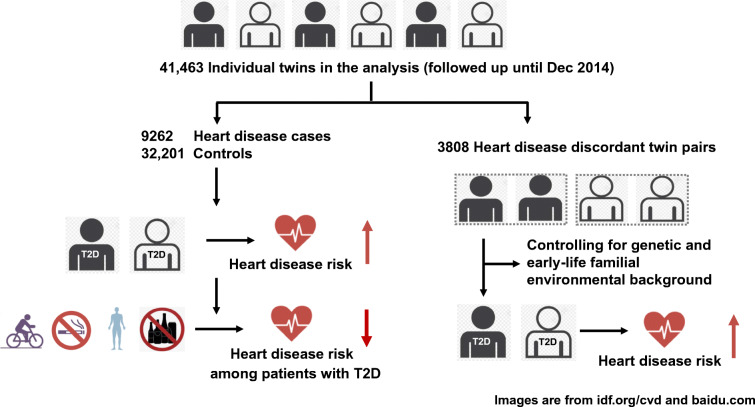
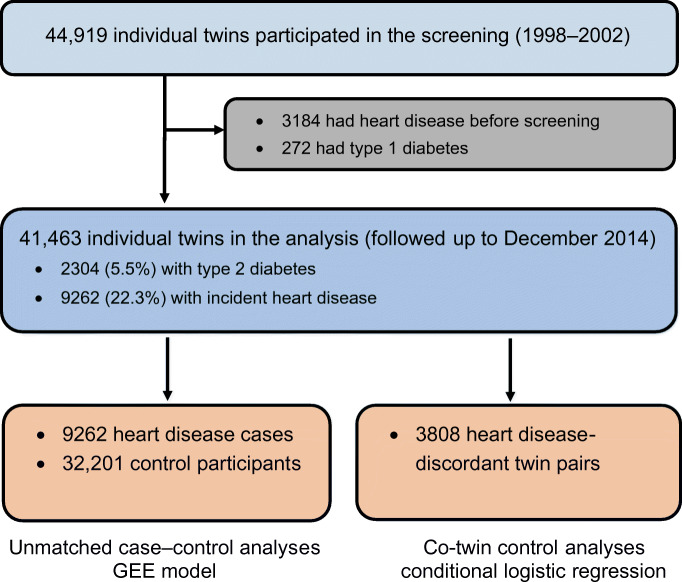
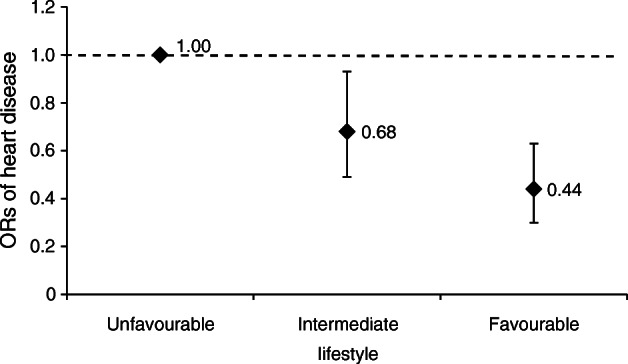
Aims/hypothesis: We aimed to examine the association between type 2 diabetes and major subtypes of heart disease, to assess the role of genetic and early-life familial environmental factors in this association and to explore whether and to what extent a healthy lifestyle mitigates the risk of heart disease related to type 2 diabetes. Methods: In this prospective nested case–control study based on the Swedish Twin Registry, 41,463 twin individuals who were aged ≥40 and heart disease-free were followed up for 16 years (from 1998 to 2014) to detect incident heart disease. Type 2 diabetes was ascertained from self-report, the National Patient Registry and glucose-lowering medication use. Heart disease diagnosis (including coronary heart disease, cardiac arrhythmias and heart failure) and onset age were identified from the National Patient Registry. Healthy lifestyle-related factors consisted of being a non-smoker, no/mild alcohol consumption, regular physical activity and being non-overweight. Participants were divided into three groups according to the number of lifestyle-related factors: (1) unfavourable (participants who had no or only one healthy lifestyle factor); (2) intermediate (any two or three); and (3) favourable (four). Generalised estimating equation models for unmatched case–control design and conditional logistic regression for co-twin control design were used in data analyses. Results: Of all participants, 2304 (5.5%) had type 2 diabetes at baseline. During the observation period, 9262 (22.3%) had any incident heart disease. In unmatched case–control analyses and co-twin control analyses, the multi-adjusted OR and 95% CI of heart disease related to type 2 diabetes was 4.36 (3.95, 4.81) and 4.89 (3.88, 6.16), respectively. The difference in ORs from unmatched case–control analyses vs co-twin control analyses was statistically significant (OR 1.57; 95% CI 1.42, 1.73; p < 0.001). In stratified analyses by type 2 diabetes, compared with an unfavourable lifestyle, an intermediate lifestyle or a favourable lifestyle was associated with a significant 32% (OR 0.68; 95% CI 0.49, 0.93) or 56% (OR 0.44; 95% CI 0.30, 0.63) decrease in heart disease risk among patients with type 2 diabetes, respectively. There were significant additive and multiplicative interactions between lifestyle and type 2 diabetes on heart disease. Conclusions/interpretation: Type 2 diabetes is associated with more than fourfold increased risk of heart disease. The association still remains statistically significant, even after fully controlling for genetic and early-life familial environmental factors. However, greater adherence to a healthy lifestyle may significantly mitigate the risk of heart disease related to type 2 diabetes.
Overview
The claims and statistics of this paper haven’t been checked yet.
Free: it reads the open-access text and checks the first 5 claims that cite a source we can check. Create a free account to check every claim.
Integrity signals
Registry
Cites
Statistics
Figures
Verification
Claims the paper makes
The claims and statistics of this paper haven’t been checked yet.
Free: it reads the open-access text and checks the first 5 claims that cite a source we can check. Create a free account to check every claim.
Claims other papers make about this one
Each is checked against this paper’s own text: does it say what the citing paper says it does?
The source backs part of the claim, not all of it — or backs it for a different population, condition or comparison.
In the citing paper
“Optimal risk factor and lifestyle management, as well as early identification and treatment of comorbidities, is a cornerstone of treatment for T2DM.”
From 2023 ESC guidelines for the management of cardiovascular disease in patients with diabetes. (2023) · cites this paper as [358]
Experimental — accuracy not yet measured
Self-check
Percentages, sums and reported differences re-computed from the paper’s own numbers.
The self-check needs the paper’s full text.
Citations
Cites
Yusuf, S., Hawken, S., Ôunpuu, S., Dans, T., Avezum, A., Lanas, F., McQueen, M., Budaj, A., Pais, P., Varigos, J., et al. (2004) · The Lancet · doi:10.1016/s0140-6736(04)17018-9 · Cited by 12,026
Heart disease and stroke statistics-2018 update: a report from the american heart association
Benjamin, E. J., Virani, S. S., Callaway, C. W., Chamberlain, A. M., Chang, A. R., Cheng, S., Chiuve, S. E., Cushman, M., Delling, F. N., Deo, R., et al. (2018) · Circulation · doi:10.1161/cir.0000000000000558 · Cited by 7,146
The Emerging Risk Factors Collaboration (2010) · The Lancet · doi:10.1016/s0140-6736(10)60484-9 · Cited by 5,125
Cosentino, F., Grant, P. J., Aboyans, V., Bailey, C. J., Ceriello, A., Delgado, V., Federici, M., Filippatos, G., Grobbee, D. E., Hansen, T. B., et al. (2020) · European Heart Journal · doi:10.1093/eurheartj/ehz486 · Cited by 4,763
Type 2 diabetes and incidence of cardiovascular diseases: a cohort study in 1.9 million people
Shah, A. D., Langenberg, C., Rapsomaniki, E., Denaxas, S., Pujades-Rodriguez, M., Gale, C. P., Deanfield, J., Smeeth, L., Timmis, A., & Hemingway, H. (2015) · The Lancet Diabetes & Endocrinology · doi:10.1016/s2213-8587(14)70219-0 · Cited by 1,225
He, J., Ogden, L. G., Bazzano, L. A., Vupputuri, S., Loria, C., & Whelton, P. K. (2001) · Archives of Internal Medicine · doi:10.1001/archinte.161.7.996 · Cited by 1,172
(2010) · Archives of Internal Medicine · doi:10.1001/archinternmed.2010.334 · Cited by 1,162
Low Wang, C. C., Hess, C. N., Hiatt, W. R., & Goldfine, A. B. (2016) · Circulation · doi:10.1161/circulationaha.116.022194 · Cited by 1,155
Predictors of congestive heart failure in the elderly: the Cardiovascular Health Study
Gottdiener, J. S., Arnold, A. M., Aurigemma, G. P., Polak, J. F., Tracy, R. P., Kitzman, D. W., Gardin, J. M., Rutledge, J. E., & Boineau, R. C. (2000) · Journal of the American College of Cardiology · doi:10.1016/s0735-1097(00)00582-9 · Cited by 907
Huxley, R. R., Lopez, F. L., Folsom, A. R., Agarwal, S. K., Loehr, L. R., Soliman, E. Z., Maclehose, R., Konety, S., & Alonso, A. (2011) · Circulation · doi:10.1161/circulationaha.110.009035 · Cited by 697
Cited by
2023 ESC guidelines for the management of cardiovascular disease in patients with diabetes.
Marx, N., Federici, M., Schütt, K., Müller-Wieland, D., Ajjan, R. A., Antunes, M. J., Christodorescu, R. M., Crawford, C., Di Angelantonio, E., Eliasson, B., et al. (2023) · European Heart Journal · doi:10.1093/eurheartj/ehad192 · Cited by 1,642
Wang, Z., Yang, W., Li, X., Qi, X., Pan, K., & Xu, W. (2022) · Journal of the American Heart Association · doi:10.1161/jaha.122.025969 · Cited by 68
Self-citationYuting, Z., Tan, X., & Wang, Q. (2023) · Frontiers in Public Health · doi:10.3389/fpubh.2023.1049396 · Cited by 56
Willoughby, E. A., Polderman, T. J. C., & Boutwell, B. B. (2023) · Nature Reviews Methods Primers · doi:10.1038/s43586-022-00191-x · Cited by 52
Zhu, Z., Li, F., Jia, Y., Li, Y., Guo, D., Chen, J., Tian, H., Yang, J., Yang, H., Chen, L., et al. (2022) · Circulation Heart Failure · doi:10.1161/circheartfailure.122.009592 · Cited by 37
Injurious falls before, during and after dementia diagnosis: a population-based study
Zhang, L., Wang, J., Dove, A. E., Yang, W., Qi, X., & Xu, W. (2022) · Age and Ageing · doi:10.1093/ageing/afac299 · Cited by 36
“Physical activity was defined based on a question about annual exercise patterns and grouped as active (including the responses ‘more than average’, ‘much more than average’ and ‘maximum’) and inactive (including the responses ‘almost never’, ‘much less than average’, ‘less than average’ and ‘average’) [23].”
Self-citationSijpkens, Y. W. J., Houweling, B., & Bilo, H. J. G. (2022) · Bohn Stafleu van Loghum eBooks · doi:10.1007/978-90-368-2761-4_4 · Cited by 29
Awareness of cardiovascular risk among persons with type 2 diabetes: a qualitative study
Jutterström, L., Stenlund, A.-L., Otten, J., Lilja, M., & Ängerud, K. H. (2023) · International Journal of Qualitative Studies on Health and Well-Being · doi:10.1080/17482631.2023.2294512 · Cited by 19
“Individuals with T2D are between two and four times more likely to suffer from CVD than those without diabetes (Kishore et al., 2012; Visseren et al., 2021; Yang et al., 2021).”
Mitochondrial related variants associated with cardiovascular traits
Cañadas‐Garre, M., Maqueda, J. J., Baños‐Jaime, B., Hill, C., Skelly, R., Cappa, R., Brennan, E. P., Doyle, R., Godson, C., Maxwell, A. P., et al. (2024) · Frontiers in Physiology · doi:10.3389/fphys.2024.1395371 · Cited by 17
Yun, J., Han, K., Park, Y., Han, E., Lee, Y., & Ko, S. (2022) · Journal of Diabetes Investigation · doi:10.1111/jdi.13818 · Cited by 16
Li, X., Wang, S., Dunk, M. M., Yang, W., Qi, X., Sun, Z., & Xu, W. (2022) · American Journal of Obstetrics and Gynecology · doi:10.1016/j.ajog.2022.06.053 · Cited by 10
Self-citationA Structural Equation Modeling Analysis to Explore Diabetes Self-Care Factors in a Rural Sample
Abbott, L. S., Graven, L. J., Schluck, G., & Lemacks, J. L. (2022) · Healthcare · doi:10.3390/healthcare10081536 · Cited by 9
Lifestyle factors and cardiometabolic risk
Li, W., Shen, Y., & Hu, G. (2026) · Chinese Medical Journal · doi:10.1097/cm9.0000000000003991 · Cited by 8
“[114] Based on all the evidence, in 2022, the AHA introduced LE8 as a comprehensive framework to optimize cardiovascular health and reduce the risk of CHD and stroke.”
Injurious Falls before, during, and after Stroke Diagnosis: A Population-based Study
Zhang, L., Wang, J., Dong, X., Dove, A. E., Sakakibara, S., Liu, X., Wang, C., Wang, Z., Welmer, A., & Xu, W. (2025) · Journal of the American Medical Directors Association · doi:10.1016/j.jamda.2024.105465 · Cited by 6
Self-citationSadegh, S., Shirazi, M., & Dehkordi, L. M. (2025) · Journal of Education and Health Promotion · doi:10.4103/jehp.jehp_1611_23 · Cited by 3
Silva, S., Csőke, E., Ng, C. J., Taylor, S., Singh, P., Sabharwal, M., Foo, A., Kee, W., Wong, R., & Reid, M. J. A. (2024) · Current Medical Research and Opinion · doi:10.1080/03007995.2024.2417752 · Cited by 4
“Of the risk factors considered, the most number of associations were reported for lifestyle factors (139 studies of the 408 studies), which include diet, smoking, physical activity, alcohol consumption, recreational drug use, and maternal or paternal alcohol/smoking habits 33–37 .”
Linee guida ESC 2023 per il trattamento delle malattie cardiovascolari nei pazienti diabetici
Marx, N., Federici, M., Schütt, K. S., Müller‐Wieland, D., Ajjan, R., Antunes, M. J., Christodorescu, R., Crawford, C. A., Angelantonio, E. D., Eliasson, B., et al. (2024) · Giornale Ialiano di Cardiologia · doi:10.1714/4162.41558 · Cited by 6
Zhu, L., Chen, C., Lu, F., & Li, B. (2026) · Frontiers in Medicine · doi:10.3389/fmed.2026.1746457 · Cited by 2
“Large cohort data show that patients with T2d risk both coronary artery disease and heart failure, with patients being over four times more likely to develop coronary disease than non-diabetic patients (95, 96).”
Karami, M., Nazari, F., Hashemi, N., & Dehkordi, L. M. (2026) · Health Science Reports · doi:10.1002/hsr2.72302 · Cited by 2
Impact of a Web-Based Lifestyle Medicine Intervention: A Qualitative Study Among Rural Participants
Abbott, L. S., Leon, J. D., & Graven, L. J. (2025) · Nursing Reports · doi:10.3390/nursrep15070227 · Cited by 2
Khanjari, S., Tehrani, F. J., Feinn, R., Wagner, J. A., Hashemi, S., & Abedini, Z. (2022) · Diabetes & Metabolic Syndrome Clinical Research & Reviews · doi:10.1016/j.dsx.2022.102563 · Cited by 2
Abbott, L. S., Killian, M., Butts, B., & Graven, L. J. (2025) · American Journal of Lifestyle Medicine · doi:10.1177/15598276251395532 · Cited by 1
Barbaresko, J., Lang, A. S., Szczerba, E., Bächle, C., Beckhaus, J., Schwingshackl, L., Neuenschwander, M., & Schlesinger, S. (2023) · doi:10.2337/figshare.21561987 · Cited by 1
Rietz, M., Lehr, A., Mino, E., Lang, A. S., Szczerba, E., Schiemann, T., Herder, C., Saatmann, N., Geidl, W., Barbaresko, J., et al. (2022) · doi:10.2337/figshare.21158605.v1 · Cited by 1
Rietz, M., Lehr, A., Mino, E., Lang, A. S., Szczerba, E., Schiemann, T., Herder, C., Saatmann, N., Geidl, W., Barbaresko, J., et al. (2022) · doi:10.2337/figshare.21158605
Digital Information for Patient Education
Zhang, X., Guo, F., & Lee, P. H. (2023) · Frontiers research topics · doi:10.3389/978-2-8325-2671-2
Risk factors associated with type 2 diabetes mellitus in early adulthood within urban populations
Fitria, E., Girsang, E., & Nasution, A. N. (2025) · Malahayati International Journal of Nursing and Health Science · doi:10.33024/minh.v8i3.618
“In addition, another study found that a healthy lifestyle can reduce the risk of type 2 DM-related heart disease by up to 56% through physical activity and a good diet (Yang, Xu, Pedersen, Li, Yu, Bao, & Xu, 2021).”
Stenlund, A.-L., Ängerud, K. H., Lilja, M., Otten, J., & Jutterström, L. (2026) · JMIR Diabetes · doi:10.2196/85748
“Persons with type 2 diabetes (T2D) face an elevated risk of micro-and macrovascular complications, including a two-to four-times increased likelihood of developing cardiovascular diseases such as myocardial infarction and stroke [1].”
Abbott, L. S., Leon, J. D., Stearns, E., Killian, M., & Graven, L. J. (2026) · American Journal of Lifestyle Medicine · doi:10.1177/15598276261471135
Stenlund, A.-L., Ängerud, K. H., Lilja, M., Otten, J., & Jutterström, L. (2026) · Nursing Open · doi:10.1002/nop2.70828
“Despite improved treatment opportunities, many persons with T2D do not achieve good metabolic control, increasing their CVD risk (Yang et al. 2021).”
Metadata
- Authors
- Yang, R., Xu, H., Pedersen, N. L., Li, X., Yu, J., Bao, C., Qi, X., & Xu, W.
- Affiliations
- Tianjin University of Traditional Chinese Medicine (CN)
- Capital Medical University (CN)
- University of Southern California (US)
- Tianjin Medical University (CN)
- Stockholm University (SE)
- Corresponding author
- Qi, Xiuying
- Xu, Weili
- Venue
- Diabetologia
- Published
- 2020-11-10
- Volume
- 64
- Issue
- 3
- Pages
- 530-539
- ISSN
- 0012-186X (ISSN-L)
- 1432-0428
- PMC
- PMC7864843
- OpenAlex
- W3101705848
- Semantic Scholar
- 2e92e382f4fca13b69d3374d067f88ff210fe864
- Cited by
- 28
- References
- 36
- Citations by year
- 2026: 5 · 2025: 6 · 2024: 2 · 2023: 5 · 2022: 10
- FWCI
- 2.83
- Type
- journal article
- Language
- en
- Open access
- hybrid
- doi.org
- Licence
- cc-by
- creativecommons.org/licenses/by/4.0 (tdm)
- creativecommons.org/licenses/by/4.0 (vor)
- Locations
- Diabetologia (publishedVersion, cc-by)
- PubMed Central (publishedVersion, cc-by)
- PubMed (publishedVersion)
- Funders
- National Natural Science Foundation of China (No. 81771519)
- the Konung Gustaf V:s och Drottning Victorias Frimurare Foundation (No. 2016-2017)
- Swedish Research Council (No. 2017-00981)
- European Union’s Horizon 2020 research and innovation programme (No 667375)
- Demensfonden, Strokefonden, Cornells Stiftelse and Alzheimerfonden (2017-2018)
- Topics
- Health Sciences › Medicine › Endocrinology, Diabetes and Metabolism › Diabetes, Cardiovascular Risks, and Lipoproteins
- Health Sciences › Medicine › Cardiology and Cardiovascular Medicine › Cardiovascular Health and Risk Factors
- Health Sciences › Medicine › Cardiology and Cardiovascular Medicine › Cardiovascular Function and Risk Factors
- Keywords
- type 2 diabetes, heart disease, healthy lifestyle, coronary artery disease, heart failure, cardiac arrhythmias, physical activity, alcohol consumption, smoking, body mass index, genetic risk, twin cohort, Swedish Twin Registry, cardiovascular risk prediction models, cardiovascular risk education
- MeSH terms
- Healthy Lifestyle, Aged, Diabetes Mellitus, Type 2, Female, Heart Diseases, Humans, Male, Middle Aged, Prognosis, Prospective Studies, Registries, Risk Factors, Sweden, Time Factors, Incidence, Case-Control Studies, Risk Assessment, Genetic Predisposition to Disease, Risk Reduction Behavior, Protective Factors
About these checks
Registry, retraction, Cites and statistics results are computed, not judged, with one exception: a printed reference that no index lists is read once by a model before it counts as a citation error. Claims are extracted by a model and kept only when their quote appears verbatim in the text; each cited source is then checked, with a model’s help, for whether it says what the claim relies on. Those verdicts can be wrong — read the claim’s quote and the cited source before relying on one.
Statistics and arithmetic are recomputed, not judged.
Confidence bands are shown only for fields calibrated on our annotated test set. None is calibrated yet, so no band is shown.
What counts as a claim ›How we measure confidence ›How we check this ›
Are you an author, or do you see a problem with this page? Request a review
Data sources
Bibliographic data: Semantic Scholar, OpenAlex, Crossref.
Contains information from the Semantic Scholar Academic Graph Datasets, made available under the ODC Attribution License (ODC-BY 1.0).
Semantic Scholar’s data is described in: Kinney, R., et al. (2023). The Semantic Scholar Open Data Platform. arXiv:2301.10140.
