

The DOI matches its Crossref record; 69 of the 69 references it cites were found in a registry or an index.
A novel diabetes typology: towards precision diabetology from pathogenesis to treatment
Open accessAbstract
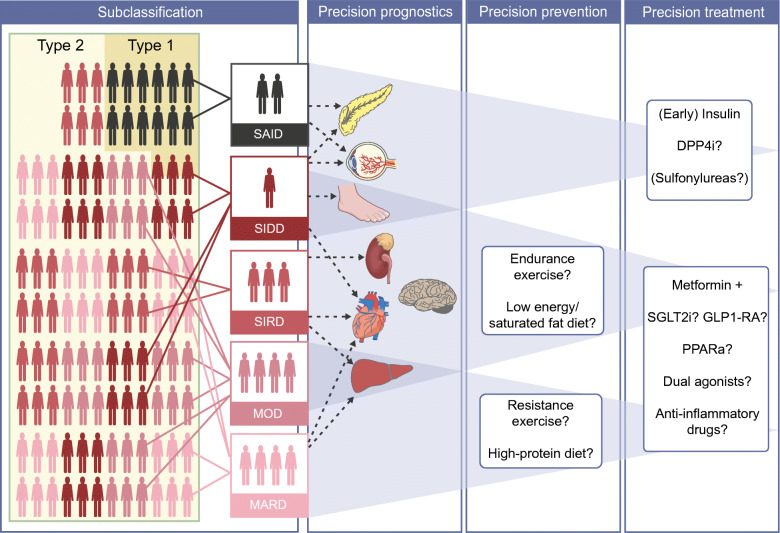
The current classification of diabetes, based on hyperglycaemia, islet-directed antibodies and some insufficiently defined clinical features, does not reflect differences in aetiological mechanisms and in the clinical course of people with diabetes. This review discusses evidence from recent studies addressing the complexity of diabetes by proposing novel subgroups (subtypes) of diabetes. The most widely replicated and validated approach identified, in addition to severe autoimmune diabetes, four subgroups designated severe insulin-deficient diabetes, severe insulin-resistant diabetes, mild obesity-related diabetes and mild age-related diabetes subgroups. These subgroups display distinct patterns of clinical features, disease progression and onset of comorbidities and complications, with severe insulin-resistant diabetes showing the highest risk for cardiovascular, kidney and fatty liver diseases. While it has been suggested that people in these subgroups would benefit from stratified treatments, RCTs are required to assess the clinical utility of any reclassification effort. Several methodological and practical issues also need further study: the statistical approach used to define subgroups and derive recommendations for diabetes care; the stability of subgroups over time; the optimal dataset (e.g. phenotypic vs genotypic) for reclassification; the transethnic generalisability of findings; and the applicability in clinical routine care. Despite these open questions, the concept of a new classification of diabetes has already allowed researchers to gain more insight into the colourful picture of diabetes and has stimulated progress in this field so that precision diabetology may become reality in the future.
Overview
The claims and statistics of this paper haven’t been checked yet.
Run the check — free, no account needed. It reads the open-access text and checks the sources it cites.
Integrity signals
Registry
Cites
Statistics
Figures
Verification
Claims the paper makes
The claims and statistics of this paper haven’t been checked yet.
Run the check — free, no account needed. It reads the open-access text and checks the sources it cites.
Claims other papers make about this one
Each is checked against this paper’s own text: does it say what the citing paper says it does?
The source backs part of the claim, not all of it — or backs it for a different population, condition or comparison.
In the citing paper
“Different subtypes/endotypes/clusters of T2D are associated with different risks of disease progression, 58,59 with particularly high risk for MASLD/MASH progression in those individuals with severe insulin resistance.”
From EASL-EASD-EASO Clinical Practice Guidelines on the management of metabolic dysfunction-associated steatotic liver disease (MASLD). (2024) · cites this paper as [59]
Experimental — accuracy not yet measured
Self-check
Percentages, sums and reported differences re-computed from the paper’s own numbers.
The self-check needs the paper’s full text.
Citations
Cites
Ahlqvist, E., Storm, P., Käräjämäki, A., Martinell, M., Dorkhan, M., Carlsson, A., Vikman, P., Prasad, R. B., Aly, D. M., Almgren, P., et al. (2018) · The Lancet Diabetes & Endocrinology · doi:10.1016/s2213-8587(18)30051-2 · Cited by 2,335
Mahajan, A., Taliun, D., Thurner, M., Robertson, N. R., Torres, J. M., Rayner, N. W., Payne, A. J., Steinthorsdottir, V., Scott, R. A., Grarup, N., et al. (2018) · Nature Genetics · doi:10.1038/s41588-018-0241-6 · Cited by 1,744
Self-citationDavies, M. J., D’Alessio, D. A., Fradkin, J., Kernan, W. N., Mathieu, C., Mingrone, G., Rossing, P., Tsapas, A., Wexler, D. J., & Buse, J. B. (2018) · Diabetologia · doi:10.1007/s00125-018-4729-5 · Cited by 1,455
The integrative biology of type 2 diabetes
Roden, M., & Shulman, G. I. (2019) · Nature · doi:10.1038/s41586-019-1797-8 · Cited by 1,167
Self-citationHuman postprandial responses to food and potential for precision nutrition
Berry, S. E., Valdes, A. M., Drew, D. A., Asnicar, F., Mazidi, M., Wolf, J., Capdevila, J., Hadjigeorgiou, G., Davies, R., Al Khatib, H., et al. (2020) · Nature Medicine · doi:10.1038/s41591-020-0934-0 · Cited by 932
Tabák, A. G., Jokela, M., Akbaraly, T. N., Brunner, E. J., Kivimäki, M., & Witte, D. R. (2009) · The Lancet · doi:10.1016/s0140-6736(09)60619-x · Cited by 898
Zaharia, O. P., Strassburger, K., Strom, A., Bönhof, G. J., Karusheva, Y., Antoniou, S., Bódis, K., Markgraf, D. F., Burkart, V., Müssig, K., et al. (2019) · The Lancet Diabetes & Endocrinology · doi:10.1016/s2213-8587(19)30187-1 · Cited by 600
Self-citationIdentification of type 2 diabetes subgroups through topological analysis of patient similarity
Li, L., Cheng, W., Glicksberg, B. S., Gottesman, O., Tamler, R., Chen, R., Böttinger, E. P., & Dudley, J. T. (2015) · Science Translational Medicine · doi:10.1126/scitranslmed.aaa9364 · Cited by 554
Udler, M. S., Kim, J., von Grotthuss, M., Bonàs-Guarch, S., Cole, J. B., Chiou, J., ISGC, C. D. A. O. B. O. M. A. T., Boehnke, M., Laakso, M., Atzmon, G., et al. (2018) · PLOS Medicine · doi:10.1371/journal.pmed.1002654 · Cited by 542
Molecular Choreography of Acute Exercise
Contrepois, K., Wu, S., Moneghetti, K. J., Hornburg, D., Ahadi, S., Tsai, M.-S., Metwally, A. A., Wei, E., Lee-McMullen, B., Quijada, J. V., et al. (2020) · Cell · doi:10.1016/j.cell.2020.04.043 · Cited by 502
Research works printed but not linked: 1
- Mahajan A, Taliun D, Thurner M et al (2018) Fine-mapping type 2 diabetes loci to single-variant resolution using high-density imputation and islet-specific epigenome maps. Nat Genet 50(11):1505–1513. https://doi.org/10.1038/s41588-018-0241-6 · DOI · Paper page
Cited by
Sorted by citations
Tacke, F., Horn, P., Wai-Sun Wong, V., Ratziu, V., Bugianesi, E., Francque, S., Zelber-Sagi, S., Valenti, L., Roden, M., Schick, F., et al. (2024) · Journal of Hepatology · doi:10.1016/j.jhep.2024.04.031 · Cited by 2,210
Self-citation(2024) · Obesity Facts · doi:10.1159/000539371 · Cited by 545
Inter-organ crosstalk during development and progression of type 2 diabetes mellitus
Xourafa, G., Korbmacher, M., & Roden, M. (2024) · Nature Reviews Endocrinology · doi:10.1038/s41574-023-00898-1 · Cited by 274
Self-citationStefan, N., & Schulze, M. B. (2023) · The Lancet Diabetes & Endocrinology · doi:10.1016/s2213-8587(23)00086-4 · Cited by 215
Precision subclassification of type 2 diabetes: a systematic review
Misra, S., Wagner, R. J., Özkan, B., Schön, M., Sevilla-González, M. D. R., Prystupa, K., Wang, C. C., Kreienkamp, R. J., CROMER, S. J., Rooney, M. R., et al. (2023) · Communications Medicine · doi:10.1038/s43856-023-00360-3 · Cited by 132
Metadata
- Authors
- Herder, C., & Roden, M.
- Affiliations
- Düsseldorf University Hospital (DE)
- Corresponding author
- Herder, Christian
- Roden, Michael
- Venue
- Diabetologia
- Published
- 2022-01-04
- Volume
- 65
- Issue
- 11
- Pages
- 1770-1781
- ISSN
- 0012-186X (ISSN-L)
- 1432-0428
- PMC
- PMC9522691
- OpenAlex
- W4206342425
- Cited by
- 140
- References
- 69
- Citations by year
- 2026: 21 · 2025: 37 · 2024: 34 · 2023: 33 · 2022: 15
- FWCI
- 4.24
- Type
- journal article
- Language
- en
- Open access
- hybrid
- doi.org
- Locations
- Diabetologia (publishedVersion, cc-by)
- PubMed Central (publishedVersion, cc-by)
- PubMed (publishedVersion)
- Informationszentrum Lebenswissenschaften (ZB MED) (submittedVersion, cc-by)
- Funders
- German Center for Diabetes Research
- German Federal Ministry of Education and Research
- German Federal Ministry of Health
- Ministry of Culture and Science of the State of North Rhine-Westphalia
- Topics
- Health Sciences › Medicine › Endocrinology, Diabetes and Metabolism › Diabetes Management and Research
- Life Sciences › Biochemistry, Genetics and Molecular Biology › Genetics › Diabetes and associated disorders
- Health Sciences › Medicine › Endocrinology, Diabetes and Metabolism › Diabetes, Cardiovascular Risks, and Lipoproteins
- Keywords
- diabetes classification, diabetes subtypes, autoimmune diabetes, insulin-deficient diabetes, obesity-related diabetes, age-related diabetes, pathogenesis, diabetes complications, cardiovascular risk, diabetic nephropathy, hepatic steatosis, treatment stratification
- MeSH terms
- Diabetes Mellitus, Type 1, Humans, Hyperglycemia, Insulin Resistance, Comorbidity, Insulins
About these checks
Registry, retraction, Cites and statistics results are computed, not judged, with one exception: a printed reference that no index lists is read once by a model before it counts as a citation error. Claims are extracted by a model and kept only when their quote appears verbatim in the text; each cited source is then checked, with a model’s help, for whether it says what the claim relies on. Those verdicts can be wrong — read the claim’s quote and the cited source before relying on one.
Statistics and arithmetic are recomputed, not judged.
Confidence bands are shown only for fields calibrated on our annotated test set. None is calibrated yet, so no band is shown.
What counts as a claim ›How we measure confidence ›How we check this ›
Are you an author, or do you see a problem with this page? Request a review
