

Psychosocial risk factors of youth suicide in the Western Pacific: a scoping review
Open accessThe DOI matches its Crossref record; 58 of the 58 references it cites were found in a registry or an index.
Abstract
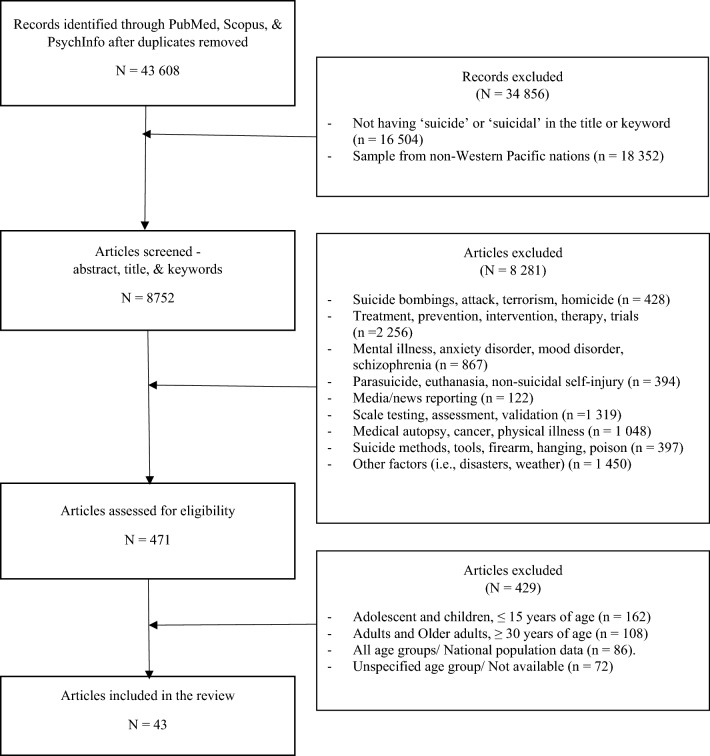
Introduction: The Western Pacific region accounts for 25% of global suicide rates globally. In the last decade, however, there is a rising concern over the rate of youth suicides in the region. In line with the regional vision of reducing the rate of non-communicable diseases by 2025, the study contributes to the literature by utilizing a scoping review approach to identify psychosocial risk factors associated with youth suicide in the region. Method: Publications on youth suicide in the Western Pacific region between 2010 and 2021 were reviewed. A total of 43 publications met the inclusion criteria and were read in full. Results: Psychosocial risk factors associated with suicide in each publication were identified and thematically classified into five themes: interpersonal factors, history of abuse, academic factors, work factors, and minority status. Discussion: Findings showed discrepancies in youth suicide research across member nations in the Western Pacific. Implications for regional policies on suicide prevention and future research were discussed.
Overview
The claims and statistics of this paper haven’t been checked yet.
Free: it reads the open-access text and checks the first 5 claims that cite a source we can check. Create a free account to check every claim.
Integrity signals
Registry
Cites
Statistics
Figures
Verification
Claims the paper makes
The claims and statistics of this paper haven’t been checked yet.
Free: it reads the open-access text and checks the first 5 claims that cite a source we can check. Create a free account to check every claim.
Self-check
Percentages, sums and reported differences re-computed from the paper’s own numbers.
The self-check needs the paper’s full text.
Citations
Cites
PRISMA Extension for Scoping Reviews (PRISMA-ScR): Checklist and Explanation
Tricco, A. C., Lillie, E., Zarin, W., O'Brien, K. K., Colquhoun, H., Levac, D., Moher, D., Peters, M. D. J., Horsley, T., Weeks, L., et al. (2018) · Annals of Internal Medicine · doi:10.7326/m18-0850 · Cited by 43,565 · cited 1×
“The 5-stage framework [7] and the PRISMA extension for scoping review (PRISMA-ScR) guidelines [10] were utilized in this review.”
MethodScoping studies: towards a methodological framework
Arksey, H., & O'Malley, L. (2005) · International Journal of Social Research Methodology · doi:10.1080/1364557032000119616 · Cited by 36,742 · cited 4×
“A scoping review synthesizes evidence to examine the extent of research in an area to stimulate research [7–9].”
BackgroundMethodInfluentialA scoping review of scoping reviews: advancing the approach and enhancing the consistency
Pham, M. T., Rajić, A., Greig, J. D., Sargeant, J. M., Papadopoulos, A., & McEwen, S. A. (2014) · Research Synthesis Methods · doi:10.1002/jrsm.1123 · Cited by 3,078
Cross-national prevalence and risk factors for suicidal ideation, plans and attempts
Nock, M. K., Borges, G., Bromet, E. J., Alonso, J., Angermeyer, M., Beautrais, A., Bruffaerts, R., Chiu, W. T., de Girolamo, G., Gluzman, S., et al. (2008) · British Journal of Psychiatry · doi:10.1192/bjp.bp.107.040113 · Cited by 2,654 · cited 2×
“…stages; s uicide ideation which refers to conscious thoughts of ending one’s life [15, 16], s uicide attempt which refers to the execution of a potentially lethal life-ending behavior with the intent of death but with no fatal outcome, and suicide death which refers to a self-initiated death [16].”
BackgroundA scoping review on the conduct and reporting of scoping reviews
Tricco, A. C., Lillie, E., Zarin, W., O’Brien, K., Colquhoun, H., Kastner, M., Levac, D., Ng, C., Sharpe, J. P., Wilson, K., et al. (2016) · BMC Medical Research Methodology · doi:10.1186/s12874-016-0116-4 · Cited by 2,250 · cited 1×
“The requirement of more than one reviewer in a scoping review, however, has been mixed [62].”
BackgroundThe Three-Step Theory (3ST): A New Theory of Suicide Rooted in the “Ideation-to-Action” Framework
Klonsky, E. D., & May, A. M. (2015) · International Journal of Cognitive Therapy · doi:10.1521/ijct.2015.8.2.114 · Cited by 1,799 · cited 1×
“Similarly, the Three-Step Theory [18] suggests that suicide ideation is a result of psychological pain and hopelessness, while the transition into an attempt is moderated by the presence of the suicide capacity (e.g., access to firearms, low pain sensitivity).”
BackgroundCommentary: Suicide as Psychache
SHNEIDMAN, E. S. (1993) · The Journal of Nervous and Mental Disease · doi:10.1097/00005053-199303000-00001 · Cited by 775
Värnik, P. (2012) · International Journal of Environmental Research and Public Health · doi:10.3390/ijerph9030760 · Cited by 481 · cited 1×
“Findings from the World Health Organization (WHO) database revealed a suicide rate of 12.6 per 100 000 among 15–29 years old in the Western Pacific region based on mortality data in 2008 [4].”
BackgroundInfluentialPsychosocial determinants of health in social epidemiology
Martikainen, P., Bartley, M., & Lahelma, E. (2002) · International Journal of Epidemiology · doi:10.1093/ije/31.6.1091 · Cited by 354 · cited 2×
“Psychosocial factors refer to social factors which influence a person’s mind, behavior, and health [11, 12].”
BackgroundLea, T., de Wit, J., & Reynolds, R. (2014) · Archives of Sexual Behavior · doi:10.1007/s10508-014-0266-6 · Cited by 247
Joiner, T. E., Ribeiro, J. D., & Silva, C. (2012) · Current Directions in Psychological Science · doi:10.1177/0963721412454873 · Cited by 238 · cited 2×
“According to the Interpersonal Theory of Suicide [17], the development of suicide ideation is a result of perceived burdensomeness and a sense of thwarted belonging-ness.”
BackgroundMethodPeltzer, K., Yi, S., & Pengpid, S. (2017) · Asian Journal of Psychiatry · doi:10.1016/j.ajp.2017.01.019 · Cited by 133 · cited 2×
“Consequently, the failure to meet these high expectations and concern over or actual poor performance is likely to increase the risk of suicidal tendencies among students [29, 48].”
BackgroundMen and suicide prevention: a scoping review
Struszczyk, S., Galdas, P. M., & Tiffin, P. A. (2019) · Journal of Mental Health · doi:10.1080/09638237.2017.1370638 · Cited by 105 · cited 1×
“A scoping review synthesizes evidence to examine the extent of research in an area to stimulate research [7–9].”
BackgroundA qualitative systematic review of experiences and perceptions of youth suicide
Grimmond, J., Kornhaber, R. A., Visentin, D. C., & Cleary, M. L. (2019) · PLoS ONE · doi:10.1371/journal.pone.0217568 · Cited by 104 · cited 2×
“A systematic review of Australian youths noted that academic stress was among the common triggers of suicide [40].”
BackgroundYouth at Risk: Suicidal Thoughts and Attempts in Vietnam, China, and Taiwan
Blum, R. W., Sudhinaraset, M., & Emerson, M. R. (2012) · Journal of Adolescent Health · doi:10.1016/j.jadohealth.2011.12.006 · Cited by 103 · cited 1×
“A multinational study in China, Taiwan, and Vietnam found that a family history of suicide was significantly linked to suicidal ideation and attempt, with a greater prevalence among female than male youths [31].”
BackgroundCorrelation between Family Environment and Suicidal Ideation in University Students in China
Zhai, H., Bai, B., Chen, L., Han, D. H., Wang, L., Qiao, Z., Qiu, X., Yang, X., & Yang, Y. (2015) · International Journal of Environmental Research and Public Health · doi:10.3390/ijerph120201412 · Cited by 99 · cited 1×
“An unstable parental income as well as improper parenting styles were associated with a higher likelihood of suicidal thoughts among female than male Chinese youth [34].”
BackgroundDenny, S., Lucassen, M. F. G., Stuart, J., Fleming, T., Bullen, P., Peiris-John, R., Rossen, F. V., & Utter, J. (2016) · Journal of Clinical Child & Adolescent Psychology · doi:10.1080/15374416.2014.958842 · Cited by 96 · cited 1×
“Moreover, a study in New Zealand found that homosexual and bisexual youths were more vulnerable to bullying, depression, and suicide than heterosexual youths [59].”
BackgroundIdentity in Emerging Adulthood
Schwartz, S. J., Zamboanga, B. L., Luyckx, K., Meca, A., & Ritchie, R. (2014) · Oxford Handbooks Online · doi:10.1093/oxfordhb/9780199795574.013.001 · Cited by 88
Wang, C.-W., Musumari, P. M., Techasrivichien, T., Suguimoto, S. P., Tateyama, Y., Chan, C.-C., Ono-Kihara, M., Kihara, M., & Nakayama, T. (2019) · BMC Public Health · doi:10.1186/s12889-019-8116-z · Cited by 88
An ecological understanding of youth suicide in South Korea
Lee, S.-Y., Hong, J. S., & Espelage, D. L. (2010) · School Psychology International · doi:10.1177/0143034310382724 · Cited by 87
Wang, M., Kou, C., Bai, W., Song, Y., Liu, X., Yu, W., Li, Y., Hua, W., & Li, W. (2018) · Journal of Affective Disorders · doi:10.1016/j.jad.2018.12.055 · Cited by 81 · cited 2×
“Separation through the incarceration of a family member was significantly associated with suicide ideation among Chinese youth [21].”
BackgroundRisk factors for rural young suicide in China: A case–control study
Zhang, J., Li, N., Tu, X.-M., Xiao, S., & Jia, C. (2011) · Journal of Affective Disorders · doi:10.1016/j.jad.2010.09.008 · Cited by 70 · cited 2×
“It is postulated that actual or perceived financial deprivation and insecurity can elevate psychological strain and therefore increase the risk of suicide among youths [30].”
BackgroundYao, Y., Chang, W., Jin, Y., Chen, Y., He, L., & Zhang, L. (2014) · Child Care Health and Development · doi:10.1111/cch.12142 · Cited by 66 · cited 2×
“Similarly, poor satisfaction with one’s family was predictive of suicide ideation among Chinese college students [24].”
BackgroundUchida, C., & Uchida, M. (2017) · The Journal of Clinical Psychiatry · doi:10.4088/jcp.16m10807 · Cited by 61 · cited 1×
“Similarly, national data on suicide deaths among Japanese students revealed that male students, medical majors, final-year undergraduates, and students who took extra years to graduate had the highest risk of suicide than any other student demography in university [49].”
BackgroundWorkplace stress, common mental disorder and suicidal ideation in junior doctors
Petrie, K., Crawford, J., Shand, F., & Harvey, S. B. (2020) · Internal Medicine Journal · doi:10.1111/imj.15124 · Cited by 57 · cited 1×
“In a study of junior doctors in Australia, workplace stress, conflict, bullying, and fear of litigation were strongly associated with suicidal ideation [54].”
BackgroundPatterns of life events preceding the suicide in rural young Chinese: A case control study
Zhang, J., & Ma, Z. (2012) · Journal of Affective Disorders · doi:10.1016/j.jad.2012.01.010 · Cited by 55 · cited 2×
“In another case–control study, being laid off and being unemployed were significant negative life events associated with suicide deaths among Chinese youth [36].”
BackgroundThe WHO START Study: Suicidal Behaviors Across Different Areas of the World
De Leo, D., Milner, A., Fleischmann, A., Bertolote, J., Collings, S., Amadeo, S., Chan, S., Yip, P. S. F., Huang, Y., Saniel, B., et al. (2013) · Crisis · doi:10.1027/0227-5910/a000193 · Cited by 53
Dai, J., Chiu, H. F. K., Conner, K. R., Chan, S. S. M., Hou, Z., Yu, X., & Caine, E. D. (2010) · Journal of Affective Disorders · doi:10.1016/j.jad.2010.10.042 · Cited by 49
Suicide by young Australians, 2006–2015: a cross‐sectional analysis of national coronial data
Hill, N. T. M., Witt, K., Rajaram, G., McGorry, P. D., & Robinson, J. (2020) · The Medical Journal of Australia · doi:10.5694/mja2.50876 · Cited by 46
Childhood Adversity, Recent Life Stressors and Suicidal Behavior in Chinese College Students
You, Z., Chen, M., Yang, S., Zhou, Z., & Qin, P. (2014) · PLoS ONE · doi:10.1371/journal.pone.0086672 · Cited by 44 · cited 3×
“Consequently, the failure to meet these high expectations and concern over or actual poor performance is likely to increase the risk of suicidal tendencies among students [29, 48].”
BackgroundResultLian, Q., Zuo, X., Lou, C., Gao, E., & Cheng, Y. (2014) · Journal of Epidemiology · doi:10.2188/jea.je20140084 · Cited by 42 · cited 1×
“In a multinational study (China, Taiwan, and Vietnam), the rate of suicide ideation and suicide attempt was higher among LGB youths compared to heterosexual youths [57].”
BackgroundSuicidal Behavior in the Western Pacific Region: Characteristics and Trends
De Leo, D., Milner, A., & Xiangdong, W. (2009) · Suicide and Life-Threatening Behavior · doi:10.1521/suli.2009.39.1.72 · Cited by 41
Luke, J., Anderson, I. P. S., Gee, G., Thorpe, R., Rowley, K., Reilly, R. E., Thorpe, A., & Stewart, P. (2013) · Crisis · doi:10.1027/0227-5910/a000187 · Cited by 40 · cited 3×
“A functioning and healthy family environment can reduce suicide risk among youths [26], while a strained family relationship can increase the risk of suicide [27, 28].”
BackgroundInfluentialSuicide in Young Singaporeans Aged 10–24 Years Between 2000 to 2004
Loh, C., Tai, B.-C., Ng, W.-Y., Chia, A., & Chia, B.-H. (2012) · Archives of Suicide Research · doi:10.1080/13811118.2012.667335 · Cited by 35 · cited 2×
“Another study noted that the dissolution of romantic relationships was a common source of distress linked to suicide deaths among young Singaporeans [38].”
BackgroundSuicides in Australia following media reports of the death of Robin Williams
Pirkis, J., Currier, D., Too, L. S., Bryant, M., Bartlett, S., Sinyor, M., & Spittal, M. J. (2020) · Australian & New Zealand Journal of Psychiatry · doi:10.1177/0004867419888297 · Cited by 35 · cited 2×
“The WHO Western Pacific branch and developed member nations should encourage collaboration and exchange of suicide prevention policies, funding, expertise, data recording, and research to address the suicide crisis in the region [6].”
BackgroundMilner, A. J., Page, A., Morrell, S. L., Hobbs, C., Carter, G. L., Dudley, M. J., Duflou, J. A., & Taylor, R. J. (2014) · Australian & New Zealand Journal of Psychiatry · doi:10.1177/0004867414521502 · Cited by 34 · cited 1×
“A case–control study of suicides by 18–34 years old 4 in New South Wales, Australia found that dismissal or involuntary job loss was significantly associated with a higher risk of suicide attempt and death [51].”
BackgroundRising Youth Suicide and the Changing Cultural Context in South Korea
Park, B. C. B., Im, J. S., & Ratcliff, K. S. (2013) · Crisis · doi:10.1027/0227-5910/a000237 · Cited by 33
Psychosocial Concepts in Humanitarian Work with Children
National Research Council (2003) · National Academies Press eBooks · doi:10.17226/10698 · Cited by 33
Perceived Family Functioning and Suicidal Ideation: Hopelessness as Mediator or Moderator
Kwok, S. Y. C. L. (2011) · Nursing Research · doi:10.1097/nnr.0b013e31823585d6 · Cited by 31 · cited 1×
“A similar link was found in Hong Kong, where family dysfunction significantly predicted suicide ideation among university students [20].”
Chou, C., Ko, H. C., Wu, J. Y., & Cheng, C. (2013) · Suicide and Life-Threatening Behavior · doi:10.1111/sltb.12007 · Cited by 31 · cited 1×
“Consequently, family factors, such as single parenthood, low paternal education, and higher birth order, were associated with suicide risk among Taiwanese youth [35].”
BackgroundWu, W., Zhang, Y., Goldsamt, L. A., Yan, F., Wang, H., & Li, X. (2018) · Journal of Interpersonal Violence · doi:10.1177/0886260518814264 · Cited by 31 · cited 1×
“Abuse is a pattern of control toward a former or current partner that is either a combination of physical, psychological, or sexual assault [44, 45].”
BackgroundDomestic violence and suicide attempts among married women: A case–control study
Rahmani, F., Salmasi, S., Rahmani, F., Bird, J., Asghari, E., Robai, N., Jafarabadi, M. A., & Gholizadeh, L. (2019) · Journal of Clinical Nursing · doi:10.1111/jocn.14901 · Cited by 31 · cited 1×
“Abuse is a pattern of control toward a former or current partner that is either a combination of physical, psychological, or sexual assault [44, 45].”
BackgroundAge-differentiated Risk Factors of Suicidal Ideation among Young and Middle-aged Korean Adults
Jo, A., Jeon, M.-H., & Oh, H. L. (2017) · Osong Public Health and Research Perspectives · doi:10.24171/j.phrp.2017.8.3.07 · Cited by 29 · cited 1×
“A cross-sectional survey in South Korea found that having a low income was significantly associated with increased suicidal ideation among youths [52].”
BackgroundOhtaki, Y., Doki, S., Kaneko, H., Hirai, Y., Oi, Y., Sasahara, S., & Matsuzaki, I. (2019) · PLoS ONE · doi:10.1371/journal.pone.0220493 · Cited by 29 · cited 1×
“Moreover, a study of young suicide crisis callers in Japan found that 21.5% of calls were about family conflicts and problems [22].”
BackgroundInfluentialLee, D., Jung, S., Park, S., Lee, K., Kweon, Y., Lee, E., Yoon, K. H., Cho, H., Jung, H., Kim, A. R., et al. (2019) · Crisis · doi:10.1027/0227-5910/a000624 · Cited by 28 · cited 2×
“Problems in romantic relationships were also cited as one of the factors attributed to the suicide of young South Koreans [37].”
BackgroundSexual abuse and substance abuse increase risk of suicidal behavior in M alaysian youth
Chan, L. F., Maniam, T., Saini, S. M., Shah, S. A., Loh, S. F., Sinniah, A., Idris, Z. H., Rus, S. C., Nudin, S. S. H., & Tan, S. M. K. (2013) · Asia-Pacific Psychiatry · doi:10.1111/appy.12057 · Cited by 23 · cited 1×
“A history of sexual abuse was significantly associated with suicidal behavior among Malaysian youth [47].”
BackgroundZaroff, C. M., Wong, H. L., Ku, L., & Van Schalkwyk, G. (2014) · Australasian Psychiatry · doi:10.1177/1039856214527139 · Cited by 23
Gibson, M., Stuart, J., Leske, S., Ward, R., & Vidyattama, Y. (2021) · Australian and New Zealand Journal of Public Health · doi:10.1111/1753-6405.13164 · Cited by 21 · cited 1×
“An investigation of Aboriginal and Torres Strait Islander youths found that low levels of community and cultural connectedness were associated with higher rates of suicide [60].”
BackgroundChen, Y.-J., Tsai, Y., Ku, Y., Lee, S., & Lee, H. (2013) · Aging & Mental Health · doi:10.1080/13607863.2013.860424 · Cited by 20 · cited 2×
“Low family income and poverty were predictive of repeated suicide attempts among Taiwanese youth, especially among males [33].”
BackgroundResultManalastas, E. J. (2016) · Asian Women · doi:10.14431/aw.2016.09.32.3.101 · Cited by 19
Kok, J. K., van Schalkwyk, G. J., & Chan, A. H. W. (2015) · International Journal of School & Educational Psychology · doi:10.1080/21683603.2014.920285 · Cited by 18 · cited 2×
“A qualitative study among Malaysian youths also reported a link between romantic and peer conflict on suicide risk [39].”
BackgroundAssociation between socioeconomic attainments and suicidal ideation by age groups in Korea
Kim, J., & Yoon, S. (2018) · International Journal of Social Psychiatry · doi:10.1177/0020764018792592 · Cited by 18 · cited 1×
“A cross-sectional study in South Korea found that youths in the labor force have an elevated risk of suicidal thoughts compared to those in fixed-waged employment [55].”
BackgroundA predictive model of suicidal ideation in Korean college students
Kim, G. M., & Cha, S. (2018) · Public Health Nursing · doi:10.1111/phn.12541 · Cited by 18 · cited 1×
“Additionally, a study of South Korean college students found that poor adjustment to college life and belonging were predictive of suicidal ideation [50].”
BackgroundA Study of the Characteristics of Suicide Notes in China
Li, F., Lu, X., & Yip, P. S. F. (2019) · Crisis · doi:10.1027/0227-5910/a000601 · Cited by 18 · cited 1×
“A review of suicide among Australian college students reported that the lack of interpersonal relationships and disconnection from others was associated with heightened suicide risk [42].”
BackgroundLow, Y. T. A., Kwok, S. Y. C. L., Tam, H.-L., Yeung, W. K. J., & Lo, H. H. M. (2017) · Children and Youth Services Review · doi:10.1016/j.childyouth.2017.07.026 · Cited by 15
Lai, Y. J., Tan, H. C., Wang, C. T., Wu, W. C., Wang, L. Y., & Shen, Y. C. (2018) · Neuropsychiatry · doi:10.4172/neuropsychiatry.1000446 · Cited by 15
Japanese university students’ difficulty in living and its association with suicidal ideation
Otsuka, H., & Anamizu, S. (2019) · Asian Journal of Psychiatry · doi:10.1016/j.ajp.2019.05.004 · Cited by 15 · cited 1×
“Similarly, a cross-sectional study of Japanese university students revealed that having a sense of emptiness and higher perceived external self-insufficiency (which reflects a sense of stress in social relationships and loneliness) were significantly associated with suicidal ideation [43].”
BackgroundHealth-Related Factors and Suicidal Ideation in High School Students in Rural China
Jia, C.-X., Li, S.-B., Han, M., & Bo, Q.-G. (2015) · OMEGA - Journal of Death and Dying · doi:10.1177/0030222815576126 · Cited by 8 · cited 1×
“In a cross-sectional study among Chinese youth, results found that family disharmony was among the factors linked to suicide ideation [19].”
Background
Research works printed but not linked: 1
- Park Y Influence of family function, mental health and depression on suicidal ideation in Fresh College Juniors Information (Japan) 2017 20 7 5065 5078
Cited by
Davis Weaver, N., Bertolacci, G. J., Rosenblad, E., Ghoba, S., Cunningham, M., Ikuta, K. S., Moberg, M. E., Mougin, V., Han, C., Wool, E. E., et al. (2025) · The Lancet Public Health · doi:10.1016/s2468-2667(25)00006-4 · Cited by 181
“38,39 It is important to note that risk factors for suicide among younger generations are complex and often the result of a combination of psychological, cultural, and social influences.”
Suicide attempts in Bangladesh: Prevalence, trends, and disparities
Shuvo, T. A., Hossain, K., Asma-Ul-Hosna, & Dey, D. R. (2024) · Journal of Medicine Surgery and Public Health · doi:10.1016/j.glmedi.2024.100170 · Cited by 21
Hung, Y.-A., Choi, M., Liao, Y.-A., Bowden, M. R., Ong, S. H., Hwang, T., Kakimoto, M., Ni, M. Y., Nishio, A., Garcia-Quiroga, J., et al. (2025) · The Lancet Regional Health - Western Pacific · doi:10.1016/j.lanwpc.2025.101678 · Cited by 16
Chang, Y.-T., Chang, S., Chan, L. F., Chen, Y., Cheng, Q., Shimizu, Y., Nishina, Y., Zhou, L., & YIP, P. S. F. (2024) · The Lancet Regional Health - Western Pacific · doi:10.1016/j.lanwpc.2024.101151 · Cited by 13
Zwickl, A. A., Tran, U. S., Schmied, S., Hampejs, V., & Voracek, M. (2025) · Psychiatry Research · doi:10.1016/j.psychres.2025.116648 · Cited by 4
Metadata
- Authors
- Morshidi, M. I., Chew, P. K. H., & Suárez, L.
- Affiliations
- James Cook University Singapore (SG)
- Corresponding author
- Morshidi, Mohammad Izzat
- Venue
- Social Psychiatry and Psychiatric Epidemiology
- Published
- 2023-07-07
- Volume
- 59
- Issue
- 2
- Pages
- 201-209
- ISSN
- 0933-7954 (ISSN-L)
- 1433-9285
- PMC
- PMC10838839
- OpenAlex
- W4383484155
- Cited by
- 12
- References
- 58
- Citations by year
- 2026: 1 · 2025: 6 · 2024: 4 · 2023: 1
- FWCI
- 0.61
- Type
- journal article
- Language
- en
- Open access
- hybrid
- doi.org
- Licence
- cc-by
- creativecommons.org/licenses/by/4.0 (tdm)
- creativecommons.org/licenses/by/4.0 (vor)
- Locations
- Social Psychiatry and Psychiatric Epidemiology (publishedVersion, cc-by)
- PubMed Central (publishedVersion, cc-by)
- PubMed (publishedVersion)
- ResearchOnline - JCU (James Cook University) (submittedVersion, other-oa)
- Funders
- James Cook University
- Topics
- Social Sciences › Psychology › Clinical Psychology › Suicide and Self-Harm Studies
- Social Sciences › Sociology and Political Science › Homicide, Infanticide, and Child Abuse
- Health Sciences › Medicine › Public Health, Environmental and Occupational Health › Injury Epidemiology and Prevention
- Keywords
- youth suicide, psychosocial risk factors, Western Pacific Region, interpersonal factors, abuse history, academic factors, work factors, minority status, suicide prevention
- MeSH terms
- Suicide Prevention, Adolescent, Humans, Risk Factors, Suicide, Population Groups
About these checks
Registry, retraction, Cites and statistics results are computed, not judged, with one exception: a printed reference that no index lists is read once by a model before it counts as a citation error. Claims are extracted by a model and kept only when their quote appears verbatim in the text; each cited source is then checked, with a model’s help, for whether it says what the claim relies on. Those verdicts can be wrong — read the claim’s quote and the cited source before relying on one.
Statistics and arithmetic are recomputed, not judged.
Confidence bands are shown only for fields calibrated on our annotated test set. None is calibrated yet, so no band is shown.
What counts as a claim ›How we measure confidence ›How we check this ›
Are you an author, or do you see a problem with this page? Request a review
Data sources
Bibliographic data: Semantic Scholar, OpenAlex, Crossref.
Contains information from the Semantic Scholar Academic Graph Datasets, made available under the ODC Attribution License (ODC-BY 1.0).
Semantic Scholar’s data is described in: Kinney, R., et al. (2023). The Semantic Scholar Open Data Platform. arXiv:2301.10140.
