

Bone microarchitecture and bone turnover in hepatic cirrhosis
Open accessThe DOI matches its Crossref record; 38 of the 38 references it cites were found in a registry or an index.
Abstract
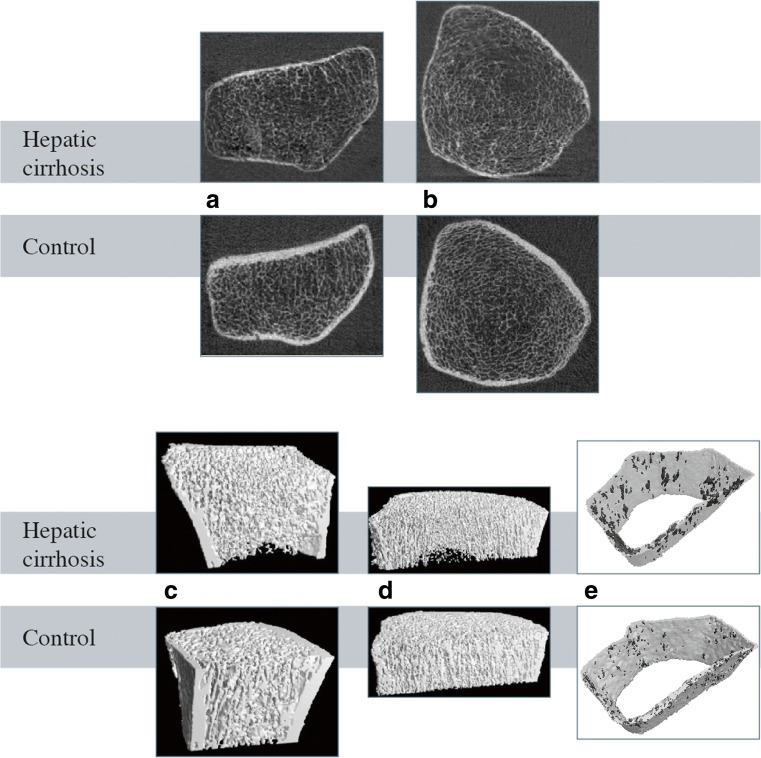
Liver cirrhosis leads to bone loss. To date, information on bone quality (three-dimensional microarchitecture) and, thus, bone strength is scarce. We observed decreased bone quality at both assessed sites, independent of disease severity. Therefore, all patients should undergo early-stage screening for osteoporosis. INTRODUCTION: Recent studies found low bone mineral density in cirrhosis, but data on bone microstructure are scarce. This study assessed weight-bearing and non-weight-bearing bones in patients with cirrhosis and healthy controls. The primary objective was to evaluate trabecular and cortical microarchitecture. METHODS: This was a single-center study in patients with recently diagnosed hepatic cirrhosis. Thirty-two patients and 32 controls participated in this study. After determining the type of cirrhosis, the parameters of bone microarchitecture were assessed by high-resolution peripheral quantitative computed tomography. RESULTS: Both cortical and trabecular microarchitectures showed significant alterations. At the radius, trabecular bone volume fraction was 17% lower (corrected p = 0.028), and, at the tibia, differences were slightly more pronounced. Trabecular bone volume fraction was 19% lower (p = 0.024), cortical bone mineral density 7% (p = 0.007), and cortical thickness 28% (p = 0.001), while cortical porosity was 32% higher (p = 0.023), compared to controls. Areal bone mineral density was lower (lumbar spine - 13%, total hip - 11%, total body - 9%, radius - 17%, and calcaneus - 26%). There was no correlation between disease severity and microarchitecture. Areal bone mineral density (aBMD) measured by dual-energy X-ray absorptiometry (DXA) correlated well with parameters of cortical and trabecular microarchitecture. CONCLUSIONS: Hepatic cirrhosis deteriorates both trabecular and cortical microarchitecture, regardless of disease severity. Areal bone mineral density is diminished at all sites as a sign of generalized affection. In patients with hepatic cirrhosis, regardless of its origin or disease severity, aBMD measurements are an appropriate tool for osteologic screening.
Overview
The claims and statistics of this paper haven’t been checked yet.
Free: it reads the open-access text and checks the first 5 claims that cite a source we can check. Create a free account to check every claim.
Integrity signals
Registry
Cites
Statistics
Figures
Verification
Claims the paper makes
The claims and statistics of this paper haven’t been checked yet.
Free: it reads the open-access text and checks the first 5 claims that cite a source we can check. Create a free account to check every claim.
Claims other papers make about this one
Each is checked against this paper’s own text: does it say what the citing paper says it does?
In the citing paper
“Nevertheless, R. Wakolbinger [75] found a significant loss of bone structural integrity at the early stage of cirrhosis which indicated a liver-bone axis in the development of cirrhosis.”
From Emerging role of liver-bone axis in osteoporosis (2024) · cites this paper as [75]
Self-check
Percentages, sums and reported differences re-computed from the paper’s own numbers.
The self-check needs the paper’s full text.
Citations
Cites
Chalasani, N., Younossi, Z., Lavine, J. E., Diehl, A. M., Brunt, E. M., Cusi, K., Charlton, M., & Sanyal, A. J. (2012) · Hepatology · doi:10.1002/hep.25762 · Cited by 3,803
Boutroy, S., Bouxsein, M. L., Munoz, F., & Delmas, P. D. (2005) · The Journal of Clinical Endocrinology & Metabolism · doi:10.1210/jc.2005-1258 · Cited by 1,192
O'Shea, R. S., Dasarathy, S., & McCullough, A. J. (2010) · Hepatology · doi:10.1002/hep.23258 · Cited by 1,077
Burghardt, A. J., Issever, A. S., Schwartz, A. V., Davis, K. A., Masharani, U., Majumdar, S., & Link, T. M. (2010) · The Journal of Clinical Endocrinology & Metabolism · doi:10.1210/jc.2010-0226 · Cited by 460
Sornay-Rendu, E., Boutroy, S., Munoz, F., & Delmas, P. D. (2007) · Journal of Bone and Mineral Research · doi:10.1359/jbmr.061206 · Cited by 454
Increased cortical porosity in type 2 diabetic postmenopausal women with fragility fractures
Patsch, J. M., Burghardt, A. J., Yap, S. P., Baum, T., Schwartz, A. V., Joseph, G. B., & Link, T. M. (2013) · Journal of Bone and Mineral Research · doi:10.1002/jbmr.1763 · Cited by 436
Bone mineral density before and after OLT: Long-term follow-up and predictive factors
Guichelaar, M. M. J., Kendall, R., Malinchoc, M., & Hay, J. E. (2006) · Liver Transplantation · doi:10.1002/lt.20874 · Cited by 207
Osteoporosis and skeletal fractures in chronic liver disease.
Diamond, T., Stiel, D., Lunzer, M., Wilkinson, M., Roche, J., & Posen, S. (1990) · Gut · doi:10.1136/gut.31.1.82 · Cited by 207
DIAMOND, T. H., Stiel, D., Lunzer, M., McDowall, D., Eckstein, R. P., & Posen, S. (1989) · Gastroenterology · doi:10.1016/0016-5085(89)90783-x · Cited by 199
Bone Mass and Microarchitecture in CKD Patients with Fracture
Nickolas, T. L., Stein, E., Cohen, A., Thomas, V., Staron, R. B., McMahon, D. J., Leonard, M. B., & Shane, E. (2010) · Journal of the American Society of Nephrology · doi:10.1681/asn.2009121208 · Cited by 188
Cited by
SIRT2 regulates extracellular vesicle-mediated liver-bone communication
Lin, L., Guo, Z., He, E., Long, X., Wang, D., Zhang, Y., Guo, W., Wei, Q., He, W., Wu, W., et al. (2023) · Nature Metabolism · doi:10.1038/s42255-023-00803-0 · Cited by 88
From liver to hormones: The endocrine consequences of cirrhosis
Aldave, J. E. Q., Osorio, E. R. G., Durand‐Vásquez, M. D. C., Rafael-Robles, L. D. P., Yovera, J. G. G., Quispe-Flores, M. A., Urteaga, L. A. C., Román-Gonzaléz, A., Paz‐Ibarra, J., & Concepción‐Zavaleta, M. J. (2024) · World Journal of Gastroenterology · doi:10.3748/wjg.v30.i9.1073 · Cited by 47
Emerging role of liver-bone axis in osteoporosis
Gao, H., Peng, X., Li, N., Gou, L., Xu, T., Wang, Y., Qin, J., Liang, H., Ma, P., Li, S., et al. (2024) · Journal of Orthopaedic Translation · doi:10.1016/j.jot.2024.07.008 · Cited by 36
“Nevertheless, R. Wakolbinger [75] found a significant loss of bone structural integrity at the early stage of cirrhosis which indicated a liver-bone axis in the development of cirrhosis.”
BackgroundBone loss in chronic liver diseases: Could healthy liver be a requirement for good bone health?
Jadzic, J. S., & Djonić, D. (2023) · World Journal of Gastroenterology · doi:10.3748/wjg.v29.i5.825 · Cited by 34
Jadzic, J. S., Milovanovic, P. D., Cvetković, D., Ivović, M., Tomanović, N., Bracanovic, M., Živković, V., Nikolić, S., Djuric, M. P., & Djonić, D. (2021) · Bone · doi:10.1016/j.bone.2021.116020 · Cited by 25
Kovalic, A. J., Cholankeril, G. T., & Satapathy, S. K. (2019) · Translational Gastroenterology and Hepatology · doi:10.21037/tgh.2019.08.09 · Cited by 26
“Although it appears patients with cirrhosis are at increased risk for altered bone mineral density and microarchitecture, regardless of etiology (109), patients with ALD harbor a multitude of unique risk factors for the development of osteopenia.”
BackgroundBone disease and liver transplantation: a review
Rodríguez-Aguilar, E. F., Pérez-Escobar, J., Sánchez Herrera, D., García-Alanis, M., Toapanta-Yanchapaxi, L., Gonzalez-Flores, E., & García-Juárez, I. (2021) · Transplantation Proceedings · doi:10.1016/j.transproceed.2021.07.049 · Cited by 19
Treatment outcomes in patients with pyogenic vertebral osteomyelitis who have cirrhosis
Kim, J., Kang, H. S., Kim, J. W., Kim, S. W., Oh, J.-K., Kim, Y., Park, M. S., & Kim, T.-H. (2019) · Scientific Reports · doi:10.1038/s41598-019-51758-w · Cited by 17
Serum levels of sclerostin reflect altered bone microarchitecture in patients with hepatic cirrhosis
Wakolbinger, R., Muschitz, C., Wallwitz, J., Bodlaj, G., Feichtinger, X., Schanda, J. E., Resch, H., Baierl, A., & Pietschmann, P. (2020) · Wiener klinische Wochenschrift · doi:10.1007/s00508-019-01595-8 · Cited by 15
Self-citationJadzic, J., Milovanovic, P. D., Cvetkovic, D., Zivkovic, V., Nikolic, S., Tomanovic, N., Djuric, M. P., & Djonic, D. (2022) · Journal of Anatomy · doi:10.1111/joa.13621 · Cited by 14
“…liver cirrhosis patients did not show significant correlations between micro- structural bone loss and clinical stages (Schmidt et al., 2021; Wakolbinger et al., 2019), suggesting that the clinical utility of our findings requires further confirmation in large prospective studies in…”
ResultHuang, S., Wu, Y., Zhao, H., Song, K., Liu, Y., Mao, J., & Li, Q. (2025) · Journal of Advanced Research · doi:10.1016/j.jare.2025.06.011 · Cited by 25
“Bone is mainly made of bone tissue (including OBs, collagen fibers, matrix, etc.) [20,21].”
Shirinezhad, A., Eshlaghi, F. M., Salabat, D., Azarboo, A., Ardakani, Z. F., Esmaeili, S., Hoveidaei, A. H., & Raeini, A. G. (2025) · BMC Gastroenterology · doi:10.1186/s12876-025-03720-6 · Cited by 19
“…and case-control [39, 40, 42] Countries where studies were conducted include Egypt [28, 30], China [37, 40], Denmark [33, 36], Italy [25, 26], Taiwan [23, 35, 39], Spain [29, 31], Serbia [34], Brazil [27], Turkey [32], Greece [42], Japan [24], the UK [36], India [41], Austria [38], and Sweden [43].”
InfluentialHsieh, B., Shen, D., Chan, T. C.-C., Cho, Y., Tang, C., & Chu, C. (2023) · Journal of the European Academy of Dermatology and Venereology · doi:10.1111/jdv.19697 · Cited by 17
The micro-structural analysis of lumbar vertebrae in alcoholic liver cirrhosis
Jadzic, J. S., Cvetković, D., Milovanovic, P. D., Tomanović, N., Živković, V., Nikolić, S., Djuric, M. P., & Djonić, D. (2020) · Osteoporosis International · doi:10.1007/s00198-020-05509-7 · Cited by 17
Jadzic, J., Milovanovic, P., Tomanovic, N., Zivkovic, V., Djukic, D., Nikolic, S., Djuric, M., & Djonic, D. (2023) · Journal of Endocrinological Investigation · doi:10.1007/s40618-023-02130-3 · Cited by 11
The Role of Extracellular Vesicles in Musculoskeletal Diseases
Fu, P., Luo, Y., Zheng, S., Ma, Z., Xiao, W., Li, H., & Li, Y. (2025) · Journal of Extracellular Vesicles · doi:10.1002/jev2.70205 · Cited by 13
Tao, J., Yan, Z.-J., Huang, W.-M., & Feng, T. (2023) · Frontiers in Medicine · doi:10.3389/fmed.2023.1120083 · Cited by 10
Hale, M. B., Romero‐Araya, P., Herrera, M. C., Espinoza, D., Castro, N., Castro, J., & Sérandour, G. (2021) · Clinical Case Reports · doi:10.1002/ccr3.4410 · Cited by 10
Liver-based inter-organ communication: A disease perspective
Luo, X.-Y., Ying, S.-Q., Cao, Y., Jin, Y. J., Jin, F., Zheng, C., & Sui, B. (2024) · Life Sciences · doi:10.1016/j.lfs.2024.122824 · Cited by 15
Jadzic, J. S., Plumeyer, C., Djukić, D., Živković, V., Nikolić, S., Veldhuis‐Vlug, A. G., Tomanović, N., Djuric, M. P., Milovanovic, P. D., Busse, B., et al. (2025) · Journal of Bone and Mineral Research · doi:10.1093/jbmr/zjaf065 · Cited by 10
Jadzic, J. S., Cvetković, D., Tomanović, N., Živković, V., Nikolić, S., Milovanovic, P. D., Djuric, M. P., & Djonić, D. (2020) · Microscopy Research and Technique · doi:10.1002/jemt.23642 · Cited by 11
“in patients with different etiology of LC and their Child-Pough or MELD scores (Campbell, Lichtenstein, Rhim, Pazianas, & Faust, 2005; Jorge-Hernandez et al., 1988; Wakolbinger et al., 2019); so, clinical utility of our observation needs further confirmations.”
BackgroundResultInfluentialThakur, P., Cherian, K. E., Kapoor, N., Rebekah, G. J., Goel, A., Zachariah, U., Eapen, C., Thomas, N., & Paul, T. V. (2021) · Journal of Clinical Densitometry · doi:10.1016/j.jocd.2021.03.001 · Cited by 9
Koepf, U. S., Scheidt, S., Hischebeth, G. T. R., Strassburg, C. P., Wirtz, D. C., Randau, T. M., & Lutz, P. L. (2022) · BMC Infectious Diseases · doi:10.1186/s12879-022-07379-2 · Cited by 7
“Cirrhotic patients suffer from deteriorated bone microarchitecture (4) and are more prone to falls (5,6), leading to an elevated fracture risk (7,8) and may end in joint replacement operations.”
BackgroundThe liver-bone axis: an emerging player in disease pathogenesis and therapeutic intervention
Han, S., Wei, Y., Yu, G., Jia, W., Liao, W., He, Y., Cheng, K., Zhao, J., Xiang, S., Zhang, W., et al. (2026) · Science China Life Sciences · doi:10.1007/s11427-025-3207-5 · Cited by 5
Micro-scale assessment of bone quality changes in adult cadaveric men with congestive hepatopathy
Jadzic, J. S., Tomanović, N., Djukić, D., Živković, V., Nikolić, S., Djuric, M. P., Milovanovic, P. D., & Djonić, D. (2022) · Histochemistry and Cell Biology · doi:10.1007/s00418-022-02128-7 · Cited by 5
Sánchez‐Delgado, J., Profitós, J., Arévalo, M., Lira, A., Mármol, C., Miquel, M., Casas, M., Vergara, M., Calvet, X., Berlanga, E., et al. (2023) · Journal of Clinical Medicine · doi:10.3390/jcm13010188 · Cited by 3
“One study reported that, among the patients with alcoholic cirrhosis, 85% had serum vitamin D levels below 50 nmol/L and 55% had levels below 25 nmol/L [40].”
BackgroundHou, X., Cheng, X.-Y., You, Y., Li, J., Ma, D., Yang, Z., & Ma, Q. (2022) · British Journal of Radiology · doi:10.1259/bjr.20201251 · Cited by 4
Effect of Zoledronic Acid in Hepatic Osteodystrophy: A Double-Blinded Placebo-Controlled Trial
Raj, H., Kamalanathan, S., Sahoo, J., Mohan, P., Nagarajan, K., Reddy, S. V. B., Durgia, H., & Palui, R. (2023) · Indian Journal of Endocrinology and Metabolism · doi:10.4103/ijem.ijem_233_23 · Cited by 4
“SFI increased significantly in both arms [Tables 2 and 3].”
BackgroundInfluentialFragility spinal fractures among cirrhotic liver transplant candidates in Croatia
Jurina, A., Delimar, V., Giljević, Z., Kanižaj, T. F., Matković, A., Vidović, D., Jurjević, N., Vidjak, V., Duić, Ž., Ćuk, M., et al. (2023) · Injury · doi:10.1016/j.injury.2023.111171 · Cited by 1
Wang, H., Liu, Q., Jiang, M., Song, C., & Liu, D. (2023) · Frontiers in Pharmacology · doi:10.3389/fphar.2023.1089774 · Cited by 1
“The bone mineral density of the lumbar spine after the treatment of Frontiers in Pharmacology frontiersin.org 07 osteoporosis drugs is better than that of other bones (Wakolbinger et al., 2019).”
BackgroundRodić, T., Wölfel, E. M., Fiedler, I. A. K., Cvetković, D., Jähn, K., Sopta, J. P., Nikolić, S., Živković, V., Busse, B., Djuric, M. P., et al. (2024) · Bone · doi:10.1016/j.bone.2024.117378 · Cited by 4
Tenório, J. R. (2019) · Digital Library of Theses and Dissertations (Universidade de São Paulo) · doi:10.11606/t.23.2019.tde-08072020-132813
Compromised bone strength in patients with alcoholic liver cirrhosis
Jadzic, J. S., & Đonić, D. (2020) · Medicinski podmladak · doi:10.5937/mp71-27443
Management of Stabil Vertebra Fractures in Patients Underwent Liver Transplantation
Paşahan, R., Tetik, B., Güldoğan, E., Başkıran, A., & Yılmaz, S. (2021) · MIDDLE BLACK SEA JOURNAL OF HEALTH SCIENCE · doi:10.19127/mbsjohs.899345 · Cited by 1
“The lumbar vertebra and thigh bone densitometry screenings are recommended in patients with hepatic cirrhosis regardless of the cause and severity of the disease (11-15).”
BackgroundImpact of Liver Cirrhosis on Bone Metabolism
Abdalbary, M., Sobh, M., Abdelsalam, M., & El-Husseini, A. A. (2022) · Digestive Disease Interventions · doi:10.1055/s-0042-1743554
Bone health and chronic viral infections: A narrative literature review
Jadzic, J. S., Baljozović, A., & Simić, L. (2026) · World Journal of Virology · doi:10.5501/wjv.v15.i1.118225
Li, C., Tang, C., Lin, B., Song, X., Zhang, X., Liu, P., Xu, C., & Yu, C. (2026) · Journal of Advanced Research · doi:10.1016/j.jare.2026.08.006
Xiang, L., Deng, K., Gao, Z., Pang, Q., Wang, A., Fernandez, J., Chen, L., & Gu, Y. (2026) · Journal of Bone and Mineral Research · doi:10.1093/jbmr/zjag138
张良平, Jiang, T., Cao, R., Han, L., & Ni, L. (2026) · Frontiers in Cellular and Infection Microbiology · doi:10.3389/fcimb.2026.1935323
Metadata
- Authors
- Wakolbinger, R., Muschitz, C., Scheriau, G., Bodlaj, G., Kocijan, R., Feichtinger, X., Schanda, J. E., Haschka, J., Resch, H., & Pietschmann, P.
- Affiliations
- Vinforce (AT)
- Medical University of Vienna (AT)
- Corresponding author
- Muschitz, C.
- ORCID
- Venue
- Osteoporosis International
- Published
- 2019-02-20
- Volume
- 30
- Issue
- 6
- Pages
- 1195-1204
- ISSN
- 0937-941X (ISSN-L)
- 1433-2965
- PMC
- PMC6546655
- OpenAlex
- W2915786099
- Cited by
- 39
- References
- 38
- Citations by year
- 2026: 5 · 2025: 4 · 2024: 4 · 2023: 9 · 2022: 5 · 2021: 5 · 2020: 4 · 2019: 3
- FWCI
- 4.52
- Type
- journal article
- Language
- en
- Open access
- hybrid
- doi.org
- Licence
- cc-by-nc
- creativecommons.org/licenses/by-nc/4.0 (tdm)
- Locations
- Osteoporosis International (publishedVersion, cc-by-nc)
- PubMed Central (publishedVersion, cc-by-nc)
- PubMed (publishedVersion)
- Funders
- Medical University of Vienna
- Topics
- Health Sciences › Medicine › Orthopedics and Sports Medicine › Bone health and osteoporosis research
- Health Sciences › Medicine › Hepatology › Liver Disease and Transplantation
- Life Sciences › Biochemistry, Genetics and Molecular Biology › Molecular Biology › Bone Metabolism and Diseases
- Keywords
- liver cirrhosis, bone microarchitecture, trabecular bone volume, cortical bone thickness, cortical porosity, bone mineral density, bone turnover, osteoporosis screening, bone quality
- MeSH terms
- Cortical Bone, Cancellous Bone, Aged, Female, Humans, Liver Cirrhosis, Liver Cirrhosis, Alcoholic, Male, Middle Aged, Radius, Tibia, Tomography, X-Ray Computed, Biomarkers, Bone Density, Case-Control Studies, Porosity, Weight-Bearing, Bone Remodeling
About these checks
Registry, retraction, Cites and statistics results are computed, not judged, with one exception: a printed reference that no index lists is read once by a model before it counts as a citation error. Claims are extracted by a model and kept only when their quote appears verbatim in the text; each cited source is then checked, with a model’s help, for whether it says what the claim relies on. Those verdicts can be wrong — read the claim’s quote and the cited source before relying on one.
Statistics and arithmetic are recomputed, not judged.
Confidence bands are shown only for fields calibrated on our annotated test set. None is calibrated yet, so no band is shown.
What counts as a claim ›How we measure confidence ›How we check this ›
Are you an author, or do you see a problem with this page? Request a review
Data sources
Bibliographic data: Semantic Scholar, OpenAlex, Crossref.
Contains information from the Semantic Scholar Academic Graph Datasets, made available under the ODC Attribution License (ODC-BY 1.0).
Semantic Scholar’s data is described in: Kinney, R., et al. (2023). The Semantic Scholar Open Data Platform. arXiv:2301.10140.
