

Exercise and the prevention of major osteoporotic fractures in adults: a systematic review and meta-analysis with special emphasis on intensity progression and study duration
Open accessThe DOI matches its Crossref record; 43 of the 43 references it cites were found in a registry or an index.
Abstract
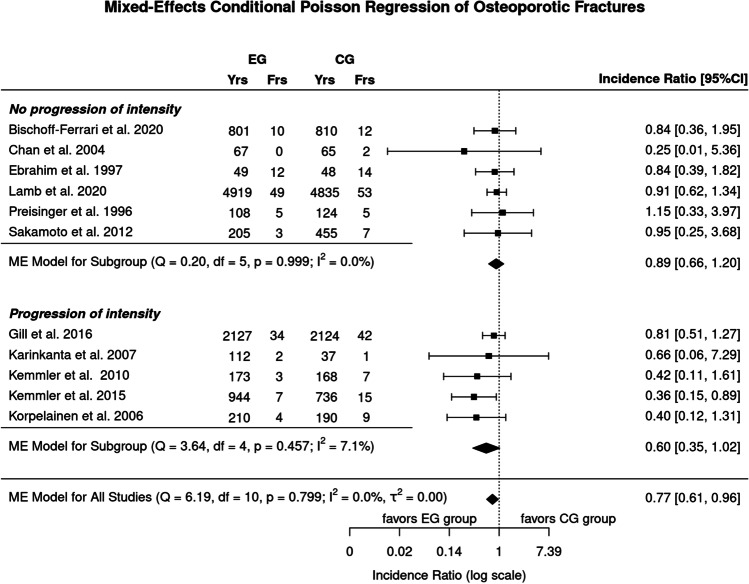
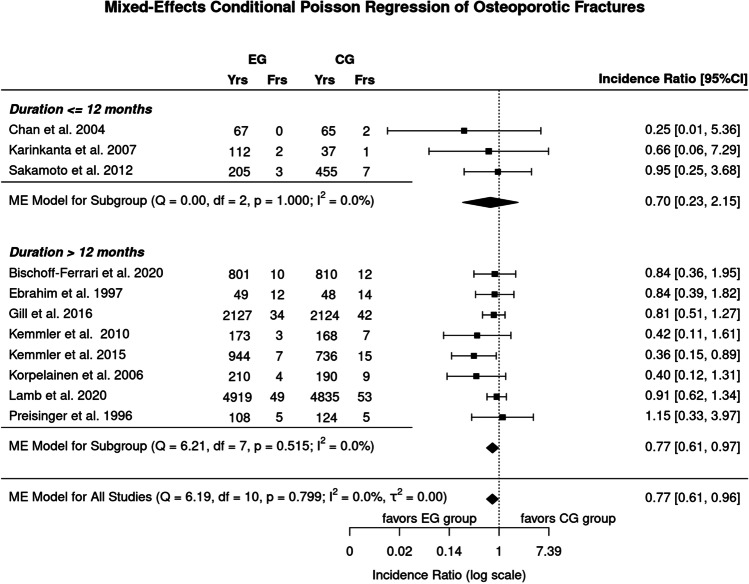
The role of exercise in preventing osteoporotic fractures is vague, and further recommendations for optimized exercise protocols are very rare. In the present work, we provided positive evidence for exercise effects on the number of osteoporotic fractures in adults, albeit without observing any significant relevance of intensity progression or study duration. Osteoporotic fractures are a major challenge confronting our aging society. Exercise might be an efficient agent for reducing osteoporotic fractures in older adults, but the most promising exercise protocol for that purpose has yet to be identified. The present meta-analysis thus aimed to identify important predictors of the exercise effect on osteoporotic fractures in adults. We conducted a systematic search of six literature databases according to the PRISMA guideline that included controlled exercise studies and reported the number of low-trauma major osteoporotic fractures separately for exercise (EG) and control (CG) groups. Primary study outcome was incidence ratio (IR) for major osteoporotic fractures. Sub-analyses were conducted for progression of intensity (yes vs. no) during the trial and the study duration (≤ 12 months vs. > 12 months). In summary, 11 studies with a pooled number of 9715 participant-years in the EG and 9592 in the CG were included. The mixed-effects conditional Poisson regression revealed positive exercise effects on major osteoporotic fractures (RR: 0.75, 95% CI: 0.54–0.94, p = .006). Although studies with intensity progression were more favorable, our subgroup analysis did not determine significant differences for diverging intensity progression ( p = .133) or study duration ( p = .883). Heterogeneity among the trials of the subgroups (I 2 ≤ 0–7.1%) was negligible. The present systematic review and meta-analysis provided significant evidence for the favorable effect of exercise on major osteoporotic fractures. However, diverging study and exercise characteristics along with the close interaction of exercise parameters prevented the derivation of reliable recommendations for exercise protocols for fracture reductions. PROSPERO ID: CRD42021250467.
Overview
The claims and statistics of this paper haven’t been checked yet.
Free: it reads the open-access text and checks the first 5 claims that cite a source we can check. Create a free account to check every claim.
Integrity signals
Registry
Cites
Statistics
Figures
Verification
Claims the paper makes
The claims and statistics of this paper haven’t been checked yet.
Free: it reads the open-access text and checks the first 5 claims that cite a source we can check. Create a free account to check every claim.
Claims other papers make about this one
Each is checked against this paper’s own text: does it say what the citing paper says it does?
In the citing paper
“This stands in contrast to the significant 25% reduction in fractures achieved with other exercise modalities [481].”
From Global consensus on optimal exercise recommendations for enhancing healthy longevity in older adults (ICFSR) (2025) · cites this paper as [481]
Self-check
Percentages, sums and reported differences re-computed from the paper’s own numbers.
The self-check needs the paper’s full text.
Citations
Cites
PRISMA-P Group, Moher, D., Shamseer, L., Clarke, M., Ghersi, D., Liberati, A., Petticrew, M., Shekelle, P., & Stewart, L. A. (2015) · Systematic Reviews · doi:10.1186/2046-4053-4-1 · Cited by 26,223 · cited 3×
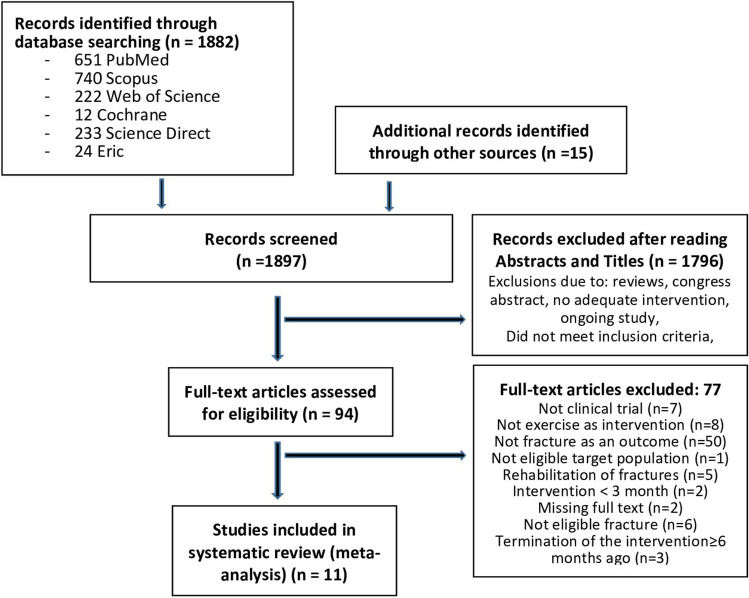
“1 Flow-chart of the present systematic review according to PRISMA [11]”
MethodInfluentialConducting Meta-Analyses in R with the metafor Package
Viechtbauer, W. (2010) · Journal of Statistical Software · doi:10.18637/jss.v036.i03 · Cited by 20,464
Neer, R. M., Arnaud, C. D., Zanchetta, J. R., Prince, R., Gaich, G. A., Reginster, J.-Y., Hodsman, A. B., Eriksen, E. F., Ish-Shalom, S., Genant, H. K., et al. (2001) · New England Journal of Medicine · doi:10.1056/nejm200105103441904 · Cited by 4,602
Once-Yearly Zoledronic Acid for Treatment of Postmenopausal Osteoporosis
Black, D. M., Delmas, P. D., Eastell, R., Reid, I. R., Boonen, S., Cauley, J. A., Cosman, F., Lakatos, P., Leung, P. C., Man, Z., et al. (2007) · New England Journal of Medicine · doi:10.1056/nejmoa067312 · Cited by 2,986
FRAX™ and the assessment of fracture probability in men and women from the UK
Kanis, J. A., Johnell, O., Oden, A., Johansson, H., & McCloskey, E. (2008) · Osteoporosis International · doi:10.1007/s00198-007-0543-5 · Cited by 2,467
Exercise to prevent falls in older adults: an updated systematic review and meta-analysis
Sherrington, C., Michaleff, Z. A., Fairhall, N., Paul, S. S., Tiedemann, A., Whitney, J., Cumming, R. G., Herbert, R. D., Close, J. C. T., & Lord, S. R. (2017) · British Journal of Sports Medicine · doi:10.1136/bjsports-2016-096547 · Cited by 1,095 · cited 3×
“Although this aspect is not negligible for fall prevention studies [2] either, it is outweighed by duration of the study/ intervention in exercise programs on bone strengthening due to the length of bone adaptation in adults [35, 36].”
BackgroundCellular mechanisms of bone remodeling
Eriksen, E. F. (2010) · Reviews in Endocrine and Metabolic Disorders · doi:10.1007/s11154-010-9153-1 · Cited by 821
Stijnen, T., Hamza, T. H., & Özdemir, P. (2010) · Statistics in Medicine · doi:10.1002/sim.4040 · Cited by 757
SCOPE 2021: a new scorecard for osteoporosis in Europe
Kanis, J. A., Norton, N., Harvey, N. C., Jacobson, T., Johansson, H., Lorentzon, M., McCloskey, E. V., Willers, C., & Borgström, F. (2021) · Archives of Osteoporosis · doi:10.1007/s11657-020-00871-9 · Cited by 714 · cited 1×
“Considering the demographic change in Europe, the number of osteoporotic fractures will quite likely increase by about 25% during the next 10–15 years [1].”
BackgroundPEDro. A database of randomized trials and systematic reviews in physiotherapy
Sherrington, C., Herbert, R. D., Maher, C. G., & Moseley, A. M. (2000) · Manual Therapy · doi:10.1054/math.2000.0372 · Cited by 508
Research works printed but not linked: 2
- Weineck J Optimales training 2019 Erlangen Spitta-Verlag
- Kemmler W Stengel V The role of exercise on fracture reduction and bone strengthening 2019 London Avademic Press
Cited by
Walker, M. D., & Shane, E. (2023) · New England Journal of Medicine · doi:10.1056/nejmcp2307353 · Cited by 381
Izquierdo, M., de Souto Barreto, P., Arai, H., Bischoff-Ferrari, H. A., Cadore, E. L., Cesari, M., Chen, L.-K., Coen, P. M., Courneya, K. S., Duque, G., et al. (2025) · The Journal of nutrition, health and aging · doi:10.1016/j.jnha.2024.100401 · Cited by 273
Self-citationWebster, J., Via, J. D., Langley, C. K., Smith, C., Sale, C., & Sim, M. (2023) · Bone Reports · doi:10.1016/j.bonr.2023.101684 · Cited by 55
Dimai, H. P., Muschitz, C., Amrein, K., Bauer, R., Cejka, D., Gasser, R. W., Gruber, R., Haschka, J., Hasenoehrl, T., Kainberger, F. M., et al. (2024) · Wiener klinische Wochenschrift · doi:10.1007/s00508-024-02441-2 · Cited by 32
Self-citationExercise for Postmenopausal Bone Health – Can We Raise the Bar?
Kumar, S., Smith, C., Clifton-Bligh, R. J., Beck, B. R., & Girgis, C. M. (2025) · Current Osteoporosis Reports · doi:10.1007/s11914-025-00912-7 · Cited by 21
“…included fractures as the primary outcome, vertebral fractures have been less frequently studied, intensity of training is often insufficient or not specified, and methodological heterogeneity between trials may dilute the fracture risk-lowering effect of more robust exercise programs [48, 49].”
Yılmaz, N., & Kösehasanoğulları, M. (2024) · Rheumatology International · doi:10.1007/s00296-024-05569-6 · Cited by 17
“Proprioceptive rehabilitation emphasizes the importance of balance exercises to prevent falls [6].”
BackgroundGuideline for diagnostic, prevention and treatment of postmenopausal osteoporosis
Grygorieva, N. V., Kovalenko, V., Коrzh, М. О., Татарчук, Т. Ф., Dedukh, N. V., Страфун, С. С., Dubossarska, Z. M., Protsenko, G., Калашніков, А. В., Musiіenko, А. S., et al. (2023) · PAIN JOINTS SPINE · doi:10.22141/pjs.13.3.2023.378 · Cited by 21
Extracellular Vesicles and Exosomes in the Control of the Musculoskeletal Health
Penna, F., Garcia‐Castillo, L., & Costelli, P. (2024) · Current Osteoporosis Reports · doi:10.1007/s11914-024-00866-2 · Cited by 18
“Consist-ently, evidences have been provided that elderly people regularly performing physical activity show a reduced incidence of falls and fractures [13].”
Nutrition and Physical Activity in Musculoskeletal Health
Dominguez, L. J., Veronese, N., Smith, L., Ragusa, F. S., Bella, G. D., Battaglia, G., Bianco, A., & Barbagallo, M. (2025) · Endocrines · doi:10.3390/endocrines6010010 · Cited by 18
“…strong evidence confirming that physical activity, in particular balance and resistance exercise, can decrease the risk of falls and fractures [18,19] and the 2022 World Guidelines for Falls Prevention and Management for Older Adults recommend performing a nutritional assessment, beyond the…”
van Scherpenseel, M. C., van Veenendaal, L. J., Donné, L., Velde, S. J. T., & Ronteltap, A. (2023) · Frontiers in Public Health · doi:10.3389/fpubh.2023.1150659 · Cited by 12
“Several studies have also found that exercise prevents falls and fractures in older people (9, 10).”
BackgroundGuðmundsdóttir, S. L., Berger, C., MACDONALD, H. M., Adachi, J. D., Hopman, W. M., Kaiser, S., Kovács, C. S., Davison, K. S., Morin, S. N., Goltzman, D., et al. (2024) · Journal of Bone and Mineral Research · doi:10.1093/jbmr/zjae004 · Cited by 7
“12-16 Alternatively, few studies of SB related to bone health have been performed in adult and elderly populations.”
BackgroundPengcheng, X., Wang, Y., Wu, X., Wang, W. T., Wang, Q., Lin, W., Zhang, Z., & Li, M. (2024) · International Journal of Burns and Trauma · doi:10.62347/kkam3344 · Cited by 10
Physical Exercise and Health, 1: An Overview of Terminology, Guidance, Benefits, and Risks
Andrade, C. (2023) · The Journal of Clinical Psychiatry · doi:10.4088/jcp.23f15099 · Cited by 13
Investigating the Role of Exercise in Improving Bone Health Among Elderly Women with Osteopenia
Kotsili, K., Michou, V., Κουτλιάνος, Ν., Dalkiranis, A., Kouidi, E. J., & Deligiannis, A. P. (2025) · Journal of Functional Morphology and Kinesiology · doi:10.3390/jfmk10040451 · Cited by 4
“…evidence from community-dwelling older adults, which shows that exercise, particularly balance and functional training, whether done alone or combined with resistance training, can reduce the risk of falls and major osteoporotic fractures by approximately 20–30% compared to usual care [68–70].”
Nazir, S., Mathiyakom, W., Tassawar, M. A., & Tantisuwat, A. (2025) · BMC Geriatrics · doi:10.1186/s12877-025-06555-8 · Cited by 5
“Exercise has been shown to prevent falls and fractures in older people, increasing their confidence and reducing fall risk [12, 13].”
O’Hare, B. S., Santaguida, P. L., Azizudin, A. M., & Papaioannou, A. (2025) · Osteoporosis International · doi:10.1007/s00198-025-07606-x · Cited by 4
“A systematic review and meta-analysis found that exercise can also reduce the risk of major osteoporotic fractures, but sub-analyses did not find evidence that intensity progression or exercise duration contributed significantly to this positive interaction [34].”
Ukrainian guideline for the prevention and treatment of glucocorticoid-induced osteoporosis
Grygorieva, N. V., Kovalenko, V., Korzh, M., Tronko, M. D., Golovach, I. Y., Dedukh, N. V., Рекалов, Д. Г., Страфун, С. С., Smiyan, S., Golubovska, O. A., et al. (2025) · Archives of Osteoporosis · doi:10.1007/s11657-025-01512-9 · Cited by 2
In Vivo quantification of 4D modeling and remodeling in trabecular and cortical bone microstructure
Shyu, P. T., Robinson, S. T., & Guo, X. (2025) · Frontiers in Medical Engineering · doi:10.3389/fmede.2025.1547895 · Cited by 2
Yang, J., Jia, H., Yu, K., & Zeng, B. (2025) · The Aging Male · doi:10.1080/13685538.2025.2604393 · Cited by 2
Zhou, Z., Wei, X., Zhang, X., Ainsworth, B. E., Lü, J., & Liu, Y. (2026) · Journal of sport and health science/Journal of Sport and Health Science · doi:10.1016/j.jshs.2026.101127 · Cited by 5
“2 (cid:1) 12).”
Mohebi, R., von Stengel, S., Kohl, M., Jakob, F. J., Kerschan‐Schindl, K., Lange, U., Peters, S., Schöne, D., Thomasius, F. E., Becker, C., et al. (2023) · Osteologie/Osteology · doi:10.1055/a-2075-7106 · Cited by 3
Self-citationUkrainian guidelines for the prevention and treatment of glucocorticoid-induced osteoporosis
Grygorieva, N. V., Kovalenko, V., Коrzh, М. О., Tronko, M. D., Golovach, I. Y., Dedukh, N. V., Рекалов, Д. Г., Страфун, С. С., Smiyan, S., Golubovska, O. A., et al. (2024) · PAIN JOINTS SPINE · doi:10.22141/pjs.14.3.2024.426 · Cited by 5
Osteoporosis and fracture risk: a practical guide for neurologists
Laskou, F., Curtis, E., Varatharaj, A., Dennison, E. M., & Harvey, N. C. (2025) · Practical Neurology · doi:10.1136/pn-2024-004257 · Cited by 3
“…favoured exercise for its positive effect on the risk of MOFs, while specifically high-intensity training significantly improved lumbar spine BMD. 70 71 Combining low- to-moderate impact weight-bearing exercises with progressive resistance and/or agility training is most effective for enhancing…”
InfluentialBewegung, körperliche Aktivität und Alter
Köppel, M. (2023) · B&G Bewegungstherapie und Gesundheitssport · doi:10.1055/a-2152-4168 · Cited by 3
“[24].”
Huang, L., Xue, W., Huang, F., Zhang, F., Pan, B., & Chen, J. (2025) · Cureus · doi:10.7759/cureus.92611 · Cited by 2
“CT values can be an effective tool for assessing bone density [7].”
KEMMLER, W. K., Schoene, D., Kohl, M., Thomasius, F. E., Jakob, F. J., Kerschan‐Schindl, K., Lange, U., Becker, C., Peters, S., & von Stengel, S. (2025) · Die Orthopädie · doi:10.1007/s00132-025-04731-7 · Cited by 2
Self-citationKEMMLER, W. K., Schoene, D., Kohl, M., Thomasius, F. E., Jakob, F., Kerschan‐Schindl, K., Lange, U., Peters, S., & von Stengel, S. (2026) · BMC Endocrine Disorders · doi:10.1186/s12902-026-02194-1 · Cited by 1
“In some cases, the relevant number of new publications required an update (e.g. [27, 28]), in other cases different eligibility criteria were applied (e.g. [21]) or the lack of studies that address this issue [20, 31] needed updated evidence.”
Self-citationBinBin, L. I. U., Luo, S., Geng, Z., Jia, X., Wang, H., Pei, Z., Tang, T., Yang, X., Zhang, G., Zhang, S., et al. (2026) · Archives of Gerontology and Geriatrics · doi:10.1016/j.archger.2026.106240 · Cited by 2
von Stengel, S., Kohl, M., Jakob, F. J., Kerschan‐Schindl, K., Lange, U., Peters, S., Thomasius, F. E., Uder, M., Fröhlich, M., Schöne, D., et al. (2023) · Osteologie/Osteology · doi:10.1055/a-2070-7512 · Cited by 1
Self-citationWalker, R. A. J., & Harada, K. (2024) · Research Quarterly for Exercise and Sport · doi:10.1080/02701367.2024.2375290 · Cited by 1
Dupont, J., Dejaeger, M., Laurent, M. R., & Gielen, E. (2024) · Elsevier eBooks · doi:10.1016/b978-0-443-13825-6.00010-8
Jallali, T., Reiser, E., & Tóth, B. (2024) · Gynäkologie in der Praxis · doi:10.1007/s41974-024-00343-9
Effects of adjusted physical activities in the prevention of osteoporosis in the elderly
Marković, I., Durlević, S., Delibašić, I., & Durlević, M. (2025) · Antropološki i teoantropološki pogled na fizičke aktivnosti · doi:10.5937/atavpa25181m
Liu, H., Wu, Z., & Scragg, R. K. R. (2025) · Archives of Osteoporosis · doi:10.1007/s11657-025-01530-7 · Cited by 1
Schmidmaier, R. (2025) · CME · doi:10.1007/s11298-025-4183-x
Fractures in the Elderly with Osteoporosis
Ramella, F., Fici, P., & Randelli, P. S. (2025) · Springer eBooks · doi:10.1007/978-3-032-01700-0_7
Avaliação e prescrição de exercícios físicos para grupos especiais (osteoporose)
de Oliveira, R. V., Martins, M. S., & Miranda, V. P. N. (2025) · Cuadernos de Educación y Desarrollo · doi:10.55905/cuadv17n12-100
Xu, J., Luo, P., & Lian, Y. (2026) · Medicine · doi:10.1097/md.0000000000047293
“[40] Even when performed only once or twice weekly, structured and sufficiently intense activity can elicit these beneficial adaptations, particularly when sustained over time.”
Sadoghi, P., Budin, M., Herbst, E., Milano, G., Musahl, V., & Hirschmann, M. T. (2026) · Knee Surgery Sports Traumatology Arthroscopy · doi:10.1002/ksa.70316
Recommendations for the diagnosis, prevention and treatment of osteoporosis in men
Grygorieva, N. V., Корж, М. О., Tronko, M. D., Mankovsky, B. M., Yatsyshyn, R. I., Golovach, I. Y., Страфун, С. С., Сміян, С. І., Gurzhenko, Y. M., Рекалов, Д. Г., et al. (2026) · TRAUMA · doi:10.22141/1608-1706.2.27.2026.1081
An International Physical Exercise Screening Questionnaire (IPESQ)
Ang, S. H. C., Teo, T. L., Ho, L. C., & Anantharaman, V. (2026) · International Journal of Emergency Medicine · doi:10.1186/s12245-026-01167-4
Preventing Hip (Proximal Femoral) Fractures: An Evidence-Based Review for Clinicians
Kawai, T., Okuzu, Y., Takaoka, Y., Natsume, D., & Matsuda, S. (2026) · Journal of Clinical Medicine · doi:10.3390/jcm15166148 · Cited by 1
“In addition, substantial heterogeneity in intervention content, supervision, progression, and adherence limits cross-trial comparability; accordingly, “exercise” should not be interpreted as a single uniform intervention in guideline-style terms [6,14,15,17,24].”
Zhang, W., Mei, J., Li, X., Chen, K., Zhang, D., & Liu, J. (2026) · Calcified Tissue International · doi:10.1007/s00223-026-01578-8
“Research has shown that moderate-intensity exercise can enhance mechanical signal transduction in bone cells and activate osteoblast activity without causing excessive fatigue [24].”
Li, S., Pan, N., Niu, L., Yao, M., Zhao, S., Liu, C., & Li, D. (2026) · Frontiers in Physiology · doi:10.3389/fphys.2026.1903705
“…or osteoporotic populations, but have generally classi fi ed interventions by exercise type rather than systematically examining how reported prescription components correspond to a single osteoporosis exercise framework (Howe et al., 2011; Giangregorio et al., 2014, 2015; Hoffmann et al., 2023).”
OSTEOPOROSIS IN ADULTS: DIAGNOSIS, PREVENTION, AND TREATMENT – A NARRATIVE REVIEW
Zawisza, M., Sontag, W., Gawlak, J., Tarnawska, Z., Figiel, K., Gawin, M., Koziara, E., Gadzina, M., Golec, A., & Kuświk, M. K. K. (2026) · International Journal of Innovative Technologies in Social Science · doi:10.31435/ijitss.3(51).2026.6627
Physical activity programmes for promoting bone mineralisation and growth in preterm infants
Kaempfen, S., Cooper, C., Schulzke, S. M., & Neonatal, S. B. C. (2026) · Cochrane Database of Systematic Reviews · doi:10.1002/14651858.cd005387.pub4
Kopanos, S., Scheel, S. N., Eggert, B., Rübberdt, A., Thiem, U., & Feldkamp, J. (2026) · BMC Geriatrics · doi:10.1186/s12877-026-08424-4
Braun, T., Hermanns, M., Haug, V., Nau, J., Scheffler, B., Diermayr, G., Hartley, G. W., Avin, K. G., & Saal, S. (2026) · Frontiers in Rehabilitation Sciences · doi:10.3389/fresc.2026.1933821
Evaluation of the effects of exercise on osteoporosis using ultrasound
Srivastav, P., David, L. R., Kadavigere, R., Sukumar, S., Ravichandran, S., Uzun, B., Ozsahin, D. U., & Özşahin, İ. (2026) · Elsevier eBooks · doi:10.1016/b978-0-443-28967-5.00016-2
Metadata
- Authors
- Hoffmann, I., Kohl, M., von Stengel, S., Jakob, F., Kerschan-Schindl, K., Lange, U., Peters, S., Schoene, D., Sieber, C., Thomasius, F., Bischoff-Ferrari, H. A., Uder, M., & Kemmler, W.
- Affiliations
- Friedrich-Alexander-Universität Erlangen-Nürnberg (DE)
- Universitätsklinikum Erlangen (DE)
- University of Würzburg (DE)
- University of Zurich (CH)
- Corresponding author
- Kemmler, Wolfgang
- ORCID
- Venue
- Osteoporosis International
- Published
- 2022-11-10
- Volume
- 34
- Issue
- 1
- Pages
- 15-28
- ISSN
- 0937-941X (ISSN-L)
- 1433-2965
- PMC
- PMC9813248
- OpenAlex
- W4308686762
- Cited by
- 49
- References
- 43
- Citations by year
- 2026: 15 · 2025: 16 · 2024: 10 · 2023: 8
- FWCI
- 1.86
- Type
- journal article
- Language
- en
- Open access
- hybrid
- doi.org
- Licence
- cc-by-nc
- creativecommons.org/licenses/by-nc/4.0 (tdm)
- creativecommons.org/licenses/by-nc/4.0 (vor)
- Locations
- Osteoporosis International (publishedVersion, cc-by-nc)
- PubMed Central (publishedVersion, cc-by-nc)
- PubMed (publishedVersion)
- Zurich Open Repository and Archive (University of Zurich) (acceptedVersion, cc-by-nc-nd)
- Informationszentrum Lebenswissenschaften (ZB MED) (submittedVersion, cc-by-nc)
- Repository of Futwangen University of Applied Sciences (Furtwangen University) (submittedVersion, cc-by-nc)
- Zurich Open Repository and Archive (University of Zurich) (submittedVersion, cc-by)
- Zurich Open Repository and Archive (University of Zurich)
- Funders
- Friedrich-Alexander-Universität Erlangen-Nürnberg
- Topics
- Health Sciences › Medicine › Orthopedics and Sports Medicine › Bone health and osteoporosis research
- Health Sciences › Health Professions › Physical Therapy, Sports Therapy and Rehabilitation › Balance, Gait, and Falls Prevention
- Health Sciences › Medicine › Public Health, Environmental and Occupational Health › Physical Activity and Health
- Keywords
- physical activity, osteoporotic fractures, fracture prevention, study duration, exercise protocols, older adults, fragility fractures, bone health
- MeSH terms
- Aged, Aging, Exercise Therapy, Humans, Quality of Life, Exercise, Osteoporotic Fractures
About these checks
Registry, retraction, Cites and statistics results are computed, not judged, with one exception: a printed reference that no index lists is read once by a model before it counts as a citation error. Claims are extracted by a model and kept only when their quote appears verbatim in the text; each cited source is then checked, with a model’s help, for whether it says what the claim relies on. Those verdicts can be wrong — read the claim’s quote and the cited source before relying on one.
Statistics and arithmetic are recomputed, not judged.
Confidence bands are shown only for fields calibrated on our annotated test set. None is calibrated yet, so no band is shown.
What counts as a claim ›How we measure confidence ›How we check this ›
Are you an author, or do you see a problem with this page? Request a review
Data sources
Bibliographic data: Semantic Scholar, OpenAlex, Crossref.
Contains information from the Semantic Scholar Academic Graph Datasets, made available under the ODC Attribution License (ODC-BY 1.0).
Semantic Scholar’s data is described in: Kinney, R., et al. (2023). The Semantic Scholar Open Data Platform. arXiv:2301.10140.
