

Computational psychopharmacology: a translational and pragmatic approach
Open accessThe DOI matches its Crossref record; 66 of the 66 references it cites were found in a registry or an index.
Abstract
RATIONALE: Psychopharmacology needs novel quantitative measures and theoretical approaches based on computational modelling that can be used to help translate behavioural findings from experimental animals to humans, including patients with neuropsychiatric disorders. OBJECTIVES: This brief review exemplifies this approach when applied to recent published studies of the effects of manipulating central dopaminergic and serotoninergic systems in rodents and marmoset monkeys, and possible comparisons with healthy human volunteers receiving systemic agents or patients with depression and schizophrenia. METHODS: Behavioural effects of central depletions of dopamine or serotonin in monkeys in probabilistic learning paradigms are characterised further by computational modelling methods and related to rodent and human data. RESULTS: Several examples are provided of the power of computational modelling to derive new measures and reappraise conventional explanations of regional neurotransmitter depletion and other drug effects, whilst enhancing construct validation in patient groups. Specifically, effects are shown on such parameters as 'stimulus stickiness' and 'side stickiness', which occur over and above effects on standard parameters of reinforcement learning, reminiscent of some early innovations in data analysis in psychopharmacology. CONCLUSIONS: Computational modelling provides a useful methodology for further detailed analysis of behavioural mechanisms that are affected by pharmacological manipulations across species and will aid the translation of experimental findings to understand the therapeutic effects of medications in neuropsychiatric disorders, as well as facilitating future drug discovery.
Overview
The claims and statistics of this paper haven’t been checked yet.
Free: it reads the open-access text and checks the first 5 claims that cite a source we can check. Create a free account to check every claim.
Integrity signals
Registry
Cites
Statistics
Figures
Verification
Claims the paper makes
The claims and statistics of this paper haven’t been checked yet.
Free: it reads the open-access text and checks the first 5 claims that cite a source we can check. Create a free account to check every claim.
Self-check
Percentages, sums and reported differences re-computed from the paper’s own numbers.
The self-check needs the paper’s full text.
Citations
Cites
Reinforcement Learning: An Introduction
Sutton, R. S., & Barto, A. G. (1998) · IEEE Transactions on Neural Networks · doi:10.1109/tnn.1998.712192 · Cited by 27,225 · cited 1×
“However, reinforcement learning theory has provided us with a number of algorithms that adequately support learning, ranging from agent-based approaches (Russell and Norvig 1995; Sutton and Barto 1998) to more psychologically motivated models such as that of Rescorla and Wagner (1972) for Pavlovian conditioning.”
BackgroundReinforcement Learning: An Introduction
(2005) · IEEE Transactions on Neural Networks · doi:10.1109/tnn.2004.842673 · Cited by 24,496
Artificial intelligence: a modern approach
(1995) · Choice Reviews Online · doi:10.5860/choice.33-1577 · Cited by 21,974
(1966) · Medical Entomology and Zoology · Cited by 10,293
Rescorla, R. A. (1972) · Medical Entomology and Zoology · Cited by 9,661
A neural substrate of prediction and reward
Schultz, W., Dayan, P., & Montague, P. R. (1997) · Science · doi:10.1126/science.275.5306.1593 · Cited by 9,388 · cited 3×
“There were effects on appetitive but not aversive learning, possibly consistent with Schultz ’ s findings in monkeys (Schultz et al. 1997).”
BackgroundResultSignal detection theory and psychophysics
Ingleby, J. D. (1967) · Journal of Sound and Vibration · doi:10.1016/0022-460x(67)90197-6 · Cited by 8,509
Classical conditioning II: Current research and theory.
Black, A. H., & Prokasy, W. F. (1972) · Appleton-Century-Crofts eBooks · Cited by 4,449
Implications of Normal Brain Development for the Pathogenesis of Schizophrenia
Weinberger, D. R. (1987) · Archives of General Psychiatry · doi:10.1001/archpsyc.1987.01800190080012 · Cited by 3,724 · cited 1×
“…prefrontal cortex in marmoset monkeys (Clarke et al. 2014) to model some of the presumed changes occurring in schizophrenia, which have been proposed to reflect a reciprocal balance between cortical DA un-deractivity and subcortical DA over-activity (Weinberger 1987; Meyer-Lindenberg et al. 2002).”
BackgroundA framework for mesencephalic dopamine systems based on predictive Hebbian learning
Montague, P., Dayan, P., & Sejnowski, T. (1996) · The Journal of Neuroscience · doi:10.1523/jneurosci.16-05-01936.1996 · Cited by 2,066 · cited 2×
“Thus, Schultz et al. (1997), based on such previously hypothesised mechanisms (Montague et al. 1996), were able to show in rhesus monkeys that the phasic firing of mid-brain DA neurons in response to conditioned stimuli (CSs) associated with reward provided the neuronal substrate of prediction…”
Background
Cited by
Prefrontal cortex and depression
Pizzagalli, D. A., & Roberts, A. C. (2022) · Neuropsychopharmacology · doi:10.1038/s41386-021-01101-7 · Cited by 667
Individual differences in computational psychiatry: A review of current challenges
Karvelis, P., Paulus, M. P., & Diaconescu, A. O. (2023) · Neuroscience & Biobehavioral Reviews · doi:10.1016/j.neubiorev.2023.105137 · Cited by 105
“…tell us why certain computational measures are predictive of clinical outcomes or how different treatments are affecting the underlying computational processes (Lan and Browning, 2022; Reiter et al., 2021; Nair et al., 2020; Iglesias et al., 2017; Robbins and Cardinal, 2019; Hauser et al., 2022).”
Roberts, C., Sahakian, B. J., & Robbins, T. W. (2020) · Neuroscience & Biobehavioral Reviews · doi:10.1016/j.neubiorev.2020.09.001 · Cited by 67
Self-citationLuo, Q., Kanen, J. W., Bari, A., Skandali, N., Langley, C., Knudsen, G. M., Alsiö, J., Phillips, B. U., Sahakian, B. J., Cardinal, R. N., et al. (2023) · Neuropsychopharmacology · doi:10.1038/s41386-023-01762-6 · Cited by 29
Self-citationStupart, O., Robbins, T. W., & Dalley, J. W. (2022) · Psychopharmacology · doi:10.1007/s00213-022-06275-6 · Cited by 35
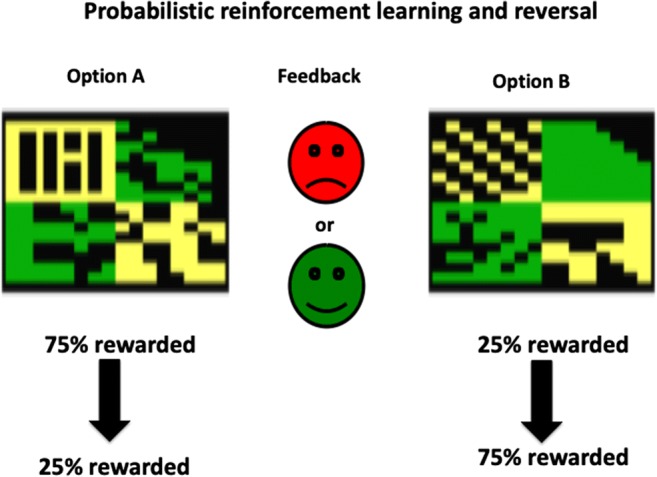
“Computational modelling based on reinforcement learning theory can also be applied to both human and experimental animal performance on the PRL task (Robbins and Cardinal 2019).”
MethodSelf-citationAguirre, C. G., Stolyarova, A., Das, K., Kolli, S., Marty, V. N., Ray, L. A., Spigelman, I., & Izquierdo, A. (2020) · PLoS ONE · doi:10.1371/journal.pone.0234729 · Cited by 24
Individual differences in learning positive affective value
Wuensch, L., Pool, E. R., & Sander, D. (2020) · Current Opinion in Behavioral Sciences · doi:10.1016/j.cobeha.2020.11.001 · Cited by 19
Impaired Learning From Negative Feedback in Stimulant Use Disorder: Dopaminergic Modulation
Lim, T. V., Cardinal, R. N., Bullmore, E. T., Robbins, T. W., & Ersche, K. D. (2021) · The International Journal of Neuropsychopharmacology · doi:10.1093/ijnp/pyab041 · Cited by 20
“Although simple RL models might not perfectly capture all the RL-related cognitive processes, the model parameters can provide sensitive behavioral measures (Heinz et al., 2016; Robbins and Cardinal, 2019).”
BackgroundSelf-citationChronic exposure to glucocorticoids induces suboptimal decision-making in mice
Cabeza, L., Ramadan, B., Giustiniani, J., Houdayer, C., Pellequer, Y., Gabriel, D., Fauconnet, S., Haffen, É., Risold, P., FELLMANN, D., et al. (2021) · European Neuropsychopharmacology · doi:10.1016/j.euroneuro.2021.01.094 · Cited by 19
Theory-driven computational models of drug addiction in humans: Fruitful or futile?
Lim, T. V., & Ersche, K. D. (2023) · Addiction Neuroscience · doi:10.1016/j.addicn.2023.100066 · Cited by 18
Sex Differences and Exogenous Estrogen Influence Learning and Brain Responses to Prediction Errors
Joue, G., Chakroun, K., Bayer, J., Gläscher, J. P., Zhang, L., Fuß, J., Hennies, N., & Sommer, T. (2021) · Cerebral Cortex · doi:10.1093/cercor/bhab334 · Cited by 14
Meccia, J., Lopez, J., & Bagot, R. C. (2022) · Psychopharmacology · doi:10.1007/s00213-022-06297-0 · Cited by 14
“2016; Robbins and Cardinal 2019; Liao and Kwan 2021).”
BackgroundTranslation of Computational Psychiatry in the Context of Addiction
Liu, S., Dolan, R. J., & Heinz, A. (2020) · JAMA Psychiatry · doi:10.1001/jamapsychiatry.2020.1637 · Cited by 12
Barnes, S. A., Dillon, D. G., Young, J. W., Thomas, M. L., Faget, L. C., Yoo, J. H., Der‐Avakian, A., Hnasko, T. S., Geyer, M. A., & Ramanathan, D. (2022) · Cerebral Cortex · doi:10.1093/cercor/bhac459 · Cited by 10
Rutherford, L. G., & Milton, A. L. (2021) · Neuroscience & Biobehavioral Reviews · doi:10.1016/j.neubiorev.2021.104514 · Cited by 10
Olia, J. B. H., Raman, A., Hsu, C., Alkhayyat, A., & Nourazarian, A. (2025) · Computers in Biology and Medicine · doi:10.1016/j.compbiomed.2025.109984 · Cited by 10
Atomoxetine Reduces Decisional Impulsivity in Human Cocaine Addiction
Lim, T. V., Cardinal, R. N., Ziauddeen, H., Regenthal, R., Sahakian, B. J., Robbins, T. W., & Ersche, K. D. (2024) · Biological Psychiatry · doi:10.1016/j.biopsych.2024.10.018 · Cited by 6
Self-citationCommon roles for serotonin in rats and humans for computations underlying flexible decision-makingPreprint
Luo, Q., Kanen, J. W., Bari, A., Skandali, N., Langley, C., Knudsen, G. M., Alsiö, J., Phillips, B. U., Sahakian, B. J., Cardinal, R. N., et al. (2023) · bioRxiv (Cold Spring Harbor Laboratory) · doi:10.1101/2023.02.15.527569 · Cited by 4
Self-citationEditorial: bridging the gap with computational and translational psychopharmacology
Flagel, S. B., Gordon, J. A., & Paulus, M. P. (2019) · Psychopharmacology · doi:10.1007/s00213-019-05320-1 · Cited by 2
“Beyond exploring relationships across levels of analyses, computational models can provide a quantitative approach to formulate distinct behavioral mechanisms (e.g., Robbins and Cardinal 2019, this issue).”
BackgroundAguirre, C. G., Stolyarova, A., Das, K., Kolli, S., Marty, V. N., Ray, L. A., Spigelman, I., & Izquierdo, A. (2020) · bioRxiv (Cold Spring Harbor Laboratory) · doi:10.1101/2020.05.01.071092 · Cited by 2
Kanen, J. W., Luo, Q., Yellowlees, R., Arntz, F. E., Christmas, D. M. B., Sahakian, B. J., Apergis-Schoute, A. M., Cardinal, R. N., & Robbins, T. W. (2021) · bioRxiv (Cold Spring Harbor Laboratory) · doi:10.1101/2021.04.05.437619 · Cited by 2
“A core appeal of PRL is its translational value, amenable to study in rodents, monkeys, and humans both in health and disease (Robbins and Cardinal 2019).”
BackgroundSelf-citationSerotonin reduces belief stickiness
Conceição, V. A., Petzschner, F. H., Cole, D. M., Wellstein, K. V., Müller, D., Raman, S., & Maia, T. V. (2026) · Nature Mental Health · doi:10.1038/s44220-026-00621-9 · Cited by 4
“We used the original formulation 77,79,120 (see ‘S–”
Chase, H. W., Wilson, R. C., & Waltz, J. A. (2022) · Frontiers in Psychiatry · doi:10.3389/fpsyt.2022.966369
“Algorithmic models of reinforcement learning (4) describing behavior in these terms have received extensive support across species and methodologies (5).”
BackgroundStupart, O., Robbins, T. W., & Dalley, J. W. (2022) · Research Square · doi:10.21203/rs.3.rs-1870443/v1
Self-citationThe NIMH Research Domain Criteria Project: Toward Precision Medicine in Psychiatry
Cuthbert, B. N. (2025) · Oxford University Press eBooks · doi:10.1093/med/9780197640654.003.0070
Metadata
- Authors
- Robbins, T. W., & Cardinal, R. N.
- Affiliations
- University of Cambridge (GB)
- Corresponding author
- Robbins, Trevor W.
- Venue
- Psychopharmacology
- Published
- 2019-07-04
- Volume
- 236
- Issue
- 8
- Pages
- 2295-2305
- ISSN
- 0033-3158 (ISSN-L)
- 1432-2072
- PMC
- PMC6695356
- OpenAlex
- W2953994914
- Cited by
- 25
- References
- 66
- Citations by year
- 2026: 1 · 2025: 2 · 2024: 1 · 2023: 4 · 2022: 5 · 2021: 6 · 2020: 5 · 2019: 1
- FWCI
- 0.56
- Type
- journal article
- Language
- en
- Open access
- hybrid
- doi.org
- Licence
- cc-by
- creativecommons.org/licenses/by/4.0 (tdm)
- creativecommons.org/licenses/by/4.0 (vor)
- Locations
- Psychopharmacology (publishedVersion, cc-by)
- PubMed Central (publishedVersion, cc-by)
- PubMed (publishedVersion)
- Apollo (University of Cambridge) (submittedVersion, cc-by)
- Apollo (cc-by)
- Funders
- University of Cambridge
- Topics
- Life Sciences › Neuroscience › Cellular and Molecular Neuroscience › Neurotransmitter Receptor Influence on Behavior
- Life Sciences › Neuroscience › Cognitive Neuroscience › Neural and Behavioral Psychology Studies
- Health Sciences › Medicine › Psychiatry and Mental health › Schizophrenia research and treatment
- Keywords
- computational modelling, dopamine depletion, serotonin depletion, probabilistic learning, reinforcement learning, marmoset monkey, rodent models, translational research, depression, schizophrenia, neuropsychiatric disorders, drug discovery
- MeSH terms
- Animals, Depressive Disorder, Dopamine, Humans, Learning, Psychopharmacology, Reinforcement, Psychology, Schizophrenia, Serotonin, Computational Biology, Translational Research, Biomedical
About these checks
Registry, retraction, Cites and statistics results are computed, not judged, with one exception: a printed reference that no index lists is read once by a model before it counts as a citation error. Claims are extracted by a model and kept only when their quote appears verbatim in the text; each cited source is then checked, with a model’s help, for whether it says what the claim relies on. Those verdicts can be wrong — read the claim’s quote and the cited source before relying on one.
Statistics and arithmetic are recomputed, not judged.
Confidence bands are shown only for fields calibrated on our annotated test set. None is calibrated yet, so no band is shown.
What counts as a claim ›How we measure confidence ›How we check this ›
Are you an author, or do you see a problem with this page? Request a review
Data sources
Bibliographic data: Semantic Scholar, OpenAlex, Crossref.
Contains information from the Semantic Scholar Academic Graph Datasets, made available under the ODC Attribution License (ODC-BY 1.0).
Semantic Scholar’s data is described in: Kinney, R., et al. (2023). The Semantic Scholar Open Data Platform. arXiv:2301.10140.
