

Systems developmental biology: the use of ontologies in annotating models and in identifying gene function within and across species
Open accessThe DOI matches its Crossref record; 21 of the 21 references it cites were found in a registry or an index.
Abstract
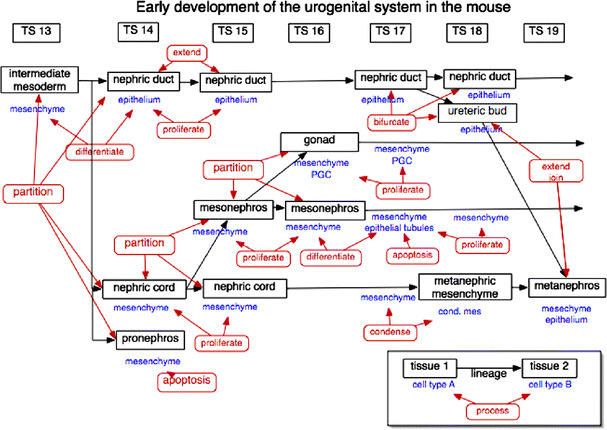
Systems developmental biology is an approach to the study of embryogenesis that attempts to analyze complex developmental processes through integrating the roles of their molecular, cellular, and tissue participants within a computational framework. This article discusses ways of annotating these participants using standard terms and IDs now available in public ontologies (these are areas of hierarchical knowledge formalized to be computationally accessible) for tissues, cells, and processes. Such annotations bring two types of benefit. The first comes from using standard terms: This allows linkage to other resources that use them (e.g., GXD, the gene-expression [G-E] database for mouse development). The second comes from the annotation procedure itself: This can lead to the identification of common processes that are used in very different and apparently unrelated events, even in other organisms. One implication of this is the potential for identifying the genes underpinning common developmental processes in different tissues through Boolean analysis of their G-E profiles. While it is easiest to do this for single organisms, the approach is extendable to analyzing similar processes in different organisms. Although the full computational infrastructure for such an analysis has yet to be put in place, two examples are briefly considered as illustration. First, the early development of the mouse urogenital system shows how a line of development can be graphically formalized using ontologies. Second, Boolean analysis of the G-E profiles of the mesenchyme-to-epithelium transitions that take place during mouse development suggest Lhx1, Foxc1, and Meox1 as candidate transcription factors for mediating this process.
Overview
The claims and statistics of this paper haven’t been checked yet.
Free: it reads the open-access text and checks the first 5 claims that cite a source we can check. Create a free account to check every claim.
Integrity signals
Registry
Cites
Statistics
Figures
Verification
Claims the paper makes
The claims and statistics of this paper haven’t been checked yet.
Free: it reads the open-access text and checks the first 5 claims that cite a source we can check. Create a free account to check every claim.
Self-check
Percentages, sums and reported differences re-computed from the paper’s own numbers.
The self-check needs the paper’s full text.
Citations
Cites
Gene Ontology: tool for the unification of biology
Ashburner, M., Ball, C. A., Blake, J. A., Botstein, D., Butler, H., Cherry, J. M., Davis, A. P., Dolinski, K., Dwight, S. S., Eppig, J. T., et al. (2000) · Nature Genetics · doi:10.1038/75556 · Cited by 43,206
The Gene Ontology (GO) database and informatics resource
Gene Ontology Consortium (2004) · Nucleic Acids Research · doi:10.1093/nar/gkh036 · Cited by 4,579
Waddington, C. H. (2014) · doi:10.4324/9781315765471 · Cited by 2,153
WormBase: a multi-species resource for nematode biology and genomics
Harris, T. W. (2004) · Nucleic Acids Research · doi:10.1093/nar/gkh066 · Cited by 715
The Evolution of an Evolutionist
(1977) · Journal of Human Evolution · doi:10.1016/s0047-2484(77)80015-8 · Cited by 616
Bard, J., Rhee, S. Y., & Ashburner, M. (2005) · Genome biology · doi:10.1186/gb-2005-6-2-r21 · Cited by 416 · cited 2×
“The first is the CellType Ontology (Bard et al. 2005) and the second is the Gene Ontology (Ashburner et al.”
BackgroundSelf-citationWaddington, C. H. (1940) · Cambridge University Press eBooks · Cited by 410
The anatomical basis of mouse development
Kaufman, M. H., & Bard, J. (1999) · Medical Entomology and Zoology · Cited by 366
Self-citation(2006) · ZOOLOGICAL SCIENCE · doi:10.2108/zsj.23.1168 · Cited by 294
From Epigenesis to Epigenetics: The Case of C. H. Waddington
Van Speybroeck, L. (2002) · Annals of the New York Academy of Sciences · doi:10.1111/j.1749-6632.2002.tb04912.x · Cited by 260
Cited by
The GUDMAP database – an online resource for genitourinary research
Harding, S. D., Armit, C., Armstrong, J., Brennan, J., Cheng, Y., Haggarty, B., Houghton, D., Lloyd-MacGilp, S., Pi, X., Roochun, Y., et al. (2011) · Development · doi:10.1242/dev.063594 · Cited by 250
Aite, M., Chevallier, M., Frioux, C., Trottier, C., Got, J., Cortés, M. P., Mendoza, S. N., Carrier, G., Dameron, O., Guillaudeux, N., et al. (2018) · PLOS Computational Biology · doi:10.1371/journal.pcbi.1006146 · Cited by 137
“Finally, all the information contained in the model can be exported in a RDF database to be explored using recent computational techniques such as semantic query languages [49–52].”
European Centre for Ecotoxicology and Toxicology of Chemicals
Carmichael, N. G. (2014) · Elsevier eBooks · doi:10.1016/b978-0-12-386454-3.00505-4 · Cited by 123
The Functional Annotation of Mammalian Genomes: The Challenge of Phenotyping
Brown, S. D. M., Wurst, W., Kühn, R., & Hancock, J. M. (2009) · Annual Review of Genetics · doi:10.1146/annurev-genet-102108-134143 · Cited by 66
Multiscale Modeling and Data Integration in the Virtual Physiological Rat Project
Beard, D. A., Neal, M. L., Tabesh-Saleki, N., Thompson, C. T., Bassingtwaighte, J. B., Shimoyama, M., & Carlson, B. E. (2012) · Annals of Biomedical Engineering · doi:10.1007/s10439-012-0611-7 · Cited by 49
Building a developmental toxicity ontology
Baker, N., Boobis, A. R., Burgoon, L. D., Carney, E. W., Currie, R. A., Fritsche, E., Knudsen, T. B., Laffont, M., Piersma, A. H., Poole, A., et al. (2018) · Birth Defects Research · doi:10.1002/bdr2.1189 · Cited by 35
Kobeissy, F. H., Guingab-Cagmat, J. D., Razafsha, M., O'Steen, L. E., Zhang, Z., Hayes, R. L., Chiu, W., & Wang, K. (2011) · PM&R · doi:10.1016/j.pmrj.2011.02.012 · Cited by 30
A systems biology view of evolutionary genetics
Bard, J. (2010) · BioEssays · doi:10.1002/bies.200900166 · Cited by 18
Self-citationBard, J., Lam, M. S., & Aitken, S. (2008) · Developmental Dynamics · doi:10.1002/dvdy.21652 · Cited by 17
Self-citationOrganizing phenotypic data—a semantic data model for anatomy
Vogt, L. (2019) · Journal of Biomedical Semantics · doi:10.1186/s13326-019-0204-6 · Cited by 14
Pandya, M., Liu, H., Dangaria, S. J., Zhu, W., Li, L. L., Pan, S., Abufarwa, M., Davis, R. G., Guggenheim, S., Keiderling, T. A., et al. (2017) · Frontiers in Physiology · doi:10.3389/fphys.2017.00793 · Cited by 13
Jaber, Z., Aouad, P., Medawar, M. A., Bahmad, H. F., Abou‐Abbass, H., & Kobeissy, F. H. (2016) · Methods in molecular biology · doi:10.1007/978-1-4939-3816-2_9 · Cited by 7
Singh, A. V., Kavlock, R. J., Richard, A. M., & Yang, C. (2010) · Elsevier eBooks · doi:10.1016/b978-0-08-046884-6.01529-3 · Cited by 2
Ontology views for collaborative ontology creation: The BioSphere Portal
Aitken, S., & Bard, J. (2008) · Cited by 1
Self-citationFundamentals and History of Informatics for Genomic and Personalized Medicine
Cuticchia, A. J. (2009) · Elsevier eBooks · doi:10.1016/b978-0-12-369420-1.00018-4
FAIRsharing record for: GenitoUrinary Development Molecular Anatomy Project
FAIRsharing Team, & Pearlman, L. (2022) · FAIRsharing.org · doi:10.25504/fairsharing.910c39
Metadata
- Authors
- Bard, J.
- Affiliations
- University of Edinburgh (GB)
- Corresponding author
- Bard, Jonathan
- ORCID
- Bard, Jonathan
- Venue
- Mammalian Genome
- Published
- 2007-07
- Volume
- 18
- Issue
- 6-7
- Pages
- 402-411
- ISSN
- 0938-8990 (ISSN-L)
- 1432-1777
- PMC
- PMC1998887
- OpenAlex
- W2105678406
- Cited by
- 15
- References
- 21
- Citations by year
- 2019: 1 · 2018: 2 · 2017: 1 · 2016: 1 · 2014: 1 · 2012: 1
- FWCI
- 0.79
- Type
- journal article
- Language
- en
- Open access
- hybrid
- doi.org
- Licence
- cc-by-nc
- creativecommons.org/licenses/by-nc/2.0 (tdm)
- creativecommons.org/licenses/by-nc/2.0 (vor)
- Locations
- Mammalian Genome (publishedVersion, cc-by-nc)
- Europe PMC (PubMed Central) (publishedVersion, cc-by-nc)
- PubMed Central (publishedVersion, cc-by-nc)
- PubMed (publishedVersion)
- Edinburgh Research Explorer (University of Edinburgh) (submittedVersion, other-oa)
- Topics
- Health Sciences › Medicine › Health Informatics › Biomedical Text Mining and Ontologies
- Life Sciences › Biochemistry, Genetics and Molecular Biology › Molecular Biology › Developmental Biology and Gene Regulation
- Life Sciences › Biochemistry, Genetics and Molecular Biology › Molecular Biology › Bioinformatics and Genomic Networks
- Keywords
- ontology (information science), gene expression database, gene function annotation, Boolean analysis, gene expression profiles, Lhx1, FOXC1, MEOX1, transcription factors, embryonic development
- MeSH terms
- Animals, Humans, Models, Biological, Models, Genetic, Species Specificity, Developmental Biology, Databases, Genetic, Growth and Development, Systems Biology, Genetic Speciation, Genes, Developmental
About these checks
Registry, retraction, Cites and statistics results are computed, not judged, with one exception: a printed reference that no index lists is read once by a model before it counts as a citation error. Claims are extracted by a model and kept only when their quote appears verbatim in the text; each cited source is then checked, with a model’s help, for whether it says what the claim relies on. Those verdicts can be wrong — read the claim’s quote and the cited source before relying on one.
Statistics and arithmetic are recomputed, not judged.
Confidence bands are shown only for fields calibrated on our annotated test set. None is calibrated yet, so no band is shown.
What counts as a claim ›How we measure confidence ›How we check this ›
Are you an author, or do you see a problem with this page? Request a review
Data sources
Bibliographic data: Semantic Scholar, OpenAlex, Crossref.
Contains information from the Semantic Scholar Academic Graph Datasets, made available under the ODC Attribution License (ODC-BY 1.0).
Semantic Scholar’s data is described in: Kinney, R., et al. (2023). The Semantic Scholar Open Data Platform. arXiv:2301.10140.
