

The DOI matches its Crossref record; 46 of the 46 references it cites were found in a registry or an index.
Tau seeding activity begins in the transentorhinal/entorhinal regions and anticipates phospho-tau pathology in Alzheimer’s disease and PART
Open accessPublished version of a preprint
Abstract
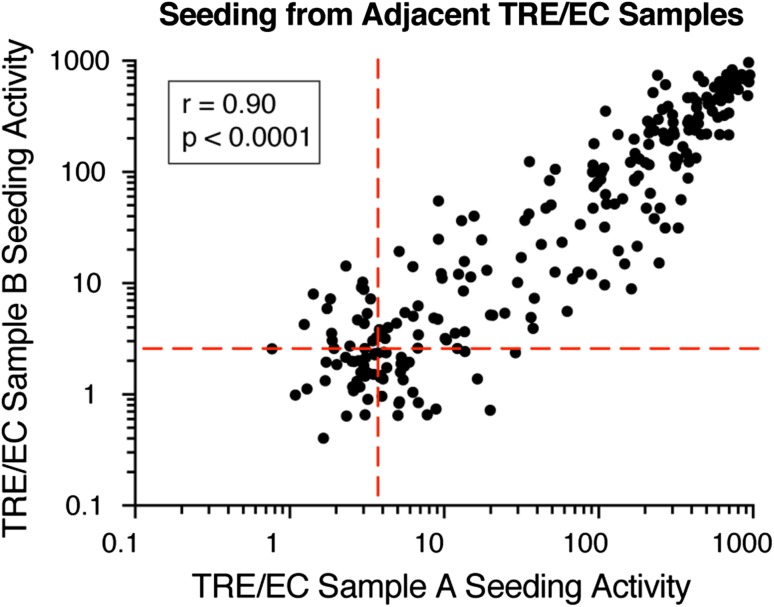
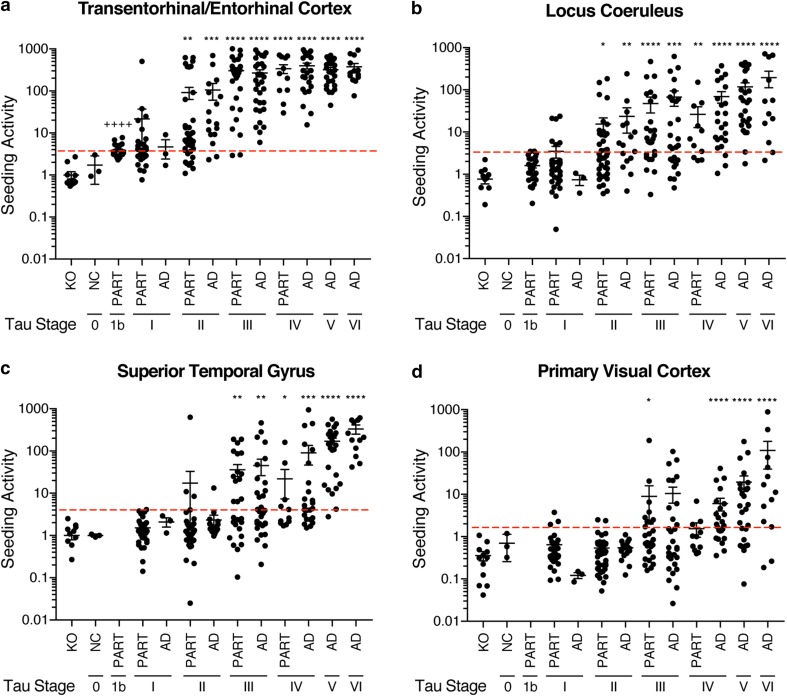
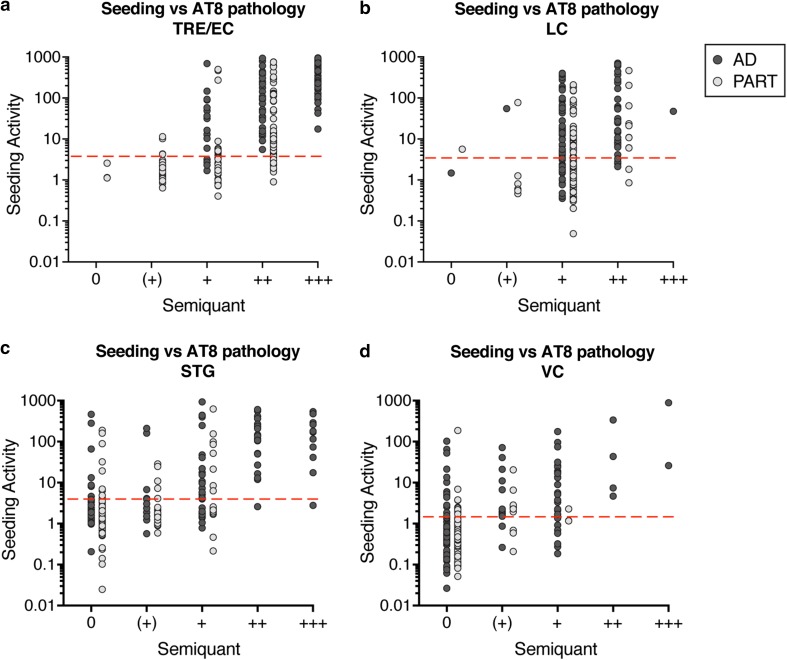
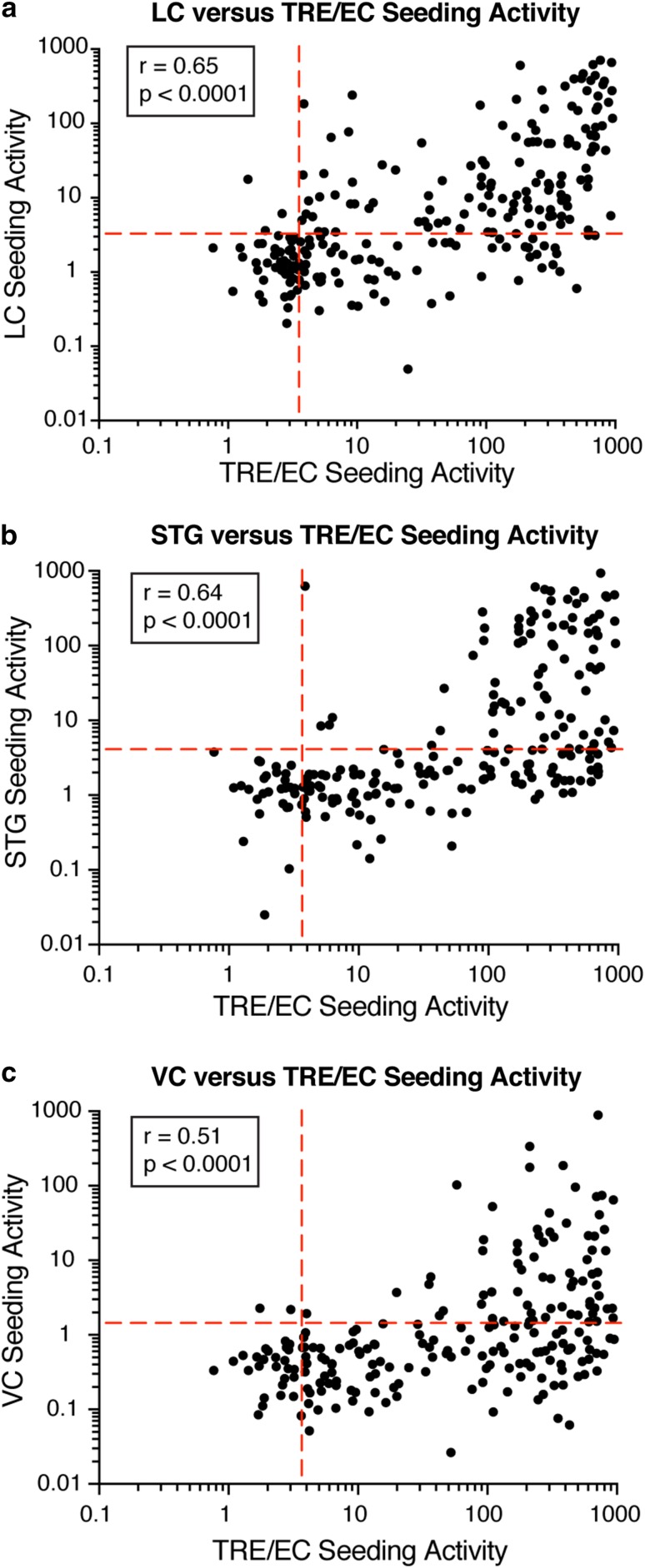
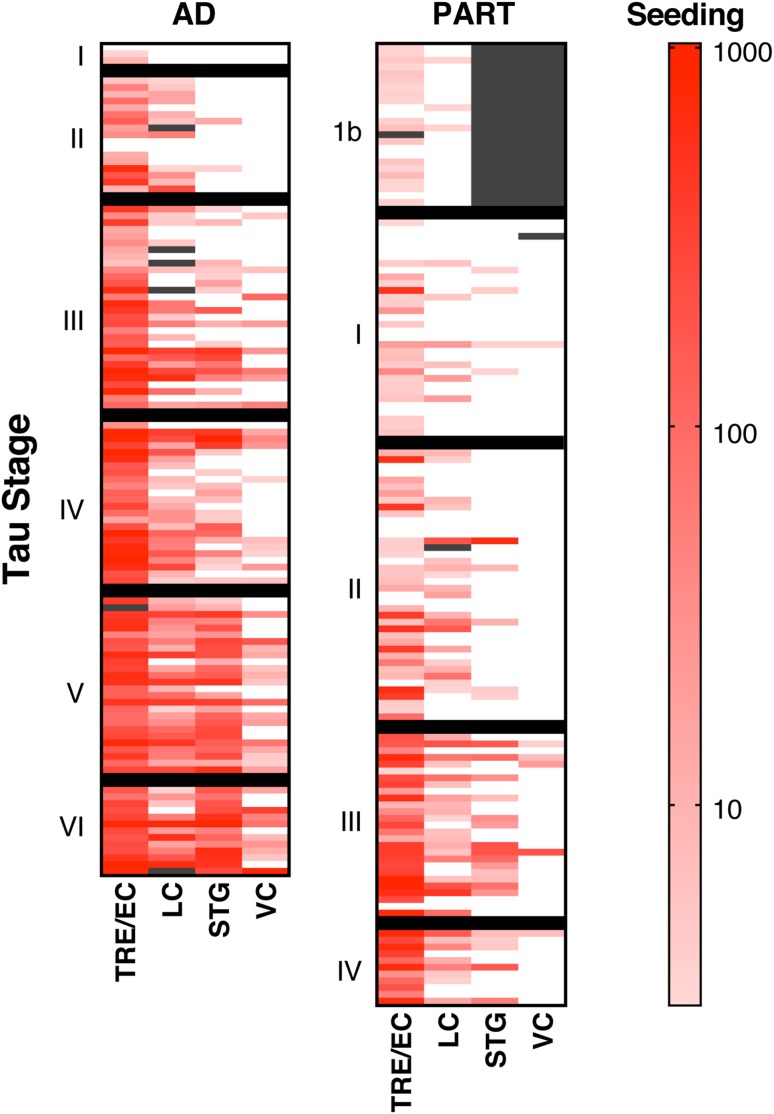
Alzheimer's disease (AD) is characterized by accumulation of tau neurofibrillary tangles (NFTs) and, according to the prion model, transcellular propagation of pathological "seeds" may underlie its progression. Staging of NFT pathology with phospho-tau antibody is useful to classify AD and primary age-related tauopathy (PART) cases. The locus coeruleus (LC) shows the earliest phospho-tau signal, whereas other studies suggest that pathology begins in the transentorhinal/entorhinal cortices (TRE/EC). The relationship of tau seeding activity, phospho-tau pathology, and progression of neurodegeneration remains obscure. Consequently, we employed an established cellular biosensor assay to quantify tau seeding activity in fixed human tissue, in parallel with AT8 phospho-tau staining of immediately adjacent sections. We studied four brain regions from each of n = 247 individuals across a range of disease stages. We detected the earliest and most robust seeding activity in the TRE/EC. The LC did not uniformly exhibit seeding activity until later NFT stages. We also detected seeding activity in the superior temporal gyrus (STG) and primary visual cortex (VC) at stages before NFTs and/or AT8-immunopositivity were detectable. AD and putative PART cases exhibited similar patterns of seeding activity that anticipated histopathology across all NFT stages. Our findings are consistent with the prion model and suggest that pathological seeding activity begins in the TRE/EC rather than in the LC. In the analysis of tauopathy, quantification of seeding activity may offer an important addition to classical histopathology.
Overview
The claims and statistics of this paper haven’t been checked yet.
Run the check — free, no account needed. It reads the open-access text and checks the sources it cites.
Integrity signals
Registry
Cites
Statistics
Figures
Verification
Claims the paper makes
The claims and statistics of this paper haven’t been checked yet.
Run the check — free, no account needed. It reads the open-access text and checks the sources it cites.
Claims other papers make about this one
Each is checked against this paper’s own text: does it say what the citing paper says it does?
The cited source says what the claim attributes to it.
In the citing paper
“Several studies have shown that seeding precedes tau pathogenesis and can even occur in brain regions where tau pathology does not usually present (DeVos et al., 2018; Kaufman et al., 2018; Stopschinski et al., 2021).”
From Network analysis identifies strain-dependent response to tau and tau seeding-associated genes (2023) · cites this paper as Kaufman et al., 2018
Self-check
Percentages, sums and reported differences re-computed from the paper’s own numbers.
The self-check needs the paper’s full text.
Citations
Cites
Neuropathological stageing of Alzheimer-related changes.
Braak, H., & Braak, E. (1991) · Acta Neuropathologica · doi:10.1007/bf00308809 · Cited by 16,123 · cited 2×
“This tau pathology has a characteristic regional pattern of progression, thereby permitting the distinction of different stages in asymptomatic and symptomatic individuals [4, 8].”
BackgroundSelf-citationStaging of brain pathology related to sporadic Parkinson’s disease
Braak, H., Tredici, K. D., Rüb, U., de Vos, R. A. I., Jansen Steur, E. N. H., & Braak, E. (2003) · Neurobiology of Aging · doi:10.1016/s0197-4580(02)00065-9 · Cited by 10,777
Self-citationAmyloid oligomers exacerbate tau pathology in a mouse model of tauopathy
Selenica, M.-L. B., Brownlow, M., Jimenez, J. P., Lee, D. C., Pena, G., Dickey, C. A., Gordon, M. N., & Morgan, D. (2013) · Neurodegenerative Diseases · doi:10.1159/000337230 · Cited by 10,359
Phases of Aβ-deposition in the human brain and its relevance for the development of AD
Thal, D. R., Rüb, U., Orantes, M., & Braak, H. (2002) · Neurology · doi:10.1212/wnl.58.12.1791 · Cited by 3,490
Self-citationBraak, H., Alafuzoff, I., Arzberger, T., Kretzschmar, H., & Del Tredici, K. (2006) · Acta Neuropathologica · doi:10.1007/s00401-006-0127-z · Cited by 3,172
Self-citationHyman, B. T., Phelps, C. H., Beach, T. G., Bigio, E. H., Cairns, N. J., Carrillo, M. C., Dickson, D. W., Duyckaerts, C., Frosch, M. P., Masliah, E., et al. (2012) · Alzheimer's & Dementia · doi:10.1016/j.jalz.2011.10.007 · Cited by 3,092
Lee, V. M.-Y., Goedert, M., & Trojanowski, J. Q. (2001) · Annual Review of Neuroscience · doi:10.1146/annurev.neuro.24.1.1121 · Cited by 2,480
Staging of alzheimer's disease-related neurofibrillary changes
Braak, H., & Braak, E. (1995) · Neurobiology of Aging · doi:10.1016/0197-4580(95)00021-6 · Cited by 2,357
Self-citationPan, K. M., Baldwin, M. A., Nguyen, J. T., Gasset, M., Serban, A. V., Groth, D., Mehlhorn, I., Huang, Z., Fletterick, R. J., & Cohen, F. E. (1993) · Proceedings of the National Academy of Sciences · doi:10.1073/pnas.90.23.10962 · Cited by 2,281
Stages of the Pathologic Process in Alzheimer Disease: Age Categories From 1 to 100 Years
Braak, H., Thal, D. R., Ghebremedhin, E., & Del Tredici, K. (2011) · Journal of Neuropathology & Experimental Neurology · doi:10.1097/nen.0b013e318232a379 · Cited by 2,194
Self-citation
Cited by
Sorted by citations
Protein transmission in neurodegenerative disease
Peng, C., Trojanowski, J. Q., & Lee, V. M.-Y. (2020) · Nature Reviews Neurology · doi:10.1038/s41582-020-0333-7 · Cited by 625
Propagation and spread of pathogenic protein assemblies in neurodegenerative diseases
Jucker, M., & Walker, L. C. (2018) · Nature Neuroscience · doi:10.1038/s41593-018-0238-6 · Cited by 450
Stancu, I.-C., Cremers, N., Vanrusselt, H., Couturier, J., Vanoosthuyse, A., Kessels, S., Lodder, C., Brône, B., Huaux, F., Octave, J.-N., et al. (2019) · Acta Neuropathologica · doi:10.1007/s00401-018-01957-y · Cited by 447
Hypothesis: Tau pathology is an initiating factor in sporadic Alzheimer's disease
Arnsten, A. F. T., Datta, D., Del Tredici, K., & Braak, H. (2021) · Alzheimer's & Dementia · doi:10.1002/alz.12192 · Cited by 361
Self-citationFunctional brain architecture is associated with the rate of tau accumulation in Alzheimer’s disease
Franzmeier, N., Neitzel, J., Rubinski, A., Smith, R. A., Strandberg, O. T., Ossenkoppele, R., Hansson, O., Ewers, M., Initiative, A. D. N., Weiner, M. W., et al. (2020) · Nature Communications · doi:10.1038/s41467-019-14159-1 · Cited by 358
Metadata
- Authors
- Kaufman, S. K., Del Tredici, K., Thomas, T. L., Braak, H., & Diamond, M. I.
- Affiliations
- Washington University in St. Louis (US)
- The University of Texas Southwestern Medical Center (US)
- Universität Ulm (DE)
- Corresponding author
- Diamond, Marc I.
- Venue
- Acta Neuropathologica
- Published
- 2018-05-11
- Volume
- 136
- Issue
- 1
- Pages
- 57-67
- ISSN
- 0001-6322 (ISSN-L)
- 1432-0533
- PMC
- PMC6015098
- OpenAlex
- W2799729840
- Cited by
- 259
- References
- 46
- Citations by year
- 2026: 15 · 2025: 40 · 2024: 30 · 2023: 41 · 2022: 19 · 2021: 43 · 2020: 28 · 2019: 32 · 2018: 10
- FWCI
- 19.42
- Type
- journal article
- Language
- en
- Open access
- hybrid
- doi.org
- Locations
- Acta Neuropathologica (publishedVersion, cc-by)
- bioRxiv (Cold Spring Harbor Laboratory) (acceptedVersion, cc-by-nc-nd)
- Europe PMC (PubMed Central) (publishedVersion, cc-by)
- PubMed Central (publishedVersion, cc-by)
- PubMed (publishedVersion)
- Funders
- Rainwater Charitable Foundation (n/a)
- National Institute on Aging (R01AG048678)
- Topics
- Life Sciences › Neuroscience › Cellular and Molecular Neuroscience › Alzheimer's disease research and treatments
- Health Sciences › Medicine › Psychiatry and Mental health › Dementia and Cognitive Impairment Research
- Life Sciences › Neuroscience › Neurology › Neuroinflammation and Neurodegeneration Mechanisms
- Keywords
- Alzheimer's disease, primary age-related tauopathy, locus coeruleus, neurofibrillary tangles, AT8 antibody, superior temporal gyrus, primary visual cortex, disease staging
- MeSH terms
- Adolescent, Adult, Aged, Aged, 80 and over, Alzheimer Disease, Animals, Female, Gene Expression Regulation, Humans, Locus Coeruleus, Male, Mice, Inbred C57BL, Microfilament Proteins, Middle Aged, Phosphorylation, Temporal Lobe, Visual Cortex, Neurofibrillary Tangles, tau Proteins, Mice, Knockout, Disease Progression, Entorhinal Cortex, Tauopathies, Mice, Young Adult, HEK293 Cells
About these checks
Registry, retraction, Cites and statistics results are computed, not judged, with one exception: a printed reference that no index lists is read once by a model before it counts as a citation error. Claims are extracted by a model and kept only when their quote appears verbatim in the text; each cited source is then checked, with a model’s help, for whether it says what the claim relies on. Those verdicts can be wrong — read the claim’s quote and the cited source before relying on one.
Statistics and arithmetic are recomputed, not judged.
Confidence bands are shown only for fields calibrated on our annotated test set. None is calibrated yet, so no band is shown.
What counts as a claim ›How we measure confidence ›How we check this ›
Are you an author, or do you see a problem with this page? Request a review
