

Low inter-examiner agreement of the Friedman staging system indicating limited value in patient selection
Open accessThe DOI matches its Crossref record; 15 of the 15 references it cites were found in a registry or an index.
Abstract
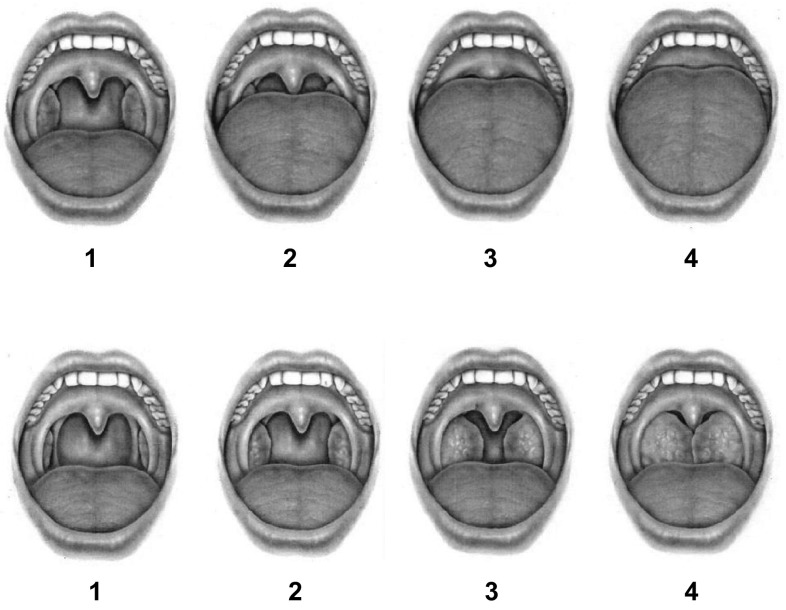
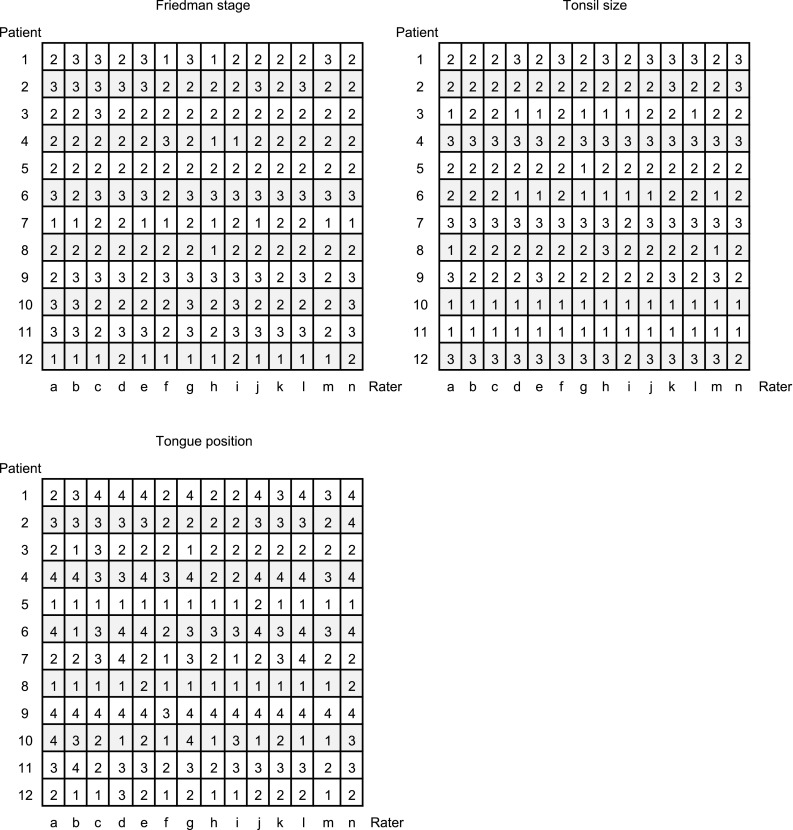
PURPOSE: The Friedman staging system is a clinical method for selecting patients with obstructive sleep apnoea who are likely to benefit from uvulopalatopharyngoplasty. The objective of this study was to evaluate the system by determining its inter-examiner agreement. METHODS: Twelve patients with obstructive sleep apnoea were examined by 14 doctors. The Friedman stage was derived from tonsil size and tongue position, and a Cohen's kappa analysis was performed to assess inter-examiner agreement. RESULTS: One hundred and sixty-eight ratings were performed. The median kappa for tongue position was 0.32 (first and third quartiles: 0.21 and 0.44) and was 0.62 (0.50 and 0.63) for tonsil size. The median kappa for the Friedman stage was 0.38 (0.24 and 0.55), which corresponds to only a slight or fair agreement. CONCLUSION: The Friedman staging system demonstrated a low inter-examiner agreement, indicating that the system is an uncertain method for selecting patients for uvulopalatopharyngoplasty. LEVEL OF EVIDENCE: 2B.
Overview
The claims and statistics of this paper haven’t been checked yet.
Free: it reads the open-access text and checks the first 5 claims that cite a source we can check. Create a free account to check every claim.
Integrity signals
Registry
Cites
Statistics
Figures
Verification
Claims the paper makes
The claims and statistics of this paper haven’t been checked yet.
Free: it reads the open-access text and checks the first 5 claims that cite a source we can check. Create a free account to check every claim.
Claims other papers make about this one
Each is checked against this paper’s own text: does it say what the citing paper says it does?
The cited source says what the claim attributes to it.
In the citing paper
“FTP and AHI are positively correlated with higher FTP grade associated with higher AHI547,552,553; however, low inter-examiner agreement in FTP scoring has been suggested.554”
From International Consensus Statement on Obstructive Sleep Apnea (2023) · cites this paper as [554]
Self-check
Percentages, sums and reported differences re-computed from the paper’s own numbers.
The self-check needs the paper’s full text.
Citations
Cites
R: A Language and Environment for Statistical Computing
R Core Team (2025) · doi:10.32614/r.manuals · Cited by 352,181
Practical Statistics for Medical Research.
Walter, S. D., & Altman, D. G. (1992) · Biometrics · doi:10.2307/2532320 · Cited by 11,668 · cited 1×
“36, which corresponded to only a slight [8] or fair [9] agreement.”
BackgroundClinical Staging for Sleep‐Disordered Breathing
Friedman, M., Ibrahim, H., & Bass, L. (2002) · Otolaryngology–Head and Neck Surgery · doi:10.1067/mhn.2002.126477 · Cited by 534
Byrt, T. (1996) · Epidemiology · doi:10.1097/00001648-199609000-00030 · Cited by 390
Vanderveken, O. M., Maurer, J. T., Hohenhorst, W., Hamans, E., Lin, H.-S., Vroegop, A. V., Anders, C., de Vries, N., & Van de Heyning, P. H. (2013) · Journal of Clinical Sleep Medicine · doi:10.5664/jcsm.2658 · Cited by 339 · cited 1×
“For example, druginduced sleep endoscopy has so far failed to show robust evidence for predicting pharyngo-surgical outcome [13, 14], although positive reports have shown its potential in the selection of patients before upper airway nerve stimulation [15].”
BackgroundAwake examination versus DISE for surgical decision making in patients with OSA: A systematic review
Certal, V. F., Pratas, R., Guimarães, L., Lugo, R., Tsou, Y., Camacho, M., & Capasso, R. (2016) · The Laryngoscope · doi:10.1002/lary.25722 · Cited by 142 · cited 1×
“For example, druginduced sleep endoscopy has so far failed to show robust evidence for predicting pharyngo-surgical outcome [13, 14], although positive reports have shown its potential in the selection of patients before upper airway nerve stimulation [15].”
BackgroundBrowaldh, N., Nerfeldt, P., Lysdahl, M., Bring, J., & Friberg, D. (2013) · Thorax · doi:10.1136/thoraxjnl-2012-202610 · Cited by 119 · cited 1×
“We also used it as an inclusion criterion in our randomizedcontrolled study SKUP3 from 2013, evaluating data from polysomnography after modified UPPP in 65 patients [3].”
MethodSelf-citationUpdated Friedman Staging System for Obstructive Sleep Apnea
Friedman, M., Salapatas, A. M., & Bonzelaar, L. B. (2017) · Advances in Oto-Rhino-Laryngology · doi:10.1159/000470859 · Cited by 118 · cited 1×
“In the original description of how the Friedman staging is performed, as well as in the 2017 update [12], it is not specified whether the patient should breathe or not, nor whether to breathe through the nose or mouth.”
MethodLi, H.-Y., Wang, P.-C., Lee, L.-A., Chen, N.-H., & Fang, T.-J. (2006) · Sleep · doi:10.1093/sleep/29.12.1537 · Cited by 112
Huntley, C. T., Chou, D. W., Doghramji, K., & Boon, M. S. (2017) · Annals of Otology Rhinology & Laryngology · doi:10.1177/0003489417703408 · Cited by 71 · cited 1×
“For example, druginduced sleep endoscopy has so far failed to show robust evidence for predicting pharyngo-surgical outcome [13, 14], although positive reports have shown its potential in the selection of patients before upper airway nerve stimulation [15].”
BackgroundThe soft palate and breathing.
Rodenstein, D. O., & Stănescu, D. C. (1986) · PubMed · doi:10.1164/arrd.1986.134.2.311 · Cited by 56 · cited 1×
“[11], and easily observable during oral examination, the positions of the soft palate and tongue vary depending on whether the patient breathes through their nose or their mouth.”
BackgroundFriedman, M., Soans, R., Gurpinar, B., Lin, H., & Joseph, N. J. (2008) · Otolaryngology–Head and Neck Surgery · doi:10.1016/j.otohns.2008.06.017 · Cited by 40 · cited 2×
“93 using video clips of oropharyngeal examination [5, 6].”
BackgroundMethodSKUP3: 6 and 24 months follow‐up of changes in respiration and sleepiness after modified UPPP
Browaldh, N., Bring, J., & Friberg, D. (2017) · The Laryngoscope · doi:10.1002/lary.26835 · Cited by 26 · cited 1×
“However, a recent study of success factors from all operated patients in SKUP3 showed that tonsil size and not Friedman stage was a predictor of success after 6 months [4], indicating that the method might be less accurate than previously expected.”
ResultSelf-citationFriedman tongue position: Age distribution and relationship to sleep-disordered breathing
Ingram, D. G., Ruiz, A. G., & Friedman, N. R. (2015) · International Journal of Pediatric Otorhinolaryngology · doi:10.1016/j.ijporl.2015.02.011 · Cited by 10
Poor interexaminer agreement on Friedman tongue position
Sundman, J., Bring, J., & Friberg, D. (2016) · Acta Oto-Laryngologica · doi:10.1080/00016489.2016.1255776 · Cited by 7
Self-citation
Cited by
International Consensus Statement on Obstructive Sleep Apnea
Chang, J. L., Goldberg, A. N., Alt, J. A., Mohammed, A., Ashbrook, L., Auckley, D., Ayappa, I., Bakhtiar, H., Barrera, J. E., Bartley, B. L., et al. (2023) · International Forum of Allergy & Rhinology · doi:10.1002/alr.23079 · Cited by 350
Yu, J. L., & Rosen, I. (2020) · Journal of Clinical Sleep Medicine · doi:10.5664/jcsm.8188 · Cited by 63
“32.(25) They concluded that FTP findings varied widely among examiners, making it an unreliable physical examination finding.”
BackgroundWang, H., Xu, W. H., Zhao, A., Sun, D., Li, Y., & Han, D. (2023) · Nature and Science of Sleep · doi:10.2147/nss.s400745 · Cited by 14
“However, FTP is not commonly used as a method of airway assessment in children, which may be related to poor cooperation in children and low inter-examiner agreement.(26) Our study also confirmed that there was no significant difference in FTP scores between the groups of children.”
MethodPérez‐Martín, N., Bosco, G., Navarro, A., Morato, M., Racionero, M. A., Fernández-Sanjuán, P., O’Connor-Reina, C., & Plaza, G. (2021) · Journal of Craniofacial Surgery · doi:10.1097/scs.0000000000008421 · Cited by 6
Nair, L. S. R., George, S., Anandaraj, S., Anuja, S., Naveena, T., & Aishwarya, U. (2024) · Journal of Indian Society of Pedodontics and Preventive Dentistry · doi:10.4103/jisppd.jisppd_85_24 · Cited by 7
Metadata
- Authors
- Sundman, J., Fehrm, J., & Friberg, D.
- Affiliations
- Karolinska University Hospital (SE)
- Uppsala University (SE)
- Corresponding author
- Sundman, Joar
- Venue
- European Archives of Oto-Rhino-Laryngology
- Published
- 2018-04-16
- Volume
- 275
- Issue
- 6
- Pages
- 1541-1545
- ISSN
- 0937-4477 (ISSN-L)
- 1434-4726
- PMC
- PMC5951900
- OpenAlex
- W2799676845
- Semantic Scholar
- fdb92d39447c1f2be5ed5679ca116774e497514f
- Cited by
- 11
- References
- 15
- Citations by year
- 2025: 1 · 2024: 3 · 2023: 3 · 2022: 1 · 2021: 1 · 2020: 2
- FWCI
- 0.52
- Type
- journal article
- Language
- en
- Open access
- hybrid
- doi.org
- Licence
- cc-by
- creativecommons.org/licenses/by/4.0 (tdm)
- Locations
- European Archives of Oto-Rhino-Laryngology (publishedVersion, cc-by)
- Europe PMC (PubMed Central) (publishedVersion, other-oa)
- PubMed Central (publishedVersion, cc-by)
- PubMed (publishedVersion)
- Uppsala University Publications (Uppsala University) (submittedVersion, other-oa)
- Topics
- Health Sciences › Medicine › Physiology (medical) › Obstructive Sleep Apnea Research
- Social Sciences › Decision Sciences › Statistics, Probability and Uncertainty › Reliability and Agreement in Measurement
- Health Sciences › Dentistry › Oral Surgery › Temporomandibular Joint Disorders
- Keywords
- obstructive sleep apnea, uvulopalatopharyngoplasty, inter-examiner agreement, patient selection, tonsil size, tongue position, surgical staging
- MeSH terms
- Adult, Aged, Female, Humans, Male, Middle Aged, Palate, Pharynx, Severity of Illness Index, Tongue, Reproducibility of Results, Observer Variation, Patient Selection, Plastic Surgery Procedures, Sleep Apnea, Obstructive
About these checks
Registry, retraction, Cites and statistics results are computed, not judged, with one exception: a printed reference that no index lists is read once by a model before it counts as a citation error. Claims are extracted by a model and kept only when their quote appears verbatim in the text; each cited source is then checked, with a model’s help, for whether it says what the claim relies on. Those verdicts can be wrong — read the claim’s quote and the cited source before relying on one.
Statistics and arithmetic are recomputed, not judged.
Confidence bands are shown only for fields calibrated on our annotated test set. None is calibrated yet, so no band is shown.
What counts as a claim ›How we measure confidence ›How we check this ›
Are you an author, or do you see a problem with this page? Request a review
Data sources
Bibliographic data: Semantic Scholar, OpenAlex, Crossref.
Contains information from the Semantic Scholar Academic Graph Datasets, made available under the ODC Attribution License (ODC-BY 1.0).
Semantic Scholar’s data is described in: Kinney, R., et al. (2023). The Semantic Scholar Open Data Platform. arXiv:2301.10140.
