

The DOI matches its Crossref record; 69 of the 70 references it cites were found in a registry or an index.
Doubly labelled water assessment of energy expenditure: principle, practice, and promise.
Open accessAbstract
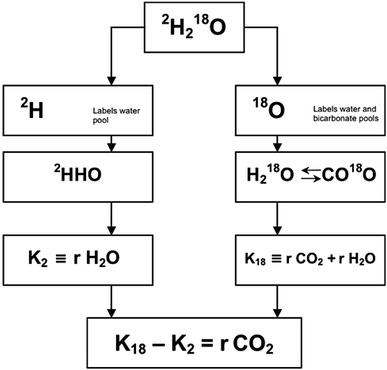
Abstract The doubly labelled water method for the assessment of energy expenditure was first published in 1955, application in humans started in 1982, and it has become the gold standard for human energy requirement under daily living conditions. The method involves enriching the body water of a subject with heavy hydrogen ( 2 H) and heavy oxygen ( 18 O), and then determining the difference in washout kinetics between both isotopes, being a function of carbon dioxide production. In practice, subjects get a measured amount of doubly labelled water ( 2 H 2 18 O) to increase background enrichment of body water for 18 O of 2000 ppm with at least 180 ppm and background enrichment of body water for 2 H of 150 ppm with 120 ppm. Subsequently, the difference between the apparent turnover rates of the hydrogen and oxygen of body water is assessed from blood-, saliva-, or urine samples, collected at the start and end of the observation interval of 1–3 weeks. Samples are analyzed for 18 O and 2 H with isotope ratio mass spectrometry. The doubly labelled water method is the indicated method to measure energy expenditure in any environment, especially with regard to activity energy expenditure, without interference with the behavior of the subjects. Applications include the assessment of energy requirement from total energy expenditure, validation of dietary assessment methods and validation of physical activity assessment methods with doubly labelled water measured energy expenditure as reference, and studies on body mass regulation with energy expenditure as a determinant of energy balance.
Overview
The claims and statistics of this paper haven’t been checked yet.
Run the check — free, no account needed. It reads the open-access text and checks the sources it cites.
Integrity signals
Registry
Cites
Statistics
Figures
Verification
Claims the paper makes
The claims and statistics of this paper haven’t been checked yet.
Run the check — free, no account needed. It reads the open-access text and checks the sources it cites.
Claims other papers make about this one
Each is checked against this paper’s own text: does it say what the citing paper says it does?
The cited source says what the claim attributes to it.
In the citing paper
“Total daily energy expenditure (TDEE) is the total amount of energy used in a day and is measured using the doubly labeled water (DLW) method (Westerterp, 2017).”
From Effect of Exercise Training on Fat Loss—Energetic Perspectives and the Role of Improved Adipose Tissue Function and Body Fat Distribution (2021) · cites this paper as Westerterp, 2017
The cited source says what the claim attributes to it.
In the citing paper
“The gold standard for measuring total energy expenditure is the DLW method (Westerterp, 2017).”
From Effect of Exercise Training on Fat Loss—Energetic Perspectives and the Role of Improved Adipose Tissue Function and Body Fat Distribution (2021) · cites this paper as Westerterp, 2017
Self-check
Percentages, sums and reported differences re-computed from the paper’s own numbers.
The self-check needs the paper’s full text.
Citations
Cites
‘Small Changes' to Diet and Physical Activity Behaviors for Weight Management
Hills, A. P., Byrne, N. M., Lindstrom, R. C., & Hill, J. O. (2013) · Obesity Facts · doi:10.1159/000345030 · Cited by 9,526
Energy and protein requirements*
Pacey, A., & Payne, P. (2019) · Routledge eBooks · doi:10.4324/9780429036279-4 · Cited by 2,545
Energy and protein requirements : report of a Joint FAO/WHO/UNU Expert Consultation
Fao, J., Energy, U. E. C. O., & Requirements, P. (1985) · Medical Entomology and Zoology · Cited by 1,857
Body composition of reference children from birth to age 10 years
Fomon, S. J., Haschke, F., Ziegler, E., & Nelson, S. (1982) · American Journal of Clinical Nutrition · doi:10.1093/ajcn/35.5.1169 · Cited by 1,264
Obesity in Britain: gluttony or sloth?
Prentice, A. M., & Jebb, S. A. (1995) · BMJ · doi:10.1136/bmj.311.7002.437 · Cited by 1,163
Theory of use of the turnover rates of body water for measuring energy and material balance
Lifson, N., & McClintock, R. (1966) · Journal of Theoretical Biology · doi:10.1016/0022-5193(66)90185-8 · Cited by 983
Fao, J. (2004) · Medical Entomology and Zoology · Cited by 947
Pace, N., & Rathbun, E. N. (1945) · Journal of Biological Chemistry · doi:10.1016/s0021-9258(19)51345-x · Cited by 757
(1996) · PubMed · Cited by 705
Energy expenditure by doubly labeled water: validation in humans and proposed calculation
Schoeller, D. A., Ravussin, É., Schutz, Y., Acheson, K. J., Baertschi, P., & Jéquier, E. (1986) · American Journal of Physiology-Regulatory, Integrative and Comparative Physiology · doi:10.1152/ajpregu.1986.250.5.r823 · Cited by 683
Research works printed but not linked: 2
- Speakman JR (1997) Doubly labelled water. Springer, Berlin
- Westerterp KR (2011) Body composition and its measurement. In: Sobotka L, Allison SP, Forbes A, Ljungqvist O, Meier RF, Pertkiewicz M, Soeters PB (eds) Basics in clinical nutrition, 4th edn. Espen, Galén, Czech Republic
Cited by
Sorted by citations
Ezpeleta, M., Gabel, K., Cienfuegos, S., Kalam, F., Lin, S., Pavlou, V., Song, Z., Haus, J. M., Koppe, S., Alexandria, S. J., et al. (2023) · Cell Metabolism · doi:10.1016/j.cmet.2022.12.001 · Cited by 181
van Iersel, L., Brokke, K. E., Adan, R. A. H., Bulthuis, L. C. M., van den Akker, E. L. T., & van Santen, H. M. (2019) · Endocrine Reviews · doi:10.1210/er.2018-00017 · Cited by 146
Risk Factors for Unhealthy Weight Gain and Obesity among Children with Autism Spectrum Disorder
Dhaliwal, K. K., Orsso, C. E., Richard, C., Haqq, A. M., & Zwaigenbaum, L. (2019) · International Journal of Molecular Sciences · doi:10.3390/ijms20133285 · Cited by 157
Precision (Personalized) Nutrition: Understanding Metabolic Heterogeneity
Zeisel, S. H. (2020) · Annual Review of Food Science and Technology · doi:10.1146/annurev-food-032519-051736 · Cited by 135
Kolnes, K. J., Petersen, M. H., Lien-Iversen, T., Højlund, K., & Jensen, J. (2021) · Frontiers in Physiology · doi:10.3389/fphys.2021.737709 · Cited by 112
“Total daily energy expenditure (TDEE) is the total amount of energy used Frontiers in Physiology | www.frontiersin.org 2 September 2021 | Volume 12 | Article 737709 in a day and is measured using the doubly labeled water (DLW) method (Westerterp, 2017).”
Method
Metadata
- Authors
- Westerterp, K. R.
- Affiliations
- Maastricht University Medical Centre (NL)
- Corresponding author
- Westerterp, Klaas R.
- ORCID
- Westerterp, Klaas R.
- Venue
- European Journal of Applied Physiology
- Published
- 2017-05-15
- Volume
- 117
- Issue
- 7
- Pages
- 1277-1285
- ISSN
- 0020-9376 (ISSN-L)
- 1439-6319
- 1439-6327
- PMC
- PMC5486561
- OpenAlex
- W2616634005
- Cited by
- 219
- References
- 70
- Citations by year
- 2026: 25 · 2025: 30 · 2024: 22 · 2023: 32 · 2022: 28 · 2021: 28 · 2020: 20 · 2019: 21 · 2018: 12 · 2017: 1
- FWCI
- 1.81
- Type
- journal article
- Language
- en
- Open access
- hybrid
- doi.org
- Locations
- European Journal of Applied Physiology (publishedVersion, cc-by)
- Europe PMC (PubMed Central) (publishedVersion, cc-by)
- PubMed Central (publishedVersion, cc-by)
- PubMed (publishedVersion)
- Research Publications (Maastricht University) (publishedVersion, cc-by)
- Research Publications (Maastricht University) (submittedVersion, other-oa)
- Topics
- Health Sciences › Medicine › Physiology (medical) › Body Composition Measurement Techniques
- Health Sciences › Nursing › Nutrition and Dietetics › Muscle metabolism and nutrition
- Life Sciences › Neuroscience › Endocrine and Autonomic Systems › Regulation of Appetite and Obesity
- Keywords
- doubly labeled water, energy expenditure, energy requirements, CO2 emissions, deuterium, physical activity energy expenditure, energy balance, body weight regulation
- MeSH terms
- Energy Metabolism, Humans, Oxygen Isotopes, Ergometry, Deuterium Oxide
About these checks
Registry, retraction, Cites and statistics results are computed, not judged, with one exception: a printed reference that no index lists is read once by a model before it counts as a citation error. Claims are extracted by a model and kept only when their quote appears verbatim in the text; each cited source is then checked, with a model’s help, for whether it says what the claim relies on. Those verdicts can be wrong — read the claim’s quote and the cited source before relying on one.
Statistics and arithmetic are recomputed, not judged.
Confidence bands are shown only for fields calibrated on our annotated test set. None is calibrated yet, so no band is shown.
What counts as a claim ›How we measure confidence ›How we check this ›
Are you an author, or do you see a problem with this page? Request a review
