

Habitat selection, facilitation, and biotic settlement cues affect distribution and performance of coral recruits in French Polynesia
Open accessThe DOI matches its Crossref record; 83 of the 83 references it cites were found in a registry or an index.
Abstract
Habitat selection can determine the distribution and performance of individuals if the precision with which sites are chosen corresponds with exposure to risks or resources. Contrastingly, facilitation can allow persistence of individuals arriving by chance and potentially maladapted to local abiotic conditions. For marine organisms, selection of a permanent attachment site at the end of their larval stage or the presence of a facilitator can be a critical determinant of recruitment success. In coral reef ecosystems, it is well known that settling planula larvae of reef-building corals use coarse environmental cues (i.e., light) for habitat selection. Although laboratory studies suggest that larvae can also use precise biotic cues produced by crustose coralline algae (CCA) to select attachment sites, the ecological consequences of biotic cues for corals are poorly understood in situ. In a field experiment exploring the relative importance of biotic cues and variability in habitat quality to recruitment of hard corals, pocilloporid and acroporid corals recruited more frequently to one species of CCA, Titanoderma prototypum, and significantly less so to other species of CCA; these results are consistent with laboratory assays from other studies. The provision of the biotic cue accurately predicted coral recruitment rates across habitats of varying quality. At the scale of CCA, corals attached to the "preferred" CCA experienced increased survivorship while recruits attached elsewhere had lower colony growth and survivorship. For reef-building corals, the behavioral selection of habitat using chemical cues both reduces the risk of incidental mortality and indicates the presence of a facilitator.
Overview
The claims and statistics of this paper haven’t been checked yet.
Free: it reads the open-access text and checks the first 5 claims that cite a source we can check. Create a free account to check every claim.
Integrity signals
Registry
Cites
Statistics
Figures
Verification
Claims the paper makes
The claims and statistics of this paper haven’t been checked yet.
Free: it reads the open-access text and checks the first 5 claims that cite a source we can check. Create a free account to check every claim.
Self-check
Percentages, sums and reported differences re-computed from the paper’s own numbers.
The self-check needs the paper’s full text.
Citations
Cites
Herbivores and the Number of Tree Species in Tropical Forests
Janzen, D. H. (1970) · The American Naturalist · doi:10.1086/282687 · Cited by 4,774 · cited 2×
“…to survival (Raimondi 1988; Schmitt and Holbrook 2002), though new arrivals may experience intraspeciWc competition, density-dependent mortality (Schmitt and Holbrook 1996, 2000; Vermeij and Sandin 2008) or increased transmission of diseases (Janzen 1970; Connell 1971) as overcrowding occurs.”
BackgroundFacilitation in plant communities: the past, the present, and the future
Brooker, R. W., Maestre, F. T., Callaway, R. M., Lortie, C. L., Cavieres, L. A., Kunstler, G., Liancourt, P., Tielbörger, K., Travis, J. M. J., Anthelme, F., et al. (2008) · Journal of Ecology · doi:10.1111/j.1365-2745.2007.01295.x · Cited by 1,815
Refining the stress‐gradient hypothesis for competition and facilitation in plant communities
Maestre, F. T., Callaway, R. M., Valladares, F., & Lortie, C. J. (2009) · Journal of Ecology · doi:10.1111/j.1365-2745.2008.01476.x · Cited by 1,486 · cited 2×
“But, as biotic (GraV et al. 2007) or abiotic (Maestre et al. 2009) conditions become more benign, as ontogenetic shifts occur (Miriti 2006), or if interacting species are closely related (Valiente-Banuet and Verdu 2008), facilitation may change to competition.”
BackgroundCompetition between corals and algae on coral reefs: a review of evidence and mechanisms
McCook, L., Jompa, J., & Diaz-Pulido, G. (2001) · Coral Reefs · doi:10.1007/s003380000129 · Cited by 1,072 · cited 2×
“…susceptible to mortality from roving grazers (urchins and parrotWshes) (Sammarco 1980, 1982; Miller and Hay 1998), overgrowth from Xeshy macroalgae (McCook et al. 2001), and smothering from sedimentation (Fabricius and Wolanski 2000; Nugues and Roberts 2003); these processes occur across a variety…”
BackgroundRosenzweig, M. L. (1981) · Ecology · doi:10.2307/1936707 · Cited by 1,066 · cited 2×
“Keywords Crustose coralline algae · HeterospeciWc attraction”
BackgroundThe Estimation and Analysis of Preference and Its Relatioship to Foraging Models
Chesson, J. (1983) · Ecology · doi:10.2307/1937838 · Cited by 975 · cited 2×
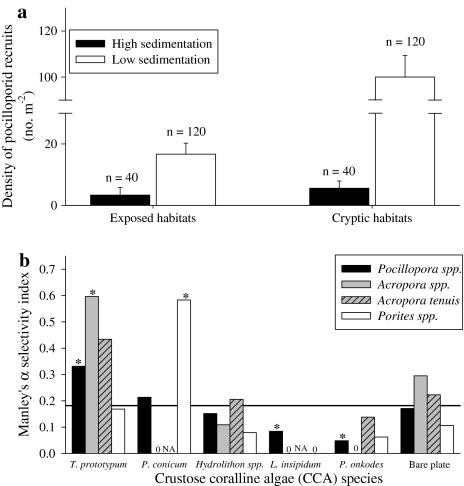
“To assess settlement preferences, to particular taxa of CCA, I used Manley’s selectivity indices (Chesson 1983); for this metric, the average index represents “no preference” because recruits would be evenly distributed across each CCA, given its relative abundance.”
MethodToward an ecological synthesis: a case for habitat selection
Morris, D. W. (2003) · Oecologia · doi:10.1007/s00442-003-1241-4 · Cited by 856 · cited 2×
“searching appropriate habitat types (Morris 2003), especially if suitable locations are diVuse.”
BackgroundNatural inducers for coral larval metamorphosis
Heyward, A. J., & Negri, A. P. (1999) · Coral Reefs · doi:10.1007/s003380050193 · Cited by 604 · cited 2×
“Keywords Crustose coralline algae · HeterospeciWc attraction”
BackgroundRECOGNITION AND SELECTION OF SETTLEMENT SUBSTRATA DETERMINE POST-SETTLEMENT SURVIVAL IN CORALS
Harrington, L., Fabricius, K., De'ath, G., & Negri, A. (2004) · Ecology · doi:10.1890/04-0298 · Cited by 568 · cited 10×
“…beneWt for corals using biotic settlement cues has been provision of an inert attachment site free from antifouling defenses in laboratory studies (Harrington et al. 2004), but here I have shown that the relative distribution, abundance, and species-speciWc characteristics of the preferred CCA…”
BackgroundResultInfluentialIndirect effects of algae on coral: algae‐mediated, microbe‐induced coral mortality
Smith, J. E., Shaw, M., Edwards, R. A., Obura, D., Pantos, O., Sala, E., Sandin, S. A., Smriga, S., Hatay, M., & Rohwer, F. L. (2006) · Ecology Letters · doi:10.1111/j.1461-0248.2006.00937.x · Cited by 561 · cited 2×
“The unique morphology of T. prototypum (Woelkerling 1988) and its lack of sloughing defenses may encourage a particular microbial consortia to associate with its crust and thus reduce exposure to infectious bacteria for newly metamorphosed coral colonies (Smith et al. 2006).”
Background
Research works printed but not linked: 2
- Galzin R, Pointier JP (1985) Moorea Island, Society Archipelago. In: Proceedings of the 5th International Coral Reef Symposium, vol 1, pp 73–102
- Roberts R A review of settlement cues for larval abalone (Haliotis spp.) J Shellfish Res 2001 20 571 586
Cited by
Items 201–214 of 214
Jorissen, H. (2020) · theses.fr (ABES) · doi:10.70675/e734c985za348z4b23z8d96z457b314f39fc · Cited by 1
Chemical and microbial effects of macroalgae on coral holobionts and reef ecosystems
Pozas‐Schacre, C. (2024) · theses.fr (ABES) · doi:10.70675/4b0e646bz5959z4451z9f34zdc85376e5a0c
Botosoamananto, R. L. (2023) · theses.fr (ABES) · doi:10.70675/4191ed02z1c12z48aczb98dzd911b0b982e4
Chemical and microbial mediators as key structuring elements for coralrecruitment
Vizon, C. (2024) · theses.fr (ABES) · doi:10.70675/044cc2e6z9426z42e4z8933za9c660254fa3
Portfolio Effects and Synchrony in Coral Communities
Edwards, C. B., Charendoff, J. A., Petrovic, V., & Sandin, S. A. (2026) · Ecology and Evolution · doi:10.1002/ece3.73658
“For instance, the coverage of crustose coralline algae, which is competitively inferior to coral (Price 2010; Buenau et al. 2011), averaged from 23.2% to 30.0% over the course of this study (Figure S4), suggesting coral growth was not space limited.”
InfluentialLand-based inputs drive demographic feedbacks in a tropical brooding coral
Merges, H. E., Barnas, D. M., & Silbiger, N. J. (2026) · Coral Reefs · doi:10.1007/s00338-026-02930-y
“…2002; Birrell et al. 2005; Doropoulos et al. 2012), behavioral responses to chemical and physical cues (Hadfield and Paul 2001; Vermeij 2005; Price 2010; Tebben et al. 2015; Levenstein et al. 2022), and demographic feedbacks linking adult populations to local recruitment (Grosberg and…”
Alvarado-Rodríguez, J. F., Nava, H., Campos-Velazquez, P., Corona‐Herrera, G. A., & Souza, C. P. (2026) · Revista de Biología Tropical · doi:10.15517/qhtgzx44
“Another explanation is that the experimental design did not include cryptic undersurfaces, which frequently serve as preferred settlement microhabitats for coral spat (Harper et al., 2021; Price, 2010).”
Coralseed: a spatially explicit probabilistic model of larval seeding for large scale restoration
Roff, G., Gouezo, M., Hardiman, L. K., Carlin, G., Thomson, D. P., Harrison, P. L., & Doropoulos, C. (2026) · Ecological Modelling · doi:10.1016/j.ecolmodel.2026.111859
Metadata
- Authors
- Price, N.
- Affiliations
- University of California, Santa Barbara (US)
- Corresponding author
- Price, Nichole
- ORCID
- Price, Nichole
- Venue
- Oecologia
- Published
- 2010-02-19
- Volume
- 163
- Issue
- 3
- Pages
- 747-758
- ISSN
- 0029-8549 (ISSN-L)
- 1432-1939
- PMC
- PMC2886133
- OpenAlex
- W2159441503
- Cited by
- 203
- References
- 83
- Citations by year
- 2026: 5 · 2025: 17 · 2024: 11 · 2023: 15 · 2022: 16 · 2021: 13 · 2020: 10 · 2019: 14 · 2018: 7 · 2017: 9 · 2016: 16 · 2015: 11 · 2014: 22 · 2013: 14 · 2012: 11
- FWCI
- 10.69
- Type
- journal article
- Language
- en
- Open access
- hybrid
- doi.org
- Licence
- cc-by-nc
- Locations
- Oecologia (publishedVersion, cc-by-nc)
- PubMed Central (publishedVersion, cc-by-nc)
- PubMed (publishedVersion)
- eScholarship (California Digital Library) (submittedVersion)
- Funders
- National Science Foundation (0417412)
- W. M. Keck Foundation
- Gordon and Betty Moore Foundation
- Topics
- Physical Sciences › Environmental Science › Ecology › Coral and Marine Ecosystems Studies
- Physical Sciences › Earth and Planetary Sciences › Oceanography › Marine Biology and Ecology Research
- Physical Sciences › Earth and Planetary Sciences › Oceanography › Marine and coastal plant biology
- Keywords
- coral recruitment, habitat selection, facilitation, crustose coralline algae, pocilloporid corals, acroporid corals, chemical cues, habitat quality, French Polynesia
- MeSH terms
- Animals, Light, Marine Biology, Oxygen, Polynesia, Species Specificity, Temperature, Ecosystem, Anthozoa, Salinity, Eukaryota
About these checks
Registry, retraction, Cites and statistics results are computed, not judged, with one exception: a printed reference that no index lists is read once by a model before it counts as a citation error. Claims are extracted by a model and kept only when their quote appears verbatim in the text; each cited source is then checked, with a model’s help, for whether it says what the claim relies on. Those verdicts can be wrong — read the claim’s quote and the cited source before relying on one.
Statistics and arithmetic are recomputed, not judged.
Confidence bands are shown only for fields calibrated on our annotated test set. None is calibrated yet, so no band is shown.
What counts as a claim ›How we measure confidence ›How we check this ›
Are you an author, or do you see a problem with this page? Request a review
Data sources
Bibliographic data: Semantic Scholar, OpenAlex, Crossref.
Contains information from the Semantic Scholar Academic Graph Datasets, made available under the ODC Attribution License (ODC-BY 1.0).
Semantic Scholar’s data is described in: Kinney, R., et al. (2023). The Semantic Scholar Open Data Platform. arXiv:2301.10140.
