

An improved fire detection approach based on YOLO-v8 for smart cities
Open accessThe DOI matches its Crossref record; 34 of the 34 references it cites were found in a registry or an index.
Abstract
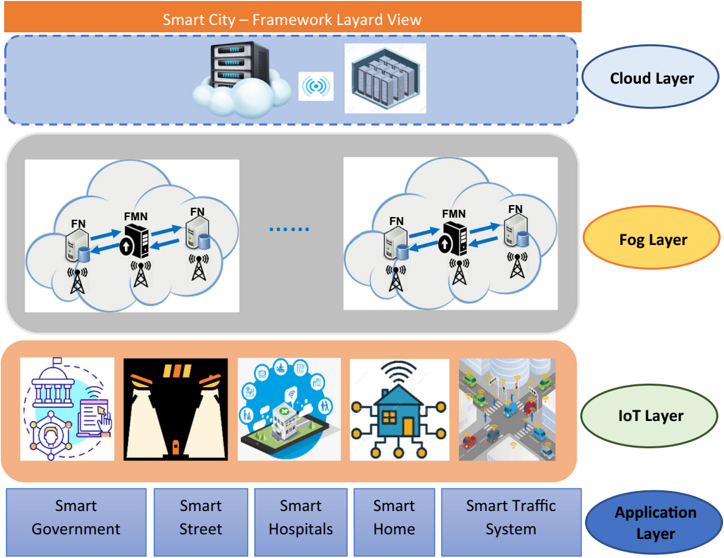
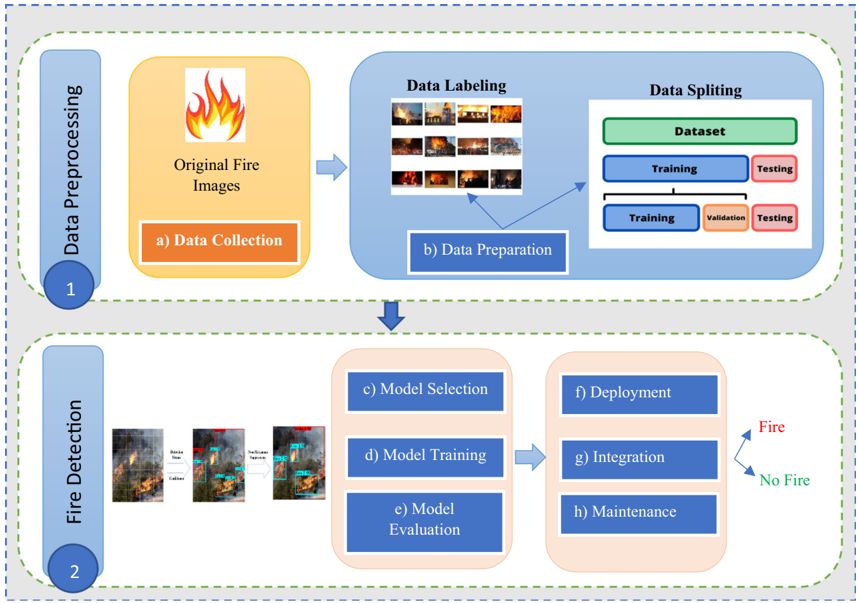
Fires in smart cities can have devastating consequences, causing damage to property, and endangering the lives of citizens. Traditional fire detection methods have limitations in terms of accuracy and speed, making it challenging to detect fires in real time. This paper proposes an improved fire detection approach for smart cities based on the YOLOv8 algorithm, called the smart fire detection system (SFDS), which leverages the strengths of deep learning to detect fire-specific features in real time. The SFDS approach has the potential to improve the accuracy of fire detection, reduce false alarms, and be cost-effective compared to traditional fire detection methods. It can also be extended to detect other objects of interest in smart cities, such as gas leaks or flooding. The proposed framework for a smart city consists of four primary layers: (i) Application layer, (ii) Fog layer, (iii) Cloud layer, and (iv) IoT layer. The proposed algorithm utilizes Fog and Cloud computing, along with the IoT layer, to collect and process data in real time, enabling faster response times and reducing the risk of damage to property and human life. The SFDS achieved state-of-the-art performance in terms of both precision and recall, with a high precision rate of 97.1% for all classes. The proposed approach has several potential applications, including fire safety management in public areas, forest fire monitoring, and intelligent security systems.
Overview
The claims and statistics of this paper haven’t been checked yet.
Free: it reads the open-access text and checks the first 5 claims that cite a source we can check. Create a free account to check every claim.
Integrity signals
Registry
Cites
Statistics
Figures
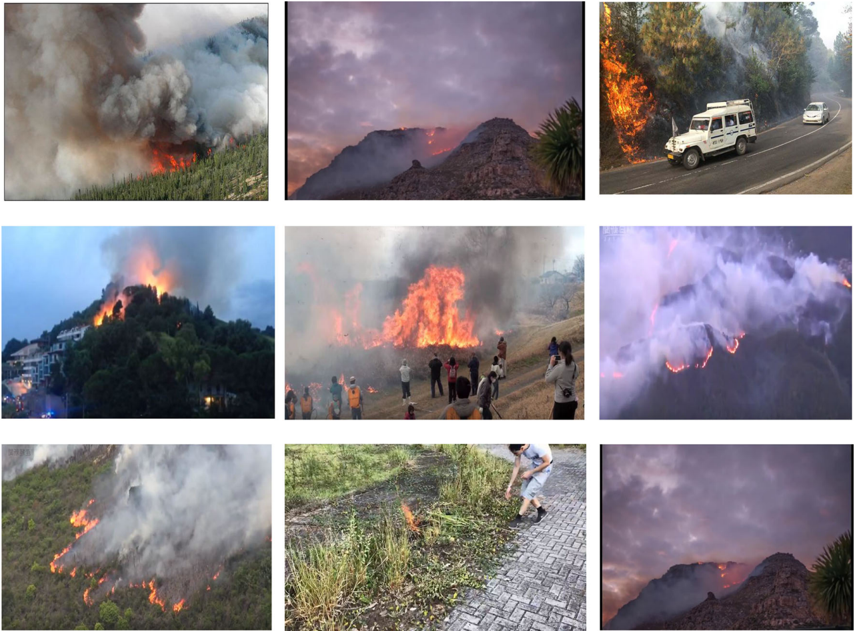
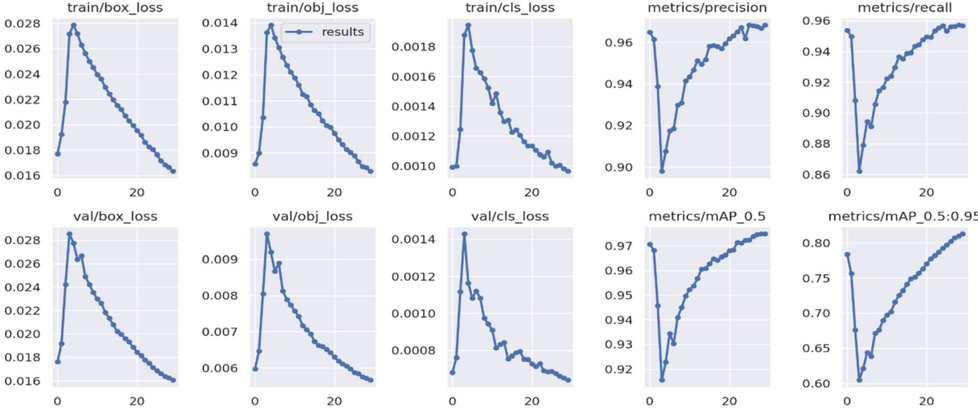
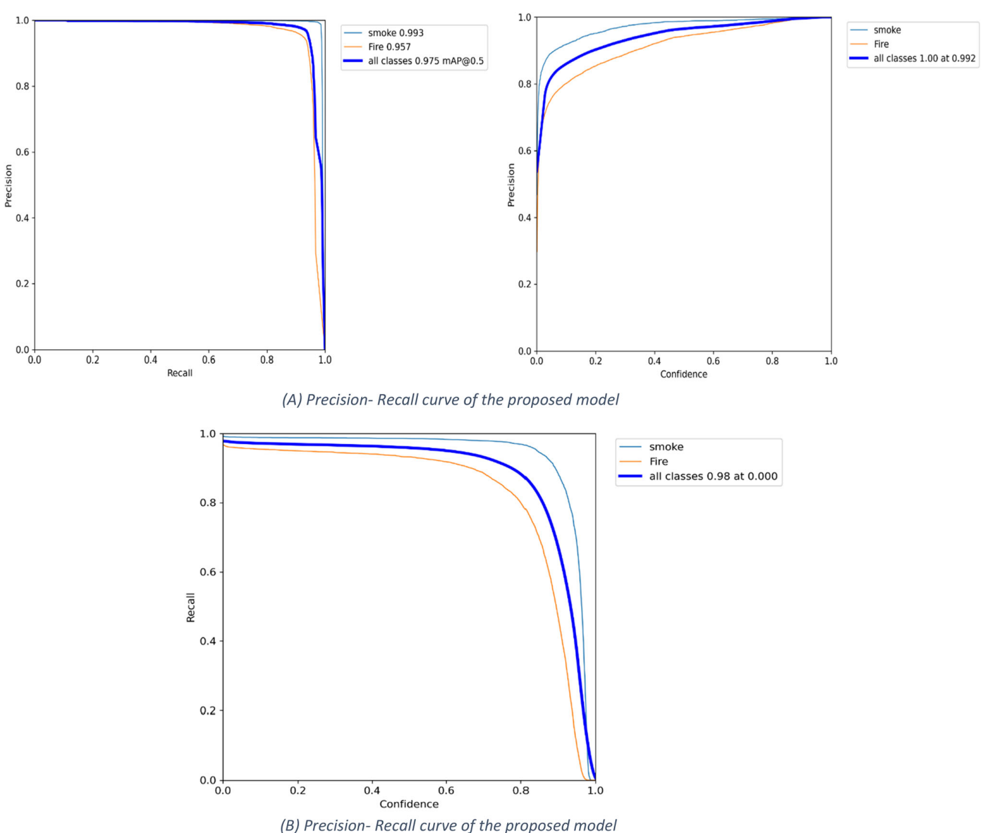
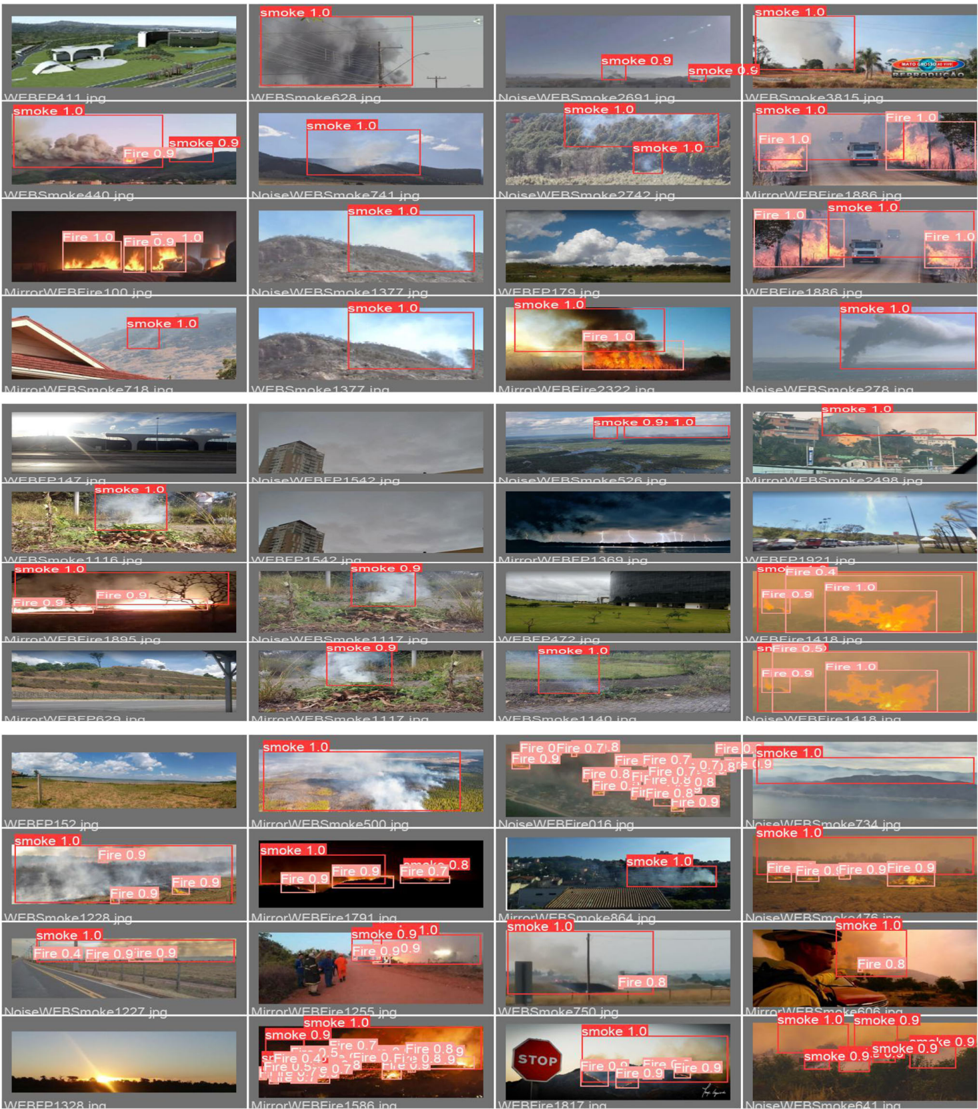
Verification
Claims the paper makes
The claims and statistics of this paper haven’t been checked yet.
Free: it reads the open-access text and checks the first 5 claims that cite a source we can check. Create a free account to check every claim.
Claims other papers make about this one
Each is checked against this paper’s own text: does it say what the citing paper says it does?
The source backs part of the claim, not all of it — or backs it for a different population, condition or comparison.
In the citing paper
“The CSPDarknet53 architecture in YOLOv8 is considered to be the backbone network for feature extraction, balancing accuracy and speed [50].”
From Visual Detection of Traffic Incident through Automatic Monitoring of Vehicle Activities (2024) · cites this paper as [50]
Experimental — accuracy not yet measuredThe check wasn’t confident either way, so it gives no verdict — never disputed.
In the citing paper
“This method has seen significant advancements with the introduction of autoencoders [171], [172] and Generative Adversarial Networks (GANs) [173], [174], [175], which have notably expanded unsupervised learning's applicability, enabling more sophisticated data generation and representation learning capabilities.”
From From Google Gemini to OpenAI Q* (Q-Star): A Survey on Reshaping the Generative Artificial Intelligence (AI) Research Landscape (2025) · cites this paper as [172]
Experimental — accuracy not yet measured
Self-check
Percentages, sums and reported differences re-computed from the paper’s own numbers.
The self-check needs the paper’s full text.
Citations
Cites
2 retracted
El-Rashidy, N. M., ElSayed, N. E., El-Ghamry, A., & Talaat, F. M. (2022) · Neural Computing and Applications · doi:10.1007/s00500-022-07420-1 · Cited by 62
Self-citationRetractedEl-Rashidy, N. M., ElSayed, N. E., El-Ghamry, A., & Talaat, F. M. (2022) · Neural Computing and Applications · doi:10.1007/s00521-022-08007-5
Self-citationRetractedConvolutional Neural Networks Based Fire Detection in Surveillance Videos
Muhammad, K., Ahmad, J., Mehmood, I., Rho, S., & Baik, S. W. (2018) · IEEE Access · doi:10.1109/access.2018.2812835 · Cited by 556
Image fire detection algorithms based on convolutional neural networks
Li, P., & Zhao, W. (2020) · Case Studies in Thermal Engineering · doi:10.1016/j.csite.2020.100625 · Cited by 376
ZainEldin, H., Gamel, S. A., El-Kenawy, E.-S. M., Alharbi, A. H., Khafaga, D. S., Ibrahim, A., & Talaat, F. M. (2022) · Bioengineering · doi:10.3390/bioengineering10010018 · Cited by 241
Self-citationReal-time video fire/smoke detection based on CNN in antifire surveillance systems
Saponara, S., Elhanashi, A., & Gagliardi, A. (2021) · Journal of Real-Time Image Processing · doi:10.1007/s11554-020-01044-0 · Cited by 234
A Video-Based Fire Detection Using Deep Learning Models
Kim, B., & Lee, J. (2019) · Applied Sciences · doi:10.3390/app9142862 · Cited by 206
Ba, R., Chen, C., Yuan, J. Y., Song, W., & Lo, S. (2019) · Remote Sensing · doi:10.3390/rs11141702 · Cited by 189
An Improved Forest Fire Detection Method Based on the Detectron2 Model and a Deep Learning Approach
Abdusalomov, A. B., Islam, B. M. S., Nasimov, R., Mukhiddinov, M., & Whangbo, T. K. (2023) · Sensors · doi:10.3390/s23031512 · Cited by 180
Fire Detection Method in Smart City Environments Using a Deep-Learning-Based Approach
Avazov, K., Mukhiddinov, M., Makhmudov, F., & Cho, Y. I. (2021) · Electronics · doi:10.3390/electronics11010073 · Cited by 163
Research works printed but not linked: 8
- Huang PY, Chen YT, Wu CC (2019) A fire detection system for smart buildings based on deep learning. J Intell Fuzzy Syst 37(4):5541-5551
- Chung T, Ball S, Stentz A (2018) Early fire detection using machine learning in smart buildings. In: Proceedings of the 21st international conference on information fusion (FUSION), pp 1-8
- Avazov K et al (2021) Fire detection method in smart city environments using a deep-learning-based approach. Electronics 11(1):73 · DOI
- Huang J, Luo Q, Wang J, Guo J (2020) Fire detection in outdoor scenes using YOLOv3. IEEE Access 8:114978-114985
- Jia J, Cao Y, Wang X, Huang J (2019) Fire detection based on multi-model fusion. In: 2019 4th International conference on image, vision and computing (ICIVC), pp 329-332. IEEE
- Wang F, Li J, Li Y, Li Y, Huang Y (2018) Real-time fire detection in surveillance video using YOLOv2. In: 2018 13th IEEE conference on industrial electronics and applications (ICIEA), pp 2428-2432. IEEE
- Shen Y, Liu J, Zhao G, Li X (2017) A deep learning approach for fire detection using convolutional neural networks. IEEE Access 5:13251-13258
- Sharma J, Granmo OC, Goodwin M (2021) Emergency analysis: multitask learning with deep convolutional neural networks for fire emergency scene parsing. In: Fujita H, Selamat A, Lin JCW, Ali M (eds) Advances and trends in artificial intelligence. Arti- ficial Intelligence Practices; IEA/AIE 2021. Lecture Notes in Computer Science. Springer, Cham, vol 12798
Cited by
Caragliu, A., Del Bo, C., & Nijkamp, P. (2011) · Journal of Urban Technology · doi:10.1080/10630732.2011.601117 · Cited by 3,409
A comprehensive review on YOLO versions for object detection
Murat, A. A., & Kıran, M. S. (2025) · Engineering Science and Technology an International Journal · doi:10.1016/j.jestch.2025.102161 · Cited by 236
Shams, M. Y., Gamel, S. A., & Talaat, F. M. (2024) · Neural Computing and Applications · doi:10.1007/s00521-023-09391-2 · Cited by 224
Self-citationLUD-YOLO: A novel lightweight object detection network for unmanned aerial vehicle
Fan, Q., Li, Y., Deveci, M., Zhong, K., & Kadry, S. (2024) · Information Sciences · doi:10.1016/j.ins.2024.121366 · Cited by 200
Um-e-Habiba, Ahmed, I., Asif, M., Alhelou, H. H., & Khalid, M. (2024) · Journal of Building Engineering · doi:10.1016/j.jobe.2024.109354 · Cited by 162
Metadata
- Authors
- Talaat, F. M., & ZainEldin, H.
- Affiliations
- Kafrelsheikh University (EG)
- Mansoura University (EG)
- Corresponding author
- Talaat, Fatma M.
- Venue
- Neural Computing and Applications
- Published
- 2023-07-28
- Volume
- 35
- Issue
- 28
- Pages
- 20939-20954
- ISSN
- 0941-0643 (ISSN-L)
- 1433-3058
- OpenAlex
- W4385342336
- Cited by
- 642
- References
- 34
- Citations by year
- 2026: 96 · 2025: 237 · 2024: 277 · 2023: 32
- FWCI
- 110.18
- Type
- journal article
- Language
- en
- Open access
- hybrid
- doi.org
- Licence
- cc-by
- creativecommons.org/licenses/by/4.0 (tdm)
- creativecommons.org/licenses/by/4.0 (vor)
- Locations
- Neural Computing and Applications (publishedVersion, cc-by)
- Funders
- Kafr El Shiekh University
- Topics
- Physical Sciences › Engineering › Safety, Risk, Reliability and Quality › Fire Detection and Safety Systems
- Physical Sciences › Computer Science › Computer Vision and Pattern Recognition › Advanced Neural Network Applications
- Physical Sciences › Engineering › Safety, Risk, Reliability and Quality › Fire dynamics and safety research
- Keywords
- fire detection, YOLOv8, smart cities, real-time object detection, fog computing, cloud computing, Internet of Things, false alarm reduction, wildfire monitoring, fire safety management, intelligent security systems
About these checks
Registry, retraction, Cites and statistics results are computed, not judged, with one exception: a printed reference that no index lists is read once by a model before it counts as a citation error. Claims are extracted by a model and kept only when their quote appears verbatim in the text; each cited source is then checked, with a model’s help, for whether it says what the claim relies on. Those verdicts can be wrong — read the claim’s quote and the cited source before relying on one.
Statistics and arithmetic are recomputed, not judged.
Confidence bands are shown only for fields calibrated on our annotated test set. None is calibrated yet, so no band is shown.
What counts as a claim ›How we measure confidence ›How we check this ›
Are you an author, or do you see a problem with this page? Request a review
Data sources
Bibliographic data: Semantic Scholar, OpenAlex, Crossref.
Contains information from the Semantic Scholar Academic Graph Datasets, made available under the ODC Attribution License (ODC-BY 1.0).
Semantic Scholar’s data is described in: Kinney, R., et al. (2023). The Semantic Scholar Open Data Platform. arXiv:2301.10140.
