

Different patterns of depressive symptoms during pregnancy
Open accessThe DOI matches its Crossref record; 37 of the 38 references it cites were found in a registry or an index.
Abstract
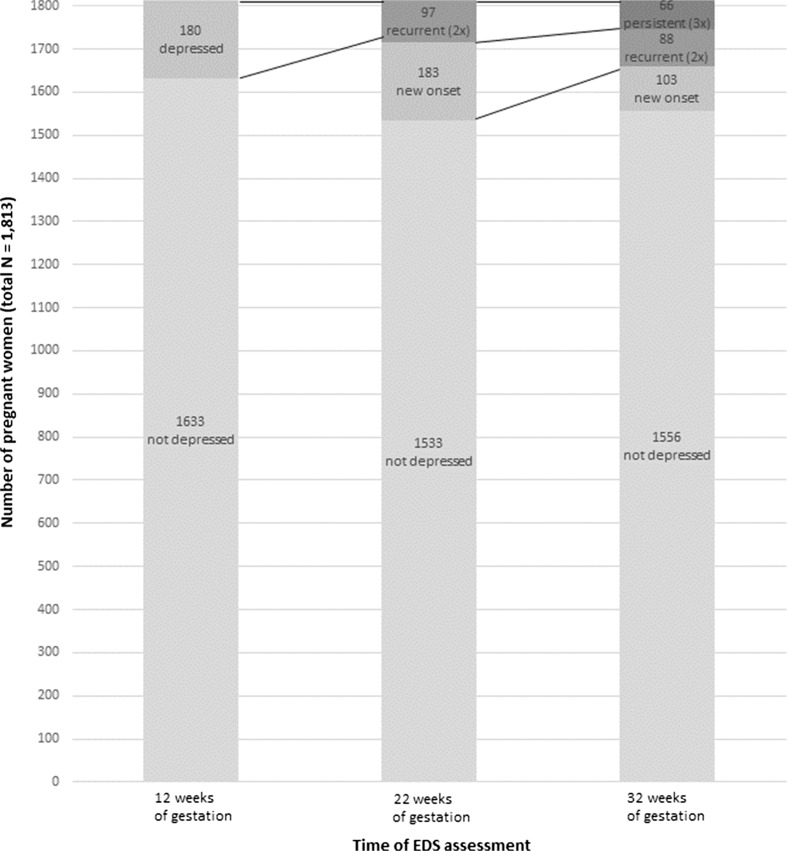
Recently, the US Preventive Services Task Force has advocated to screen pregnant and postpartum women for depression. However, we questioned the meaning of a single elevated depression score: does it represent just one episode of depression or do these symptoms persist throughout the entire pregnancy? This study assessed depressive symptoms at each trimester in a cohort of 1813 pregnant women and evaluated whether women with different patterns of depressive symptoms showed other characteristics. Depending on the trimester, elevated depression scores were prevalent in 10-15% of the pregnant women. Up to 4% reported persistent symptoms of depression throughout pregnancy. Different patterns of depressive symptoms were observed, for which persistent symptoms were related to other characteristics than incidentally elevated symptoms. Besides a previous history of mental health problems as best overall predictor, incidentally elevated depression scores were related to major life events. Furthermore, persistently depressive symptoms were related to unplanned pregnancy and multiparity. An EDS assessment at 12 weeks of gestation including three additional items (history of mental health problems, unplanned pregnancy and multiparity) enabled us to identify 83% of the women with persistent depressive symptoms. A depression screening strategy in pregnant women should take into account the potential chronicity of depressive symptoms by repeated assessments in order to offer an intervention to the most vulnerable women.
Overview
The claims and statistics of this paper haven’t been checked yet.
Free: it reads the open-access text and checks the first 5 claims that cite a source we can check. Create a free account to check every claim.
Integrity signals
Registry
Cites
Statistics
Figures
Verification
Claims the paper makes
The claims and statistics of this paper haven’t been checked yet.
Free: it reads the open-access text and checks the first 5 claims that cite a source we can check. Create a free account to check every claim.
Claims other papers make about this one
Each is checked against this paper’s own text: does it say what the citing paper says it does?
The source backs part of the claim, not all of it — or backs it for a different population, condition or comparison.
In the citing paper
“Antepartum depressive symptoms and subclinical depression with prevalence rates ranging from 10 to 20%, often remain unnoticed by maternity care providers during antenatal visits [1].”
From Effectiveness of a guided ACT-based self-help resilience training for depressive symptoms during pregnancy: Study protocol of a randomized controlled trial embedded in a prospective cohort. (2020) · cites this paper as [1]
Experimental — accuracy not yet measuredThe source backs part of the claim, not all of it — or backs it for a different population, condition or comparison.
In the citing paper
“Antepartum depressive symptoms and subclinical depression with prevalence rates ranging from 10 to 20%, often remain unnoticed by maternity care providers during antenatal visits [1].”
From Effectiveness of a guided ACT-based self-help resilience training for depressive symptoms during pregnancy: Study protocol of a randomized controlled trial embedded in a prospective cohort. (2020) · cites this paper as [1]
Experimental — accuracy not yet measured
Self-check
Percentages, sums and reported differences re-computed from the paper’s own numbers.
The self-check needs the paper’s full text.
Citations
Cites
Statistical Power Analysis for the Behavioral Sciences
Muller, K. (1989) · Technometrics · doi:10.1080/00401706.1989.10488618 · Cited by 99,167
Statistical power analysis for the behavioral sciences
(1990) · Computers, Environment and Urban Systems · doi:10.1016/0198-9715(90)90050-4 · Cited by 65,269
Detection of Postnatal Depression: Development of the 10-item Edinburgh Postnatal Depression Scale
Cox, J. L., Holden, J. M., & Sagovsky, R. (1987) · British Journal of Psychiatry · doi:10.1192/bjp.150.6.782 · Cited by 14,183
Cohen, J. (1992) · Psychological Bulletin · doi:10.1037//0033-2909.112.1.155 · Cited by 8,771
Screening for Depression in Adults: US Preventive Services Task Force Recommendation Statement
Siu, A. L., and the US Preventive Services Task Force (USPSTF), Bibbins-Domingo, K., Grossman, D. C., Baumann, L. C., Davidson, K. W., Ebell, M., García, F. A. R., Gillman, M., Herzstein, J., et al. (2016) · JAMA · doi:10.1001/jama.2015.18392 · Cited by 1,407 · cited 1×
“Furthermore, the US Preventive Services Task Force has recently advocated for this screening (O’Connor et al. 2016; Siu et al. 2016).”
BackgroundRisk factors for depressive symptoms during pregnancy: a systematic review
Lancaster, C. A., Gold, K. J., Flynn, H. A., Yoo, H., Marcus, S. M., & Davis, M. M. (2010) · American Journal of Obstetrics and Gynecology · doi:10.1016/j.ajog.2009.09.007 · Cited by 1,208 · cited 2×
“In 1988, Lewinsohn and colleagues already described a relationship between depression and living with young children, but there are inconclusive results about the relationship between depression and parity (Lancaster et al. 2010; Lewinsohn et al. 1988).”
BackgroundQUANTITATIVE METHODS IN PSYCHOLOGY A Power Primer
Cohen, J. (1992) · Cited by 1,040
Spijkerman, M. P. J., Pots, W. T. M., & Bohlmeijer, E. T. (2016) · Clinical Psychology Review · doi:10.1016/j.cpr.2016.03.009 · Cited by 975 · cited 1×
“Moreover, several types of mental health interventions are web-based nowadays (including online mindfulness training (Krusche et al. 2012; Cavanagh et al. 2013; Spijkerman et al. 2016) and making them highly accessible to pregnant women.”
BackgroundValidation of the Edinburgh Depression Scale during pregnancy
Bergink, V., Kooistra, L., Lambregtse-van den Berg, M. P., Wijnen, H., Bunevicius, R., van Baar, A., & Pop, V. (2011) · Journal of Psychosomatic Research · doi:10.1016/j.jpsychores.2010.07.008 · Cited by 601 · cited 3×
“same Dutch region and who had similar characteristics (Bergink et al. 2011).”
BackgroundMethodSelf-citationO’Connor, E., Rossom, R. C., Henninger, M., Groom, H. C., & Burda, B. U. (2016) · JAMA · doi:10.1001/jama.2015.18948 · Cited by 563 · cited 1×
“Furthermore, the US Preventive Services Task Force has recently advocated for this screening (O’Connor et al. 2016; Siu et al. 2016).”
Background
Cited by
Fekadu Dadi, A., Miller, E. R., & Mwanri, L. (2020) · PLOS ONE · doi:10.1371/journal.pone.0227323 · Cited by 238
Mattina, G. F., Lieshout, R. J. V., & Steiner, M. S. (2019) · Therapeutic Advances in Cardiovascular Disease · doi:10.1177/1753944719851950 · Cited by 115
Pharmacokinetic considerations for current state-of-the-art antidepressants
Wyska, E. (2019) · Expert Opinion on Drug Metabolism & Toxicology · doi:10.1080/17425255.2019.1669560 · Cited by 82
He, L., Soh, K. L., Huang, F., Khaza’ai, H., Soh, K. G., Vorasiha, P., Chen, A., & Ma, J. (2022) · Journal of Affective Disorders · doi:10.1016/j.jad.2022.10.026 · Cited by 75
“…depression is related to serious consequences for the well-being of the woman, her partner, family, and the birth and development of the infants (Truijens et al., 2017), which can cause intense sadness and anxiety in the mother and prevent her from establishing contact with her child or…”
The dynamic course of peripartum depression across pregnancy and childbirth
Dekel, S., Ein‐Dor, T., Ruohomäki, A., Lampi, J., Voutilainen, S., Tuomainen, T., Heinonen, S. T., Kumpulainen, K., Pekkanen, J., Keski‐Nisula, L., et al. (2019) · Journal of Psychiatric Research · doi:10.1016/j.jpsychires.2019.03.016 · Cited by 61
“Some focus on the course of PPD during pregnancy (Truijens et al., 2017); but data on symptom trajectory assessed at more than one prenatal assessment and following parturition, which is a period of anticipated changes, is limited.”
BackgroundFurtado, M., Van Lieshout, R. J., Van Ameringen, M., Green, S. M., & Frey, B. N. (2019) · Journal of Affective Disorders · doi:10.1016/j.jad.2019.02.064 · Cited by 50
Maternal Sleeping Problems Before and After Childbirth - A Systematic Review
Witkowska-Zimny, M., Zhyvotovska, A. I., Isakov, R. І., Boiko, D. I., & Nieradko‐Iwanicka, B. (2024) · International Journal of Women s Health · doi:10.2147/ijwh.s446490 · Cited by 54
Przybyła-Basista, H., Kwiecińska, E., & Ilska, M. (2020) · International Journal of Environmental Research and Public Health · doi:10.3390/ijerph17249436 · Cited by 62
“The prenatal depression experienced by pregnant women has various negative consequences for the wellbeing of the woman, her partner, family, and the birth and development of the child [5].”
BackgroundMeems, M., Hulsbosch, L. P., Riem, M. M. E., Meyers, C., Pronk, T., Broeren, M. A. C., Nabbe, K. C., Oei, S. G., Bogaerts, S., & Pop, V. J. M. (2020) · BMJ Open · doi:10.1136/bmjopen-2020-038891 · Cited by 29
Self-citationLi, C., Huo, L., Wang, R., Qi, L., Wang, W., Zhou, X., Zhou, Y., & Zhang, X. (2021) · Journal of Affective Disorders · doi:10.1016/j.jad.2021.01.019 · Cited by 29
Psychometric aspects of the Tilburg Pregnancy Distress Scale: data from the HAPPY study
Boekhorst, M. G. B. M., Beerthuizen, A., van Son, M. J. M., Bergink, V., & Pop, V. J. M. (2019) · Archives of Women s Mental Health · doi:10.1007/s00737-019-00974-4 · Cited by 26
Self-citationPrenatal Anxiety and Depression: Treatment Uptake, Barriers, and Facilitators in Midwifery Care
Browne, P. D., Bossenbroek, R., Kluft, A., van Tetering, E. M. A., & de Weerth, C. (2021) · Journal of Women s Health · doi:10.1089/jwh.2019.8198 · Cited by 35
“71 This approach is in line with the Lancet 2016 editorial on screening for perinatal depression, which states that maternity care providers should discuss with positive-screened women the possibility of referral or treatment through sensitive inquiry.”
Qu, J., Weng, X., & Gao, L. (2021) · International Journal of Nursing Practice · doi:10.1111/ijn.12997 · Cited by 34
Do, T. T. H., Bui, Q. T. T., Ha, B. T. T., Le, T. M., Le, V. T., Nguyen, Q.-C. T., Lakin, K. J., Dang, T. T., Bui, L. V., Le, T. C., et al. (2023) · International Journal of Women's Health · doi:10.2147/ijwh.s404993 · Cited by 20
“Moreover, literature has pointed out that mental health symptoms can vary through different gestational periods and can be affected by a range of factors including history of mental health problems, unplanned pregnancy, multiparity, and family relationship.(47,48) It might be worthwhile to examine whether the SRQ-20 s…”
BackgroundWu, D., Chen, S., Zhong, X., Zhang, J., Zhao, G., & Jiang, L. (2024) · BMC Pregnancy and Childbirth · doi:10.1186/s12884-024-06680-z · Cited by 28
Yang, J., Qu, Y., Zhan, Y., Ma, H., Li, X., Man, D., Wu, H., Huang, P., Ma, L., & Jiang, Y. (2023) · Psychiatry Research · doi:10.1016/j.psychres.2023.115284 · Cited by 23
Huang, P., Wei, D., Xiao, W., Yuan, M., Chen, N., Wei, X., Xie, J., Lu, J., Xia, X., Lu, M., et al. (2020) · Clinical Nutrition · doi:10.1016/j.clnu.2020.11.038 · Cited by 20
Vaillancourt, M., Lane, V., Ditto, B., & Costa, D. D. (2021) · Journal of Immigrant and Minority Health · doi:10.1007/s10903-021-01284-7 · Cited by 20
Pop, V. J. M., van Son, M. J. M., Wijnen, H. A. A., Spek, V., Denollet, J., & Bergink, V. (2019) · Journal of Affective Disorders · doi:10.1016/j.jad.2019.08.062 · Cited by 19
Self-citationWitteveen, A. B., Henrichs, J., Walker, A. L., Bohlmeijer, E. T., Burger, H., Fontein-Kuipers, Y., Schellevis, F. G., Stramrood, C. A. I., Olff, M., Verhoeven, C. J., et al. (2020) · BMC Pregnancy and Childbirth · doi:10.1186/s12884-020-03395-9 · Cited by 13
de Moraes, E. V., de Toledo, O. R., David, F. L., GODOI, B. N., Monteiro, K. A., Deluqui, T. C., Teixeira, T. W., Carvalho, A. L., & Avelino, M. M. (2019) · BMC Psychiatry · doi:10.1186/s12888-019-2157-9 · Cited by 15
Faisal‐Cury, A., Rocha, A. C., Silotto, A. E. M. R., & Rodrigues, D. M. D. O. (2021) · Journal of Affective Disorders Reports · doi:10.1016/j.jadr.2021.100166 · Cited by 13
Osma-Zambrano, S. E., Lozano-Osma, M. D., Mojica-Perilla, M., & Redondo-Rodríguez, S. (2019) · Medunab · doi:10.29375/01237047.3586 · Cited by 22
Yang, J., Jiang, Y., Qu, Y., Zhan, Y., Ma, H., Li, X., Man, D., Wu, H., & Huang, P. C. (2025) · BMC Public Health · doi:10.1186/s12889-024-21213-1 · Cited by 15
Damme, R. V., Parys, A.-S. V., Vogels, C., Roelens, K., & Lemmens, G. M. D. (2019) · Journal of Psychosomatic Research · doi:10.1016/j.jpsychores.2019.109865 · Cited by 14
Muyiduli, X., Wang, S., Mo, M., Shen, Y., Shao, B., Li, M., & Yu, Y. (2020) · International Journal of Psychiatry in Clinical Practice · doi:10.1080/13651501.2020.1828930 · Cited by 8
“Sem et al. (Truijens et al. 2017) found the trimester-specific prevalence of depressive symptoms from The HAPPY study (holistic approach to pregnancy and the first postpartum year).”
BackgroundLadyman, C., Gander, P. H., Huthwaite, M., Sweeney, B., & Signal, T. L. (2020) · Behavioral Sleep Medicine · doi:10.1080/15402002.2020.1772265 · Cited by 9
“…pregnancy and these show an increased vulnerability in the first trimester compared to later in pregnancy (Fan et al., 2009; Teixeira et al., 2009; Truijens et al., 2017) and for women who become depressed early in pregnancy, an increased risk of postpartum depression (H. Skouteris, Wertheim,…”
BackgroundComplicações clínicas na gravidez: uma revisão sistemática de estudos com gestantes brasileiras
Pedraza, D. F., & Lins, A. C. D. L. (2021) · Ciência & Saúde Coletiva · doi:10.1590/1413-812320212611.3.33202019 · Cited by 91
Association of morningness-eveningness with psychiatric symptoms among pregnant women
Ashi, K., Levey, E. J., Friedman, L. E., Sánchez, S. E., Williams, M. A., & Gelaye, B. (2022) · Chronobiology International · doi:10.1080/07420528.2022.2053703 · Cited by 8
“depression has been found to increase later in pregnancy (Truijens et al. 2017) and the post-partum period (Obeysekare et al.”
BackgroundZhang, M., Zhou, N., Chen, X., Li, Q., Zhang, C., Tang, Y., Ming, X., Zhou, W., Qi, H., & Zhou, W. (2024) · Journal of Affective Disorders · doi:10.1016/j.jad.2024.09.044 · Cited by 8
Impact of Seeking Safety Dose on Depression and PTSD Symptoms Among Pregnant and Post-Partum Women
Salvador, J. G., Bonham, C. A., Durán, D., & Crisanti, A. S. (2020) · Journal of Child and Family Studies · doi:10.1007/s10826-020-01747-9 · Cited by 5
Damme, R. V., Parys, A.-S. V., Vogels, C., Roelens, K., & Lemmens, G. M. D. (2021) · Tijdschrift voor Geneeskunde · doi:10.47671/tvg.77.21.183 · Cited by 3
Vaillancourt, M., Deville-Stoetzel, J.-B., deMontigny, F., Dubeau, D., Gervais, C., Meunier, S., Pierce, T., Ditto, B., & Costa, D. D. (2024) · BMC Pregnancy and Childbirth · doi:10.1186/s12884-024-06768-6 · Cited by 10
VanderWall, R., Haefner, J., & Wehbe-Alamah, H. B. (2020) · Journal of the American Association of Nurse Practitioners · doi:10.1097/jxx.0000000000000494 · Cited by 4
“Wilusz et al. (2013) and Truijens et al. (2017) also found no significant correlation between gestational age and prenatal depression.”
BackgroundAssociation of Low Back and Pelvic Pain with Mental Health Condition during Pregnancy and Postpartum
Uemura, Y., Yasui, T., Horike, K., Maeda, K., Uemura, H., Haku, M., Sakae, R., & Matsumura, K. (2018) · Health · doi:10.4236/health.2018.1012124 · Cited by 2
“It has been reported that 83% of women with persistent depressive symptoms were identified by EPDS assessment at 12 weeks of gestation [21].”
BackgroundLongitudinal Changes of Depressive Symptoms in Sedentary Women Who Exercised During Pregnancy
Hicks, L., & Yeo, S. (2023) · Women s Health Reports · doi:10.1089/whr.2023.0028 · Cited by 2
“13 Our study findings aligned with these findings.”
Sándor, N. G., Boros, J., Kopcsó, K., & Lábadi, B. (2024) · Demográfia · doi:10.21543/dem.67.1.1 · Cited by 1
Perceived Social Support as Predictor of Peripartum Mental Illness in Gilgit, Pakistan
Hussain, S., & Saeed, A. (2022) · Pakistan Journal of Psychological Research · doi:10.33824/pjpr.2022.37.2.16 · Cited by 1
“For example, psychiatric history, major life events, unplanned pregnancy (Truijens et al., 2017), history of depression, and old age depression and anxiety.”
BackgroundZou, Q., Liu, X., Yang, Y., Yang, Y., & Duan, X. (2025) · Frontiers in Public Health · doi:10.3389/fpubh.2025.1544463 · Cited by 4
Osma-Zambrano, S. E., Lozano-Osma, M. D., Mojica-Perilla, M., & Redondo-Rodríguez, S. (2019) · Redalyc (Universidad Autónoma del Estado de México) · Cited by 1
Márquez-Tello, R. M., Zuñiga-Kwon, H. A., & Alvarado, G. F. (2023) · Revista Colombiana de Psiquiatría · doi:10.1016/j.rcp.2023.06.004 · Cited by 2
Suhy, V. A., Pauley, A. M., Griffith, O., Whitney, J., & Downs, D. S. (2026) · Psychology and Health · doi:10.1080/08870446.2026.2733983
The Role of Resiliency Education in Prenatal Classes on Maternal Mental Health
Choi, H., Arellano, F., Dudovitz, R., Moini, M., Jackson, A., Jackson, N., Schickedanz, A., & Saleeby, E. (2026) · Journal of Women s Health · doi:10.1177/15409996261495721
Metadata
- Authors
- Truijens, S. E. M., Spek, V., van Son, M. J. M., Guid Oei, S., & Pop, V. J. M.
- Affiliations
- Máxima Medisch Centrum (NL)
- Tilburg University (NL)
- Corresponding author
- Truijens, Sophie E. M.
- Venue
- Archives of Women's Mental Health
- Published
- 2017-06-08
- Volume
- 20
- Issue
- 4
- Pages
- 539-546
- ISSN
- 1434-1816 (ISSN-L)
- 1435-1102
- PMC
- PMC5509781
- OpenAlex
- W2624099230
- Cited by
- 43
- References
- 38
- Citations by year
- 2026: 2 · 2025: 2 · 2024: 5 · 2023: 4 · 2022: 3 · 2021: 6 · 2020: 10 · 2019: 10 · 2018: 1
- FWCI
- 5.39
- Type
- journal article
- Language
- en
- Open access
- hybrid
- doi.org
- Locations
- Archives of Women s Mental Health (publishedVersion, cc-by)
- Europe PMC (PubMed Central) (publishedVersion, cc-by)
- PubMed Central (publishedVersion, cc-by)
- Research portal (Tilburg University) (publishedVersion, other-oa)
- PubMed (publishedVersion)
- Data Archiving and Networked Services (DANS) (submittedVersion, other-oa)
- TU/e Research Portal (submittedVersion)
- TU/e Research Portal (submittedVersion, other-oa)
- Funders
- Eindhoven University of Technology
- Topics
- Health Sciences › Medicine › Public Health, Environmental and Occupational Health › Maternal Mental Health During Pregnancy and Postpartum
- Health Sciences › Medicine › Obstetrics and Gynecology › Pregnancy-related medical research
- Health Sciences › Medicine › Pediatrics, Perinatology and Child Health › Maternal and Neonatal Healthcare
- Keywords
- depressive symptoms, pregnancy, persistent depressive symptoms, depression screening, unintended pregnancy, multiparity, major life events, Edinburgh Depression Scale, postpartum depression
- MeSH terms
- Adolescent, Depression, Female, Humans, Mass Screening, Netherlands, Pregnancy, Pregnancy Complications, Pregnancy Trimester, First, Pregnancy Trimester, Second, Pregnancy Trimester, Third, Pregnancy Trimesters, Psychiatric Status Rating Scales, Risk Factors, Cohort Studies, Prevalence, Pregnant People, Pregnant Women, Young Adult
About these checks
Registry, retraction, Cites and statistics results are computed, not judged, with one exception: a printed reference that no index lists is read once by a model before it counts as a citation error. Claims are extracted by a model and kept only when their quote appears verbatim in the text; each cited source is then checked, with a model’s help, for whether it says what the claim relies on. Those verdicts can be wrong — read the claim’s quote and the cited source before relying on one.
Statistics and arithmetic are recomputed, not judged.
Confidence bands are shown only for fields calibrated on our annotated test set. None is calibrated yet, so no band is shown.
What counts as a claim ›How we measure confidence ›How we check this ›
Are you an author, or do you see a problem with this page? Request a review
Data sources
Bibliographic data: Semantic Scholar, OpenAlex, Crossref.
Contains information from the Semantic Scholar Academic Graph Datasets, made available under the ODC Attribution License (ODC-BY 1.0).
Semantic Scholar’s data is described in: Kinney, R., et al. (2023). The Semantic Scholar Open Data Platform. arXiv:2301.10140.
