

The DOI matches its Crossref record; 1 of the 1 references it cites were found in a registry or an index.
Bioinformatics and metabolic flux analysis highlight a new mechanism involved in lactate oxidation in Clostridium tyrobutyricum
Published version of a preprint
Abstract
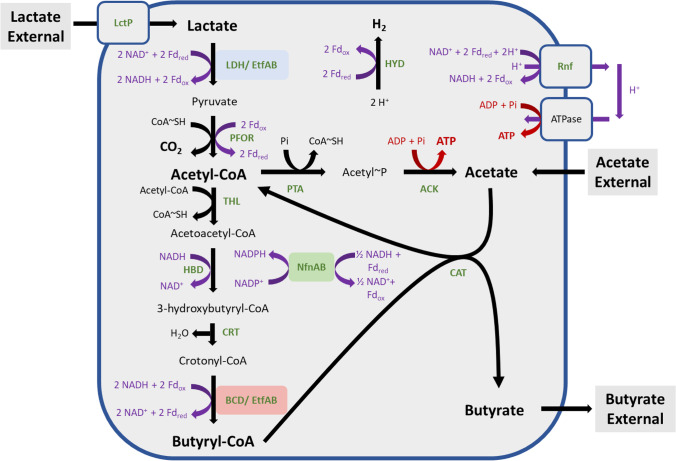
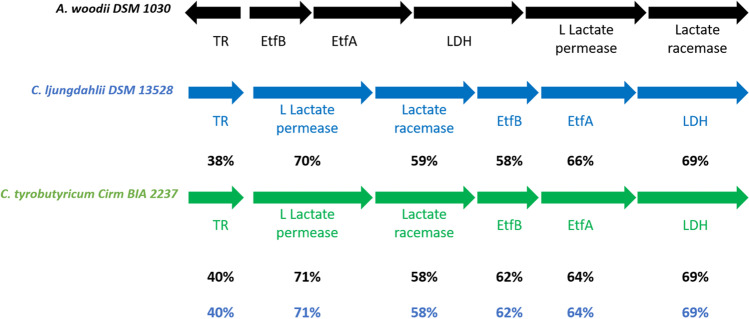
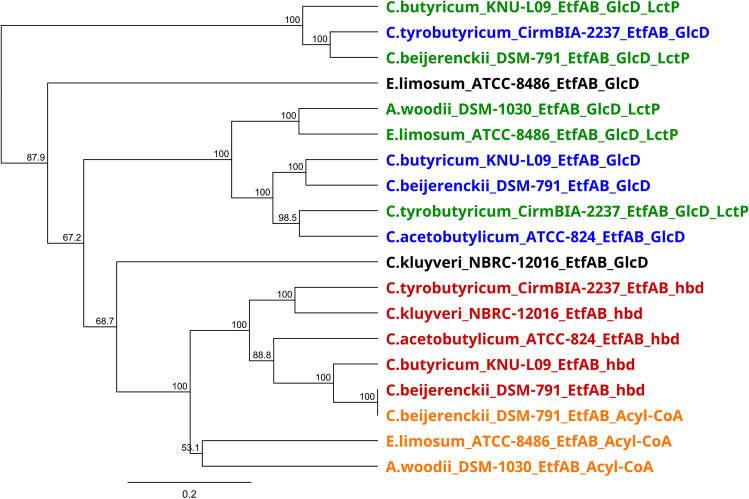
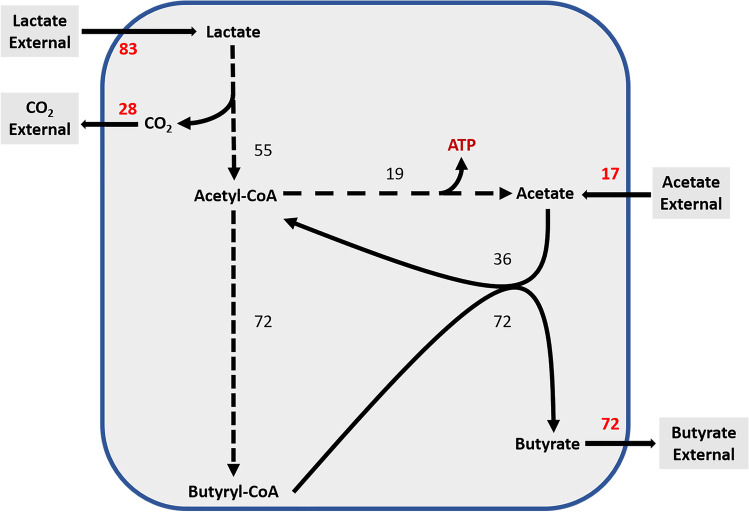
Climate change and environmental issues compel us to find alternatives to the production of molecules of interest from petrochemistry. This study aims at understanding the production of butyrate, hydrogen, and CO 2 from the oxidation of lactate with acetate in Clostridium tyrobutyricum and thus proposes an alternative carbon source to glucose. This specie is known to produce more butyrate than the other butyrate-producing clostridia species due to a lack of solvent genesis phase. The recent discoveries on flavin-based electron bifurcation and confurcation mechanism as a mode of energy conservation led us to suggest a new metabolic scheme for the formation of butyrate from lactate-acetate co-metabolism. While searching for genes encoding for EtfAB complexes and neighboring genes in the genome of C. tyrobutyricum , we identified a cluster of genes involved in butyrate formation and another cluster involved in lactate oxidation homologous to Acetobacterium woodii . A phylogenetic approach encompassing other butyrate-producing and/or lactate-oxidizing species based on EtfAB complexes confirmed these results. A metabolic scheme on the production of butyrate, hydrogen, and CO 2 from the lactate-acetate co-metabolism in C. tyrobutyricum was constructed and then confirmed with data of steady-state continuous culture. This in silico metabolic carbon flux analysis model showed the coherence of the scheme from the carbon recovery, the cofactor ratio, and the ATP yield. This study improves our understanding of the lactate oxidation metabolic pathways and the role of acetate and intracellular redox balance, and paves the way for the production of molecules of interest as butyrate and hydrogen with C. tyrobutyricum .
Overview
The claims and statistics of this paper haven’t been checked yet.
Run the check — free, no account needed. It reads the open-access text and checks the sources it cites.
Integrity signals
Registry
Cites
Statistics
Figures

Verification
Claims the paper makes
The claims and statistics of this paper haven’t been checked yet.
Run the check — free, no account needed. It reads the open-access text and checks the sources it cites.
Claims other papers make about this one
Each is checked against this paper’s own text: does it say what the citing paper says it does?
In the citing paper
“Considering that many other Clostridium spp. are known to catalyze the reduction of short-chain acyl-CoA substrates using genomically identifiable CarCDE homologs (35, 36)”
From Electron bifurcation and fluoride efflux systems implicated in defluorination of perfluorinated unsaturated carboxylic acids by Acetobacterium spp (2024) · cites this paper as [36]
Self-check
Percentages, sums and reported differences re-computed from the paper’s own numbers.
The self-check needs the paper’s full text.
Citations
Cites
Recent advances in lactic acid production by microbial fermentation processes
Abdel-Rahman, M. A., Tashiro, Y., & Sonomoto, K. (2013) · Biotechnology Advances · doi:10.1016/j.biotechadv.2013.04.002 · Cited by 1,022
Research works printed but not linked: 48
- Bao T, Feng J, Jiang W et al (2020) Recent advances in n-butanol and butyrate production using engineered Clostridium tyrobutyricum. World J Microbiol Biotechnol 36:138. https://doi.org/10.1007/s11274-020-02914-2 · DOI
- Bennett GN, Rudolph FB (1995) The central metabolic pathway from acetyl-CoA to butyryl-CoA in Clostridium acetobutylicum. FEMS Microbiol Rev 17:241–249. https://doi.org/10.1111/j.1574-6976.1995.tb00208.x · DOI
- Bryant MP, Burkey LA (1956) The characteristics of lactate-fermenting spore forming anaerobes from silage. J Bacteriol 71:43 · DOI
- Buckel W, Thauer RK (2018a) Flavin-based electron bifurcation, ferredoxin, flavodoxin, and anaerobic respiration with protons (Ech) or NAD+ (Rnf) as electron acceptors: a historical review. Front Microbiol 9:401. https://doi.org/10.3389/fmicb.2018.00401 · DOI
- Buckel W, Thauer RK (2018b) Flavin-based electron bifurcation, a new mechanism of biological energy coupling. Chem Rev 118:3862–3886. https://doi.org/10.1021/acs.chemrev.7b00707 · DOI · Paper page
- Cai G, Jin B, Saint C, Monis P (2010) Metabolic flux analysis of hydrogen production network by Clostridium butyricum W5: effect of pH and glucose concentrations. Int J Hydrog Energy 35:6681–6690. https://doi.org/10.1016/j.ijhydene.2010.04.097 · DOI
- Cheng H-H, Whang L-M, Lin C-A et al (2013) Metabolic flux network analysis of fermentative hydrogen production: using Clostridium tyrobutyricum as an example. Bioresour Technol 141:233–239. https://doi.org/10.1016/j.biortech.2013.03.141 · DOI
- Collins MD, Lawson PA, Willems A et al (1994) The phylogeny of the genus Clostridium: proposal of five new genera and eleven new species combinations. Int J Syst Bacteriol 44:812–826. https://doi.org/10.1099/00207713-44-4-812 · DOI
- Crabbendam PM, Neijssel OM, Tempest DW (1985) Metabolic and energetic aspects of the growth of Clostridium butyricum on glucose in chemostat culture. Arch Microbiol 142:375–382. https://doi.org/10.1007/BF00491907 · DOI
- Cummins CS, Johnson JL (1971) Taxonomy of the Clostridia: wall composition and DNA homologies in Clostridium butyricum and other butyric acid-producing Clostridia. J Gen Microbiol 67:33–46. https://doi.org/10.1099/00221287-67-1-33 · DOI
- D’Incecco P, Pellegrino L, Hogenboom JA et al (2018) The late blowing defect of hard cheeses: behaviour of cells and spores of Clostridium tyrobutyricum throughout the cheese manufacturing and ripening. LWT - Food Sci Technol 87:134–141. https://doi.org/10.1016/j.lwt.2017.08.083 · DOI
- Detman A, Mielecki D, Chojnacka A et al (2019) Cell factories converting lactate and acetate to butyrate: Clostridium butyricum and microbial communities from dark fermentation bioreactors. Microb Cell Factories 18:36. https://doi.org/10.1186/s12934-019-1085-1 · DOI
- Du Y, Jiang W, Yu M et al (2015) Metabolic process engineering of Clostridium tyrobutyricum Δack-adhE2 for enhanced n-butanol production from glucose: effects of methyl viologen on NADH availability, flux distribution, and fermentation kinetics: metabolic process engineering of Clostridium tyrobutyricum. Biotechnol Bioeng 112:705–715. https://doi.org/10.1002/bit.25489 · DOI
- Dwidar M, Park J-Y, Mitchell RJ, Sang B-I (2012) The future of butyric acid in industry. Sci World J 2012:1–10. https://doi.org/10.1100/2012/471417 · DOI
- Fu H, Yu L, Lin M et al (2017) Metabolic engineering of Clostridium tyrobutyricum for enhanced butyric acid production from glucose and xylose. Metab Eng 40:50–58. https://doi.org/10.1016/j.ymben.2016.12.014 · DOI
- Garcia Costas AM, Poudel S, Miller A-F et al (2017) Defining electron bifurcation in the electron-transferring flavoprotein family. J Bacteriol 199:e00440-e517. https://doi.org/10.1128/JB.00440-17 · DOI
- Jang Y-S, Woo HM, Im JA et al (2013) Metabolic engineering of Clostridium acetobutylicum for enhanced production of butyric acid. Appl Microbiol Biotechnol 97:9355–9363. https://doi.org/10.1007/s00253-013-5161-x · DOI
- Jang Y-S, Im JA, Choi SY et al (2014) Metabolic engineering of Clostridium acetobutylicum for butyric acid production with high butyric acid selectivity. Metab Eng 23:165–174. https://doi.org/10.1016/j.ymben.2014.03.004 · DOI
- Jantasee S, Kienberger M, Mungma N, Siebenhofer M (2017) Potential and assessment of lactic acid production and isolation-a review: potential and assessment of lactic acid production. J Chem Technol Biotechnol 92:2885–2893. https://doi.org/10.1002/jctb.5237 · DOI
- Jaros AM, Rova U, Berglund KA (2013) Acetate adaptation of clostridia tyrobutyricum for improved fermentation production of butyrate. Springerplus 2:47. https://doi.org/10.1186/2193-1801-2-47 · DOI
- Jiang L, Song P, Zhu L et al (2013) Comparison of metabolic pathway for hydrogen production in wild-type and mutant Clostridium tyrobutyricum strain based on metabolic flux analysis. Int J Hydrog Energy 38:2176–2184. https://doi.org/10.1016/j.ijhydene.2012.11.050 · DOI
- Jo JH, Jeon CO, Lee SY et al (2010) Molecular characterization and homologous overexpression of [FeFe]-hydrogenase in Clostridium tyrobutyricum JM1. Int J Hydrog Energy 35:1065–1073. https://doi.org/10.1016/j.ijhydene.2009.11.102 · DOI
- Jukes TH, Cantor CR (1969) Evolution of protein molecules. In: Mammalian protein metabolism. Elsevier, pp 21–132 · DOI · Paper page
- Kanehisa M, Furumichi M, Tanabe M et al (2017) KEGG: new perspectives on genomes, pathways, diseases and drugs. Nucleic Acids Res 45:D353–D361. https://doi.org/10.1093/nar/gkw1092 · DOI · Paper page
- Klijn N, Nieuwenhof FF, Hoolwerf JD et al (1995) Identification of Clostridium tyrobutyricum as the causative agent of late blowing in cheese by species-specific PCR amplification. Appl Env Microbiol 61:2919–2924 · DOI
- Lee SY, Park JH, Jang SH et al (2008) Fermentative butanol production by Clostridia. Biotechnol Bioeng 101:209–228. https://doi.org/10.1002/bit.22003 · DOI
- Lee J, Jang Y-S, Han M-J et al (2016) Deciphering Clostridium tyrobutyricum metabolism based on the whole-genome sequence and proteome analyses. Mbio 7:e00743-e816. https://doi.org/10.1128/mBio.00743-16 · DOI
- Li F, Hinderberger J, Seedorf H et al (2008) Coupled ferredoxin and crotonyl coenzyme A (CoA) reduction with NADH catalyzed by the butyryl-CoA dehydrogenase/Etf complex from Clostridium kluyveri. J Bacteriol 190:843–850. https://doi.org/10.1128/JB.01417-07 · DOI · Paper page
- Li W, Cheng C, Cao G et al (2020) Comparative transcriptome analysis of Clostridium tyrobutyricum expressing a heterologous uptake hydrogenase. Sci Total Environ 749:142022. https://doi.org/10.1016/j.scitotenv.2020.142022 · DOI
- Liu X, Zhu Y, Yang S-T (2006) Butyric acid and hydrogen production by Clostridium tyrobutyricum ATCC 25755 and mutants. Enzyme Microb Technol 38:521–528. https://doi.org/10.1016/j.enzmictec.2005.07.008 · DOI
- Marshall DD, Sadykov MR, Thomas VC et al (2016) Redox imbalance underlies the fitness defect associated with inactivation of the Pta-AckA pathway in Staphylococcus aureus. J Proteome Res 15:1205–1212. https://doi.org/10.1021/acs.jproteome.5b01089 · DOI
- Matsumoto M, Nishimura Y (2007) Hydrogen production by fermentation using acetic acid and lactic acid. J Biosci Bioeng 103:236–241. https://doi.org/10.1263/jbb.103.236 · DOI
- Michener CD, Sokal RR (1957) A quantitative approach to a problem in classification. Evolution 11:130–162. https://doi.org/10.1111/j.1558-5646.1957.tb02884.x · DOI
- Munier E, Licandro-Séraut H, Achilleos C, et al (2019) Whole-genome sequencing and annotation of Clostridium tyrobutyricum strain CIRMBIA 2237, isolated from silage. Microbiol Resour Announc 8:e00492–19, /mra/8/30/MRA.00492–19.atom. https://doi.org/10.1128/MRA.00492-19 · DOI
- Orth JD, Thiele I, Palsson BØ (2010) What is flux balance analysis? Nat Biotechnol 28:245–248. https://doi.org/10.1038/nbt.1614 · DOI · Paper page
- Riondet C, Cachon R, Wache Y et al (2000) Extracellular oxidoreduction potential modifies carbon and electron flow in Escherichia coli. J Bacteriol 182:620–626. https://doi.org/10.1128/JB.182.3.620-626.2000 · DOI
- Roux C, Bergere JL (1977) Taxonomic characters of Clostridium tyrobutyricum. Ann Microbiol Paris 128A:267–276
- Seeliger S, Janssen PH, Schink B (2002) Energetics and kinetics of lactate fermentation to acetate and propionate via methylmalonyl-CoA or acrylyl-CoA. FEMS Microbiol Lett 211:65–70. https://doi.org/10.1111/j.1574-6968.2002.tb11204.x · DOI
- Suo Y, Fu H, Ren M et al (2018a) Enhanced butyric acid production in Clostridium tyrobutyricum by overexpression of rate-limiting enzymes in the Embden-Meyerhof-Parnas pathway. J Biotechnol 272–273:14–21. https://doi.org/10.1016/j.jbiotec.2018.02.012 · DOI
- Suo Y, Ren M, Yang X et al (2018b) Metabolic engineering of Clostridium tyrobutyricum for enhanced butyric acid production with high butyrate/acetate ratio. Appl Microbiol Biotechnol. https://doi.org/10.1007/s00253-018-8954-0 · DOI
- Suo Y, Liao Z, Qu C et al (2019) Metabolic engineering of Clostridium tyrobutyricum for enhanced butyric acid production from undetoxified corncob acid hydrolysate. Bioresour Technol 271:266–273. https://doi.org/10.1016/j.biortech.2018.09.095 · DOI
- Thauer RK, Jungermann K, Henninger H et al (1968) The energy metabolism of Clostridium kluyveri. Eur J Biochem 4:173–180. https://doi.org/10.1111/j.1432-1033.1968.tb00189.x · DOI
- Thauer RK, Kaster A-K, Seedorf H et al (2008) Methanogenic archaea: ecologically relevant differences in energy conservation. Nat Rev Microbiol 6:579–591. https://doi.org/10.1038/nrmicro1931 · DOI · Paper page
- Tsai SP, Lee YH (1988) Application of metabolic pathway stoichiometry to statistical analysis of bioreactor measurement data. Biotechnol Bioeng 32:713–715. https://doi.org/10.1002/bit.260320517 · DOI
- Wang S, Huang H, Moll J, Thauer RK (2010) NADP+ reduction with reduced ferredoxin and NADP+ reduction with NADH are coupled via an electron-bifurcating enzyme complex in Clostridium kluyveri. J Bacteriol 192:5115–5123. https://doi.org/10.1128/JB.00612-10 · DOI · Paper page
- Weghoff MC, Bertsch J, Müller V (2015) A novel mode of lactate metabolism in strictly anaerobic bacteria: a novel mode of lactate metabolism in anaerobes. Environ Microbiol 17:670–677. https://doi.org/10.1111/1462-2920.12493 · DOI
- Yu L, Zhao J, Xu M et al (2015) Metabolic engineering of Clostridium tyrobutyricum for n-butanol production: effects of CoA transferase. Appl Microbiol Biotechnol 99:4917–4930. https://doi.org/10.1007/s00253-015-6566-5 · DOI
- Zeng K, Zhang D (2010) Recent progress in alkaline water electrolysis for hydrogen production and applications. Prog Energy Combust Sci 36:307–326. https://doi.org/10.1016/j.pecs.2009.11.002 · DOI · Paper page
Cited by
Sorted by citations
Yu, Y., Xu, F., Zhao, W., Thoma, C., Che, S., Richman, J. E., Jin, B., Zhu, Y., Xing, Y., Wackett, L., et al. (2024) · Science Advances · doi:10.1126/sciadv.ado2957 · Cited by 63
Metadata
- Authors
- Munier, E., Licandro, H., Beuvier, E., & Cachon, R.
- Venue
- International Microbiology
- Published
- 2023-01-07
- Volume
- 26
- Issue
- 3
- Pages
- 501-511
- ISSN
- 1618-1905
- PMC
- PMC10397141
- Cited by
- 18
- References
- 1
- Language
- en
About these checks
Registry, retraction, Cites and statistics results are computed, not judged, with one exception: a printed reference that no index lists is read once by a model before it counts as a citation error. Claims are extracted by a model and kept only when their quote appears verbatim in the text; each cited source is then checked, with a model’s help, for whether it says what the claim relies on. Those verdicts can be wrong — read the claim’s quote and the cited source before relying on one.
Statistics and arithmetic are recomputed, not judged.
Confidence bands are shown only for fields calibrated on our annotated test set. None is calibrated yet, so no band is shown.
What counts as a claim ›How we measure confidence ›How we check this ›
Are you an author, or do you see a problem with this page? Request a review
