

The DOI matches its Crossref record.
DyP-type peroxidases: a promising and versatile class of enzymes
Abstract
DyP peroxidases comprise a novel superfamily of heme-containing peroxidases, which is unrelated to the superfamilies of plant and animal peroxidases. These enzymes have so far been identified in the genomes of fungi, bacteria, as well as archaea, although their physiological function is still unclear. DyPs are bifunctional enzymes displaying not only oxidative activity but also hydrolytic activity. Moreover, these enzymes are able to oxidize a variety of organic compounds of which some are poorly converted by established peroxidases, including dyes, β-carotene, and aromatic sulfides. Interestingly, accumulating evidence shows that microbial DyP peroxidases play a key role in the degradation of lignin. Owing to their unique properties, these enzymes are potentially interesting for a variety of biocatalytic applications. In this review, we deal with the biochemical and structural features of DyP-type peroxidases as well as their promising biotechnological potential.
Overview
The claims and statistics of this paper haven’t been checked yet.
Run the check — free, no account needed. It reads the open-access text and checks the sources it cites.
Integrity signals
Registry
Cites
Statistics
Figures
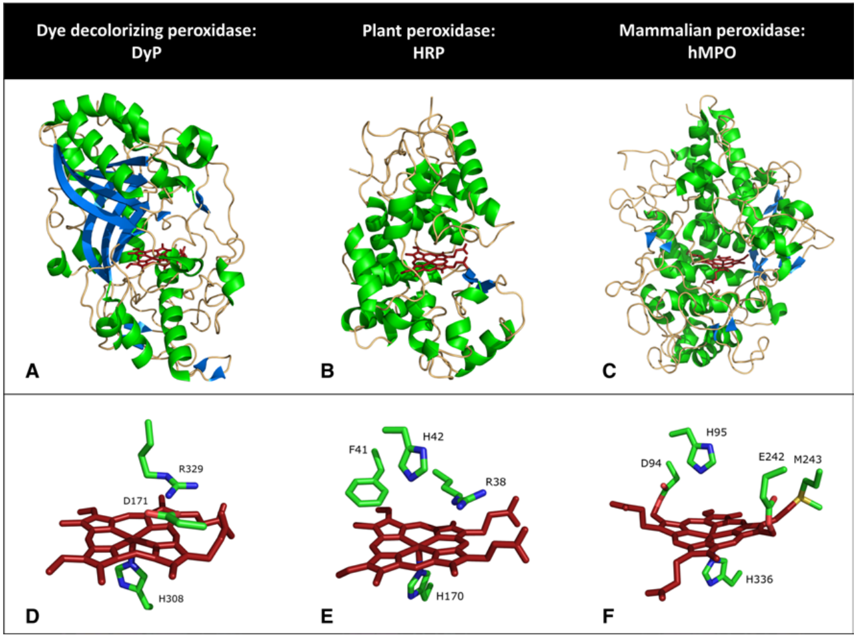
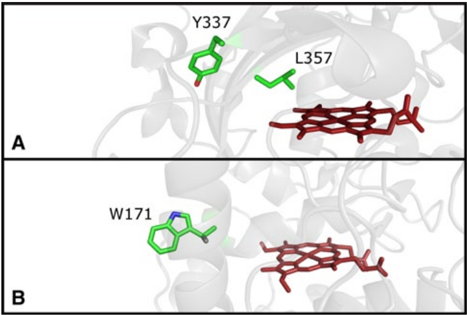
Verification
Claims the paper makes
The claims and statistics of this paper haven’t been checked yet.
Run the check — free, no account needed. It reads the open-access text and checks the sources it cites.
Claims other papers make about this one
Each is checked against this paper’s own text: does it say what the citing paper says it does?
The cited source says what the claim attributes to it.
In the citing paper
“DyPs were first reported almost 20 years ago, showing a great activity over the decolorisation of anthraquinone dyes 97, 127 , followed by lignin-like compounds 128 .”
From Degradation of anthraquinone dyes from effluents: A review focusing on enzymatic dye degradation with industrial potential (2020) · cites this paper as [128]
Self-check
Percentages, sums and reported differences re-computed from the paper’s own numbers.
The self-check needs the paper’s full text.
Citations
Cites
No references could be resolved yet.
Research works printed but not linked: 50
- Adav, 2010, Quantitative iTRAQ secretome analysis of cellulolytic Thermobifida fusca, J Proteome Res, 9, 3016, 10.1021/pr901174z · DOI
- Ahmad, 2011, Identification of DypB from Rhodococcus jostii RHA1 as a lignin peroxidase, Biochemistry, 50, 5096, 10.1021/bi101892z · DOI
- Amini, 2011, Antibiotics and the post-genome revolution, Curr Opin Microbiol, 14, 513, 10.1016/j.mib.2011.07.017 · DOI
- Banci, 1997, Structural properties of peroxidases, J Biotechnol, 53, 253, 10.1016/S0168-1656(97)01677-5 · DOI
- Brown, 2012, Identification and characterization of a multifunctional dye peroxidase from a lignin-reactive bacterium, ACS Chem Biol, 7, 2074, 10.1021/cb300383y · DOI
- Bugg, 2011, The emerging role for bacteria in lignin degradation and bio-product formation, Curr Opin Biotechnol, 22, 394, 10.1016/j.copbio.2010.10.009 · DOI
- Burner, 2000, Oxidation of hydroquinone, 2,3-dimethylhydroquinone and 2,3,5-trimethylhydroquinone by human myeloperoxidase, Redox Rep, 5, 185, 10.1179/135100000101535735 · DOI
- Chen, 2006, Recent advances in azo dye degrading enzyme research, Curr Protein Pept Sci, 7, 101, 10.2174/138920306776359786 · DOI
- Choinowski, 1999, The crystal structure of lignin peroxidase at 1.70-A resolution reveals a hydroxy group on the cbeta of tryptophan 171: a novel radical site formed during the redox cycle, J Mol Biol, 286, 809, 10.1006/jmbi.1998.2507 · DOI
- Davies, 2008, Mammalian heme peroxidases: from molecular mechanisms to health implications, Antioxid Redox Signal, 10, 1199, 10.1089/ars.2007.1927 · DOI
- Doyle, 1998, Two substrate interaction sites in lignin peroxidase revealed by site-directed mutagenesis, Biochemistry, 37, 15097, 10.1021/bi981633h · DOI
- Faraco, 2007, Identification of a new member of the dye-decolorizing peroxidase family from Pleurotus ostreatus, World J Microbiol Biotechnol, 23, 889, 10.1007/s11274-006-9303-5 · DOI
- Johjima, 2003, Isolation and cDNA cloning of novel hydrogen peroxide-dependent phenol oxidase from the basidiomycete Termitomyces albuminosus, Appl Microbiol Biotechnol, 61, 220, 10.1007/s00253-003-1236-4 · DOI
- Jongbloed, 2004, Two minimal Tat translocases in Bacillus, Mol Microbiol, 54, 1319, 10.1111/j.1365-2958.2004.04341.x · DOI
- Kim, 1999, Purification and characterization of a novel peroxidase from Geotrichum candidum dec 1 involved in decolorization of dyes, Appl Environ Microbiol, 65, 1029, 10.1128/AEM.65.3.1029-1035.1999 · DOI · Paper page
- Klibanov, 2003, Asymmetric enzymatic oxidoreductions in organic solvents, Curr Opin Biotechnol, 14, 427, 10.1016/S0958-1669(03)00074-0 · DOI
- Kong, 2010, Cloning and expression of a toxin gene from Pseudomonas fluorescens GcM5-1A, Arch Microbiol, 192, 585, 10.1007/s00203-010-0585-5 · DOI
- Li, 2012, Identification and molecular characterization of a novel DyP-type peroxidase from Pseudomonas aeruginosa PKE117, Appl Biochem Biotechnol, 166, 774, 10.1007/s12010-011-9466-x · DOI
- Liers, 2010, DyP-like peroxidases of the jelly fungus Auricularia auricula-judae oxidize nonphenolic lignin model compounds and high-redox potential dyes, Appl Microbiol Biotechnol, 85, 1869, 10.1007/s00253-009-2173-7 · DOI
- Liers, 2013, Substrate oxidation by dye-decolorizing peroxidases (DyPs) from wood- and litter-degrading agaricomycetes compared to other fungal and plant heme-peroxidases, Appl Microbiol Biotechnol, 97, 5839, 10.1007/s00253-012-4521-2 · DOI
- Liers, 2011, A heme peroxidase of the ascomyceteous lichen Leptogium saturninum oxidizes high-redox potential substrates, Fungal Genet Biol, 48, 1139, 10.1016/j.fgb.2011.10.004 · DOI
- Liu, 2011, Crystal structure and biochemical features of EfeB/YcdB from Escherichia coli O157: ASP235 plays divergent roles in different enzyme-catalyzed processes, J Biol Chem, 286, 14922, 10.1074/jbc.M110.197780 · DOI
- Ogola, 2009, Molecular characterization of a novel peroxidase from the cyanobacterium Anabaena sp. strain PCC 7120, Appl Environ Microbiol, 75, 7509, 10.1128/AEM.01121-09 · DOI · Paper page
- Passardi, 2005, Peroxidases have more functions than a Swiss army knife, Plant Cell Rep, 24, 255, 10.1007/s00299-005-0972-6 · DOI
- Puhse, 2009, Marasmius scorodonius extracellular dimeric peroxidase—exploring its temperature and pressure stability, Biochim Biophys Acta, 1794, 1091, 10.1016/j.bbapap.2009.03.015 · DOI
- Regalado, 2004, Biotechnological applications of peroxidases, Phytochem Rev, 3, 243, 10.1023/B:PHYT.0000047797.81958.69 · DOI · Paper page
- Reszka, 2001, Peroxidase- and nitrite-dependent metabolism of the anthracycline anticancer agents daunorubicin and doxorubicin, Biochemistry, 40, 15349, 10.1021/bi011869c · DOI
- Reszka, 2005, Effects of peroxidase substrates on the Amplex red/peroxidase assay: antioxidant properties of anthracyclines, Anal Biochem, 342, 327, 10.1016/j.ab.2005.04.017 · DOI
- Roberts, 2011, Characterization of dye-decolorizing peroxidases from Rhodococcus jostii RHA1, Biochemistry, 50, 5108, 10.1021/bi200427h · DOI
- Salvachua, 2013, Characterization of a novel dye-decolorizing peroxidase (DyP)-type enzyme from Irpex lacteus and its application in enzymatic hydrolysis of wheat straw, Appl Environ Microbiol, 79, 4316, 10.1128/AEM.00699-13 · DOI
- Santos, 2013, New dye-decolorizing peroxidases from Bacillus subtilis and Pseudomonas putida MET94: towards biotechnological applications, Appl Microbiol Biotechnol
- Scheibner, 2008, Novel peroxidases of Marasmius scorodonius degrade beta-carotene, Appl Microbiol Biotechnol, 77, 1241, 10.1007/s00253-007-1261-9 · DOI
- Sezer, 2013, Distinct structural and redox properties of the heme active site in bacterial dye decolorizing peroxidase-type peroxidases from two subfamilies: resonance Raman and electrochemical study, Biochemistry, 52, 3074, 10.1021/bi301630a · DOI
- Singh, 2012, Distal heme pocket residues of B-type dye-decolorizing peroxidase: arginine but not aspartate is essential for peroxidase activity, J Biol Chem, 287, 10623, 10.1074/jbc.M111.332171 · DOI
- Stolz, 2001, Basic and applied aspects in the microbial degradation of azo dyes, Appl Microbiol Biotechnol, 56, 69, 10.1007/s002530100686 · DOI · Paper page
- Strittmatter, 2013, First crystal structure of a fungal high-redox potential dye-decolorizing peroxidase: substrate interaction sites and long-range electron transfer, J Biol Chem, 288, 4095, 10.1074/jbc.M112.400176 · DOI
- Strittmatter, 2013, Radical formation on a conserved tyrosine residue is crucial for DyP activity, Arch Biochem Biophys, 10.1016/j.abb.2013.07.007 · DOI
- Sturm, 2006, YcdB from Escherichia coli reveals a novel class of Tat-dependently translocated hemoproteins, J Biol Chem, 281, 13972, 10.1074/jbc.M511891200 · DOI
- Sugano, 2009, DyP-type peroxidases comprise a novel heme peroxidase family, Cell Mol Life Sci, 66, 1387, 10.1007/s00018-008-8651-8 · DOI
- Sugano, 2004, Role of H164 in a unique dye-decolorizing heme peroxidase DyP, Biochem Biophys Res Commun, 322, 126, 10.1016/j.bbrc.2004.07.090 · DOI
- Sugano, 2007, DyP, a unique dye-decolorizing peroxidase, represents a novel heme peroxidase family: ASP171 replaces the distal histidine of classical peroxidases, J Biol Chem, 282, 36652, 10.1074/jbc.M706996200 · DOI
- Sutter, 2008, Structural basis of enzyme encapsulation into a bacterial nanocompartment, Nat Struct Mol Biol, 15, 939, 10.1038/nsmb.1473 · DOI
- van Bloois, 2010, A robust and extracellular heme-containing peroxidase from Thermobifida fusca as prototype of a bacterial peroxidase superfamily, Appl Microbiol Biotechnol, 86, 1419, 10.1007/s00253-009-2369-x · DOI · Paper page
- van Rantwijk, 2000, Selective oxygen transfer catalysed by heme peroxidases: synthetic and mechanistic aspects, Curr Opin Biotechnol, 11, 554, 10.1016/S0958-1669(00)00143-9 · DOI
- Veitch, 2004, Horseradish peroxidase: a modern view of a classic enzyme, Phytochemistry, 65, 249, 10.1016/j.phytochem.2003.10.022 · DOI
- Welinder, 1992, Structure of plant and fungal peroxidases, Biochem Soc Trans, 20, 337, 10.1042/bst0200337 · DOI
- Yoshida, 2011, The catalytic mechanism of dye-decolorizing peroxidase DyP may require the swinging movement of an aspartic acid residue, FEBS J, 278, 2387, 10.1111/j.1742-4658.2011.08161.x · DOI
- Zamocky, 2008, The peroxidase-cyclooxygenase superfamily: reconstructed evolution of critical enzymes of the innate immune system, Proteins, 72, 589, 10.1002/prot.21950 · DOI · Paper page
- Zubieta, 2007, Identification and structural characterization of heme binding in a novel dye-decolorizing peroxidase, TyrA, Proteins, 69, 234, 10.1002/prot.21673 · DOI
- Zubieta, 2007, Crystal structures of two novel dye-decolorizing peroxidases reveal a beta-barrel fold with a conserved heme-binding motif, Proteins, 69, 223, 10.1002/prot.21550 · DOI
Cited by
Sorted by citations
Routoula, E., & Patwardhan, S. V. (2020) · Environmental Science & Technology · doi:10.1021/acs.est.9b03737 · Cited by 579
Lignin depolymerization and biotransformation to industrially important chemicals/biofuels
Radhika, N. L., Sachdeva, S., & Kumar, M. (2022) · Fuel · doi:10.1016/j.fuel.2021.122935 · Cited by 88
Metadata
- Authors
- Colpa, D. I., Fraaije, M. W., & van Bloois, E.
- Venue
- Journal of Industrial Microbiology and Biotechnology
- Publisher
- Oxford University Press (OUP)
- Published
- 2014-01-01
- Volume
- 41
- Issue
- 1
- Pages
- 1-7
- ISSN
- 1476-5535
- 1367-5435
- Cited by
- 203
- References
- 0
- Language
- en
About these checks
Registry, retraction, Cites and statistics results are computed, not judged, with one exception: a printed reference that no index lists is read once by a model before it counts as a citation error. Claims are extracted by a model and kept only when their quote appears verbatim in the text; each cited source is then checked, with a model’s help, for whether it says what the claim relies on. Those verdicts can be wrong — read the claim’s quote and the cited source before relying on one.
Statistics and arithmetic are recomputed, not judged.
Confidence bands are shown only for fields calibrated on our annotated test set. None is calibrated yet, so no band is shown.
What counts as a claim ›How we measure confidence ›How we check this ›
Are you an author, or do you see a problem with this page? Request a review
