

Photodegradation of typical Mediterranean plant litters: variations with Quercus species and the leaf-surface exposed
Open accessThe DOI matches its Crossref record; 39 of the 39 references it cites were found in a registry or an index.
Abstract
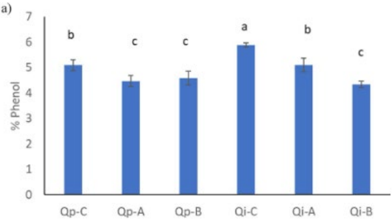
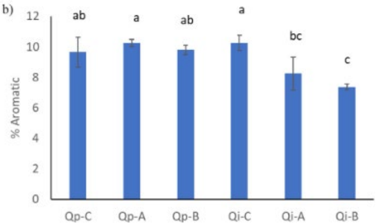
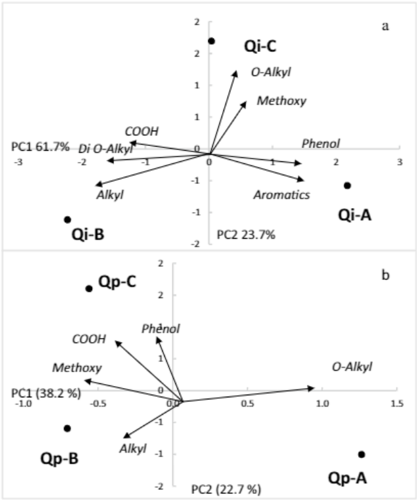
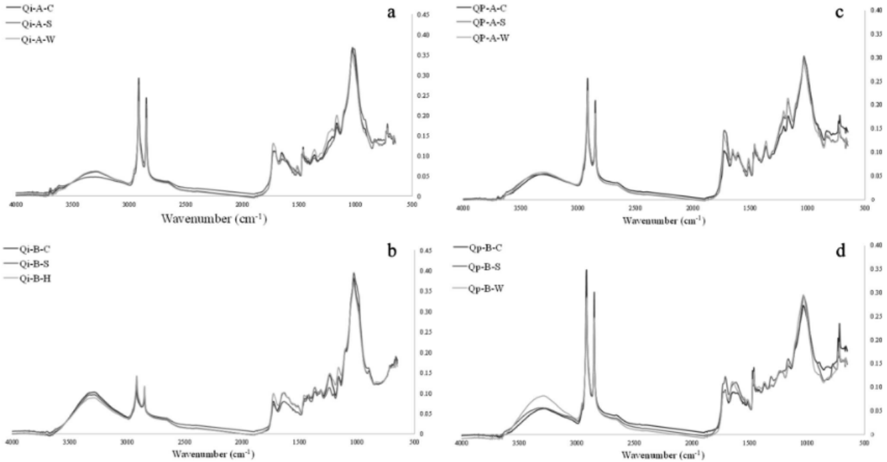
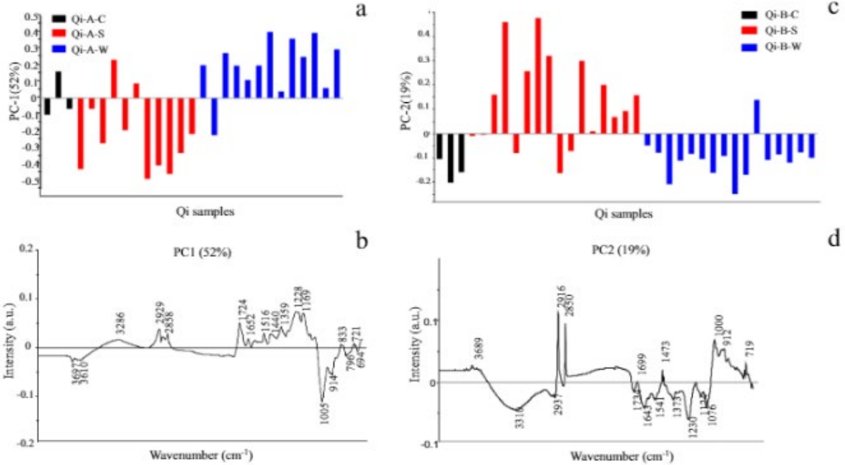
Photodegradation can play a key role in litter decomposition under the context of climate change which hinders organic matter turnover because of available water scarcity. Here, we aimed at testing the effect of a two-month sunlight exposure with different radiation intensities (either in winter or summer) on the chemical signature of two typical Mediterranean species, i.e., Quercus ilex and Q. pubescens . We also tested whether the side of the leaf exposed mattered in the chemical modification observed. To do so, two holistic chemical approaches, FTIR-ATR (Fourier transform infrared–attenuated total reflectance) and solid-state NMR of ^13C, were used. ANOVA from solid-state NMR of ^13C revealed that after exposure in summer, certain markers of lignin (phenol and aromatics) decreased in leaves whatever the Quercus spp. and it depended on the side of the leaf exposed. Lignin transformation thus occurred via dearomatization and/or dephenolization. Moreover, for both species, when leaves were exposed at their topside, their NMR chemical signatures were negatively correlated with alkyl assigned to cutin and waxes, showing that the thin layer of cuticle was attacked by photodegradation. FTIR-ATR spectra and NMR data also highlighted that a weaker irradiation (winter vs summer exposure) strongly limited lignin content decrease. Finally, lignin, cutin and wax oxidation, by enhancing the availability of polysaccharides from lignocellulose, may favor further litter transformation when suitable climate conditions (mainly humidity) are recovered.
Overview
The claims and statistics of this paper haven’t been checked yet.
Free: it reads the open-access text and checks the first 5 claims that cite a source we can check. Create a free account to check every claim.
Integrity signals
Registry
Cites
Statistics
Figures
Verification
Claims the paper makes
The claims and statistics of this paper haven’t been checked yet.
Free: it reads the open-access text and checks the first 5 claims that cite a source we can check. Create a free account to check every claim.
Claims other papers make about this one
Each is checked against this paper’s own text: does it say what the citing paper says it does?
The cited source says what the claim attributes to it.
In the citing paper
“This occurs through direct breakdown of the lignin component of plant litter (photomineralisation) by the radiation [201, 202] and indirectly by facilitating subsequent microbial degradation (photofacilitation) [203–205].”
Self-check
Percentages, sums and reported differences re-computed from the paper’s own numbers.
The self-check needs the paper’s full text.
Citations
Cites
Jolliffe, I. T. (1986) · Springer Series in Statistics · doi:10.1007/978-1-4757-1904-8 · Cited by 8,273
Modelling one‐ and two‐dimensional solid‐state NMR spectra
Massiot, D., Fayon, F., Capron, M., King, I., Le Calvé, S., Alonso, B., Durand, J., Bujoli, B., Gan, Z., & Hoatson, G. (2002) · Magnetic Resonance in Chemistry · doi:10.1002/mrc.984 · Cited by 4,279 · cited 1×
“Dmfit 2003 software was used to determine the intensity of each chemical shift region (Massiot et al. 2002).”
MethodFungal laccases – occurrence and properties
Baldrian, P. (2006) · FEMS Microbiology Reviews · doi:10.1111/j.1574-4976.2005.00010.x · Cited by 2,179
Litter decomposition, climate and liter quality
Couˆteaux, M.-M., Bottner, P., & Berg, B. (1995) · Trends in Ecology & Evolution · doi:10.1016/s0169-5347(00)88978-8 · Cited by 1,137
Plant litter decomposition in a semi-arid ecosystem controlled by photodegradation
Austin, A. T., & Vivanco, L. (2006) · Nature · doi:10.1038/nature05038 · Cited by 827 · cited 2×
“UV-B (280-320 nm) and UV-A (320-400 nm) are the major radiations of the light spectrum involved in photodegradation (Austin and Vivanco 2006; Brandt et al. 2007).”
BackgroundBaldock, J. A., Oades, J. M., Nelson, P. N., Skene, T. M., Golchin, A., & Clarke, P. (1997) · Soil Research · doi:10.1071/s97004 · Cited by 657
Changes in nutrient concentrations of leaves and roots in response to global change factors
Sardans, J., Grau, O., Chen, H. Y. H., Janssens, I. A., Ciais, P., Piao, S., & Peñuelas, J. (2017) · Global Change Biology · doi:10.1111/gcb.13721 · Cited by 255 · cited 1×
“, elemental compositions of leaves and root (Sardans et al. 2017) or modifications of chemical components such as cutin and waxes with higher proportions of longer aliphatic compounds (Heredia‐Guerrero et al.”
BackgroundPhotodegradation alleviates the lignin bottleneck for carbon turnover in terrestrial ecosystems
Austin, A. T., Méndez, M. S., & Ballaré, C. L. (2016) · Proceedings of the National Academy of Sciences · doi:10.1073/pnas.1516157113 · Cited by 231
Bornman, J. F., Barnes, P. W., Robinson, S. A., Ballaré, C. L., Flint, S. D., & Caldwell, M. M. (2014) · Photochemical & Photobiological Sciences · doi:10.1039/c4pp90034k · Cited by 226
Photo- and radiation chemical induced degradation of lignin model compounds
Lanzalunga, O., & Bietti, M. (2000) · Journal of Photochemistry and Photobiology B: Biology · doi:10.1016/s1011-1344(00)00054-3 · Cited by 196 · cited 1×
“Lanzalunga and Bietti (2000) described the reactivity of lignin to photodegradation using models including different lignin structural motifs.”
BackgroundBRANDT, L. A., KING, J. Y., & MILCHUNAS, D. G. (2007) · Global Change Biology · doi:10.1111/j.1365-2486.2007.01428.x · Cited by 167 · cited 1×
“UV-B (280-320 nm) and UV-A (320-400 nm) are the major radiations of the light spectrum involved in photodegradation (Austin and Vivanco 2006; Brandt et al. 2007).”
BackgroundSuseela, V., & Tharayil, N. (2018) · Global Change Biology · doi:10.1111/gcb.13923 · Cited by 140 · cited 2×
“Climate change can impact mineralization directly, by affecting microbial communities and their activities, and indirectly, by inducing plant responses to such stresses and thus modification in plant chemistry (Suseela and Tharayil 2018).”
BackgroundDay, T. A., Zhang, E., & Ruhland, C. T. (2007) · Plant Ecology · doi:10.1007/s11258-006-9257-6 · Cited by 137
Mathers, N. J., Jalota, R. K., Dalal, R. C., & Boyd, S. E. (2006) · Soil Biology and Biochemistry · doi:10.1016/j.soilbio.2006.11.009 · Cited by 113
Almagro, M., Maestre, F. T., Martínez‐López, J., Valencia, E., & Rey, A. (2015) · Soil Biology and Biochemistry · doi:10.1016/j.soilbio.2015.08.006 · Cited by 102
Richardson, A. D., Reeves, J. B., & Grégoire, T. G. (2003) · New Phytologist · doi:10.1046/j.1469-8137.2003.00913.x · Cited by 93
Wang, Q., Pieristè, M., Liu, C., Kenta, T., Robson, T. M., & Kurokawa, H. (2021) · New Phytologist · doi:10.1111/nph.17022 · Cited by 91
Duguay, K. J., & Klironomos, J. N. (2000) · Applied Soil Ecology · doi:10.1016/s0929-1393(00)00049-4 · Cited by 86 · cited 1×
“Photodegradation can indeed control litter mass loss directly, by breaking down molecules and releasing CO2, and indirectly, by favoring substrate availability for microbial activities (Duguay and Klironomos 2000).”
BackgroundPhotodegradation of plant litter in the Sonoran Desert varies by litter type and age
Day, T. A., Guénon, R., & Ruhland, C. T. (2015) · Soil Biology and Biochemistry · doi:10.1016/j.soilbio.2015.06.029 · Cited by 83
Day, T. A., Bliss, M. S., Tomes, A. R., Ruhland, C. T., & Guénon, R. (2018) · Global Change Biology · doi:10.1111/gcb.14438 · Cited by 77 · cited 1×
“Previous studies have underlined the importance of the type of litter on the efficiency of photodegradation (Day et al. 2018; Kirschbaum et al. 2011; Hunt and Seveny 2002) since the quantity of molecules absorbing UV varies with this factor.”
BackgroundThe role of biodegradation and photo-oxidation in the transformation of terrigenous organic matter
Feng, X., Hills, K. M., Simpson, A. J., Whalen, J. K., & Simpson, M. J. (2011) · Organic Geochemistry · doi:10.1016/j.orggeochem.2011.01.002 · Cited by 69
Litter decomposition in hyper-arid deserts: Photodegradation is still important
Huang, G., Zhao, H., & Li, Y. (2017) · The Science of The Total Environment · doi:10.1016/j.scitotenv.2017.05.213 · Cited by 59 · cited 3×
“Also, in deserts, a dependence of the effects of UV photodegradation of litter (shrubs, summer and spring annuals) decomposition on rainfall has been observed: Photodegradation effects were not strongest in the driest region (Huang et al. 2017) and litters decomposed faster under high-frequency than lowfrequency preci…”
BackgroundInfluentialModelling photodegradation in the global carbon cycle
Foereid, B., Rivero, M. J., Primo, Ó., & Ortíz, I. (2011) · Soil Biology and Biochemistry · doi:10.1016/j.soilbio.2011.03.004 · Cited by 45
Plant cuticle under global change: Biophysical implications
Heredia‐Guerrero, J. A., Guzmán‐Puyol, S., Benitez, J. J., Athanassiou, A., Heredia, A., & Domίnguez, E. (2018) · Global Change Biology · doi:10.1111/gcb.14276 · Cited by 45 · cited 1×
“2017) or modifications of chemical components such as cutin and waxes with higher proportions of longer aliphatic compounds (Heredia‐Guerrero et al., 2018).”
BackgroundBrunel, C., Gros, R., Ziarelli, F., & Farnet, A. (2017) · The Science of The Total Environment · doi:10.1016/j.scitotenv.2017.03.023 · Cited by 42
Self-citationHuang, G., & Li, Y. (2017) · Soil Biology and Biochemistry · doi:10.1016/j.soilbio.2017.08.034 · Cited by 41 · cited 2×
“In addition, the surface of the leaves and the proportion of lignin should also be factors to consider when studying the effects of UV photodegradation (Huang and Li 2017).”
BackgroundWang, Q.-W., Robson, T. M., Pieristè, M., Kenta, T., Zhou, W., & Kurokawa, H. (2022) · Science of The Total Environment · doi:10.1016/j.scitotenv.2022.153185 · Cited by 40 · cited 1×
“Moreover, it has to be noted that photodegradation in natura strongly depends on the intensity of UV radiations depending on biomes, on the covering canopy phenology (in deciduous forests), on the relative proportion of gaps vs understorey in the forests and thus on tree density (Wang et al. 2022).”
BackgroundLin, Y., King, J. Y., Karlen, S. D., & Ralph, J. (2015) · Biogeochemistry · doi:10.1007/s10533-015-0132-1 · Cited by 38
Kirschbaum, M. U. F., Lambie, S. M., & Zhou, H. (2011) · Soil Biology and Biochemistry · doi:10.1016/j.soilbio.2011.03.001 · Cited by 38 · cited 1×
“Previous studies have underlined the importance of the type of litter on the efficiency of photodegradation (Day et al. 2018; Kirschbaum et al. 2011; Hunt and Seveny 2002) since the quantity of molecules absorbing UV varies with this factor.”
BackgroundPieristè, M., Forey, E., Lounès-Hadj Sahraoui, A., Meglouli, H., Laruelle, F., Delporte, P., Robson, T. M., & Chauvat, M. (2020) · Plant and Soil · doi:10.1007/s11104-020-04557-6 · Cited by 37
UV radiation doubles microbial degradation of standing litter in a subtropical forest
Jiang, H., Pan, Y., Liang, J., Yang, Y., Chen, Q., Lv, M., Pang, L., He, W., & Tian, X. (2022) · Journal of Ecology · doi:10.1111/1365-2745.13939 · Cited by 35
Pieristè, M., Neimane, S., Solanki, T., Nybakken, L., Jones, A. G., Forey, E., Chauvat, M., Ņečajeva, J., & Robson, T. M. (2020) · Plant Physiology and Biochemistry · doi:10.1016/j.plaphy.2019.11.005 · Cited by 33
Esch, E. H., King, J. Y., & Cleland, E. E. (2019) · Plant and Soil · doi:10.1007/s11104-019-04069-y · Cited by 22
Delcourt, N., Rébufa, C., Dupuy, N., Boukhdoud, N., Brunel, C., Abadie, J., Giffard, I., & Farnet, A. (2019) · The Science of The Total Environment · doi:10.1016/j.scitotenv.2019.05.240 · Cited by 22 · cited 1×
“Both techniques have been proved to be useful tools to describe organic matter “fingerprint” in litters and soils and discriminate chemical signature depending on plant species and decomposition stage (Farnet-Da Silva et al. 2017; Delcourt et al. 2019; Richardson et al. 2004).”
MethodLambie, S. M., Kirschbaum, M. U. F., & Dando, J. (2013) · Soil Biology and Biochemistry · doi:10.1016/j.soilbio.2013.10.037 · Cited by 19
Farnet, A., Ferré, E., Dupuy, N., de la Boussinière, A., & Rébufa, C. (2017) · Soil Biology and Biochemistry · doi:10.1016/j.soilbio.2017.06.026 · Cited by 17
Mao, B., Zhao, L., Zhao, Q., & Zeng, D. (2018) · Journal of Arid Land · doi:10.1007/s40333-018-0054-6 · Cited by 17 · cited 1×
“Conversely to some studies assessing how UV radiation, the seasonal canopy phenology, the litter layer thickness or their interaction may affect litter photodegradation (Wang et al. 2020; Mao et al. 2018), the scenario chosen here was to”
BackgroundBoukhdoud, N., Gros, R., Darwish, T., & Farnet, A. (2016) · European Journal of Soil Science · doi:10.1111/ejss.12347 · Cited by 14
Kheir, M., Lerch, T. Z., Borsali, A. H., Roche, P. K., Ziarelli, F., Zouidi, M., & Farnet, A. (2020) · Applied Soil Ecology · doi:10.1016/j.apsoil.2020.103681 · Cited by 9
Self-citation
Research works printed but not linked: 3
- Gliksman D, Haenel S, Osem Y, Yakir D, Zangy E, Preisler Y, Grünzweig JM (2017) Litter decomposition in Mediterranean pine forests is enhanced by reduced canopy cover. Plant Soil 422:317-329. https://doi.org/10.1007/s1110.4-017-3366-y · doi:10.1007/s1110.4-017-3366-y
- Hunt JE, Mc Seveny TM (2002) Seasonal changes of UV-absorbing compounds in the leaves of two native trees, UV radiation and its effects: an update 2002. Royal Society of New Zealand, Christchurch, New Zealand, p 124
- Kheir M, Roche P, Ziarelli F, Farnet da Silva AM (2019) Mediterranean coastal conditions and litter type drive litter microbial responses to drought stress. Eur J Soil Sci 12:828
Cited by
Photodegradation in terrestrial ecosystems
Austin, A. T., & Ballaré, C. L. (2024) · New Phytologist · doi:10.1111/nph.20105 · Cited by 37
Neale, P. J., Hylander, S., Banaszak, A. T., Häder, D.-P., Rose, K. C., Vione, D., Wängberg, S.-Å., Jansen, M. A. K., Busquets, R., Andersen, M. P. S., et al. (2025) · Photochemical & Photobiological Sciences · doi:10.1007/s43630-025-00687-x · Cited by 32
“This occurs through direct breakdown of the lignin component of plant litter (photomineralisation) by the radiation [201, 202] and indirectly by facilitating subsequent microbial degradation (photofacilitation) [203–205].”
Chang, L., Deng, J., Zhang, J., Fu, Q., Wang, T., Osono, T., Peng, H., Robson, T. M., Kurokawa, H., & Wang, Q. (2025) · Journal of Forestry Research · doi:10.1007/s11676-024-01811-w · Cited by 6
“After the two-month exposure in summer, lignin markers (both aromatic and phenol) significantly decreased, and the leaf chemical signature was characterized by polysaccharides (Farnet Da Silva et al. 2023).”
InfluentialRegus, F., Farnet, A., Prudent, P., Foli, L., Capowiez, Y., Vassalo, L., Dupuy, N., Folzer, H., & Laffont‐Schwob, I. (2026) · Scientia Horticulturae · doi:10.1016/j.scienta.2026.115090
Self-citation
Metadata
- Authors
- Farnet Da Silva, A.-M., Foli, L., Boudenne, J.-L., Ziarelli, F., & Rebufa, C.
- Affiliations
- Centre National de la Recherche Scientifique (FR)
- Venue
- European Journal of Forest Research
- Published
- 2022-12-21
- Volume
- 142
- Issue
- 2
- Pages
- 275-286
- ISSN
- 1612-4669 (ISSN-L)
- 1612-4677
- OpenAlex
- W4312070913
- Cited by
- 4
- References
- 39
- Citations by year
- 2026: 1 · 2025: 2 · 2024: 1
- FWCI
- 0.42
- Type
- journal article
- Language
- en
- Open access
- green
- hal.science
- Licence
- cc-by
- www.springernature.com/gp/researchers/text-and-data-mining (tdm)
- www.springernature.com/gp/researchers/text-and-data-mining (vor)
- Locations
- European Journal of Forest Research (publishedVersion)
- HAL AMU (submittedVersion, cc-by)
- Funders
- Aix Marseille Université
- Topics
- Life Sciences › Agricultural and Biological Sciences › Soil Science › Soil Carbon and Nitrogen Dynamics
- Physical Sciences › Environmental Science › Ecology › Environmental and biological studies
- Physical Sciences › Chemical Engineering › Process Chemistry and Technology › Lignin and Wood Chemistry
- Keywords
- photodegradation, plant litter, litter decomposition, Quercus ilex, Quercus pubescens, lignin, cutin, cuticular wax, radiation intensity, Mediterranean forests, organic matter turnover, climate change
About these checks
Registry, retraction, Cites and statistics results are computed, not judged, with one exception: a printed reference that no index lists is read once by a model before it counts as a citation error. Claims are extracted by a model and kept only when their quote appears verbatim in the text; each cited source is then checked, with a model’s help, for whether it says what the claim relies on. Those verdicts can be wrong — read the claim’s quote and the cited source before relying on one.
Statistics and arithmetic are recomputed, not judged.
Confidence bands are shown only for fields calibrated on our annotated test set. None is calibrated yet, so no band is shown.
What counts as a claim ›How we measure confidence ›How we check this ›
Are you an author, or do you see a problem with this page? Request a review
Data sources
Bibliographic data: Semantic Scholar, OpenAlex, Crossref.
Contains information from the Semantic Scholar Academic Graph Datasets, made available under the ODC Attribution License (ODC-BY 1.0).
Semantic Scholar’s data is described in: Kinney, R., et al. (2023). The Semantic Scholar Open Data Platform. arXiv:2301.10140.
