

The Effects of School-Based Condom Availability Programs (CAPs) on Condom Acquisition, Use and Sexual Behavior: A Systematic Review
Open accessThe DOI matches its Crossref record; 18 of the 18 references it cites were found in a registry or an index.
Abstract
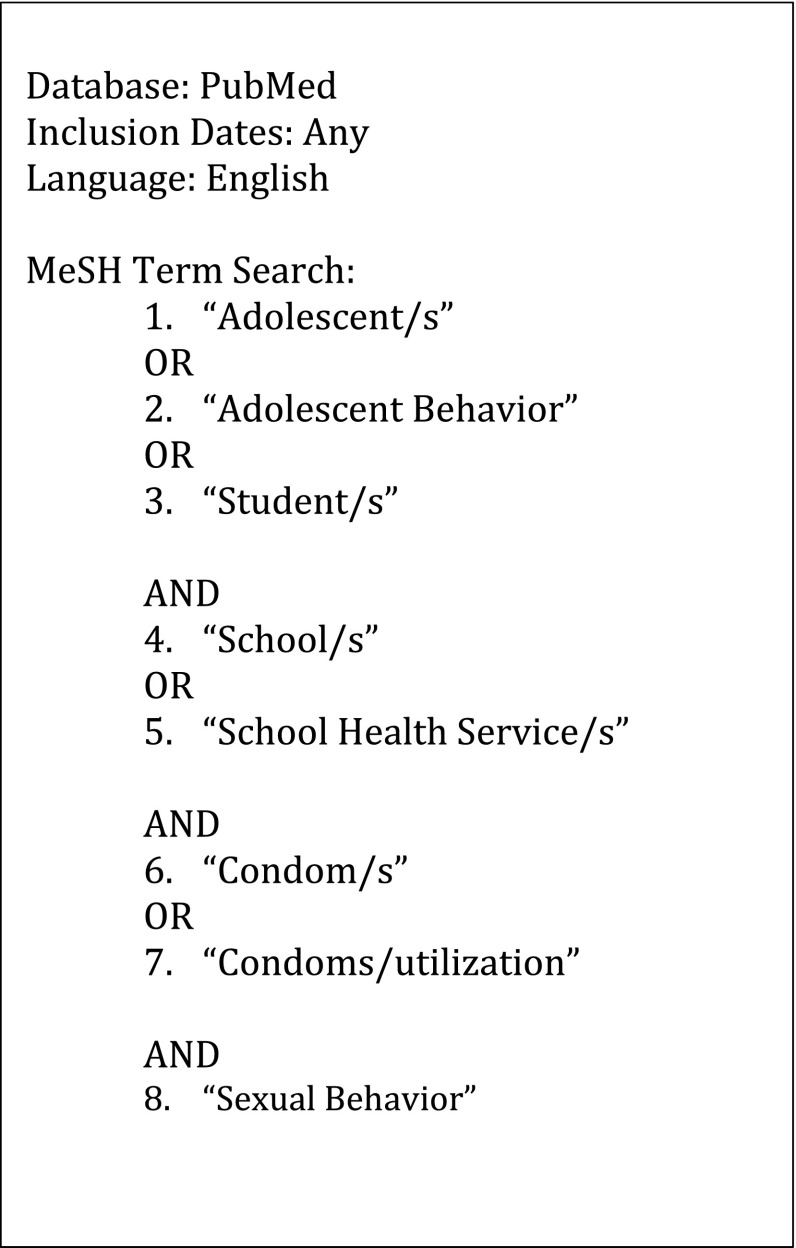
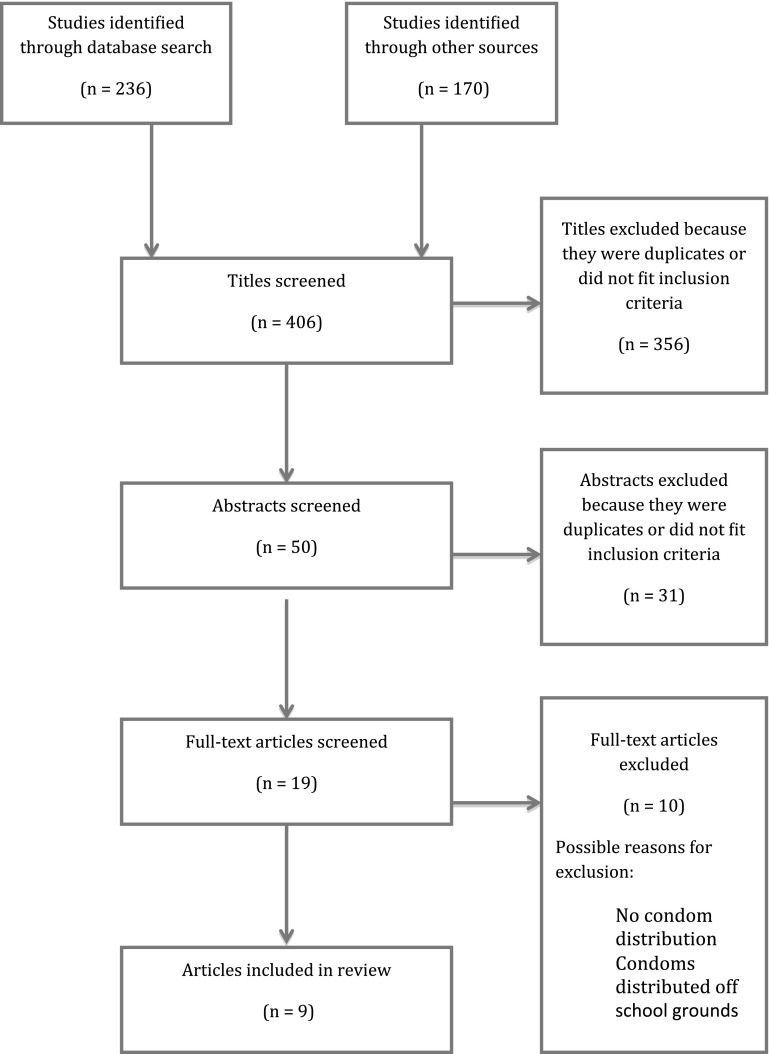
We conducted a systematic review to assess the impact of school-based condom availability programs (CAPs) on condom acquisition, use and sexual behavior. We searched PubMed to identify English-language studies evaluating school-based CAPs that reported process (i.e. number of condoms distributed or used) and sexual behavior measures. We identified nine studies that met our inclusion criteria, with the majority conducted in the United States of America. We judged most studies to have medium risk of bias. Most studies showed that school-based CAPs increased the odds of students obtaining condoms (odds ratios (ORs) for individual studies ranged between 1.81 and 20.28), and reporting condom use (OR 1.36-3.2). Three studies showed that school-based CAPs positively influenced sexual behavior, while no studies reported increase in sexual activity. Findings suggest that school-based CAPs may be an effective strategy for improving condom coverage and promoting positive sexual behaviors.
Overview
The claims and statistics of this paper haven’t been checked yet.
Free: it reads the open-access text and checks the first 5 claims that cite a source we can check. Create a free account to check every claim.
Integrity signals
Registry
Cites
Statistics
Figures
Verification
Claims the paper makes
The claims and statistics of this paper haven’t been checked yet.
Free: it reads the open-access text and checks the first 5 claims that cite a source we can check. Create a free account to check every claim.
Claims other papers make about this one
Each is checked against this paper’s own text: does it say what the citing paper says it does?
The source backs part of the claim, not all of it — or backs it for a different population, condition or comparison.
In the citing paper
“Further, despite frequently voiced public concerns to the contrary, evidence clearly indicates that providing access to sexual health information and services does not hasten sexual initiation or increase sexual frequency or number of partners (Dreweke, 2019; Wang, 2018).”
From The role (and limits) of developmental neuroscience in determining adolescents' autonomy rights: The case for reproductive and voting rights (2024) · cites this paper as Wang, 2018
Experimental — accuracy not yet measured
Self-check
Percentages, sums and reported differences re-computed from the paper’s own numbers.
The self-check needs the paper’s full text.
Citations
Cites
The Joint United Nations Programme on HIV / AIDS (UNAIDS). Project update.
(1999) · PubMed · Cited by 909
Bearinger, L. H., Sieving, R. E., Ferguson, J., & Sharma, V. (2007) · The Lancet · doi:10.1016/s0140-6736(07)60367-5 · Cited by 762
Contraception for adolescents in low and middle income countries: needs, barriers, and access
Chandra-Mouli, V., McCarraher, D. R., Phillips, S. J., Williamson, N. E., & Hainsworth, G. (2014) · Reproductive Health · doi:10.1186/1742-4755-11-1 · Cited by 687 · cited 1×
“Given that contraception is an effective and low-cost method for preventing STIs and pregnancy, lack of availability of contraception is a missed opportunity for SBHCs to help prevent STIs and unwanted pregnancies in adolescents and young adults [4, 10].”
Chandra-Mouli, V., Camacho, A. V., & Michaud, P.-A. (2013) · Journal of Adolescent Health · doi:10.1016/j.jadohealth.2013.03.002 · Cited by 593 · cited 1×
“Annually, an estimated 16 million adolescents (15–19 years) give birth in low- and middle-income countries, with complications from childbirth being the leading cause of mortality among adolescent females [3].”
BackgroundComprehensive approaches to school health promotion: how to achieve broader implementation?
Deschesnes, M. (2003) · Health Promotion International · doi:10.1093/heapro/dag410 · Cited by 297 · cited 4×
“The Comprehensive School Health Program (CSHP) was also developed during this period and & Darshini Govindasamy darshini.govindasamy@mrc.ac.za 1 Health Policy Research Department, The Fenway Institute, Fenway Health, Boston, MA, USA 2 Department of Epidemiology, Brown University School of Public Health, Providence, RI…”
BackgroundInfluentialEstablishing a new journal for systematic review products
Moher, D., Stewart, L., & Shekelle, P. (2012) · Systematic Reviews · doi:10.1186/2046-4053-1-1 · Cited by 245
Mason-Jones, A. J., Crisp, C., Momberg, M., Koech, J., De Koker, P., & Mathews, C. (2012) · Systematic Reviews · doi:10.1186/2046-4053-1-49 · Cited by 145 · cited 4×
“Given that contraception is an effective and low-cost method for preventing STIs and pregnancy, lack of availability of contraception is a missed opportunity for SBHCs to help prevent STIs and unwanted pregnancies in adolescents and young adults [4, 10].”
BackgroundResultInfluentialSelf-citationBlake, S. M., Ledsky, R., Goodenow, C. S., Sawyer, R., Lohrmann, D. K., & Windsor, R. A. (2003) · American Journal of Public Health · doi:10.2105/ajph.93.6.955 · Cited by 139 · cited 7×
“8) were two times higher among students that attended schools with CAPs [17].”
BackgroundMethodInfluentialGuttmacher, S. J., Lieberman, L., Ward, D., Freudenberg, N., Radosh, A., & Jarlais, D. D. (1997) · American Journal of Public Health · doi:10.2105/ajph.87.9.1427 · Cited by 123 · cited 6×
“Most studies also reported increases in condom use among students who attended schools with CAPs, particularly among sexually active students in their last sexual intercourse [11, 17, 20].”
BackgroundMethodInfluentialKirby, D. B., Brener, N. D., Brown, N. L., Peterfreund, N., Hillard, P., & Harrist, R. B. (1999) · American Journal of Public Health · doi:10.2105/ajph.89.2.182 · Cited by 114
Cited by
Duby, Z., Jonas, K., Appollis, T. M., Maruping, K., Dietrich, J. J., & Mathews, C. (2021) · International Journal of Sexual Health · doi:10.1080/19317611.2020.1851334 · Cited by 93
“The perception that the provision of free condoms in schools will promote earlier sexual debut and increased sexual activity has long been a socially divisive issue (Han & Bennish, 2009; Wang et al., 2018).”
BackgroundSelf-citationVaivada, T., Lassi, Z. S., Irfan, O., Salam, R. A., Das, J. K., Oh, C., Carducci, B., Jain, R. P., Als, D., Sharma, N., et al. (2022) · The Lancet · doi:10.1016/s0140-6736(21)02725-2 · Cited by 89
Dombola, G. M., Manda, W. C., & Chipeta, E. K. (2021) · Reproductive Health · doi:10.1186/s12978-021-01259-9 · Cited by 69
Adekola, A. P., & Mavhandu‐Mudzusi, A. H. (2021) · Sexuality Research and Social Policy · doi:10.1007/s13178-021-00651-1 · Cited by 58
George, G., Beckett, S., Reddy, T., Govender, K., Cawood, C., Khanyile, D., & Kharsany, A. B. M. (2022) · JAIDS Journal of Acquired Immune Deficiency Syndromes · doi:10.1097/qai.0000000000002951 · Cited by 44
Promoting sexual health in schools: a systematic review of the European evidence
Abrams, R., Nordmyr, J., & Forsman, A. K. (2023) · Frontiers in Public Health · doi:10.3389/fpubh.2023.1193422 · Cited by 36
“Furthermore, previous review studies covering adolescent sexual health have primarily focused on North America (33) or employed a global perspective (32, 34).”
BackgroundBarrier Protection Use by Adolescents During Sexual Activity
Grubb, L. K., Alderman, E. M., Chung, R. J., Lee, J. B., Powers, M. E., Rahmandar, M. H., Upadhya, K. K., & Wallace, S. B. (2020) · PEDIATRICS · doi:10.1542/peds.2020-007245 · Cited by 31
Condom Availability Programs in Schools: A Review of the Literature
Andrzejewski, J., Liddon, N. C., & Leonard, S. B. (2018) · American Journal of Health Promotion · doi:10.1177/0890117118791118 · Cited by 29
Logie, C. H., Lys, C. L., Okumu, M., & Fujioka, J. K. (2018) · Vulnerable Children and Youth Studies · doi:10.1080/17450128.2018.1554277 · Cited by 27
“Adolescent sexual practices such as condomless sex may negatively affect adolescent wellbeing, including STI acquisition and transmission and unintended pregnancies (Public Health Agency of Canada, 2012; Wang et al., 2018).”
BackgroundLogie, C. H., Lys, C. L., Mackay, K. I., MacNeill, N., Pauchulo, A., & Yasseen, A. S. (2019) · International Journal of Behavioral Medicine · doi:10.1007/s12529-019-09797-0 · Cited by 25
Barrier Protection Use by Adolescents During Sexual Activity
Grubb, L. K., Alderman, E. M., Chung, R. J., Lee, J. B., Powers, M. E., Rahmandar, M. H., Upadhya, K. K., & Wallace, S. B. (2020) · PEDIATRICS · doi:10.1542/peds.2020-007237 · Cited by 24
Richter, M. L., & Buthelezi, K. (2021) · Springer eBooks · doi:10.1007/978-3-030-64171-9_8 · Cited by 20
Andrzejewski, J., Pampati, S., Johns, M. M., Sheremenko, G., Lesesne, C. A., & Rasberry, C. N. (2020) · Journal of School Health · doi:10.1111/josh.12880 · Cited by 21
Heslop, C. W., Burns, S. K., & Lobo, R. C. (2019) · Sex Education · doi:10.1080/14681811.2019.1566120 · Cited by 17
Szucs, L. E., Demissie, Z., Steiner, R. J., Brener, N. D., Lindberg, L., Young, E., & Rasberry, C. N. (2022) · Health Education Research · doi:10.1093/her/cyac032 · Cited by 15
Hamid, N. C., Malek, K. A., Nasir, N. M., Mohamad, M., & Nasir, N. M. N. M. (2022) · International Journal of Environmental Research and Public Health · doi:10.3390/ijerph191912179 · Cited by 14
“These findings might be contributed to condom initiative programs that they implement among youth [36,37].”
BackgroundRisky sexual behaviors and substance use among youths in post-conflict Liberia
Ogundare, T., Ghebrehiwet, S., Benjamin, L. H., Ojediran, B., Alison, M. D., Haniya, S. S., David, C. H., & Borba, C. P. C. (2020) · Journal of Public Health and Epidemiology · doi:10.5897/jphe2020.1219 · Cited by 12
“Making condoms accessible is an effective strategy in increasing condom use and promoting positive sexual behaviors among youths (Wang et al., 2018).”
BackgroundAbrams, J. A., Rutledge, J., & Opara, I. N. (2023) · Preventive Medicine · doi:10.1016/j.ypmed.2023.107445 · Cited by 11
“…resources in convenient and easily accessible community-based locations (e.g., night clubs, shopping centers, community centers, barbershops, hair salons, home-less shelters, schools, universities) can increase their uptake and utilization (Faina & Lavazza; Sutton et al., 2010; Wang et al., 2018).”
A Perspective on Implementation Outcomes and Strategies to Promote the Uptake of COVID-19 Vaccines
Pilar, M. R., Elwy, A. R., Lushniak, L. M., Huang, G. C., McLoughlin, G. M., Hooley, C., Nadesan-Reddy, N., Sandler, B., Moshabela, M., Alonge, O., et al. (2022) · Frontiers in Health Services · doi:10.3389/frhs.2022.897227 · Cited by 10
To Save a Girl-Child, You Must Train a Boy-Child: A Note on Situational Irony
Amoo, E. O., Adebayo, M. E., Owoeye, M. O., & Egharevba, M. E. (2022) · International Journal of Environmental Research and Public Health · doi:10.3390/ijerph192316313 · Cited by 10
“The profound objectives and effectiveness lie in stopping or reducing unprotected sexual activity and its consequences such as unintended pregnancy and curbing the spread of sexually transmitted diseases (STDs) including HIV and AIDS [41,42].”
BackgroundMaina, B. W., Juma, K. O., Igonya, E. K., Osindo, J., Wao, H., & Kabiru, C. W. (2021) · BMJ Open · doi:10.1136/bmjopen-2020-044398 · Cited by 10
Villa-Rueda, A. A., Landeros-Olvera, E., Manjarres-Posada, N. I., & Benavides-Torres, R. A. (2020) · Nova Scientia · doi:10.21640/ns.v12i25.2296 · Cited by 9
Chawhanda, C., Ogunlela, T. O., Mapuroma, R., Ojifinni, O. O., Bwambale, M. F., Levin, J., & Ibisomi, L. (2021) · African Journal of Reproductive Health · doi:10.29063/ajrh2021/v25i3.7 · Cited by 9
Fretheim, A., Elgersma, I. H., Kristiansen, F. A., Varmbo, C. R., Olsbø, M. K. S., Glover, I. H. S., & Flatø, M. (2021) · International Journal of Environmental Research and Public Health · doi:10.3390/ijerph18178971 · Cited by 10
Ramos‐Ortiz, J., Strube, O. L., Kinman, N., Meier, S., & DeMaria, A. L. (2020) · The European Journal of Contraception & Reproductive Health Care · doi:10.1080/13625187.2020.1810226 · Cited by 9
Maslowsky, J., Buss, E., & Wray-Lake, L. (2024) · Developmental Cognitive Neuroscience · doi:10.1016/j.dcn.2024.101435 · Cited by 8
“Further, despite frequently voiced public concerns to the contrary, evidence clearly indicates that providing access to sexual health information and services does not hasten sexual initiation or increase sexual frequency or number of partners (Dreweke, 2019; Wang, 2018).”
Debele, G. R., Tsegaye, D., Gemechu, T., & Siraj, S. Z. (2022) · PLoS ONE · doi:10.1371/journal.pone.0271906 · Cited by 8
Multilevel Barriers to Sexual Health Behavior Among Vulnerable Adolescent Girls in the USA
Kamke, K., Stewart, J., & Widman, L. M. (2021) · Sexuality Research and Social Policy · doi:10.1007/s13178-021-00594-7 · Cited by 8
Smith, S., Platt, J., Clifford, D. R., Preston, M. A., Satterwhite, C. L., Kelly, P. J., & Ramaswamy, M. (2019) · The Journal of School Nursing · doi:10.1177/1059840518824728 · Cited by 8
“School nurses need evidence of CAPs that have succeeded over time.”
BackgroundInfluentialBehavioural science to improve effectiveness of HIV programmes, South Africa
George, G., Maughan‐Brown, B., & Thirumurthy, H. (2021) · Bulletin of the World Health Organization · doi:10.2471/blt.21.285626 · Cited by 6
Promoting Condom Use Through a Youth-Focused Community-Wide Free Condom Distribution Initiative
Tibbits, M. K., Ndashe, T. P., King, K. M., & Siahpush, M. (2018) · American Journal of Public Health · doi:10.2105/ajph.2018.304679 · Cited by 3
Junck, L. D., & George, G. (2022) · African Journal of AIDS Research · doi:10.2989/16085906.2022.2040550 · Cited by 3
“This is despite evidence suggesting that condom availability at schools can be an effective strategy for improving condom coverage and reducing risky sexual behaviour (Wang et al., 2018), while also showing that sexuality education (Paul-Ebhohimhen et al.”
BackgroundInfluentialDombola, G. M., Chipeta, E. K., & Manda, W. C. (2021) · Research Square · doi:10.21203/rs.3.rs-71529/v2 · Cited by 3
Nisengwe, S., Habtu, M., Asingizwe, D., Ntakirutimana, T., Dodoo, N. D., Woolway, E., Drake, J. K., Karamage, E., Ndikubwimana, L. F., & Rutayisire, E. (2026) · Contraception and Reproductive Medicine · doi:10.1186/s40834-026-00435-1 · Cited by 2
“Moreover, poverty led to increase of school dropout which can limit teenagers to access knowledge to make informed decision related to contraceptive use [48, 49].”
(2024) · Journal of Advocacy, Research and Education/Journal of advocacy, research and education · doi:10.13187/jare.2024.2.282 · Cited by 2
Enablers and deterrents on the school-based condom availability and distribution: a scoping review
Reñosa, M. D. C., Palola, T. K. F., & Antonio, C. A. T. (2020) · Journal of Global Health Reports · doi:10.29392/001c.12676 · Cited by 2
1992, S. L. E., & 1993, S. J. (2018) · Skemman · Cited by 2
Sanyaolu, O., Olaniyan, A. C., Reeves-Doyle, B., Addy, T. N. A., Dutta, T., Gregory, K. A., & Braithwaite, R. (2026) · Journal of American College Health · doi:10.1080/07448481.2026.2647038 · Cited by 1
“11,16 Some participants described their experiences of condom failure or peers’ unprotected sex, which raised their perceived susceptibility to contract STIs and unintended pregnancies, informing the use of the SRHVM to access SRH products.”
Siu, W. H. S., Tsai, L.-H., Li, P., & See, L. (2022) · Journal of Public Health · doi:10.1007/s10389-022-01772-6 · Cited by 1
“This might be because of the preconception that promoting condom use in high schools may encourage risky sexual behaviors, despite long-standing evidence suggesting otherwise (Wang et al. 2018).”
BackgroundDombola, G. M., Chipeta, E. K., & Manda, W. C. (2020) · Research Square · doi:10.21203/rs.3.rs-71529/v1 · Cited by 1
Predictors of Condom Use Among High School Students in North Carolina
Robinson, D. C. (2020) · ScholarWorks (Walden University)
Comparison of Contraception Method and Associated Risk Among US High School Students
Dunn, M. S. (2023) · Psychological Reports · doi:10.1177/00332941231169667
Carabbacan, H. T., Caballes, M. M., & Galvez, A. (2025) · INTERNATIONAL JOURNAL OF SOCIAL SCIENCE AND EDUCATION RESEARCH STUDIES · doi:10.55677/ijssers/v05i06y2025-15
Teaching, Learning and Promoting Sexual and Reproductive Health in Senior High Schools in Indonesia
Ridwan, R. (2024) · UNSWorks (University of New South Wales, Sydney, Australia) · doi:10.26190/unsworks/30376
McMenamin, S. B., Coppernoll-Blach, P., Melnikow, J. A., Weyrich, M. S., Pourat, N., Keller, M., Hammer, C., Roberson, A. L., Foster, D. G., Tsou, A.-C., et al. (2021) · eScholarship (California Digital Library) · doi:10.13140/rg.2.2.12464.48647
Barriers to Consistent Condom Use Among Young People in Ireland
Garcia-Guerrero, S., Lawlor, R., Bourke, A., Gilmore, J., Kelleher, C., Lohan, M., O’Connell, N., Neary, M., Siersbaek, R., Villa, G., et al. (2026) · International Journal of Sexual Health · doi:10.1080/19317611.2026.2753721
Sex Work, Health, and Human Rights: Global Inequities, Challenges, and Opportunities for Action
Goldenberg, S. M., Morgan-Thomas, R., Forbes, A., & Baral, S. (n.d.) · Summit (Simon Fraser University)
Preventing Teen Pregnancy Through Expanded Contraceptive Access in McCreary County, Kentucky
Chitwood, D. B. (2026) · UKnowledge (University of Kentucky)
Educação sexual e contracepção para adolescentes nas escolas: uma revisão sistemática
Araujo, M. V. L., & de Mesquita, J. C. (2026) · RAMB Revista da Associação Médica Brasileira Junior Doctors · doi:10.5327/2965-0682-20256207
Evaluating student use, access, and perceptions of a campus sexual health vending machine
Sheng, G., & Gualtieri, L. (2026) · Frontiers in Public Health · doi:10.3389/fpubh.2026.1916539
Metadata
- Authors
- Wang, T., Lurie, M., Govindasamy, D., & Mathews, C.
- Affiliations
- Fenway Health (US)
- Brown University (US)
- South African Medical Research Council (ZA)
- Corresponding author
- Govindasamy, Darshini
- Venue
- AIDS and Behavior
- Published
- 2017-06-17
- Volume
- 22
- Issue
- 1
- Pages
- 308-320
- ISSN
- 1090-7165 (ISSN-L)
- 1573-3254
- PMC
- PMC5758683
- OpenAlex
- W2625516638
- Cited by
- 40
- References
- 18
- Citations by year
- 2026: 4 · 2024: 1 · 2023: 3 · 2022: 9 · 2021: 9 · 2020: 8 · 2019: 3 · 2018: 3
- FWCI
- 0.67
- Type
- journal article
- Language
- en
- Open access
- hybrid
- doi.org
- Locations
- AIDS and Behavior (publishedVersion, cc-by)
- Europe PMC (PubMed Central) (publishedVersion, cc-by)
- PubMed Central (publishedVersion, cc-by)
- PubMed (publishedVersion)
- LSHTM Research Online (London School of Hygiene and Tropical Medicine) (acceptedVersion)
- Funders
- South African Medical Research Council
- Medical Research Council
- Topics
- Health Sciences › Medicine › Public Health, Environmental and Occupational Health › Adolescent Sexual and Reproductive Health
- Health Sciences › Medicine › Infectious Diseases › HIV/AIDS Research and Interventions
- Health Sciences › Medicine › Public Health, Environmental and Occupational Health › Reproductive Health and Contraception
- Keywords
- condom use, sexual behavior, adolescent sexual health, HIV prevention, condom distribution
- MeSH terms
- Adolescent, Adolescent Behavior, Data Collection, Female, Health Services Accessibility, Humans, Health Knowledge, Attitudes, Practice, Male, School Health Services, Schools, Sexual Behavior, Students, United States, Condoms
About these checks
Registry, retraction, Cites and statistics results are computed, not judged, with one exception: a printed reference that no index lists is read once by a model before it counts as a citation error. Claims are extracted by a model and kept only when their quote appears verbatim in the text; each cited source is then checked, with a model’s help, for whether it says what the claim relies on. Those verdicts can be wrong — read the claim’s quote and the cited source before relying on one.
Statistics and arithmetic are recomputed, not judged.
Confidence bands are shown only for fields calibrated on our annotated test set. None is calibrated yet, so no band is shown.
What counts as a claim ›How we measure confidence ›How we check this ›
Are you an author, or do you see a problem with this page? Request a review
Data sources
Bibliographic data: Semantic Scholar, OpenAlex, Crossref.
Contains information from the Semantic Scholar Academic Graph Datasets, made available under the ODC Attribution License (ODC-BY 1.0).
Semantic Scholar’s data is described in: Kinney, R., et al. (2023). The Semantic Scholar Open Data Platform. arXiv:2301.10140.
