

The DOI matches its Crossref record; 73 of the 73 references it cites were found in a registry or an index; none of the 20 sources its claims cite is checked for support yet.
Home advantage and mispricing in indoor sports’ ghost games: the case of European basketball
Open accessAbstract
Several recent studies suggest that the home advantage, that is, the benefit competitors accrue from performing in familiar surroundings, was—at least temporarily—reduced in games played without spectators due to the COVID-19 Pandemic. These games played without fans during the Pandemic have been dubbed ‘ghost games’. However, the majority of the research to date focus on soccer and no contributions have been provided for indoor sports, where the effect of the support of the fans might have a stronger impact than in outdoor arenas. In this paper, we try to fill this gap by investigating the effect of ghost games in basketball with a special focus on the possible reduction of the home advantage due to the absence of spectators inside the arena. In particular, we test (i) for the reduction of the home advantage in basketball, (ii) whether such reduction tends to disappear over time, (iii) if the bookmakers promptly adapt to such structural change or whether mispricing was created on the betting market. The results from a large data set covering all seasons since 2004 for the ten most popular and followed basketball leagues in Europe show, on the one hand, an overall significant reduction of the home advantage of around 5% and no evidence that suggests that this effect has been reduced at as teams became more accustomed to playing without fans; on the other hand, bookmakers appear to have anticipated such effect and priced home win in basketball matches accordingly, thus avoiding creating mispricing on betting markets.
Overview
CoChat Summary
TL;DR
Ghost games in the top ten European basketball leagues reduced the home advantage by about 5 percentage points, and this reduction did not diminish as teams played more games without fans. Bookmakers anticipated the drop in home-win probability, so no systematic mispricing appeared in the betting markets.
Key findings
- Across 27,691 matches (1,026 ghost games), the home-win percentage fell from 61.1% pre-Covid to 56.0% post-Covid, a significant decrease of 5.1% (p<0.01). In linear probability models, ghost games reduced the home-win probability by about 5% (β = –0.0505* in model 1; β = –0.0474* in model 2).
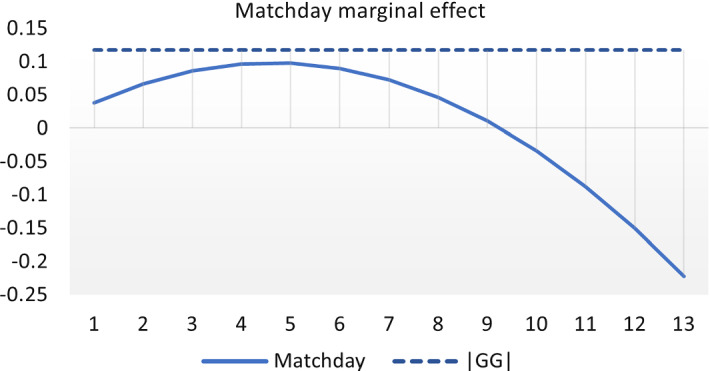
- The effect did not appear temporary: adding Matchday and Matchday² gave a positive linear term (0.0424*) and negative quadratic term (–0.0046), with the maximum marginal effect at about five ghost home games, but this was not enough to offset the negative ghost-game effect (β = –0.1174).
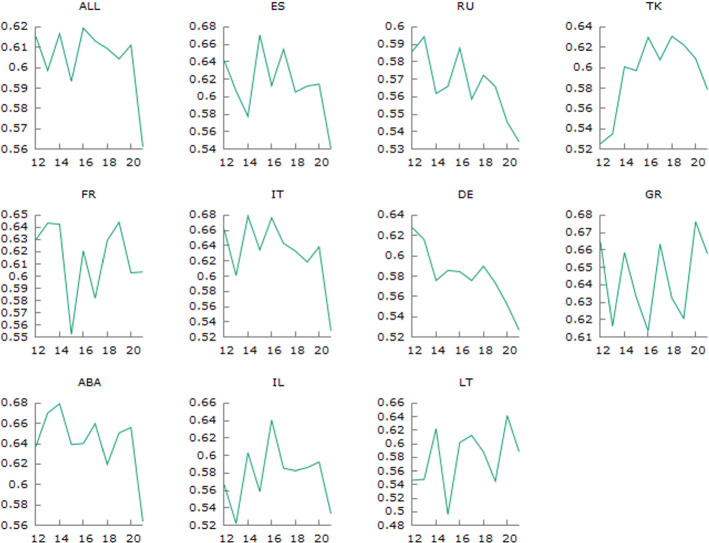
- League-level ghost-game effects did not differ significantly across leagues (H0: β6 = 0 not rejected), though overall home-win probabilities varied by league (lowest in Russia at 56.6%, highest in the Adriatic ABA league at 65.7%).
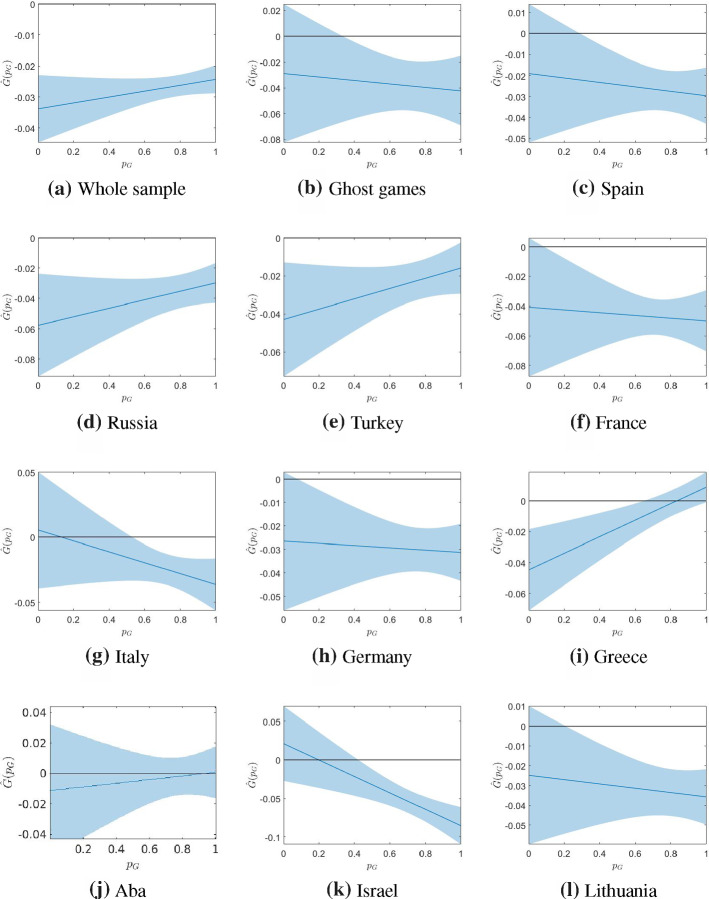
- Betting markets showed no evidence of mispricing: bookmakers’ implied home-win probabilities were significantly affected by ghost games at 1%, falling by about 3.5% in models (1)–(4) and about 5.2% in models (5)–(6). Market efficiency was not rejected except for the Greek HEBA league at 1% significance, consistent with a favourite-longshot bias; average bookmaker margin was about 3.4% overall, ranging from 1.12% (Adriatic) to 5.77% (Russia).
Methods
- Data cover the top ten European basketball leagues from 2004 to early 2021, totalling 27,691 matches, of which 1,026 were ghost games; odds come from 47 international online bookmakers via oddsportal.com.
- Home-advantage effects are estimated with linear probability models (OLS) where the dependent variable is a home-win dummy, with regressors for ghost games, playoffs, Matchday and Matchday², league indicators, and ghost-game-by-league interactions; HC3 robust standard errors are used, and the design is described as akin to difference-in-differences.
- Betting-market efficiency is tested using Mincer-Zarnowitz forecast-error regressions estimated by WLS with weights p(1–p), plus efficiency curves; a further OLS model regresses bookmakers’ implied probabilities on ghost games, playoffs, weighted Elo rating, Matchday, and Matchday².
Limitations
- The paper does not include a formal limitations section; it states future research could examine other indoor sports such as volleyball or ice hockey and relate the findings to US basketball.
- Evident from the text: the design is an observational natural experiment without random assignment, and ghost games are a small share of the sample (1,026 of 27,691, about 3.7%), which the authors note makes standard robust covariance estimators potentially imprecise.
- Also evident: sample periods vary by league, the analysis uses average odds across bookmakers, and the authors state they are unable to identify any travel effect from Covid-19-related competition changes in basketball.
Model-written summary. Check it against the paper before relying on it.
Integrity signals
Registry
Cites
Statistics
Figures
Verification
Claims the paper makes
0 Valid · 1 Not valid · 19 Not checked · 71 Own results and interpretations
A result the paper reports from its own data — it cites no other source for it, so there is none to check. The quote shows it is in the paper.
In the paper
“From this figure, we note that the maximum value of the quadratic marginal effect is achieved for Matchday≈5, i.e. when the team has played five ghost games in its own arena.”
§ Home advantage and mispricing in indoor sports’ ghost games: the case of European basketball > Empirical analysis > Model results
plainstates an association- Asserted: passes — The authors put it forward as true.
- Checkable: passes — It can be checked against evidence.
- Load-bearing: unclear — It is unclear whether the paper’s conclusions depend on it.
- Based: passes — The paper gives a reason why it holds.
A result the paper reports from its own data — it cites no other source for it, so there is none to check. The quote shows it is in the paper.
In the paper
“Fig. 3 shows that all efficiency curves are below the zero line, except for very high values of pG in the Greek league, or very low values of pG for the Italian and Israeli leagues.”
§ Home advantage and mispricing in indoor sports’ ghost games: the case of European basketball > Empirical analysis > Efficiency of online European basketball betting markets
plain- Asserted: passes — The authors put it forward as true.
- Checkable: passes — It can be checked against evidence.
- Load-bearing: passes — The paper’s conclusions depend on it.
- Based: passes — The paper gives a reason why it holds.
A result the paper reports from its own data — it cites no other source for it, so there is none to check. The quote shows it is in the paper.
In the paper
“We find empirical evidence of a significant reduction of around 5% of the home winning probability in the top ten European basketball leagues in 2020, i.e. when the basketball leagues resumed playing behind closed doors.”
§ Home advantage and mispricing in indoor sports’ ghost games: the case of European basketball > Conclusions
plainstates a cause- Asserted: passes — The authors put it forward as true.
- Checkable: passes — It can be checked against evidence.
- Load-bearing: passes — The paper’s conclusions depend on it.
- Based: passes — The paper gives a reason why it holds.
A result the paper reports from its own data — it cites no other source for it, so there is none to check. The quote shows it is in the paper.
In the paper
“In summary, we observe league effects on the overall home advantage, i.e. different home winning probabilities across basketball leagues in Europe, but no differences among leagues are observed in post-Covid ghost game sample considered here.”
§ Home advantage and mispricing in indoor sports’ ghost games: the case of European basketball > Empirical analysis > Model results
plainstates an association- Asserted: passes — The authors put it forward as true.
- Checkable: passes — It can be checked against evidence.
- Load-bearing: passes — The paper’s conclusions depend on it.
- Based: passes — The paper gives a reason why it holds.
A result the paper states — it cites no source for it, so there is none to check. The quote shows it is in the paper.
In the paper
“Moreover, since this effect is concave (β^4<0), there is no evidence that increasing the number of ghost games played by a team at home allows to restore the pre-Covid home advantage.”
§ Home advantage and mispricing in indoor sports’ ghost games: the case of European basketball > Empirical analysis > Model results
plain- Asserted: passes — The authors put it forward as true.
- Checkable: passes — It can be checked against evidence.
- Load-bearing: passes — The paper’s conclusions depend on it.
- Based: passes — The paper gives a reason why it holds.
51 more claims
Create a free account to see all 91 claims and to verify the 15 references still open.
- It may state two separate claims as one. 26
- The quote only partly states this claim. 1
- Probably not a substantial claim. 13
Self-check
Percentages, sums and reported differences re-computed from the paper’s own numbers.
Each contradiction between two passages listed here was confirmed by an independent check.
Rated major: it would touch a result — a value a result rests on, reported and recomputed p-values on opposite sides of the significance level, two passages that conflict with no sign which is right, or a cited work retracted before this paper was published.
In the paper
§ Home advantage and mispricing in indoor sports’ ghost games: the case of European basketball > Empirical analysis > Efficiency of online European basketball betting markets
“The only exception is the Greek league (HEBA) where the null hypothesis of market efficiency is rejected at 1% significance level.”
§ Home advantage and mispricing in indoor sports’ ghost games: the case of European basketball > Empirical analysis > Efficiency of online European basketball betting markets
“| Israel | 0.0212 | –0.1066*** | 2182 |”
Rated minor: it would not touch a result — a value no result rests on, a p-value that stays on the same side of the significance level, or a conflict that is clerical, resolved elsewhere in the paper, or outside its own findings.
In the paper
§ Home advantage and mispricing in indoor sports’ ghost games: the case of European basketball > Empirical analysis > Efficiency of online European basketball betting markets
“| GG | –0.0288 | –0.0135 | 1027 |”
§ Home advantage and mispricing in indoor sports’ ghost games: the case of European basketball > Empirical analysis > Data and preliminary analysis
“| Total sample | | 27,691 | 26,675 | 1026 | | 2004–2021 |”
Citations
Cites
EFFICIENT CAPITAL MARKETS: A REVIEW OF THEORY AND EMPIRICAL WORK*
Malkiel, B. G., & Fama, E. F. (1970) · The Journal of Finance · doi:10.1111/j.1540-6261.1970.tb00518.x · Cited by 15,699
Journal of the Royal Statistical Society: Series C (Applied Statistics)
(2023) · Journal of the Royal Statistical Society Series C (Applied Statistics) · doi:10.1111/(issn)1467-9876 · Cited by 1,178
International Journal of Sport Finance
(2019) · International Journal of Sport Finance · doi:10.32731/ijsf/ · Cited by 1,049
Anomalies: Parimutuel Betting Markets: Racetracks and Lotteries
Thaler, R. H., & Ziemba, W. T. (1988) · Journal of Economic Perspectives · doi:10.1257/jep.2.2.161 · Cited by 621
The influence of crowd noise and experience upon refereeing decisions in football
Nevill, A. M., Balmer, N. J., & Williams, A. M. (2002) · Psychology of sport and exercise · doi:10.1016/s1469-0292(01)00033-4 · Cited by 573
The Home Advantage In Sport Competitions: A Literature Review
Courneya, K. S., & Carron, A. V. (1992) · Journal of Sport and Exercise Psychology · doi:10.1123/jsep.14.1.13 · Cited by 561
Modelling Association Football Scores and Inefficiencies in the Football Betting Market
Dixon, M. J., & Coles, S. (1997) · Journal of the Royal Statistical Society Series C (Applied Statistics) · doi:10.1111/1467-9876.00065 · Cited by 447
Favoritism Under Social Pressure
Garicano, L., Palacios‐Huerta, I., & Prendergast, C. J. (2005) · The Review of Economics and Statistics · doi:10.1162/0034653053970267 · Cited by 417
Journal of the Royal Statistical Society: Series D (The Statistician)
(2022) · Journal of the Royal Statistical Society Series D (The Statistician) · doi:10.1111/(issn)1467-9884 · Cited by 401
Home Advantage in Sport: An Overview of Studies on the Advantage of Playing at Home
Nevill, A. M., & Holder, R. L. (1999) · Sports Medicine · doi:10.2165/00007256-199928040-00001 · Cited by 383
Research works printed but not linked: 1
- Pollard, R., & Gómez, M. A. (2007). Home advantage analysis in different basketball leagues according to team ability. In Iberian congress on basketball research, 4, 61–64.
Cited by
The Influence of Home-Court Advantage in Elite Basketball: A Systematic Review
Mochales Cuesta, I., Jiménez-Sáiz, S. L., Kelly, A. L., & Bustamante-Sánchez, Á. (2024) · Journal of Functional Morphology and Kinesiology · doi:10.3390/jfmk9040192 · Cited by 13
Butler, D., & Butler, R. N. (2023) · Sports Economics Review · doi:10.1016/j.serev.2023.100012 · Cited by 9
Fernández-Cortés, J. A., Gómez‐Carmona, C. D., García-Rubio, J., & Ibáñez, S. J. (2024) · E-balonmano com Journal Sports Science · doi:10.17398/1885-7019.20.169 · Cited by 6
Economics lessons from sports during the COVID-19 pandemic
Singleton, C., Bryson, A., Dolton, P., Reade, J. J., & Schreyer, D. (2022) · Edward Elgar Publishing eBooks · doi:10.4337/9781802207576.00008 · Cited by 5
Self-citationThe Effects of Crowds on Professional European Basketball Teams
Jiménez, J. L., Valido, J., & Jiménez, M. (2025) · Journal of Sports Economics · doi:10.1177/15270025241309831 · Cited by 4
Metadata
- Authors
- De Angelis, L., & Reade, J. J.
- Affiliations
- University of Reading (GB)
- Corresponding author
- Reade, J. James
- Venue
- Annals of Operations Research
- Published
- 2022-09-28
- Volume
- 325
- Issue
- 1
- Pages
- 391-418
- ISSN
- 0254-5330 (ISSN-L)
- 1572-9338
- PMC
- PMC9517988
- OpenAlex
- W4297502715
- Semantic Scholar
- ddeaeb54b9ef2111f4ae2bf9f397cf9b09fd4248
- Cited by
- 18
- References
- 73
- Citations by year
- 2026: 5 · 2025: 2 · 2024: 7 · 2023: 3 · 2022: 1
- FWCI
- 2.38
- Type
- journal article
- Language
- en
- Open access
- hybrid
- doi.org
- Licence
- cc-by
- creativecommons.org/licenses/by/4.0 (tdm)
- creativecommons.org/licenses/by/4.0 (vor)
- Locations
- Annals of Operations Research (publishedVersion, cc-by)
- PubMed (publishedVersion)
- PubMed Central (publishedVersion, cc-by)
- CentAUR (University of Reading) (submittedVersion)
- Archivio istituzionale della ricerca (Alma Mater Studiorum Università di Bologna) (submittedVersion, cc-by)
- RePEc: Research Papers in Economics (submittedVersion)
- Funders
- Alma Mater Studiorum - Università di Bologna
- Topics
- Social Sciences › Economics, Econometrics and Finance › Economics and Econometrics › Sports Analytics and Performance
- Social Sciences › Gender Studies › Sports, Gender, and Society
- Social Sciences › Sociology and Political Science › Sport and Mega-Event Impacts
- Keywords
- home advantage, ghost games, COVID-19 pandemic, basketball, sports betting, betting markets, indoor sports
About these checks
Registry, retraction, Cites and statistics results are computed, not judged, with one exception: a printed reference that no index lists is read once by a model before it counts as a citation error. Claims are extracted by a model and kept only when their quote appears verbatim in the text; each cited source is then checked, with a model’s help, for whether it says what the claim relies on. Those verdicts can be wrong — read the claim’s quote and the cited source before relying on one.
A language model drew the claims from the paper on 2026-11-14, under version 3 of the claim definition (model deepseek-v4.1-flash, prompt extract-v3).
A second model labelled each claim on 2026-11-14 (model jev-1.13-20260917, definition revision gold-guideline-v0.2).
Statistics and arithmetic are recomputed, not judged.
Confidence bands are shown only for fields calibrated on our annotated test set. None is calibrated yet, so no band is shown.
What counts as a claim ›How we measure confidence ›How we check this ›
Are you an author, or do you see a problem with this page? Request a review
How to cite
Cite CoChat for the checks on this page, and the paper for its own findings.
- This page
- CoChat. (2026). Citation check: Home advantage and mispricing in indoor sports’ ghost games: the case of European basketball. https://app.cochat.ai/papers/10.1007/s10479-022-04950-7
- The paper
- De Angelis, L., & Reade, J. J. (2023). Home advantage and mispricing in indoor sports’ ghost games: the case of European basketball. Annals of Operations Research. https://doi.org/10.1007/s10479-022-04950-7
Data sources
Bibliographic data: Semantic Scholar, OpenAlex, Crossref.
Contains information from the Semantic Scholar Academic Graph Datasets, made available under the ODC Attribution License (ODC-BY 1.0).
Semantic Scholar’s data is described in: Kinney, R., et al. (2023). The Semantic Scholar Open Data Platform. arXiv:2301.10140.
