

Practical verification of decision-making in agent-based autonomous systems
Open accessThe DOI matches its Crossref record; 93 of the 97 references it cites were found in a registry or an index.
Abstract
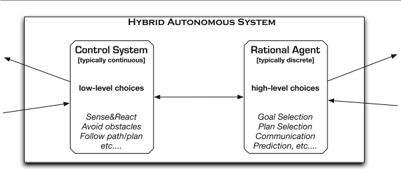
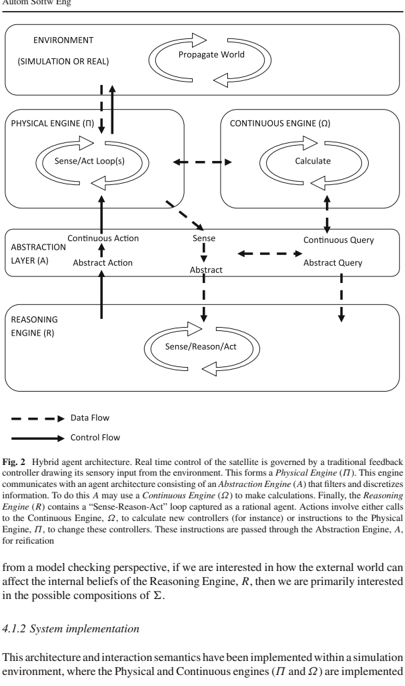
We present a verification methodology for analysing the decision-making component in agent-based hybrid systems. Traditionally hybrid automata have been used to both implement and verify such systems, but hybrid automata based modelling, programming and verification techniques scale poorly as the complexity of discrete decision-making increases making them unattractive in situations where complex logical reasoning is required. In the programming of complex systems it has, therefore, become common to separate out logical decision-making into a separate, discrete, component. However, verification techniques have failed to keep pace with this development. We are exploring agent-based logical components and have developed a model checking technique for such components which can then be composed with a separate analysis of the continuous part of the hybrid system. Among other things this allows program model checkers to be used to verify the actual implementation of the decision-making in hybrid autonomous systems.
Overview
The claims and statistics of this paper haven’t been checked yet.
Free: it reads the open-access text and checks the first 5 claims that cite a source we can check. Create a free account to check every claim.
Integrity signals
Registry
Cites
Statistics
Figures
Verification
Claims the paper makes
The claims and statistics of this paper haven’t been checked yet.
Free: it reads the open-access text and checks the first 5 claims that cite a source we can check. Create a free account to check every claim.
Claims other papers make about this one
Each is checked against this paper’s own text: does it say what the citing paper says it does?
The cited source says what the claim attributes to it.
In the citing paper
“The AI systems auditing literature is also multidisciplinary in that it harbours contributions from many academic disciplines, including computer science (Adler et al., 2018;Kearns et al., 2018), systems engineering (Dennis et al., 2016;Leveson, 2011), law (Laux et al., 2021;Selbst, 2021), media and communication studies (Bandy & Diakopoulos, 2019;Sandvig et al., 2014), social science (Metaxa et”
From Auditing of AI: Legal, Ethical and Technical Approaches (2023) · cites this paper as Dennis et al., 2016
Self-check
Percentages, sums and reported differences re-computed from the paper’s own numbers.
The self-check needs the paper’s full text.
Citations
Cites
Clarke, E. M., Grümberg, O., & Long, D. (1996) · Cited by 6,813
An Introduction to MultiAgent Systems
Wooldridge, M. (2002) · Cited by 5,394
Handbook of theoretical computer science
Leeuwen, J. V. (1990) · Medical Entomology and Zoology · Cited by 4,259
BDI Agents: From Theory to Practice
Rao, A. S., & Georgeff, M. (1995) · Cited by 3,632
The Temporal Logic of Reactive and Concurrent Systems
Manna, Z., & Pnueli, A. (1992) · Springer eBooks · doi:10.1007/978-1-4612-0931-7 · Cited by 2,958
EMERSON, E. A. (1990) · Formal Models and Semantics · doi:10.1016/b978-0-444-88074-1.50021-4 · Cited by 2,585
Shoham, Y. (1993) · Artificial Intelligence · doi:10.1016/0004-3702(93)90034-9 · Cited by 2,041
The algorithmic analysis of hybrid systems
Alur, R., Courcoubetis, C., Halbwachs, N., Henzinger, T. A., Ho, P.-H., Nicollin, X., Olivero, A., Sifakis, J., & Yovine, S. (1995) · Theoretical Computer Science · doi:10.1016/0304-3975(94)00202-t · Cited by 1,876 · cited 1×
“1994) and abstractions for model checking hybrid systems have been extensively studied (Alur et al. 1995; Henzinger et al. 1997; Tiwari 2008; Tabuada 2009).”
BackgroundIntention is choice with commitment
Cohen, P. R., & Levesque, H. J. (1990) · Artificial Intelligence · doi:10.1016/0004-3702(90)90055-5 · Cited by 1,860
Henzinger, T. A. (2002) · Proceedings 11th Annual IEEE Symposium on Logic in Computer Science · doi:10.1109/lics.1996.561342 · Cited by 1,837 · cited 1×
“…the algorithms and procedures being designed or implemented for making decisions, and those which are being designed and implemented for continuous control, this reduces the understandability of the resulting code and therefore increases the risk of errors and bugs being present in the code.”
Method
Research works printed but not linked: 10
- Morgan Kaufmann, San Mateo, CA (1988)
- Bratman, M.E.: Intentions, Plans, and Practical Reason. Harvard University Press, Cambridge, MA (1987)
- Dennis, L.A., Farwer, B.: Gwendolen: A BDI language for verifiable agents. In: Workshop on Logic and the Simulation of Interaction and Reasoning, AISB (2008)
- Holzmann, G.: Spin Model Checker: Primer and Reference Manual. Addison-Wesley, Reading (2004)
- Kitano, H., Tadokoro, S.: RoboCup rescue: a grand challenge for multiagent and intelligent systems. AI Mag. 22(1), 39-52 (2001)
- Addison Wesley, Reading (2003)
- Rao, A.S., Georgeff, M.P.: Modeling agents within a BDI-architecture. In: Proceedings of the 2nd Interna- tional Conference on Principles of Knowledge Representation and Reasoning (KR&R), pp. 473-484.
- Morgan Kaufmann, San Mateo, CA (1991)
- Morgan Kaufmann, San Mateo, CA (1992)
- Sierhuis, M.: Modeling and Simulating Work Practice. BRAHMS: a Multiagent Modeling and Simluation Language for Work System Analysis and Design. PhD thesis, Social Science and Informatics (SW), University of Amsterdam (2001)
Cited by
Morley, J., Floridi, L., Kinsey, L., & Elhalal, A. (2020) · Science and Engineering Ethics · doi:10.1007/s11948-019-00165-5 · Cited by 882
Research Priorities for Robust and Beneficial Artificial Intelligence
Russell, S., Dewey, D., & Tegmark, M. (2015) · AI Magazine · doi:10.1609/aimag.v36i4.2577 · Cited by 637
“In these cases, it may be practical to verify that the system acts correctly given the knowledge that it has, avoiding the problem of modelling the real environment (Dennis et al. 2013).”
BackgroundEthics-Based Auditing of Automated Decision-Making Systems: Nature, Scope, and Limitations
Mökander, J., Morley, J., Taddeo, M., & Floridi, L. (2021) · Science and Engineering Ethics · doi:10.1007/s11948-021-00319-4 · Cited by 207
From ethical AI frameworks to tools: a review of approaches
Prem, E. (2023) · AI and Ethics · doi:10.1007/s43681-023-00258-9 · Cited by 242
Formal verification of ethical choices in autonomous systems
Dennis, L., Fisher, M., Slavkovik, M., & Webster, M. (2016) · Robotics and Autonomous Systems · doi:10.1016/j.robot.2015.11.012 · Cited by 223
“Model checking (which is best applied to discrete problems) is then used to analyse the high level decision-making and methods, such as testing (or indeed theorem proving—see [24] for an example of where program model checking of an agent is combined with a theorem proving approach based on hybrid automata), are used…”
MethodSelf-citationMorley, J., Floridi, L., Kinsey, L., & Elhalal, A. (2021) · Philosophical studies series · doi:10.1007/978-3-030-81907-1_10 · Cited by 235
Auditing of AI: Legal, Ethical and Technical Approaches
Mökander, J. (2023) · Digital Society · doi:10.1007/s44206-023-00074-y · Cited by 152
“…it harbours contributions from many academic disciplines, including computer science (Adler et al., 2018; Kearns et al., 2018), systems engineering (Dennis et al., 2016; Leveson, 2011), law (Laux et al., 2021; Selbst, 2021), media and communication studies (Bandy & Diakopoulos, 2019; Sandvig et…”
BackgroundArtificial Moral Agents: A Survey of the Current Status
Cervantes, J.-A., López, S., Rodríguez, L.-F., Cervantes, S., Cervantes, F., & Ramos, F. (2020) · Science and Engineering Ethics · doi:10.1007/s11948-019-00151-x · Cited by 151
“Additionally, a BDI agent language called Ethan for a prototype implementation was proposed (Dennis et al. 2016a).”
BackgroundMethodFisher, M., Dennis, L., & Webster, M. (2013) · Communications of the ACM · doi:10.1145/2494558 · Cited by 137
Self-citationFormal verification of autonomous vehicle platooning
Kamali, M., Dennis, L. A., McAree, O., Fisher, M., & Veres, S. M. (2017) · Science of Computer Programming · doi:10.1016/j.scico.2017.05.006 · Cited by 134
Self-citationTowards a framework for certification of reliable autonomous systems
Fisher, M., Mascardi, V., Rozier, K. Y., Schlingloff, B., Winikoff, M., & Yorke‐Smith, N. (2020) · Autonomous Agents and Multi-Agent Systems · doi:10.26686/wgtn.13490913.v1 · Cited by 120
Self-citationOn Proactive, Transparent, and Verifiable Ethical Reasoning for Robots
Bremner, P., Dennis, L. A., Fisher, M., & Winfield, A. F. T. (2019) · Proceedings of the IEEE · doi:10.1109/jproc.2019.2898267 · Cited by 112
“We adopt the verification methodology from [11] which describes the formal verification of rational agent components in autonomous systems.”
MethodInfluentialSelf-citationChatila, R., Dignum, V., Fisher, M., Giannotti, F., Morik, K. J., Russell, S., & Yeung, K. (2021) · Lecture notes in computer science · doi:10.1007/978-3-030-69128-8_2 · Cited by 113
Self-citationAn Overview of Verification and Validation Challenges for Inspection Robots
Fisher, M., Cardoso, R. C., Collins, E. C., Dadswell, C., Dennis, L. A., Dixon, C., Farrell, M., Ferrando, A., Huang, X., Jump, M., et al. (2021) · Robotics · doi:10.3390/robotics10020067 · Cited by 82
“For example, hybrid agent architectures [78] have symbolic agents dealing with the high-level decision-making, while other components deal with (symbolic) planning and (sub-symbolic) feedback control.”
BackgroundSelf-citationUmbrello, S., & Yampolskiy, R. V. (2022) · International Journal of Social Robotics · doi:10.1007/s12369-021-00790-w · Cited by 61
“This promotes that ability to discern the highlevel reasoning structure and formally verify the decisions taken, as well as strongly demarcating scenario selection and scenario execution [63].”
BackgroundAgent programming in the cognitive era
Bordini, R. H., Seghrouchni, A. E. F., Hindriks, K. V., Logan, B. S., & Ricci, A. (2020) · Autonomous Agents and Multi-Agent Systems · doi:10.1007/s10458-020-09453-y · Cited by 68
Verifiable Self-Aware Agent-Based Autonomous Systems
Dennis, L. A., & Fisher, M. (2020) · Proceedings of the IEEE · doi:10.1109/jproc.2020.2991262 · Cited by 49
“[70] L.”
BackgroundSelf-citationMultilayered review of safety approaches for machine learning-based systems in the days of AI
Dey, S., & Lee, S.-W. (2021) · Journal of Systems and Software · doi:10.1016/j.jss.2021.110941 · Cited by 53
“Semi-autonomous systems with both machine and human controllers can be considered as hybrid 775 systems [108, 109, 110] and therefore can follow a probabilistic process of verification.”
BackgroundA Review of Verification and Validation for Space Autonomous Systems
Cardoso, R. C., Kourtis, G., Dennis, L. A., Dixon, C., Farrell, M., Fisher, M., & Webster, M. (2021) · Current Robotics Reports · doi:10.1007/s43154-021-00058-1 · Cited by 45
Self-citationTowards Trusting Autonomous Systems
Winikoff, M. (2018) · Lecture notes in computer science · doi:10.1007/978-3-319-91899-0_1 · Cited by 41
“They also reach the conclusion that formal verification is required, and, like the earlier work of Fisher et al. [19,22,23], propose verifying the decision making process in isolation.”
BackgroundVerifiable Self-Certifying Autonomous Systems
Fisher, M., Collins, E. C., Dennis, L. A., Luckcuck, M., Webster, M., Jump, M., Page, V., Patchett, C., Dinmohammadi, F., Flynn, D., et al. (2018) · IEEE International Symposium on Software Reliability Engineering Workshops (ISSREW) · doi:10.1109/issrew.2018.00028 · Cited by 35
“This not only supports explainability [53] and scrutability [12] but, by being able to formally verify these rational agents [19], we can prove that the correct, even safe and ethical [18], decisions will always be taken [17], [48].”
BackgroundSelf-citationThe MCAPL Framework including the Agent Infrastructure Layer an Agent Java Pathfinder
Dennis, L. A. (2018) · The Journal of Open Source Software · doi:10.21105/joss.00617 · Cited by 31
“…Project ( EP/L024845/1) The MCAPL framework has enabled research reported in a variety of papers (Louise A. Dennis, Fisher, and Webster 2015,Fisher, Dennis, and Webster (2013),Louise A. Dennis et al. (2014),L. A. Dennis et al. (2010),Louise A. Dennis et al. (2016),L. A. Dennis et Dennis, (2018).”
BackgroundSelf-citationAgent systems verification : systematic literature review and mapping
Bakar, N. A., & Selamat, A. (2018) · Applied Intelligence · doi:10.1007/s10489-017-1112-z · Cited by 30
Towards Verifiably Ethical Robot Behaviour
Dennis, L. A., Fisher, M., & Winfield, A. F. T. (2015) · Research Explorer (The University of Manchester) · doi:10.48550/arxiv.1504.03592 · Cited by 30
“Model-checking the consequence engine in listing 1 with the addition of beliefs and placed in in this new environment we were able to prove (7): it is always the case that if a 1 is a selected action and its outcome is predicted to be that the human has fallen in the hole, then all the other…”
BackgroundSelf-citationVerifying and Validating Autonomous Systems: Towards an Integrated Approach
Ferrando, A., Dennis, L. A., Ancona, D., Fisher, M., & Mascardi, V. (2018) · Lecture notes in computer science · doi:10.1007/978-3-030-03769-7_15 · Cited by 27
Self-citationBDI agent testability revisited
Winikoff, M. (2017) · Autonomous Agents and Multi-Agent Systems · doi:10.1007/s10458-016-9356-2 · Cited by 27
Hybrid Verification Technique for Decision-Making of Self-Driving Vehicles
Al-Nuaimi, M., Wibowo, S., Qu, H., Aitken, J. M., & Veres, S. M. (2021) · Journal of Sensor and Actuator Networks · doi:10.3390/jsan10030042 · Cited by 28
“Reconfigurable and adaptive RA-based control systems are capable of controlling a vehicle in a trajectory to avoid other vehicles and people [11].”
BackgroundSelf-citationRobot Authority in Human-Machine Teams: Effects of Human-Like Appearance on Compliance
Haring, K. S., Mosley, A., Pruznick, S., Fleming, J., Satterfield, K., de Visser, E. J., Tossell, C. C., & Funke, G. J. (2019) · Lecture notes in computer science · doi:10.1007/978-3-030-21565-1_5 · Cited by 32
Torens, C., & Adolf, F. (2015) · AIAA Infotech@Aerospace Conference · doi:10.2514/6.2015-1645 · Cited by 25
Intelligent Agent-Based Stimulation for Testing Robotic Software in Human-Robot Interactions
Araiza-Illan, D., Pipe, A. G., & Eder, K. (2016) · doi:10.1145/3022099.3022101 · Cited by 24
“present in software for autonomous robots; see [9] for a recent example.”
Alves, G. V., Dennis, L. A., & Fisher, M. (2021) · Journal of Sensor and Actuator Networks · doi:10.3390/jsan10030041 · Cited by 22
“The second question is answered by the own use of the double-level Model Checking technique and adoption of the methodology of exploring scenarios via random events from [18].”
BackgroundMethodSelf-citationModelling and verifying BDI agents with bigraphs
Archibald, B., Calder, M., Sevegnani, M., & Xu, M. (2021) · Science of Computer Programming · doi:10.1016/j.scico.2021.102760 · Cited by 17
Towards enhanced threat modelling and analysis using a Markov Decision Process
Malik, S. U. R., Anjum, A., Moqurrab, S. A., & Srivastava, G. (2022) · Computer Communications · doi:10.1016/j.comcom.2022.07.038 · Cited by 17
Strategy Synthesis for Autonomous Agents Using PRISM
Giaquinta, R., Hoffmann, R., Ireland, M., Miller, A. A., & Norman, G. (2018) · Lecture notes in computer science · doi:10.1007/978-3-319-77935-5_16 · Cited by 17
“Similarly, in [6] model checking is used to verify the decision making aspect of autonomous systems.”
MethodVerifiable Machine Ethics in Changing Contexts
Dennis, L. A., Bentzen, M. M., Lindner, F., & Fisher, M. (2021) · Proceedings of the AAAI Conference on Artificial Intelligence · doi:10.1609/aaai.v35i13.17366 · Cited by 17
“The E THAN system (Dennis et al. 2016a) does explicitly allow that its encoding is context specific – it anticipates some context-specific ranking of ethical concerns being supplied by some external agent and then reasons using that ranking but no account is provided for this process.”
BackgroundMethodSelf-citationToward a Holistic Approach to Verification and Validation of Autonomous Cognitive Systems
Ferrando, A., Dennis, L. A., Cardoso, R. C., Fisher, M., Ancona, D., & Mascardi, V. (2021) · ACM Transactions on Software Engineering and Methodology · doi:10.1145/3447246 · Cited by 16
“Dennis et al. [40] advocate the use of model-checking for verifying declarative decision-making components within such autonomous systems.”
Self-citationAutonomous Agent Behaviour Modelled in PRISM – A Case Study
Hoffmann, R., Ireland, M., Miller, A. A., Norman, G., & Veres, S. M. (2016) · Lecture notes in computer science · doi:10.1007/978-3-319-32582-8_7 · Cited by 15
“Previous work in which model checking is used to verify autonomy includes [3] in which the decision making process is verified in isolation, while our aim is to integrate this process with the autonomous agent as a whole.”
MethodSelf-citationQuantitative modelling and analysis of BDI agents
Archibald, B., Calder, M., Sevegnani, M., & Xu, M. (2023) · Software & Systems Modeling · doi:10.1007/s10270-023-01121-5 · Cited by 12
“work such as [11, 12]), where plan, event, and intention selection denotes branching choices and actions have a single outcome.”
Model Checking Human-Agent Collectives for Responsible AI
Abeywickrama, D. B., Ĉırstea, C., & Ramchurn, S. D. (2019) · IEEE RO-MAN · doi:10.1109/ro-man46459.2019.8956429 · Cited by 14
“In [11], [12], the authors propose a theoretical framework for ethical plan selection that can be formally verified.”
BackgroundInfluentialEngineering Responsible And Explainable Models In Human-Agent Collectives
Abeywickrama, D. B., & Ramchurn, S. D. (2023) · Applied Artificial Intelligence · doi:10.1080/08839514.2023.2282834 · Cited by 12
Reliable Decision-Making in Autonomous Vehicles
Alves, G. V., Dennis, L. A., Fernandes, L., & Fisher, M. (2019) · Springer eBooks · doi:10.1007/978-3-030-14628-3_10 · Cited by 11
Self-citationRanjitsingh, L. M., & Rao, T. V. S. (2025) · International Journal of Systems Assurance Engineering and Management · doi:10.1007/s13198-025-02865-7 · Cited by 16
“Dennis et al. [2016] demonstrated in this study that a compositional approach to the verification of the decision-making components of hybrid autonomous systems is both possible and can be pursued.”
Collaborative models for autonomous systems controller synthesis
Fraser, D., Giaquinta, R., Hoffmann, R., Ireland, M., Miller, A. A., & Norman, G. (2020) · Formal Aspects of Computing · doi:10.1007/s00165-020-00508-1 · Cited by 10
“In[HIM + 16]weintroducedabstractMDPmodelsrepresentingtheconcretesimulation model of Sect.”
BackgroundCertification of Safe and Trusted Robotic Inspection of Assets
Dinmohammadi, F., Page, V., Flynn, D., Robu, V., Fisher, M., Patchett, C., Jump, M., Tang, W., & Webster, M. (2018) · Prognostics and System Health Management Conference · doi:10.1109/phm-chongqing.2018.00054 · Cited by 10
“However, its use in autonomous software is relatively recent [6], while application to the verification of practical autonomous systems is still at a very early stage [7, 8].”
BackgroundSelf-citationLiu, L., & Liu, Y. (2025) · Engineering Construction & Architectural Management · doi:10.1108/ecam-03-2025-0384 · Cited by 12
Agent-Based Autonomous Systems and Abstraction Engines: Theory Meets Practice
Dennis, L. A., Aitken, J. M., Collenette, J., Cucco, E., Kamali, M., McAree, O., Shaukat, A., Atkinson, K. M., Gao, Y., Veres, S. M., et al. (2016) · Lecture notes in computer science · doi:10.1007/978-3-319-40379-3_8 · Cited by 9
“The EASS framework was used in an extensive case study for the architecture involving satellite and space craft systems [13, 10].”
MethodSelf-citationProbabilistic BDI Agents: Actions, Plans, and Intentions
Archibald, B., Calder, M., Sevegnani, M., & Xu, M. (2021) · Lecture notes in computer science · doi:10.1007/978-3-030-92124-8_15 · Cited by 9
“[12, 13]), where plan and intention selection denotes branching choices and actions have a single outcome.”
BackgroundSoda: An Object-Oriented Functional Language for Specifying Human-Centered ProblemsPreprint
Mendez, J. (2023) · arXiv (Cornell University) · doi:10.48550/arxiv.2310.01961 · Cited by 9
“Verification is only as strong as the assumptions that underlie the specification, which means that specifying assumptions and analyzing these specifications is crucial for verification [7].”
An epistemic logic for formalizing group dynamics of agents
Costantini, S., Formisano, A., & Pitoni, V. (2022) · Interaction Studies Social Behaviour and Communication in Biological and Artificial Systems · doi:10.1075/is.22019.cos · Cited by 11
Fantastic MASs and Where to Find Them: First Results and Lesson Learned
Briola, D., Ferrando, A., & Mascardi, V. (2023) · Lecture notes in computer science · doi:10.1007/978-3-031-48539-8_16 · Cited by 7
Ensuring trustworthy and ethical behaviour in intelligent logical agents
Costantini, S. (2021) · Journal of Logic and Computation · doi:10.1093/logcom/exab091 · Cited by 7
“Finally, concerning model checking of agent systems we mention the recent work presented in [41,42,43] concerning the MCAPL model checking framework, where [41] explicitly considers checking agents’ ethical choices.”
MethodA Review on Software/Systems Architecture Description for Autonomous Systems
Souza, L. S., Rocha, F. G., & Soares, M. S. (2022) · Recent Advances in Computer Science and Communications · doi:10.2174/2666255815666220513101350 · Cited by 7
Verifiable Autonomy and Responsible Robotics
Dennis, L. A., & Fisher, M. (2020) · Springer eBooks · doi:10.1007/978-3-030-66494-7_7 · Cited by 7
Self-citationTowards an Extended Requirements Problem Formulation for Superintelligence Safety
Kaindl, H., & Ferdigg, J. (2020) · IEEE International Workshop on Artificial Intelligence for Requirements Engineering (AIRE) · doi:10.1109/aire51212.2020.00012 · Cited by 6
“[17] have goals assigned, but statically and at design-time.”
BackgroundRequirement Specification, Analysis and Verification for Autonomous Systems
Pinto, A. (2021) · ACM/IEEE Design Automation Conference (DAC) · doi:10.1109/dac18074.2021.9586208 · Cited by 6
From AgentSpeak to C for Safety Considerations in Unmanned Aerial Vehicles
Bucheli, S., Kroening, D., Martins, R., & Natraj, A. (2015) · Lecture notes in computer science · doi:10.1007/978-3-319-22416-9_9 · Cited by 7
“As outlined in [9, 15], questions and procedures relating to the safety of the low-level control are well-established.”
BackgroundEnhanced agent-oriented programming for robot teams
Silvestre, I. D. O., Becker, L. B., Fisher, M., Hübner, J. F., & de Brito, M. (2025) · Engineering Applications of Artificial Intelligence · doi:10.1016/j.engappai.2025.111390 · Cited by 5
Self-citationHow Testable Are BDI Agents? An Analysis of Branch Coverage
Winikoff, M. (2016) · Lecture notes in computer science · doi:10.1007/978-3-319-46882-2_6 · Cited by 5
Computational Framework for Verifiable Decisions of Self-Driving Vehicles
Al-Nuaimi, M., Hongyang Qu, B., & Veres, S. M. (2018) · IEEE Conference on Control Technology and Applications (CCTA) · doi:10.1109/ccta.2018.8511432 · Cited by 5
“Development and design of rational agents with sophisticated decisions have been employed in several works [2], [3].”
BackgroundSelf-citationSlicing Agent Programs for More Efficient Verification
Winikoff, M., Dennis, L. A., & Fisher, M. (2019) · Lecture notes in computer science · doi:10.1007/978-3-030-25693-7_8 · Cited by 5
Self-citationFaulkner, A., & Nicholson, M. (2020) · Elsevier eBooks · doi:10.1016/b978-0-12-820790-1.00018-8 · Cited by 5
Stringer, A., Sun, B. Y., Hoyt, Z., Schley, L., Hougen, D. F., & Antonio, J. K. (2021) · IEEE/AIAA Digital Avionics Systems Conference (DASC) · doi:10.1109/dasc52595.2021.9594351 · Cited by 5
A Cognitive Architecture for Verifiable System Ethics via Explainable Autonomy
Yılmaz, L., & Sivaraj, S. (2019) · IEEE International Systems Conference (SysCon) · doi:10.1109/syscon.2019.8836896 · Cited by 6
Model Checking for Closed-Loop Robot Reactive Planning
Chandler, C., Porr, B., Miller, A. A., & Lafratta, G. (2023) · Electronic Proceedings in Theoretical Computer Science · doi:10.4204/eptcs.395.6 · Cited by 6
“In autonomous robotic systems, model checking has been used for static and runtime verification [23, 10, 5, 33] and has been proposed for strategy synthesis [11, 17].”
MethodSafe Autonomous Decision-Making with vGOAL
Yang, Y. H., & Holvoet, T. (2023) · Lecture notes in computer science · doi:10.1007/978-3-031-37616-0_32 · Cited by 4
Formal Verification of Astronaut-Rover Teams for Planetary Surface Operations
Webster, M., Dennis, L. A., Dixon, C., Fisher, M., Stocker, R., & Sierhuis, M. (2020) · IEEE Aerospace Conference (AERO) · doi:10.1109/aero47225.2020.9172303 · Cited by 4
“An obvious choice might be the Agent JPF model checker, which we have developed in previous work [20], [21].”
MethodSelf-citationA Framework for Verifying Autonomous Robotic Agents Against Environment Assumptions
Dinh, H. T., & Holvoet, T. (2020) · Lecture notes in computer science · doi:10.1007/978-3-030-49778-1_23 · Cited by 4
A Proposal for Artificial Moral Pedagogical Agents
Córdova, P. R., Vicari, R. M., Brusius, C., & Coelho, H. (2021) · Advances in intelligent systems and computing · doi:10.1007/978-3-030-72657-7_38 · Cited by 4
Li, D., Lin, R., Wang, Z., & Li, Y. (2026) · Journal of Reliability Science and Engineering · doi:10.1088/3050-2454/ae524c · Cited by 4
Gaggar, H. (2025) · International Journal of Computational and Experimental Science and Engineering · doi:10.22399/ijcesen.5497 · Cited by 5
“Autonomous agents must therefore generate sufficient evidence to establish who initiated an operation, which agent performed it, what resources were accessed, which policy authorized the action, and what outcome resulted (Dennis et al., 2016).”
Ethical Design Perspectives of Intelligent UAVs
Halibas, A. S., Bulushi, T. A. R. M. A., Cordova, R. S., & Shaqsi, A. S. M. A. (2019) · International Conference on Unmanned Vehicle Systems-Oman (UVS) · doi:10.1109/uvs.2019.8658305 · Cited by 4
“Dennis [23] argues that it is practical to use the knowledge base of a system instead of modeling the real environment which can be difficult when used for decision making in a timeconstrained scenario.”
BackgroundIncreasing confidence in autonomous systems
Fisher, M., Ferrando, A., & Cardoso, R. C. (2021) · doi:10.1145/3464974.3468452 · Cited by 3
“Typically, we will carry out some form of model checking [7] before deployment, but will have to make some abstract assumptions about the environment.”
BackgroundMethodSelf-citationSeamless Integration and Testing for MAS Engineering
Parizi, M. M., Sileno, G., & van Engers, T. (2022) · Lecture notes in computer science · doi:10.1007/978-3-030-97457-2_15 · Cited by 3
“Can our results be generalized to other agent programming frameworks? Motivated by the success of works like AJPF/MCAPL [13] that provides model checking for multiple BDI frameworks, as a future study we intend to explore how to apply this approach to a wider range of MAS frameworks.”
Evaluation of AI ethics tools in language models: a developers’ perspective case study
Silva, J., Moreira, D. A. B., dos Santos, G. O., Ferreira, A., Maia, H., Avila, S., & Pedrini, H. (2026) · AI and Ethics · doi:10.1007/s43681-025-00914-2 · Cited by 3
Agent Toolkits Anno 2025: Where We Are, Where We Go
Briola, D., Collier, R., Ferrando, A., Mascardi, V., & Ricci, A. (2026) · Springer eBooks · doi:10.1007/978-3-032-01082-7_1 · Cited by 2
Using BECAMEDA method to specify and verify a smart home system
Haqiq, A., & Bounabat, B. (2017) · International Conference on Smart Digital Environment (ICSDE) · doi:10.1145/3128128.3128135 · Cited by 2
“Other approaches, like [24] proposes a methodology to model the agent behavior and describe its interface (input/output), and also verify the decision-making agents through the model checking technique.”
MethodArslan, A. K. (2021) · INTERNATIONAL JOURNAL OF COMPUTERS & TECHNOLOGY · doi:10.24297/ijct.v21i.9009 · Cited by 2
Dennis, L. A. (2022) · Lecture notes in computer science · doi:10.1007/978-3-031-07727-2_1 · Cited by 2
Self-citationHow Testable are BDI Agents? An Analysis of Branch Coverage
Winikoff, M. (2016) · Lecture notes in computer science · doi:10.1007/978-3-319-50983-9_12 · Cited by 2
A rational agent framework for adaptive flight control of UAVs
Tantrairatn, S., & Veres, S. M. (2015) · International Conference on Unmanned Aircraft Systems (ICUAS) · doi:10.1109/icuas.2015.7152286 · Cited by 2
“These techniques not only allow for modular design but make the schemes suitable for practical implementation where decision making can also be formally verified [8].”
BackgroundSelf-citationSuperintelligence Safety: A Requirements Engineering Perspective
Kaindl, H., & Ferdigg, J. (2023) · Advances in Artificial Intelligence and Machine Learning · doi:10.54364/aaiml.2023.1156 · Cited by 2
Observable and Attention-Directing BDI Agents for Human-Autonomy Teaming
Archibald, B., Calder, M., Sevegnani, M., & Xu, M. (2021) · Electronic Proceedings in Theoretical Computer Science · doi:10.4204/eptcs.348.12 · Cited by 2
“Verifying BDI agents through model checking has been well explored, e.g. [12] verifies the decision making part (modelled in BDI agents) of a hybrid autonomous system, and [11] uses model checking to reason about agent programs written in Agent Programming Languages.”
MethodVerifiable autonomy: From theory to applications
Dennis, L. A., Dixon, C., & Fisher, M. (2022) · AI Communications · doi:10.3233/aic-220115 · Cited by 2
“We have been part of standards activities for transparency across autonomous systems [123] and continue to ensure that both the programming and architectural approaches we develop are open to analysis.”
Self-citationVerifying autonomous decision making against environment assumptions: An experience report
Dinh, H. T., & Holvoet, T. (2020) · IEEE International Conference on Robotic Computing (IRC) · doi:10.1109/irc.2020.00059 · Cited by 1
“[4], [17] use the AJPF model checker [18] to verify decision making logic implemented in the agent programming language GWENDOLEN.”
BackgroundMethodAdaptive Cognitive Agents: Updating Action Descriptions and Plans
Stringer, P., Cardoso, R. C., Dixon, C., Fisher, M., & Dennis, L. A. (2023) · Lecture notes in computer science · doi:10.1007/978-3-031-43264-4_22 · Cited by 1
“Our starting point is the system architecture outlined in [15] in which a cognitive agent performs high-level mission reasoning, such as deciding in which order some set of waypoints are to be visited.”
BackgroundSelf-citationSafety of Artificial Intelligence and its role in Autonomy: A Maritime Perspective
McDermid, J. A., & Daffey, K. (2018) · Safety-Critical Systems Symposium (SSS) · doi:10.65391/r922 · Cited by 1
Mallah, R., Brynjolfsson, E., Calo, R., Dietterich, T. G., George, D., Hassabis, D., Horvitz, E., Manyika, J., Osborne, M. A., Parkes, D. C., et al. (2015)
Spectrum-Based Fault Diagnosis in Multi-Agent Systems
Passos, L. S. (2015) · Portuguese National Funding Agency for Science, Research and Technology (RCAAP Project by FCT) · doi:10.34626/kd0k-4202
Realization of Automatic Control System Based on Artificial Intelligence
Yao, J., Wu, Z., Feng, J., Yan, K., Liu, Y., Chen, L., You, R., Zhang, X., Xiang, Y., & Chen, X. (2020) · Advances in intelligent systems and computing · doi:10.1007/978-981-33-4572-0_147
Towards Trusting Autonomous Systems
Winikoff, M. (2020) · Open Access Victoria University of Wellington | Te Herenga Waka (Figshare) · doi:10.26686/wgtn.12909971.v1
(2020) · Elsevier eBooks · doi:10.1016/b978-0-12-820790-1.00045-0
Tatum, R., & Wettergren, T. A. (2022) · MTS/IEEE OCEANS Conference (OCEANS) · doi:10.1109/oceans47191.2022.9977027
“Other approaches that do not use compositional verification exist such as the method found in [10] that uses reachability analysis for neural network controlled autonomous systems or model checking techniques to verify the actual implementation of an autonomous system [11].”
MethodA Mathematical Framework and Theory Governing the Verification of Autonomous Systems
Hartman, B. T., & Tatum, R. (2022) · MTS/IEEE OCEANS Conference (OCEANS) · doi:10.1109/oceans47191.2022.9977336
“Dennis, Fisher, et al. tackle the verification of decision making entities, focusing on modeling and checking the system as a rational agent or a hybrid where a significant part of it is rational [4].”
BackgroundАжмухамедов, И. М., & Романова, О. М. (2020) · Modelirovanie, optimizaciâ i informacionnye tehnologii. · doi:10.26102/2310-6018/2020.28.1.004
Reliable Robot Missions in Dynamic Environments Using Agent-based Controllers
Limarga, R., Tse, K. W., Dennis, L. A., Dixon, C., Faruq, F., & Fisher, M. (2025) · IEEE Engineering Reliable Autonomous Systems (ERAS) · doi:10.1109/eras63351.2025.11135852
“The particular BDI language we utilise, G WENDOLEN , comes with an associated formal verification toolset [9], [10], providing strong reliability guarantees particularly in terms of the decisions it makes.”
Self-citationFACTORS INFLUENCING THE DEVELOPMENT OF THE EPIDEMIC PROCESS OF TUBERCULOSIS: EXPERT OPINION
Doktorovа, N. P., Kudlay, D. A., Vasileva, I. A., Parolina, L., Sterlikov, S. A., Иванова, О. Г., & Nikolenko, N. Y. (2025) · Современные проблемы науки и образования · doi:10.17513/spno.34274
Kumbhar, S. (2025) · Biomedical Engineering Applications Basis and Communications · doi:10.4015/s1016237225500486
Ethics-based auditing of automated decision-making systems: considerations, challenges, na
Mökander, J. (2023) · Oxford University Research Archive (ORA) (University of Oxford) · doi:10.5287/ora-z5qakao0p · Cited by 12
Dagstuhl Reports, Volume 6, Issue 5, May 2016, Complete Issue
Informatik, S. D. L.-Z. F. (2016) · DROPS (Schloss Dagstuhl – Leibniz Center for Informatics) · doi:10.4230/dagrep.6.5
Real-Time Model Checking for Closed-Loop Robot Reactive Planning
Chandler, C., Porr, B., Lafratta, G., & Miller, A. (2026) · Formal Aspects of Computing · doi:10.1145/3849801
Metadata
- Authors
- Dennis, L. A., Fisher, M., Lincoln, N. K., Lisitsa, A., & Veres, S. M.
- Affiliations
- University of Liverpool (GB)
- University of Southampton (GB)
- Corresponding author
- Dennis, Louise A.
- Venue
- Automated Software Engineering
- Published
- 2014-09-06
- Volume
- 23
- Issue
- 3
- Pages
- 305-359
- ISSN
- 0928-8910 (ISSN-L)
- 1573-7535
- OpenAlex
- W2138512963
- Cited by
- 102
- References
- 97
- Citations by year
- 2026: 9 · 2025: 5 · 2023: 9 · 2022: 8 · 2021: 20 · 2020: 17 · 2019: 9 · 2018: 8 · 2017: 3 · 2016: 5 · 2015: 8
- FWCI
- 5.52
- Type
- journal article
- Language
- en
- Open access
- hybrid
- doi.org
- Locations
- Automated Software Engineering (publishedVersion, cc-by)
- Research Explorer (The University of Manchester) (publishedVersion, other-oa)
- White Rose Research Online (University of Leeds, The University of Sheffield, University of York) (acceptedVersion)
- arXiv (Cornell University) (submittedVersion)
- arXiv (Cornell University)
- Funders
- University of Southampton
- Engineering and Physical Sciences Research Council (EP/J011843/2, EP/L024942/1, EP/F037201/1, EP/J011843/1, EP/L024845/1)
- Topics
- Physical Sciences › Computer Science › Computational Theory and Mathematics › Formal Methods in Verification
- Physical Sciences › Computer Science › Artificial Intelligence › Multi-Agent Systems and Negotiation
- Physical Sciences › Computer Science › Software › Logic, programming, and type systems
- Keywords
- agent-based systems, hybrid systems, hybrid automata, model checking, autonomous systems, compositional verification
About these checks
Registry, retraction, Cites and statistics results are computed, not judged, with one exception: a printed reference that no index lists is read once by a model before it counts as a citation error. Claims are extracted by a model and kept only when their quote appears verbatim in the text; each cited source is then checked, with a model’s help, for whether it says what the claim relies on. Those verdicts can be wrong — read the claim’s quote and the cited source before relying on one.
Statistics and arithmetic are recomputed, not judged.
Confidence bands are shown only for fields calibrated on our annotated test set. None is calibrated yet, so no band is shown.
What counts as a claim ›How we measure confidence ›How we check this ›
Are you an author, or do you see a problem with this page? Request a review
Data sources
Bibliographic data: Semantic Scholar, OpenAlex, Crossref.
Contains information from the Semantic Scholar Academic Graph Datasets, made available under the ODC Attribution License (ODC-BY 1.0).
Semantic Scholar’s data is described in: Kinney, R., et al. (2023). The Semantic Scholar Open Data Platform. arXiv:2301.10140.
