

The DOI matches its Crossref record; 22 of the 22 references it cites were found in a registry or an index.
Adaptive and accessible user interfaces for seniors through model-driven engineering
Open accessAbstract
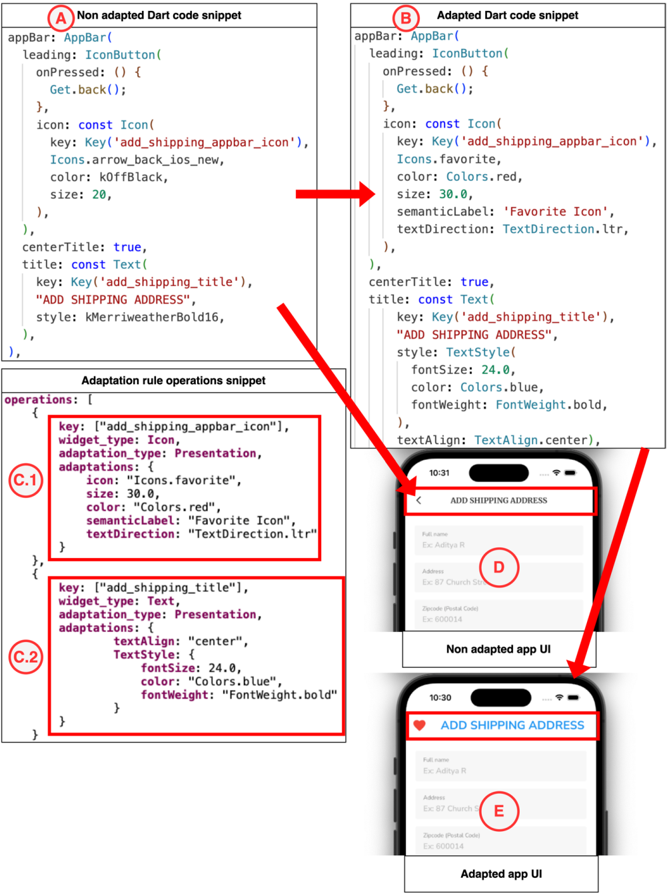
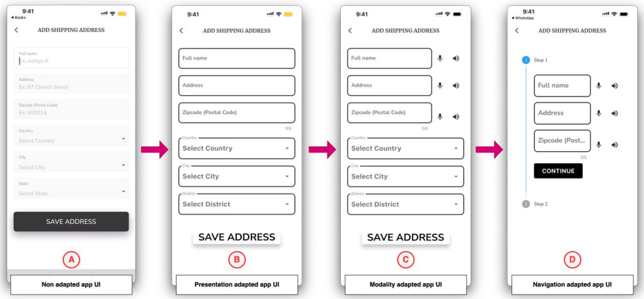
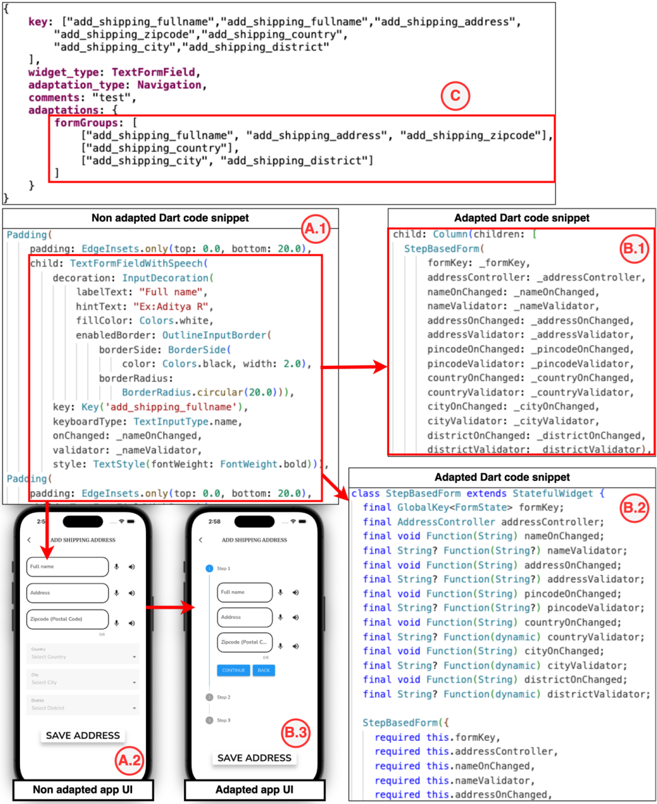
The use of diverse mobile applications among senior users is becoming increasingly widespread. However, many of these apps contain accessibility problems that result in negative user experiences for seniors. A key reason is that software practitioners often lack the time or resources to address the broad spectrum of age-related accessibility and personalisation needs. As current developer tools and practices encourage one-size-fits-all interfaces with limited potential to address the diversity of senior needs, there is a growing demand for approaches that support the systematic creation of adaptive, accessible app experiences. To this end, we present AdaptForge , a novel model-driven engineering (MDE) approach that enables advanced design-time adaptations of mobile application interfaces and behaviours tailored to the accessibility needs of senior users. AdaptForge uses two domain-specific languages (DSLs) to address age-related accessibility needs. The first model defines users’ context-of-use parameters, while the second defines conditional accessibility scenarios and corresponding UI adaptation rules. These rules are interpreted by an MDE workflow to transform an app’s original source code into personalised instances. We also report evaluations with professional software developers and senior end-users, demonstrating the feasibility and practical utility of AdaptForge .
Overview
The claims and statistics of this paper haven’t been checked yet.
Free: it reads the open-access text and checks the first 5 claims that cite a source we can check. Create a free account to check every claim.
Integrity signals
Registry
Cites
Statistics
Figures



Verification
Claims the paper makes
The claims and statistics of this paper haven’t been checked yet.
Free: it reads the open-access text and checks the first 5 claims that cite a source we can check. Create a free account to check every claim.
Claims other papers make about this one
Each is checked against this paper’s own text: does it say what the citing paper says it does?
The source backs part of the claim, not all of it — or backs it for a different population, condition or comparison.
In the citing paper
“This finding not only supports previous research showing that font readability affects interface friendliness for older adults (25–27), but also further suggests that dynamic adaptation is more aligned with the visual and cognitive needs of older users than conventional static optimization (28).”
From Designing age-friendly interfaces and wearable–environment integrations to enhance medication adherence: a discrete choice experiment among older adults (2026) · cites this paper as [28]
Experimental — accuracy not yet measured
Self-check
Percentages, sums and reported differences re-computed from the paper’s own numbers.
The self-check needs the paper’s full text.
Citations
Cites
The impact of aging on access to technology
Czaja, S. J., & Lee, C. C. (2007) · Universal Access in the Information Society · doi:10.1007/s10209-006-0060-x · Cited by 560 · cited 1×
“Seniors have diverse needs, and ageing is a highly individualised process, leading to significant differences in abilities, limitations, and experiences among users [8].”
Model-Driven Software Engineering in Practice
Brambilla, M., Cabot, J., & Wimmer, M. (2017) · Synthesis Lectures on Software Engineering · doi:10.1007/978-3-031-02549-5 · Cited by 500
Sirius: A rapid development of DSM graphical editor
Viyovic, V., Maksimovic, M., & Perišić, B. (2014) · IEEE International Conference on Intelligent Engineering Systems (INES) · doi:10.1109/ines.2014.6909375 · Cited by 191 · cited 3×
“In contrast, our implementation adopts a semi-graphical approach (see Figure 4) built using the Sirius DSL definition workbench [30].”
Adaptive Model-Driven User Interface Development Systems
Akiki, P. A., Bandara, A. K., & Yu, Y. (2014) · ACM Computing Surveys · doi:10.1145/2597999 · Cited by 151 · cited 3×
“However, this one-size-fits-all approach often falls short because seniors have diverse and non-homogeneous accessibility needs that cannot always be met through general design principles alone [9].”
Accessibility to Mobile Interfaces for Older People
Díaz-Bossini, J.-M., & Moreno, L. (2014) · Procedia Computer Science · doi:10.1016/j.procs.2014.02.008 · Cited by 136
Mobile Health Apps: Improving Usability for Older Adult Users
Morey, S. A., Stuck, R. E., Chong, A. W., Barg‐Walkow, L. H., Mitzner, T. L., & Rogers, W. A. (2019) · Ergonomics in Design The Quarterly of Human Factors Applications · doi:10.1177/1064804619840731 · Cited by 130
Harte, R., Quinlan, L. R., Glynn, L. G., Rodríguez‐Molinero, A., Baker, P. M. A., Scharf, T., & OLaighin, G. M. (2017) · JMIR mhealth and uhealth · doi:10.2196/mhealth.7046 · Cited by 110
Interaction Flow Modeling Language: Model-Driven UI Engineering of Web and Mobile Apps with IFML
Brambilla, M., & Fraternali, P. (2014) · Cited by 99
Integrated model-driven development of self-adaptive user interfaces
Yigitbas, E., Jovanovikj, I., Biermeier, K., Sauer, S., & Engels, G. (2020) · Software & Systems Modeling · doi:10.1007/s10270-020-00777-7 · Cited by 69 · cited 10×
“Our study is primarily inspired by Yigitbas et al.’s [16] work on an MDE-based approach for self-adaptive UIs, which also proposes two DSLs conceptually similar to ours.”
InfluentialEngineering Adaptive Model-Driven User Interfaces
Akiki, P. A., Bandara, A. K., & Yu, Y. (2016) · IEEE Transactions on Software Engineering · doi:10.1109/tse.2016.2553035 · Cited by 68 · cited 1×
“A fundamentally different paradigm is proposed by Akiki et al. [15] for MDE-based adaptive UI generation.”
Research works printed but not linked: 5
- Calvary, G., Coutaz, J., Bouillon, L., Florins, M., Limbourg, Q., Marucci, L., Paterno, F., Santoro, C., Souchon, N., Thevenin, D., Vanderdonckt, J.: The cameleon reference framework. Technical report, CAMELEON Project (2002)
- Dodd, C.T., Athauda, R.I., Adam, M.T.P.: Designing user interfaces for the elderly: A systematic literature review. In: Australasian Conference on Information Systems (ACIS 2017). Association for Information Systems (AIS), Hobart, Australia. (2017).https://api.semanticscholar.org/CorpusID:209410212
- Johnson, J., Finn, K.: Designing User Interfaces for an Aging Population: Towards Universal Design. Morgan Kaufmann, 50 Hampshire Street, 5th Floor, Cambridge, MA 02139, United States. (2017)
- Steinberg, D., Budinsky, F., Paternostro, M., Merks, E.: EMF: Eclipse Modeling Framework, 2nd revised edn. The Eclipse Series. Addison-Wesley, 221 River Street, Hoboken, NJ (2009)
- Stephanidis, C., Akoumianakis, D., Antona, M., Bannon, L.: User Interfaces for All: Concepts, Methods, and Tools, 1st edn. Human Fact. Ergonom., 1. CRC Press, Boca Raton (2001)
Cited by
Jeong, T., Hwang, G., & Kim, D. Y. (2025) · Healthcare · doi:10.3390/healthcare13243225 · Cited by 5
“This architecture supports real-time adaptation on resource-constrained devices [69].”
Addressing Visual Impairments with Model-Driven Engineering: A Systematic Literature Review
Michael, J., Netz, L., Rumpe⋆, B., Mueller, I., Grundy, J., Wickramathilaka, S., & Khalajzadeh, H. (2026) · ACM Transactions on Software Engineering and Methodology · doi:10.1145/3803865 · Cited by 1
Self-citationA Low-Code Approach for the Automatic Personalization of Conversational Agents
Conrardy, A. D., Capozucca, A., & Cabot, J. (2026) · Lecture notes in computer science · doi:10.1007/978-3-032-29372-5_4 · Cited by 2
“Newer approaches focus more on personalization [26, 25], albeit not targeting either CAs and only providing textual syntaxes, therefore not catered towards non-technical users.”
Accessible GenAI UI Generation with Post-render Verification
Jerry, B., Moreno, L. D. L. R., & Martínez, P. (2026) · Lecture notes in computer science · doi:10.1007/978-3-032-31285-3_47 · Cited by 1
Qin, J., Wu, Z., Zhang, H., & Qi, X. (2026) · Frontiers in Medicine · doi:10.3389/fmed.2026.1749507
“Additional research on “adaptive inter-faces” suggests that interfaces can dynamically adjust font and layout, as well as notification styles, based on the user’s status to reduce interaction burden for older adults (28).”
Metadata
- Authors
- Wickramathilaka, S., Grundy, J., Madampe, K., & Haggag, O.
- Affiliations
- Monash University (AU)
- Corresponding author
- Wickramathilaka, Shavindra
- Venue
- Automated Software Engineering
- Published
- 2025-08-11
- Volume
- 32
- Issue
- 2
- ISSN
- 0928-8910 (ISSN-L)
- 1573-7535
- OpenAlex
- W4413129833
- Cited by
- 11
- References
- 21
- Citations by year
- 2026: 10 · 2025: 1
- FWCI
- 24.46
- Type
- journal article
- Language
- en
- Open access
- hybrid
- doi.org
- Licence
- cc-by
- creativecommons.org/licenses/by/4.0 (tdm)
- creativecommons.org/licenses/by/4.0 (vor)
- Locations
- Automated Software Engineering (publishedVersion, cc-by)
- arXiv (Cornell University) (submittedVersion)
- Monash University Research Portal (Monash University) (submittedVersion, cc-by)
- arXiv (Cornell University)
- Funders
- Monash University
- Topics
- Health Sciences › Medicine › Geriatrics and Gerontology › Technology Use by Older Adults
- Physical Sciences › Computer Science › Human-Computer Interaction › Usability and User Interface Design
- Social Sciences › Human Factors and Ergonomics › Digital Accessibility for Disabilities
- Keywords
- adaptive user interfaces, model-driven engineering, mobile application, domain-specific languages, context of use, personalization
About these checks
Registry, retraction, Cites and statistics results are computed, not judged, with one exception: a printed reference that no index lists is read once by a model before it counts as a citation error. Claims are extracted by a model and kept only when their quote appears verbatim in the text; each cited source is then checked, with a model’s help, for whether it says what the claim relies on. Those verdicts can be wrong — read the claim’s quote and the cited source before relying on one.
Statistics and arithmetic are recomputed, not judged.
Confidence bands are shown only for fields calibrated on our annotated test set. None is calibrated yet, so no band is shown.
What counts as a claim ›How we measure confidence ›How we check this ›
Are you an author, or do you see a problem with this page? Request a review
How to cite
Cite CoChat for the checks on this page, and the paper for its own findings.
- This page
- CoChat. (2026). Citation check: Adaptive and accessible user interfaces for seniors through model-driven engineering. https://app.cochat.ai/papers/10.1007/s10515-025-00547-z
- The paper
- Wickramathilaka, S., Grundy, J., Madampe, K., & Haggag, O. (2025). Adaptive and accessible user interfaces for seniors through model-driven engineering. Automated Software Engineering. https://doi.org/10.1007/s10515-025-00547-z
Data sources
Bibliographic data: Semantic Scholar, OpenAlex, Crossref.
Contains information from the Semantic Scholar Academic Graph Datasets, made available under the ODC Attribution License (ODC-BY 1.0).
Semantic Scholar’s data is described in: Kinney, R., et al. (2023). The Semantic Scholar Open Data Platform. arXiv:2301.10140.
