

Agency and Intra-textual co-creation in Punchdrunk Enrichment’s Immersive Story Worlds for Children
Open accessThe DOI matches its Crossref record; 51 of the 52 references it cites were found in a registry or an index, and 1 are not checked yet; 1 of the 83 sources its claims cite were checked for support.
Abstract
Abstract Recent immersive theatre practices being developed by UK theatre companies invite children to believe that a book story has come to life and is really happening to them within their school environment. The thrill of being able act within a story motivates children’s embodied agency to physically explore an immersive set installation and acts of creative writing performed during the story experience, which allow children to co-create the narrative alongside the adult practitioners. These acts are fictionalised into the narrative frame of the children as heroic story writers, offering new perspectives on how child co-creation of adult narratives can be enabled intra-textually, within the bounds of the adult-initiated story, rather than extra-textually after it has finished, as is the case with fan fiction. However, it raises questions about the nature and limits of this co-creative agency the experiences purport to elicit from their child participants, especially in terms of their critical agency to manipulate fictional devices presented to them through such a hyper-real aesthetic. Drawing on theories of children’s literature and participatory performance, this article argues that it is the way these immersive productions uncannily overlay real and fictional temporalities that enables the child participants’ critical agency within them. Approaches for further participatory, practice-based research in this understudied corner of children’s reading universes are suggested for harnessing the potential of immersive story worlds to generate research data from within children’s first aesthetic engagement with stories.
Verified 2026-11-25 · 1 reference not checked yet
Overview
CoChat Summary
TL;DR
The article argues that Punchdrunk Enrichment’s school-based immersive story worlds elicit child agency through embodied participation and “intra-textual co-creation,” where children write into the unfolding story rather than only after it ends. It also claims these productions use uncanny overlays of real and fictional time to make children’s critical agency possible while keeping immersion intact.
Key findings
- Across Under the Eiderdown (2009), The Lost Lending Library (2013–ongoing), and A Small Tale (2016–ongoing), the productions give children roles as participants and story-writers, but the adult procedural authorship still frames the experience and its logistics.
- The article distinguishes levels of child agency using Breel’s terms: reactive, interactive, proactive, and creative agency; the paper argues Punchdrunk increasingly enables higher-order agency through children’s embodied participation and writing.
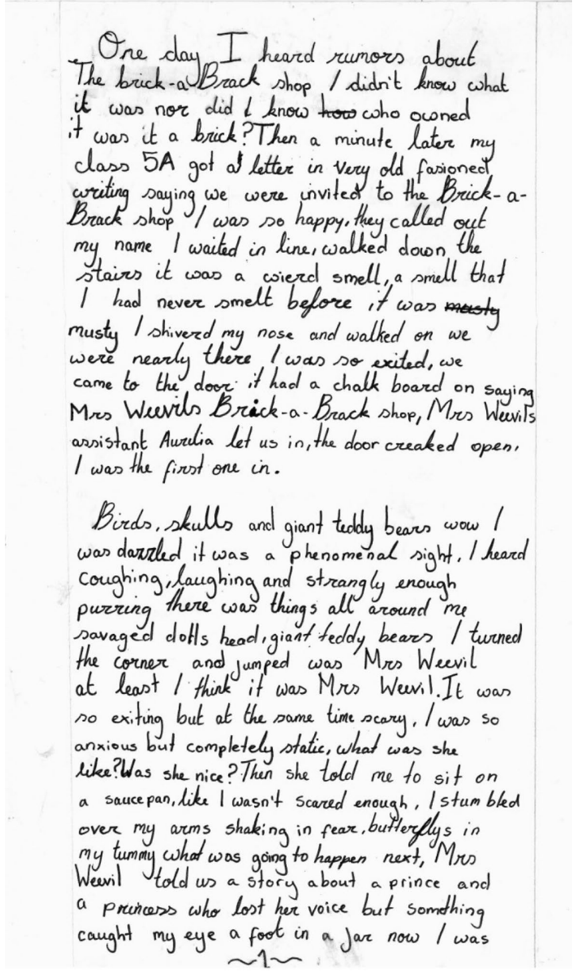
- In Under the Eiderdown, children generate ideas for the bric-a-brac shop through movement, gesture, and sound, and then write stories about the objects; in A Small Tale, children’s stories help tempt Abe and Alba back into the book.
- The paper argues that these productions shift agency from the book’s future-bound moral lesson into the present aesthetic moment, where children can act within the story world and co-create it intra-textually.
Methods
- Qualitative interpretive study grounded in children’s literature and participatory performance theory.
- Main evidence comes from close reading of Punchdrunk’s procedural texts: teacher packs for A Small Tale and The Lost Lending Library, plus secondary sources and the company website for Under the Eiderdown.
- Analysis is supplemented by excerpts of children’s writing, images/videos, and interviews with practitioners, but the author notes it is weighted toward practitioner intention rather than direct child response.
Limitations
- The paper itself states that researching these productions is difficult because “there is little trace left” of the set installations or children’s participation after the schools finish running them.
- The study is limited to procedural authorship and brief glimpses of participation, so it examines how agency is elicited, not how it is fully experienced by children.
- This means the evidence is more about practitioner intention than real child response (stated in the paper), and the paper itself says future research should access children’s participation more directly.
Model-written summary. Check it against the paper before relying on it.
Integrity signals
Registry
Cites
Statistics
Figures



Verification
Claims the paper makes
1 Valid · 0 Not valid · 62 Not checked · 50 Own results and interpretations
In the paper
“The outcome of the experience is pre-planned. The characters return to the pages again after the children leave their stories next to the empty book as bait, its pages propped open as a trap (2018, pp. 26-27).”
What the sources say
- Not matchedcites 2018, pp. 26-27
This doesn’t read as a citation we can look up.
plainstates a cause- Asserted: passes — The authors put it forward as true.
- Checkable: passes — It can be checked against evidence.
- Load-bearing: passes — The paper’s conclusions depend on it.
- Based: passes — The paper gives a reason why it holds.
- Not matched
In the paper
“Their sets stay in the schools for a week after the actors' performance, so that the children can revisit, 'look around more and relish' them (Machon, 2018, p. 284).”
What the sources say
- Not checked — no full text of the sourcecites Machon, 2018 matched to “The Punchdrunk Encyclopaedia” (2018) source
plainstates a causeSingle case- Asserted: passes — The authors put it forward as true.
- Checkable: passes — It can be checked against evidence.
- Load-bearing: passes — The paper’s conclusions depend on it.
- Based: passes — The paper gives a reason why it holds.
In the paper
“The company punctuates their experiences with temporal markers like blinking lights or ticking clocks ( Eiderdown Video , 2016), which draws real and fictional temporalities into closer juxtaposition.”
What the sources say
- Not matchedcites Eiderdown Video, 2016
An author–year citation the paper’s reference list doesn’t settle. We don’t search these by name.
plainstates a cause- Asserted: passes — The authors put it forward as true.
- Checkable: passes — It can be checked against evidence.
- Load-bearing: unclear — It is unclear whether the paper’s conclusions depend on it.
- Based: passes — The paper gives a reason why it holds.
- Not matched
A conclusion the paper draws from its own results — it cites no other source for it, so there is none to check. The quote shows it is in the paper.
In the paper
“this article argues that it is the way these immersive productions uncannily overlay real and fictional temporalities that enables the child participants' critical agency within them.”
plainstates a cause- Asserted: passes — The authors put it forward as true.
- Checkable: passes — It can be checked against evidence.
- Load-bearing: passes — The paper’s conclusions depend on it.
- Based: unclear — It is unclear why the paper says it holds.
A conclusion the paper draws from its own results — it cites no other source for it, so there is none to check. The quote shows it is in the paper.
In the paper
“Just as in children's literature in book form, immersive theatre practitioners elicit this agency by pre-writing the fictional experience to some degree.”
plainstates a cause- Asserted: passes — The authors put it forward as true.
- Checkable: passes — It can be checked against evidence.
- Load-bearing: passes — The paper’s conclusions depend on it.
- Based: passes — The paper gives a reason why it holds.
16 more claims
Create a free account to see all 113 claims and every source verdict.
- Probably not a substantial claim. 83
- It may state two separate claims as one. 39
- The quote only partly states this claim. 1
Citations
Cites
Dewey, J. (1910) · D C Heath eBooks · doi:10.1037/10903-000 · Cited by 3,998 · cited 1×
““Time is required “to digest impressions, and translate them into substantial ideas” (Dewey, 1910, p. 37; in Joy, 2019, p. 27).”
Iser, W. (1980) · Johns Hopkins University Press eBooks · doi:10.56021/9780801821011 · Cited by 1,602
The Reader, the Text, the Poem: The Transactional Theory of the Literary Work
Reichert, J., & Rosenblatt, L. M. (1979) · The Journal of Aesthetics and Art Criticism · doi:10.2307/430053 · Cited by 1,292
Language and ideology in children's fiction
(1993) · Choice Reviews Online · doi:10.5860/choice.30-5418 · Cited by 538 · cited 2×
“…not on the page, but in the mind of the real and implied child reader in their critical agency to free themselves from textual devices during the aesthetic moment of story engagement enough that they can become aware of how those devices are positioning them as subjects (Stephens, 1992, pp. 80–81).”
The Reader, the Text, the Poem: The Transactional Theory of the Literary Work
Rosenblatt, L. M. (1978) · Project Muse (Johns Hopkins University) · Cited by 529
Non-Representational Methodologies
(2015) · Routledge eBooks · doi:10.4324/9781315883540 · Cited by 484
How Texts Teach What Readers Learn
Meek, M. (1987) · Medical Entomology and Zoology · Cited by 366
Nodelman, P. (2008) · doi:10.56021/9780801889790 · Cited by 308
The Case of Peter Pan or The Impossibility of Children’s Fiction
Rose, J. (1992) · doi:10.1007/978-1-349-23208-6 · Cited by 290
Children's literature: criticism and the fictional child
(1995) · Choice Reviews Online · doi:10.5860/choice.32-2548 · Cited by 249 · cited 1×
“…reader into a “voluntary, spontane-ous surrender” to the aesthetic power of adult narrative devices, leading many to believe that their aesthetic and didactic aims are necessarily mutually exclusive (Lesnik-Oberstein, 1994, p. 76; also Rose, 1993; Rosenblatt, 1994; McGillis, 1997; Beauvais, 2021).”
Machon, J. (2013) · doi:10.1007/978-1-137-01985-1 · Cited by 236 · cited 3×
“This creates a “felt sense of time-play” as “temporality itself becomes experiential” (Machon, 2013, p. 96) and the uncanny sense of “the participant’s physical body responding within the imaginative experience”, “a defining feature of immersive theatre” (2013, pp. 67–68) (Fig.”
InfluentialNarrative Discourse, an Essay in Method.
Guerlac, S., Genette, G., & Lewin, J. E. (1980) · MLN · doi:10.2307/2906507 · Cited by 221
Power, Voice and Subjectivity in Literature for Young Readers
Nikolajeva, M. (2009) · doi:10.4324/9780203866924 · Cited by 219
Risky Business: Talking about Children in Children’s Literature Criticism
Gubar, M. (2013) · Children's Literature Association Quarterly · doi:10.1353/chq.2013.0048 · Cited by 212 · cited 12×
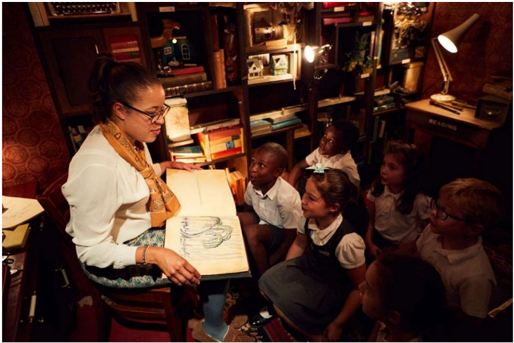
“3 Peabody, the custodian of The Lost Lending Library , meets the child participants.”
InfluentialPractice-as-research and the Problem of Knowledge
Nelson, R. (2006) · Performance Research · doi:10.1080/13528160701363556 · Cited by 203 · cited 1×
“Video has been suggested as a way it can be captured (Nelson, 2006, p. 113) that might be extended to children recording their own participation as a means for research to incorporate how “children perceive and act upon the world” (Green, 2016, p. 292).”
International companion encyclopedia of children's literature
(2005) · Choice Reviews Online · doi:10.5860/choice.42-4365 · Cited by 170
The Mighty Child: Time and power in children's literature
Beauvais, C. (2015) · Children’s Literature, Culture, and Cognition · doi:10.1075/clcc.4 · Cited by 162
Audience Participation in Theatre
White, G. (2013) · doi:10.1057/9781137010742 · Cited by 153 · cited 11×
“However, the practitioners soon make “an overt invitation” to the children to exercise their embodied agency (White, 2013, p. 40) by asking them, “What objects would be in a bric-a-brac shop?” and instructing them to generate suggestions via movement, gesture and sound, while the company’s set…”
InfluentialLanguage and ideology in children's fiction
Stephens, J. (2003) · Cited by 131
The Creation of Narrative in Tabletop Role-Playing Games
Cover, J. G. (2010) · Medical Entomology and Zoology · Cited by 119
(2009) · Medical Entomology and Zoology · Cited by 119
Alston, A. (2016) · doi:10.1057/978-1-137-48044-6 · Cited by 109 · cited 1×
“…to participate as it is dependent on the intuitive embodied reactions of the children as a group (White, 2013, pp. 133–138) as they explore how they might unlock the most powerful affective experience from the procedural authorship together with their co-partic-ipants (Alston, 2016, p. 3).”
What Is Fanfiction and Why Are People Saying Such Nice Things about It??
Thomas, B. (2011) · Storyworlds: A Journal of Narrative Studies · doi:10.5250/storyworlds.3.2011.0001 · Cited by 99
(2000) · Cited by 89
Immersive Theatre and Audience Experience
Biggin, R. (2017) · doi:10.1007/978-3-319-62039-8 · Cited by 86 · cited 1×
“…the UK company Punchdrunk, founded in 2000, known for their site-specific productions for adults that bring to live theatre some of the player agency of video-games as participants explore the sets—often in old, abandoned buildings—manipulate objects, or interact with actors (Biggin, 2017, p. 73).”
Barnes, J. L. (2015) · Poetics · doi:10.1016/j.poetic.2014.12.004 · Cited by 59 · cited 4×
“…of fan fiction, usually defined as “extra-textual stories, written by fans, that focus on the characters or world of an established narrative” (Barnes, 2015, p. 70; also Thomas, 2011), in which young readers “reject key plot points, morally invert the original story, change the emphasis the…”
InfluentialGreen, C. J. (2016) · International Journal of Early Childhood · doi:10.1007/s13158-016-0173-1 · Cited by 46 · cited 1×
“Video has been suggested as a way it can be captured (Nelson, 2006, p. 113) that might be extended to children recording their own participation as a means for research to incorporate how “children perceive and act upon the world” (Green, 2016, p. 292).”
Storytelling, story-retelling, storyknowing: towards a participatory practice of storytelling
Reason, M., & Heinemeyer, C. (2016) · Research in Drama Education The Journal of Applied Theatre and Performance · doi:10.1080/13569783.2016.1220247 · Cited by 42 · cited 1×
“…companies for “manag(ing) emotions carefully and ensur(ing) participants are protected” (Hig-gin, 2018a), negotiating participants’ withdrawal of participation (Higgin, 2018b; Reason and Heinemeyer, 2016) and establishing relationships of trust with their child participants (White, 2013, p. 75).”
(2015) · Research Space · Cited by 32
Children's Voices in the Polish Canon Wars: Participatory Research in Action
Chawar, E., Deszcz–Tryhubczak, J., Kowalska, K., Maniakowska, O., Marecki, M., Palczyńska, M., Pszczołowski, E., & Sikora, D. (2018) · International Research in Children s Literature · doi:10.3366/ircl.2018.0269 · Cited by 28
Deszcz-Tryhubczak, J. (2016) · The Lion and the Unicorn · doi:10.1353/uni.2016.0012 · Cited by 22 · cited 2×
“…children might “become peer researchers whose contribution to generating knowledge about what they read has an intrinsic value similar to insights offered by adult readers” (Deszcz-Tryhubczak, 2016, p. 217; see also Deszcz-Tryhubczak et al., 2019; Helma van Lierop-Debrauwer, 2022; Joosen, 2019).”
Psychic Barriers and Contact Zones: Rereading Rose and the Rupture between Child and Adult
Waller, A. (2010) · Children's Literature Association Quarterly · doi:10.1353/chq.2010.0009 · Cited by 19
Machon, J. (2018) · doi:10.4324/9781315150352 · Cited by 19
Thinking and doing with childism in children's literature studies
Deszcz‐Tryhubczak, J., & García‐González, M. (2023) · Children & Society · doi:10.1111/chso.12619 · Cited by 15
Children’s Literature in Translation: Towards a Participatory Approach
Joosen, V. (2019) · Humanities · doi:10.3390/h8010048 · Cited by 14 · cited 4×
“…children might “become peer researchers whose contribution to generating knowledge about what they read has an intrinsic value similar to insights offered by adult readers” (Deszcz-Tryhubczak, 2016, p. 217; see also Deszcz-Tryhubczak et al., 2019; Helma van Lierop-Debrauwer, 2022; Joosen, 2019).”
InfluentialResearching Child Authors: Which Questions (not to) Ask
Wesseling, E. (2019) · Humanities · doi:10.3390/h8020087 · Cited by 14 · cited 2×
“This should be of interest to children’s literature studies as renewed attention is being paid to the possibility of child-authored or co-created children’s literature as a window into children’s fic-tional experiences (Wesseling, 2019, p. 94; also van Lierop-Debrauwer and Steels, 2021).”
Productive Remembering of Childhood: Child–Adult Memory-Work with the School Literary Canon
Deszcz–Tryhubczak, J., Marecki, M., Chawar, E., Kaczkowska, M., Kowalska, K., Kulawik, A., Ożlańska, M., Palczyńska, M., Parcheniak, N., & Pszczołowski, E. (2019) · Humanities · doi:10.3390/h8020074 · Cited by 11 · cited 1×
“…children might “become peer researchers whose contribution to generating knowledge about what they read has an intrinsic value similar to insights offered by adult readers” (Deszcz-Tryhubczak, 2016, p. 217; see also Deszcz-Tryhubczak et al., 2019; Helma van Lierop-Debrauwer, 2022; Joosen, 2019).”
Learning to Read, Reading to Learn; or Engaging in Critical Pedagogy
McGillis, R. (1997) · Children's Literature Association quarterly · doi:10.1353/chq.0.1276 · Cited by 9 · cited 2×
“…whether children’s agency can be elicited through stories that coerce them into passively believing in their fic-tional events as “inevitable”, like the functioning of the real world, rather than as narrative constructs that have been crafted to work their effects on them (McGillis, 1997, p. 132).”
The Limits of Agency for Children’s Literature Scholars
Schwebel, S. L. (2016) · Jeunesse: Young People, Texts, Cultures · doi:10.1353/jeu.2016.0014 · Cited by 9 · cited 3×
“…creates a long-demanded channel of communication between children’s literature and theatre for young audiences studies (Gubar, 2013, pp. 452–453; Schwebel, 2016, p. 278), and aligns with calls for a wider definition of children’s literature that situates child readers “not just as recipients of…”
Children as readers: what we learn from their conversations about reading
Hodges, G. C. (2009) · Education 3-13 · doi:10.1080/03004270802168608 · Cited by 8 · cited 4×
“We then had to write a story about who could have owned the button before us” (‘Our Fun’, 2009).”
InfluentialChapleau, S. (2007) · Presses universitaires François-Rabelais eBooks · doi:10.4000/books.pufr.4946 · Cited by 8 · cited 5×
“While there have been calls for more research into child-authored children’s literature (Chapleau, 2007; Wesseling, 2019, p. 94; Lierop-Debrauwer and Steels, 2021, p. 219), such writing has often been imagined as stories children write alone (Chapleau, 2007).”
InfluentialTHE MINGLING OF TEENAGE AND ADULT BREATHS: THE DUTCH SLASH SERIES AS INTERGENERATIONAL COMMUNICATION
van Lierop-Debrauwer, H., & Steels, S. (2021) · University Press of Mississippi eBooks · doi:10.14325/mississippi/9781496831910.003.0016 · Cited by 8
Ghosts We Have Seen Before: Trends in Adaptation in Contemporary Performance
Krebs, K. (2014) · Theatre Journal · doi:10.1353/tj.2014.0125 · Cited by 7
Children’s Literature: A Joint Venture
van Lierop-Debrauwer, H. (2022) · International Research in Children's Literature · doi:10.3366/ircl.2022.0465 · Cited by 7 · cited 4×
“2 This creates a long-demanded channel of communication between children’s literature and theatre for young audiences studies (Gubar, 2013, pp. 452–453; Schwebel, 2016, p. 278), and aligns with calls for a wider definition of children’s literature that situates child readers “not just as recipients of adult-produced t…”
InfluentialLiterature’s Children: The Critical Child and the Art of Idealization
Joy, L. (2019) · doi:10.5040/9781472594037 · Cited by 5 · cited 3×
“This reveals adult notions of how children’s correct deployment of critical agency “has a temporal dimension” (Joy, 2019, p. 26).”
Hasbun, S., Osborne, G., Carney, R., Gittner, J., Cartwright, C., villette, A., & Matthews, H. (2022) · Journal for Artistic Research · doi:10.22501/jar.1264307 · Cited by 5
Self-citationImmersive Theatre, Immersive Experience
Biggin, R. (2017) · Springer eBooks · doi:10.1007/978-3-319-62039-8_1 · Cited by 5
Thompson, C. P. (1995) · Cited by 5
(2018) · Cited by 3
Breel, A. (2022) · Routledge Companion to Audiences and the Performing Arts · doi:10.4324/9781003033226-31 · Cited by 3
Lesnik-Oberstein, K. (1993) · doi:10.1093/acprof:oso/9780198119982.001.0001
Children’s Voices in the Polish Canon Wars: Participatory Research in Action
Chawar, E., Deszcz-Tryhubczak, J., Kowalska, K., Maniakowska, O., Marecki, M., Palczyńska, M., Pszczołowski, E., & Sikora, D. (2018) · International Research in Children's Literature · doi:10.1353/irc.2018.a998422
Research works printed but not linked: 14
- Beauvais, C. (2021, October 21). The Future of Reading for Pleasure. Keynote Address . International Research Society in Children's Literature Conference: Aesthetic and Pedagogic Entanglements, Santiago, Chile.
- Freud, S. (1919). The Uncanny,' trans. James Strachey. Art and Literature: Jensen's Gradiva, Leonardo Da Vinci and Other Works (pp. 335-376) . London: Penguin.
- Heathcote, D. (2002). Contexts for Active Learning-Four Models to Forge Links Between Schooling and Society. Paper Presented at the NATD Conference, Birmingham, https:// www. mantl eofth eexpe rt. com/ wp- conte nt/ uploa ds/ 2018/ 01/ dh- conte xts- for- active- learn ing. pdf.
- Higgin, P. (2018a). On Enrichment, Engagement and Education. In J. Machon (Ed.), The Punchdrunk Encyclopaedia , 1st ed (pp. 98-99). London: Routledge. - Higgin, P. (2018b). Punchdrunk Enrichment: On Core Principles. In J. Machon (Ed.), The Punchdrunk Encyclopaedia , 1st ed (pp. 101-102). London: Routledge.
- Higgin, P. (2018b). Punchdrunk Enrichment: On Core Principles. In J. Machon (Ed.), The Punchdrunk Encyclopaedia, 1st ed (pp. 101–102). London: Routledge.
- Hunt, P. 1945-. (1991). Criticism, Theory, and Children's Literature . Cambridge: B. Blackwell
- McGonigal, J. (2003). A Real Little Game: The Performance of Belief in Pervasive Play. In Proceedings of DiGRA 2003 .
- Merleau-Ponty, M. 1908-1961, and Landes, D. A. (2012). Phenomenology of Perception (Vol. 1-1 online resource (lxxxv)). New York: Routledge (Original work published 1945).
- O'Neill, C. (1995). Drama Worlds: A Framework for Process Drama . Portsmouth: Heinemann Drama. <!-- image -->
- Our Fun Creative Writing Lesson. (2009, March 21). CBBC Newsround: Press Pack Reports . http:// news. bbc. co. uk/ cbbcn ews/ hi/ newsid\_ 79400 00/ newsid\_ 79421 00/ 79421 22. stm.
- Roms, H. (2022, September 11). ASSITEJ - Workshop . Performance Beyond Binaries: On the Relationship Between Children and Adults in Performance Art/Live Art, Fundus Theater - Theater of Research Hamburg. https:// www. fundus- theat er. de/ perfo rmance- beyond- binar ies-i/.
- Taylor, M. (2007). British Pantomime Performance: British Pantomime Performance . Bristol: Intellect Books.
- Tims, C. (2016). Doorways: A Review of Punchdrunk Enrichment Projects 2013-2016 . Punchdrunk Enrichment. https:// punch drunk. org. uk/ conte nt/ uploa ds/ 2019/ 10/ DOORW AYS. pdf.
- Year 5 Work . (2010). Gayhurst Primary School. https:// www. gayhu rst. hackn ey. sch. uk/ galle ry/? pid= 33& gcatid= 2& album id=8. Publisher's Note Springer Nature remains neutral with regard to jurisdictional claims in published maps and institutional affiliations. <!-- image -->
Cited by
Turning stories into learning journeys: the principles and methods of Immersive Education
Brunetti, R., Ferrante, S., Avella, A. M., Indraccolo, A., & Gatto, C. D. (2024) · Frontiers in Psychology · doi:10.3389/fpsyg.2024.1471459 · Cited by 32
Metadata
- Authors
- Osborne, G.
- Affiliations
- University of Bristol (GB)
- Corresponding author
- Osborne, Gareth
- ORCID
- Osborne, Gareth
- Venue
- Children's Literature in Education
- Published
- 2023-06-15
- Volume
- 55
- Issue
- 4
- Pages
- 603-626
- ISSN
- 0045-6713 (ISSN-L)
- 1573-1693
- OpenAlex
- W4380996126
- Semantic Scholar
- 8f29f2e5016117b470978acf78f9e2ac5a7778ff
- Cited by
- 1
- References
- 52
- Citations by year
- 2024: 1
- FWCI
- 2.87
- Type
- journal article
- Language
- en
- Update notices
- correction (2023-09-15)
- Open access
- hybrid
- dx.doi.org
- Licence
- cc-by
- creativecommons.org/licenses/by/4.0 (tdm)
- creativecommons.org/licenses/by/4.0 (vor)
- Locations
- Children s Literature in Education (publishedVersion, cc-by)
- ORCA Online Research @Cardiff (Cardiff University) (submittedVersion, cc-by)
- Funders
- Arts and Humanities Research Council
- Topics
- Social Sciences › Arts and Humanities › Visual Arts and Performing Arts › Theatre and Performance Studies
- Social Sciences › Arts and Humanities › Literature and Literary Theory › Themes in Literature Analysis
- Social Sciences › Arts and Humanities › Visual Arts and Performing Arts › Artistic and Creative Research
- Keywords
- immersive theatre, children's agency, children's creative writing, participatory performance, critical agency, children's literature, fan fiction, temporality, children's reading
About these checks
Registry, retraction, Cites and statistics results are computed, not judged, with one exception: a printed reference that no index lists is read once by a model before it counts as a citation error. Claims are extracted by a model and kept only when their quote appears verbatim in the text; each cited source is then checked, with a model’s help, for whether it says what the claim relies on. Those verdicts can be wrong — read the claim’s quote and the cited source before relying on one.
A language model drew the claims from the paper on 2026-10-10, under version 3 of the claim definition (model deepseek-v4.1-flash, prompt extract-v3).
A second model labelled each claim on 2026-10-10 (model jev-1.13-20260917, definition revision gold-guideline-v0.2).
Statistics and arithmetic are recomputed, not judged.
Confidence bands are shown only for fields calibrated on our annotated test set. None is calibrated yet, so no band is shown.
What counts as a claim ›How we measure confidence ›How we check this ›
Are you an author, or do you see a problem with this page? Request a review
Data sources
Bibliographic data: Semantic Scholar, OpenAlex, Crossref.
Contains information from the Semantic Scholar Academic Graph Datasets, made available under the ODC Attribution License (ODC-BY 1.0).
Semantic Scholar’s data is described in: Kinney, R., et al. (2023). The Semantic Scholar Open Data Platform. arXiv:2301.10140.
