

Transitional justice and authoritarian backsliding
Open accessThe DOI matches its Crossref record; 23 of the 26 references it cites were found in a registry or an index.
Abstract
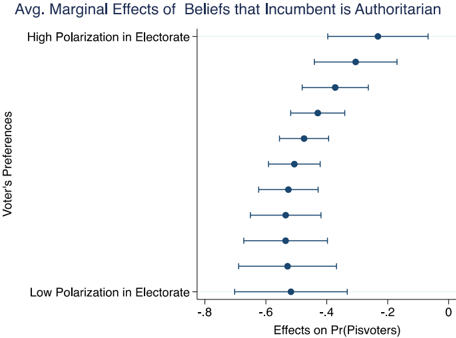
Can a lack of transitional justice contribute to democratic backsliding? This paper uses the case of Poland to argue that selective enforcement of transitional justice can be linked to democratic erosion. In doing so, the paper adjudicates between two theories of democratic backsliding. The first, advanced by Milan Svolik, argues that elite polarization drives erosion: when political candidates are ideologically far apart, citizens who strongly prefer one over the other may turn a blind eye to antidemocratic transgressions by their preferred candidate to prevent the competing candidate from winning. The second theory, presented by Nalepa, Vanberg, and Ciopris (NVC), describes an equilibrium where voters are uncertain whether the candidate they are dealing with is a closet autocrat or an ideological incumbent, but reelect him into office regardless. This theory posits that a closet autocrat is reelected into office because his first period actions are identical to those of an ideological incumbent. I argue that judiciary reforms in Poland reflect exactly the kind of incumbent actions that are consistent both with the actions of an ideological incumbent and with the actions of a closet autocrat. Using survey data from Poland, I find evidence of elite polarization, offering support for the first theory, but also find ample evidence of polarization in the electorate and of a belief structure supportive of the equilibrium from NVC. I present Hungary’s experience with transitional justice and the rule of law as a shadow case to illustrate similar dynamics to those taking place in Poland.
Overview
The claims and statistics of this paper haven’t been checked yet.
Free: it reads the open-access text and checks the first 5 claims that cite a source we can check. Create a free account to check every claim.
Integrity signals
Registry
Cites
Statistics
Figures
Verification
Claims the paper makes
The claims and statistics of this paper haven’t been checked yet.
Free: it reads the open-access text and checks the first 5 claims that cite a source we can check. Create a free account to check every claim.
Self-check
Percentages, sums and reported differences re-computed from the paper’s own numbers.
The self-check needs the paper’s full text.
Citations
Cites
The third wave: democratization in the late twentieth century
(1992) · Choice Reviews Online · doi:10.5860/choice.29-4135 · Cited by 7,983
Transitions from Authoritarian Rule: Tentative Conclusions about Uncertain Democracies
O'Donnell, G. A., & Schmitter, P. C. (1986) · Cited by 3,034
Political Polarization in the American Public
Fiorina, M. P., & Abrams, S. J. (2008) · Annual Review of Political Science · doi:10.1146/annurev.polisci.11.053106.153836 · Cited by 1,881
Trials and Errors: Principle and Pragmatism in Strategies of International Justice
Snyder, J., & Vinjamuri, L. (2004) · International Security · doi:10.1162/016228803773100066 · Cited by 644
Svolik, M. W. (2020) · Quarterly Journal of Political Science · doi:10.1561/100.00018132 · Cited by 340
Skeletons in the Closet: Transitional Justice in Post-Communist Europe
Nalepa, M. (2010) · Cambridge University Press · doi:10.1017/cbo9780511815362 · Cited by 222 · cited 3×
“Poland’s initial TJ project was extremely mild (Nalepa 2010).”
BackgroundSelf-citationConstitutional Judiciary in a New Democracy: The Hungarian Constitutional Court
(2000) · University of Michigan Press eBooks · doi:10.3998/mpub.16423 · Cited by 149
The DNA of Constitutional Justice in Latin America: Politics, Governance, and Judicial Design
Brinks, D. M., & Blass, A. (2018) · Cambridge University Press eBooks · doi:10.1017/9781316823538 · Cited by 144
Politicized Justice in Emerging Democracies: A Study of Courts in Russia and Ukraine
Popova, M. (2012) · doi:10.1017/cbo9781139055345 · Cited by 136 · cited 1×
“2 See, for an alternative interpretation of keeping the former authoritarian judiciary intact, Popova (2012).”
Background(2010) · Cited by 130
Self-citationThe Politics of Judicial Reform in Eastern Europe
Magalhães, P. C. (1999) · Comparative Politics · doi:10.2307/422432 · Cited by 111
David, R. (2003) · Law <html_ent glyph="@amp;" ascii="&"/> Social Inquiry · doi:10.1111/j.1747-4469.2003.tb00197.x · Cited by 100 · cited 1×
“…(PiS) party came to power in 2015 because even after the parliament passed lustration bills, the country’s Constitutional Tribunal struck them down, citing the sharp conflict between these bills and the principle of judicial independence (Nalepa 2010; David 2003; Horne 2009; Magalhaes 1999).”
BackgroundCoalition Formation and the Regime Divide in New Democracies: East Central Europe
Grzymała-Busse, A. M. (2001) · Comparative Politics · doi:10.2307/422416 · Cited by 79
Politicized Justice in Emerging Democracies: A Study of Courts in Russia and Ukraine
Popova, M. (2012) · Cited by 78
The Role of Constitutional Courts in the Transition to Democracy: With Special Reference to Hungary
Sólyom, L. (2003) · International Sociology · doi:10.1177/0268580903018001008 · Cited by 71
Normative and Strategic Aspects of Transitional Justice
Kaminski, M. M., Nalepa, M., & O’neill, B. (2006) · Journal of Conflict Resolution · doi:10.1177/0022002706286949 · Cited by 57
Self-citationGraver, H. P. (2014) · Springer eBooks · doi:10.1007/978-3-662-44293-7 · Cited by 55
Accountability by Numbers: A New Global Transitional Justice Dataset (1946–2016)
Bates, G., Cinar, I., & Nalepa, M. (2020) · Perspectives on Politics · doi:10.1017/s1537592719000756 · Cited by 49
Self-citationLate lustration programmes in Romania and Poland: supporting or undermining democratic transitions?
Horne, C. M. (2009) · Democratization · doi:10.1080/13510340902732581 · Cited by 47 · cited 1×
“…(PiS) party came to power in 2015 because even after the parliament passed lustration bills, the country’s Constitutional Tribunal struck them down, citing the sharp conflict between these bills and the principle of judicial independence (Nalepa 2010; David 2003; Horne 2009; Magalhaes 1999).”
BackgroundRighting wrongs in Eastern Europe
(1998) · Choice Reviews Online · doi:10.5860/choice.36-0581 · Cited by 45
Carroll, R., & Nalepa, M. (2019) · Parliamentary Affairs · doi:10.1093/pa/gsz027 · Cited by 13
Self-citationThe Nulla Poena Sine Culpa Principle in European Courts Case Law
Panebianco, G. (2014) · Springer eBooks · doi:10.1007/978-3-319-12042-3_4 · Cited by 12
Nolan, D. (2019) · Index on Censorship · doi:10.1177/0306422019842100 · Cited by 5
Research works printed but not linked: 2
- 2. Brinks, D., & Blass, A. (2019). DNA of constitutional justice in Latin America. Cambridge: Cambridge University Press.
- 3. Carroll, R., & Nalepa, M. (2019). When do open lists matter? The consequences of the personal vote for party loyalty. Parliamentary Affairs. https ://doi.org/10.1093/pa/gsz02 7. · doi:10.1093/pa/gsz02
Cited by
Mihr, A., & Pierobon, C. (2023) · Springer eBooks · doi:10.1007/978-3-031-44584-2 · Cited by 23
Transitions, populism, and democratic decline: evidence from Hungary and the Czech Republic
Roháč, D. (2021) · European Politics and Society · doi:10.1080/23745118.2021.1973213 · Cited by 23
Riding the democracy train: incumbent-led paths to autocracy
Çınar, İ. (2021) · Constitutional Political Economy · doi:10.1007/s10602-021-09340-y · Cited by 9
The access to justice gap and the rule of law crisis in Poland
Winczorek, J., & Muszyński, K. (2022) · Zeitschrift für Rechtssoziologie · doi:10.1515/zfrs-2022-0002 · Cited by 13
Populism and transitional justice: talking the talk without walking the walk
Dias, A. L., Manucci, L., & Raimundo, F. (2023) · Acta Politica · doi:10.1057/s41269-023-00307-5 · Cited by 3
Metadata
- Authors
- Nalepa, M.
- Affiliations
- University of Chicago (US)
- Corresponding author
- Nalepa, Monika
- ORCID
- Nalepa, Monika
- Venue
- Constitutional Political Economy
- Published
- 2020-08-17
- Volume
- 32
- Issue
- 3
- Pages
- 278-300
- ISSN
- 1043-4062 (ISSN-L)
- 1572-9966
- OpenAlex
- W3053151117
- Semantic Scholar
- 69b027284053fd0f1ad2660afd2b4bfb2c57af8f
- Cited by
- 21
- References
- 26
- Citations by year
- 2026: 2 · 2025: 5 · 2024: 1 · 2023: 6 · 2022: 3 · 2021: 4
- FWCI
- 4.34
- Type
- journal article
- Language
- en
- Open access
- hybrid
- doi.org
- Licence
- cc-by
- creativecommons.org/licenses/by/4.0 (tdm)
- creativecommons.org/licenses/by/4.0 (vor)
- Locations
- Constitutional Political Economy (publishedVersion, cc-by)
- RePEc: Research Papers in Economics (submittedVersion)
- Funders
- National Science Foundation (1658170)
- Center for International Social Science Research
- Pozen Family Center for Human Rights
- Topics
- Social Sciences › Sociology and Political Science › Political Conflict and Governance
- Social Sciences › Political Science and International Relations › Political Theory and Democracy
- Social Sciences › Political Science and International Relations › Electoral Systems and Political Participation
- Keywords
- transitional justice, democratic backsliding, authoritarian backsliding, selective enforcement, elite polarization, incumbent reelection, judicial reform, rule of law, electoral polarization, Poland, Hungary
About these checks
Registry, retraction, Cites and statistics results are computed, not judged, with one exception: a printed reference that no index lists is read once by a model before it counts as a citation error. Claims are extracted by a model and kept only when their quote appears verbatim in the text; each cited source is then checked, with a model’s help, for whether it says what the claim relies on. Those verdicts can be wrong — read the claim’s quote and the cited source before relying on one.
Statistics and arithmetic are recomputed, not judged.
Confidence bands are shown only for fields calibrated on our annotated test set. None is calibrated yet, so no band is shown.
What counts as a claim ›How we measure confidence ›How we check this ›
Are you an author, or do you see a problem with this page? Request a review
Data sources
Bibliographic data: Semantic Scholar, OpenAlex, Crossref.
Contains information from the Semantic Scholar Academic Graph Datasets, made available under the ODC Attribution License (ODC-BY 1.0).
Semantic Scholar’s data is described in: Kinney, R., et al. (2023). The Semantic Scholar Open Data Platform. arXiv:2301.10140.
